Kirjojen hintavertailu. Mukana 12 415 453 kirjaa ja 12 kauppaa.

Kirjahaku

Etsi kirjoja tekijän nimen, kirjan nimen tai ISBN:n perusteella.

1000 tulosta hakusanalla Edward B. Foote

Economics, Natural-Resource Scarcity and Development (Routledge Revivals)
Global warming is an increasing problem, tropical forests are being wiped out and major upper watersheds are being degraded. Using insights provided by environmentalism, ecology and thermo-dynamics, this book – first published in 1989 – outlines an economic approach to the use of natural resources and particularly to the problem of environmental degradation. Edward Barbier reviews and critiques the long past of environmental and resource economics and then goes on to elaborate an economics which allows us to develop alternative strategies for dealing with the problems faced. With examples drawn from Latin America and Indonesia, he not only develops a major theoretical advance but shows how it can be applied. Barbier’s work is an important and relevant contribution to the discussion surrounding the economics of environmental sustainability.
Elephants, Economics and Ivory

Elephants, Economics and Ivory

Edward B. Barbier; Joanne C. Burgess; Timothy M. Swanson; David W. Pearce

Routledge
2013
nidottu
Ivory is big business, and in some parts of Africa elephants have been hunted almost to extinction in the quest for it. The losses to African economies have been catastrophic. Now there is an international ban on the trade and conservation is. the principal goal. This should be a matter for rejoicing, but nothing is quite so simple. The authors of this book have looked at the overall statistics, including those for countries where the elephant population is stable. They have considered the multiplicity of economic and social functions fulfilled by ensuring that elephant herds survive, tourism, a variety of ecological purpose. and, finally, as a source of ivory. They show how the careful management of elephants as a resource can best serve African interests. This book is at the cutting edge of economic thinking and provides a model for the consideration of the difficult relationship between people and wildlife. Originally published in 19990
The Gulistan; or Rose-Garden of Shekh Muslihu'D-Din Sadi Shiraz
This is Volume I of thirteen in a collection on Persia. Originally published in 1880, this is a translation of The Gulistan or Rose-Garden of Shekh Muslihu'D-Din Sadi Shiraz. The Gulistan of Sadi has attained a popularity in the East which, perhaps, has never been reached by any European work in this Western world. Written in the first half of the thirteen century, in Sadi's code of morals, mercy and charity are not restricted to true believers.
Extending the Frontiers of Mathematics

Extending the Frontiers of Mathematics

Edward B. Burger

John Wiley Sons Inc
2008
nidottu
Mathematicians do not know in advance if their assertions are true, so they need to verify assertions with rigorous proofs or produce counterexamples, then attempt to salvage the assertions by transforming them into theorems. Extending the Frontiers of Mathematics: Inquiries into proof and argumentation invites students to experience this progression of mathematical discovery. Burger's informal, humorous writing style and intriguing puzzles engage students throughout the learning process. The innovative text offers a discovery-based approach that is ideally suited for use in a proofs course, a discrete math course, or any bridge course to more abstract mathematics.
The Spelling Teacher's Lesson-a-Day

The Spelling Teacher's Lesson-a-Day

Edward B. Fry

John Wiley Sons Inc
2010
nidottu
The effective and fun-filled way to teach spelling to elementary students The Spelling Teacher's Lesson-a-Day gives teachers 180 engaging and ready-to-use lessons-one for each day of the school year-that boost spelling skills in students grades 3-6. These lessons may be used as "sponge" or "hook" activities (five-minute lessons to start off each school day) or teachers may simply pick and choose activities from within the book for the occasional spelling lesson. Fry teaches spelling patterns by contrasting homophones (like-sounding words) to help students recognize these spelling patterns in more complex words. He also boosts students' spelling skills by demystifying contractions, abbreviations, capitalization, silent letters, suffixes and prefixes, and more. Offers an easy-to-use method for teaching spelling that has been proven to be effectiveIncludes 180 ready-to-use, reproducible lessons-one for each day of the school yearA new volume in the new series 5-Minute FUNdamentals This book is designed to be used by classroom teachers, homeschoolers, tutors, and parents.
A Global Green New Deal

A Global Green New Deal

Edward B. Barbier

Cambridge University Press
2010
pokkari
Meeting the short run challenges of reviving the worldwide economy need not mean sacrificing long run economic and environmental sustainability. A Global Green New Deal (GGND) is an economic policy strategy for ensuring a more economically and environmentally sustainable world economic recovery. Reviving growth and creating jobs should be essential objectives. But policies should also aim to reduce carbon dependency, protect ecosystems and water resources, and alleviate poverty. Otherwise, economic recovery today will do little to avoid future economic and environmental crises. Part One argues why a GGND strategy is essential to the sustainability of the global economy. Part Two provides an overview of the key national policies whilst Part Three focuses on the global actions necessary to allow national policies to work. Part Four summarizes the main recommendations for national and international action, and discusses the wider implications for restructuring the world economy towards 'greener' development.
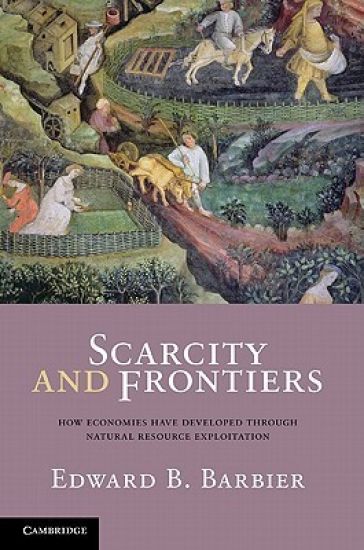
Scarcity and Frontiers

Scarcity and Frontiers

Edward B. Barbier

Cambridge University Press
2010
pokkari
Throughout much of history, a critical driving force behind global economic development has been the response of society to the scarcity of key natural resources. Increasing scarcity raises the cost of exploiting existing natural resources and creates incentives in all economies to innovate and conserve more of these resources. However, economies have also responded to increasing scarcity by obtaining and developing more of these resources. Since the agricultural transition over 12,000 years ago, this exploitation of new 'frontiers' has often proved to be a pivotal human response to natural resource scarcity. This book provides a fascinating account of the contribution that natural resource exploitation has made to economic development in key eras of world history. This not only fills an important gap in the literature on economic history but also shows how we can draw lessons from these past epochs for attaining sustainable economic development in the world today.
Natural Resources and Economic Development

Natural Resources and Economic Development

Edward B. Barbier

Cambridge University Press
2007
pokkari
Natural Resources and Economic Development, first published in 2005, explores a key paradox: why is natural resource exploitation not yielding greater benefits to the poor economies of Africa, Asia and Latin America? Part I examines this paradox both through a historical review of resource use and development and through examining current theories which explain the under-performance of today's resource-abundant economies, and proposes a frontier expansion hypothesis as an alternative explanation. Part II develops models to analyse the key economic factors underlying land expansion and water use in developing countries. Part III explores further the 'dualism within dualism' structure of resource dependency, rural poverty and resource degradation within developing countries, and through illustrative country case-studies, proposes policy and institutional reforms necessary for successful resource-based development.
A Global Green New Deal

A Global Green New Deal

Edward B. Barbier

Cambridge University Press
2010
sidottu
Meeting the short run challenges of reviving the worldwide economy need not mean sacrificing long run economic and environmental sustainability. A Global Green New Deal (GGND) is an economic policy strategy for ensuring a more economically and environmentally sustainable world economic recovery. Reviving growth and creating jobs should be essential objectives. But policies should also aim to reduce carbon dependency, protect ecosystems and water resources, and alleviate poverty. Otherwise, economic recovery today will do little to avoid future economic and environmental crises. Part One argues why a GGND strategy is essential to the sustainability of the global economy. Part Two provides an overview of the key national policies whilst Part Three focuses on the global actions necessary to allow national policies to work. Part Four summarizes the main recommendations for national and international action, and discusses the wider implications for restructuring the world economy towards 'greener' development.
Scarcity and Frontiers

Scarcity and Frontiers

Edward B. Barbier

Cambridge University Press
2010
sidottu
Throughout much of history, a critical driving force behind global economic development has been the response of society to the scarcity of key natural resources. Increasing scarcity raises the cost of exploiting existing natural resources and creates incentives in all economies to innovate and conserve more of these resources. However, economies have also responded to increasing scarcity by obtaining and developing more of these resources. Since the agricultural transition over 12,000 years ago, this exploitation of new 'frontiers' has often proved to be a pivotal human response to natural resource scarcity. This book provides a fascinating account of the contribution that natural resource exploitation has made to economic development in key eras of world history. This not only fills an important gap in the literature on economic history but also shows how we can draw lessons from these past epochs for attaining sustainable economic development in the world today.
Black Light

Black Light

Edward B Mahoney

iUniverse
2002
pokkari
On the rocky northern shores of Massachusetts, a dark power is quickly building strength. It feeds off of darkness. It strengthens with fear. It is evil incarnate. Kay and Matthew McManus are trying to rebuild their lives by moving to the small town of Burns Bay, Massachusetts, in the hope of starting anew. The abandoned lighthouse that they now call home seems like a dream come true...at first. Kay McManus begins having nightmares that are shockingly real. Voices echo through the hallways at night. Something is in the lighthouse with her, feeding off of her fear. Fate and destiny have brought Kay to this place to solve a centuries old mystery, one that could destroy her. With pulse-pounding intensity and a breathtaking finale, Black Light is a new breed of thriller that has to be read to be believed.