Kirjojen hintavertailu. Mukana 11 244 527 kirjaa ja 12 kauppaa.

Kirjahaku

Etsi kirjoja tekijän nimen, kirjan nimen tai ISBN:n perusteella.

1000 tulosta hakusanalla Eric M Watterson

But Their Faces Were All Looking Up

But Their Faces Were All Looking Up

Eric M. Vanden Eykel

T. T.Clark Ltd
2016
sidottu
This study of the Protevangelium of James explores the interrelationship of authors, readers, texts, and meaning. Its central aim is to better understand how the process of repetition gave rise to the narratives of the early Christian movement, and how that process continued to fuel the creativity and imagination of future generations. Divided into three parts, Vanden Eykel addresses first specific episodes in the life of the Virgin, consisting of Mary's childhood in the Jerusalem temple (PJ 7-9), her spinning thread for the temple veil (PJ 10-12), and Jesus' birth in a cave outside Bethlehem (PJ 17-20). The three episodes present a uniform picture of how the reader's discernment of intertexts can generate new layers of meaning, and that these layers may reveal new aspects of the author's meaning, some of which the author may not have anticipated.
But Their Faces Were All Looking Up

But Their Faces Were All Looking Up

Eric M. Vanden Eykel

T. T.Clark Ltd
2018
nidottu
This study of the Protevangelium of James explores the interrelationship of authors, readers, texts, and meaning. Its central aim is to better understand how the process of repetition gave rise to the narratives of the early Christian movement, and how that process continued to fuel the creativity and imagination of future generations. Divided into three parts, Vanden Eykel addresses first specific episodes in the life of the Virgin, consisting of Mary's childhood in the Jerusalem temple (PJ 7-9), her spinning thread for the temple veil (PJ 10-12), and Jesus' birth in a cave outside Bethlehem (PJ 17-20). The three episodes present a uniform picture of how the reader's discernment of intertexts can generate new layers of meaning, and that these layers may reveal new aspects of the author's meaning, some of which the author may not have anticipated.
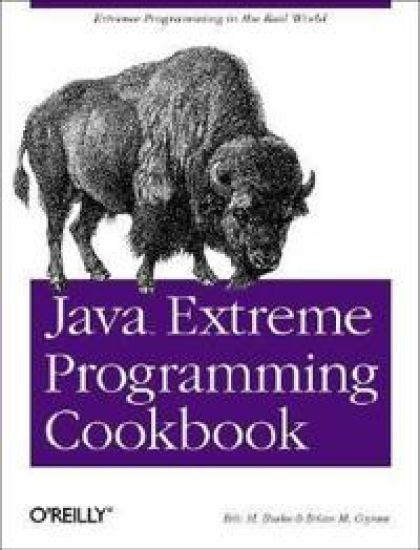
Java Extreme Programming Cookbook

Java Extreme Programming Cookbook

Eric M Burke

O'Reilly Media, Inc, USA
2003
nidottu
Extreme Programming does not mean programming naked while rollerblading down the side of the Grand Canyon. It does mean a new approach to software development that is both radical and common-sense. Unlike many software development methodologies, XP has been accepted quickly because its core practices - particularly code sharing, test-first development, and continuous integration - resonated immediately with software developers everywhere. Instead of impressing developers with a body of theory, XP got programmers to say, "Yeah, that's how I'd like to work." Oddly enough, although most developers turn to Extreme Programming methods in order to code real, hands-on, and extensible projects quickly ("Code comes first"), most books on Extreme Programming insist on focusing on the theory and not the practice. Not the Java Extreme Programming Cookbook. Brimming with over 100 "recipes" for getting down to business and actually doing XP, the Java Extreme Programming Cookbook doesn't try to "sell" you on XP; it succinctly documents the most important features of popular open source tools for XP in Java - including Ant, Junit, HttpUnit, Cactus, Tomcat, XDoclet - and then digs right in, providing recipes for implementing the tools in real-world environments. Each recipe offers solutions that help you put an extreme programming environment together: then provides code for automating the build process and testing. Although the time saved using any one of these solutions will more than pay for the book, Java Extreme Programming Cookbook offers more than just a collection of cut-and-paste code. Each recipe also includes explanations of how and why the approach works, so you can adapt the techniques to similar situation. One of the biggest challenges facing developers today is sorting through the wide variety of tools available form various source and figuring out how to them effectively. The recipes in Java Extreme Programming Cookbook showcase how to use the most important features of these XP tools. Many of these tools are geared towards unit testing, while others are invaluable for continuous integration; with these practical examples, you'll be able to choose the most effective tools to accomplish your goals, then implement them in a cohesive development environment quickly.
Making the Majors

Making the Majors

Eric M. Leifer

Harvard University Press
1998
nidottu
In this in-depth look at major league sports, Eric Leifer traces the growth and development of major leagues in baseball, football, basketball, and hockey, and predicts fundamental changes as the majors pursue international expansion. He shows how every past expansion of sports publics has been accompanied by significant changes in the way sporting competition is organized. With each reorganization, the majors have created teams closer in ability, bringing repetition to competition across time, only to expand and energize the public's search for differences between teams and for events that disrupt the repetitive flow. "The phenomenal success of league sports," Leifer writes, "rests on their ability to manufacture inequalities for fans to latch on to without jeopardizing the equalities that draw fans in."Leifer supports his theory with historical detail and statistical analysis. He examines the special concerns of league organizers in pursuing competitive balance and presents a detailed analysis of how large-city domination has been undermined in the modern era of Major League Baseball. Using games from the four major league sports, he then shows how fans can themselves affect the course of competition. In NFL football, for example, fans account for nearly all of the persisting inequality in team performance. The possibility of sustaining inequality among equals emerges from the cross-pressures that fans and leagues place on competition.With substantial data in hand, Leifer asks the essential question facing the leagues today: how can they sustain a situation that depends entirely on simultaneous equality and contention, one in which fan involvement may evaporate as soon as one team dominates? His answer has significant implications for the future of major league sports, both nationally and internationally.
Etale Homotopy of Simplicial Schemes

Etale Homotopy of Simplicial Schemes

Eric M. Friedlander

Princeton University Press
1982
pokkari
This book presents a coherent account of the current status of etale homotopy theory, a topological theory introduced into abstract algebraic geometry by M. Artin and B. Mazur. Eric M. Friedlander presents many of his own applications of this theory to algebraic topology, finite Chevalley groups, and algebraic geometry. Of particular interest are the discussions concerning the Adams Conjecture, K-theories of finite fields, and Poincare duality. Because these applications have required repeated modifications of the original formulation of etale homotopy theory, the author provides a new treatment of the foundations which is more general and more precise than previous versions. One purpose of this book is to offer the basic techniques and results of etale homotopy theory to topologists and algebraic geometers who may then apply the theory in their own work. With a view to such future applications, the author has introduced a number of new constructions (function complexes, relative homology and cohomology, generalized cohomology) which have immediately proved applicable to algebraic K-theory.
Reforms at Risk

Reforms at Risk

Eric M. Patashnik

Princeton University Press
2008
pokkari
Reforms at Risk is the first book to closely examine what happens to sweeping and seemingly successful policy reforms after they are passed. Most books focus on the politics of reform adoption, yet as Eric Patashnik shows here, the political struggle does not end when major reforms become enacted. Why do certain highly praised policy reforms endure while others are quietly reversed or eroded away? Patashnik peers into some of the most critical arenas of domestic-policy reform--including taxes, agricultural subsidies, airline deregulation, emissions trading, welfare state reform, and reform of government procurement--to identify the factors that enable reform measures to survive. He argues that the reforms that stick destroy an existing policy subsystem and reconfigure the political dynamic. Patashnik demonstrates that sustainable reforms create positive policy feedbacks, transform institutions, and often unleash the "creative destructiveness" of market forces. Reforms at Risk debunks the argument that reforms inevitably fail because Congress is prey to special interests, and the book provides a more realistic portrait of the possibilities and limits of positive change in American government. It is essential reading for scholars and practitioners of U.S. politics and public policy, offering practical lessons for anyone who wants to ensure that hard-fought reform victories survive.
Physics for the Inquiring Mind

Physics for the Inquiring Mind

Eric M. Rogers

Princeton University Press
2011
pokkari
In our scientific age an understanding of physics is part of a liberal education. Lawyers, bankers, governors, business heads, administrators, all wise educated people need a lasting understanding of physics so that they can enjoy those contacts with science and scientists that are part of our civilization both materially and intellectually. They need knowledge and understanding instead of the feelings, all too common, that physics is dark and mysterious and that physicists are a strange people with incomprehensible interests. Such a sense of understanding science and scientists can be gained neither from sermons on the beauty of science nor from the rigorous courses that colleges have offered for generations; when the headache clears away it leaves little but a confused sense of mystery. Nor is the need met by survey courses that offer a smorgasbord of tidbit--they give science a bad name as a compendium of information or formulas. The non-scientist needs a course of study that enables him to learn real science and make its own--with delight. For lasting benefits the intelligent non-scientist needs a course of study that enables him to learn genuine science carefully and then encourages him to think about it and use it. He needs a carefully selected framework of topics--not so many that learning becomes superficial and hurried; not so few that he misses the connected nature of scientific work and thinking. He must see how scientific knowledge is built up by building some scientific knowledge of his own, by reading and discussing and if possible by doing experiments himself. He must think his own way through some scientific arguments. He must form his own opinion, with guidance, concerning the parts played by experiment and theory; and he must be shown how to develop a taste for good theory. He must see several varieties of scientific method at work. And above all, he must think about science for himself and enjoy that. These are the things that this book encourages readers to gain, by their own study and thinking. Physics for the Inquiring Mind is a book for the inquiring mind of students in college and for other readers who want to grow in scientific wisdom, who want to know what physics really is.
Unhealthy Politics

Unhealthy Politics

Eric M. Patashnik; Alan S. Gerber; Conor M. Dowling

PRINCETON UNIVERSITY PRESS
2017
sidottu
How partisanship, polarization, and medical authority stand in the way of evidence-based medicine The U.S. medical system is touted as the most advanced in the world, yet many common treatments are not based on sound science. Treatments can go into widespread use before they are rigorously evaluated, and every year patients are harmed because they receive too many procedures--and too few treatments that really work. Unhealthy Politics sheds new light on why the government's response to this troubling situation has been so inadequate, and why efforts to improve the evidence base of U.S. medicine continue to cause so much political controversy and public trepidation. This critically important book draws on public opinion surveys, physician surveys, case studies, and political science models to explain how political incentives, polarization, and the misuse of professional authority have undermined efforts to tackle the medical evidence problem and curb wasteful spending. It paints a portrait of a medical industry with vast influence over which procedures and treatments get adopted, and a public burdened by the rising costs of health care yet fearful of going against "doctor's orders." The book shows how the government's efforts to promote evidence-based medicine have become mired in partisan debates. It also proposes sensible solutions that can lead to better, more efficient health care for all of us. Unhealthy Politics offers vital insights not only into health policy but also into the limits of science, expertise, and professionalism as political foundations for pragmatic problem solving in American democracy.
Unhealthy Politics

Unhealthy Politics

Eric M. Patashnik; Alan S. Gerber; Conor M. Dowling

Princeton University Press
2020
pokkari
How partisanship, polarization, and medical authority stand in the way of evidence-based medicineThe U.S. medical system is touted as the most advanced in the world, yet many common treatments are not based on sound science. Unhealthy Politics sheds new light on why the government's response to this troubling situation has been so inadequate, and why efforts to improve the evidence base of U.S. medicine continue to cause so much political controversy. This critically important book paints a portrait of a medical industry with vast influence over which procedures and treatments get adopted, and a public burdened by the rising costs of health care yet fearful of going against "doctor's orders." Now with a new preface by the authors, Unhealthy Politics offers vital insights into the limits of science, expertise, and professionalism in American politics.
Astronomy for the Inquiring Mind

Astronomy for the Inquiring Mind

Eric M. Rogers

Princeton University Press
2017
pokkari
This selection from the author's famous Physics for the Inquiring Mind is a book for readers who want to grow in scientific wisdom, who want to know the fundamentals of the history and theory of basic astronomy. Originally published in 1982. The Princeton Legacy Library uses the latest print-on-demand technology to again make available previously out-of-print books from the distinguished backlist of Princeton University Press. These editions preserve the original texts of these important books while presenting them in durable paperback and hardcover editions. The goal of the Princeton Legacy Library is to vastly increase access to the rich scholarly heritage found in the thousands of books published by Princeton University Press since its founding in 1905.
Astronomy for the Inquiring Mind

Astronomy for the Inquiring Mind

Eric M. Rogers

Princeton University Press
2017
sidottu
This selection from the author's famous Physics for the Inquiring Mind is a book for readers who want to grow in scientific wisdom, who want to know the fundamentals of the history and theory of basic astronomy. Originally published in 1982. The Princeton Legacy Library uses the latest print-on-demand technology to again make available previously out-of-print books from the distinguished backlist of Princeton University Press. These editions preserve the original texts of these important books while presenting them in durable paperback and hardcover editions. The goal of the Princeton Legacy Library is to vastly increase access to the rich scholarly heritage found in the thousands of books published by Princeton University Press since its founding in 1905.
Hashimoto's Triggers: Eliminate Your Thyroid Symptoms by Finding and Removing Your Specific Autoimmune Triggers
Reverse your Hashimoto's condition and eliminate your thyroid symptoms by finding and removing your specific autoimmune triggers. There are millions of people with Hashimoto's thyroiditis. And while Hashimoto's is an autoimmune thyroid condition, most medical doctors don't do anything to improve the health of the person's immune system. It can take years for Hashimoto's to get diagnosed, and when it finally is diagnosed, many people with this condition are simply given a prescription for thyroid hormone replacement. And while taking thyroid hormone can be important for some people, this of course isn't doing anything to address the underlying cause of the condition. That's the purpose of this book ...to help you find and remove your specific autoimmune triggers. Here is what you will discover from reading this book: More than one dozen triggers of Hashimoto's thyroiditis The different diet options for those with Hashimoto's A comprehensive list of the blood tests you should get, along with the optimal reference ranges for each marker Other specific tests that can help detect your triggers How to detect your specific food triggers Everything you need to know to heal your gut How to reduce fatigue, brain fog, hair loss, and other common symptoms Strategies to lower thyroid antibodies when nothing else has worked Why most people with Hashimoto's struggle to lose weight...and what to do about it The goal of this book is simple: to show you how to restore your health by finding and removing your specific triggers. This book is also well-organized, which means that if you don't want to read the entire book you can easily pick and choose to read those chapters that are of most interest to you. The book is divided into the following five sections: Section one: Understanding the Autoimmune Component of Hashimoto's Section two: The Triggers of Hashimoto's Section three: Detecting Your Specific Triggers Section four: Removing The Triggers Section five: Questions You Might Have About Hashimoto's Start taking the necessary steps to find and remove your specific triggers Get your copy of Hashimoto's Triggers today by clicking the Buy Now button at the top of this page
The Good Gift of Weakness

The Good Gift of Weakness

Eric M Schumacher

HARVEST HOUSE PUBLISHERS,U.S.
2024
pokkari
This overview of the theme of weakness in the Bible offers readers practical encouragement and hope as they learn to view their frailties as part of God’s plan and purpose for their lives. Our culture deifies strength—and sadly, the church does too. Who has the most successful ministry, the largest congregation, or the godliest family? Our misplaced faith in human strength is a false hope with no basis in Scripture. But a closer look throughout the Bible reveals the central role human frailty plays in the redemption story. From Genesis to Revelation, God’s power is made perfect when people are at their weakest. Far from an undesirable defect, God designed our weakness to draw us closer to himself. As you learn to accept the good gift of weakness, you will experience true strength—the kind that only comes from a loving and infinitely powerful God.