Kirjojen hintavertailu. Mukana 11 393 262 kirjaa ja 12 kauppaa.

Kirjahaku

Etsi kirjoja tekijän nimen, kirjan nimen tai ISBN:n perusteella.

1000 tulosta hakusanalla Eugene Field
Eugene Field and His Age

Eugene Field and His Age

Lewis O. Saum

University of Nebraska Press
2000
sidottu
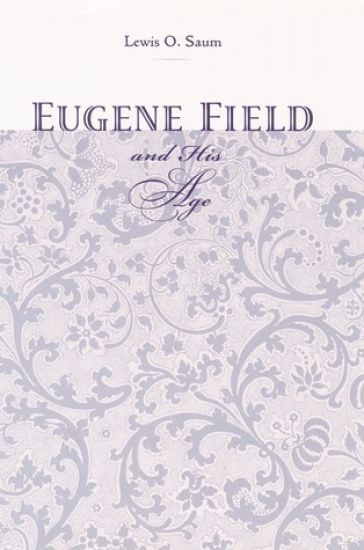
Eugene Field (1850–95) is perhaps best remembered for his children's verse, especially "Little Boy Blue" and "Wynken, Blynken, and Nod." During his journalistic career, however, his column, "Sharps and Flats," in the Chicago Daily News illuminated the shenanigans of local and national politics, captured the excitement of baseball, and praised the cultural scene of Chicago and the West over that of the East Coast and Europe. Field used whimsy, satire, and, at times, unadorned admiration to depict and encapsulate the energy of a young nation reinventing itself and its political ambitions in the closing decades of the nineteenth century. Foremost, Field was a political observer. During his lifetime politics saw more public awareness and involvement than at any other time in American history, and Field's great popularity derived mainly from his near-ceaseless commentary—arch, outlandish, comic, serious—on that arena of affairs. Field also devoted many columns to entertainment and diversions, discussing the baseball "idiocy" that stormed Chicago and championing and criticizing authors and actors.
Eugene Field, a Study in Heredity and Contradictions
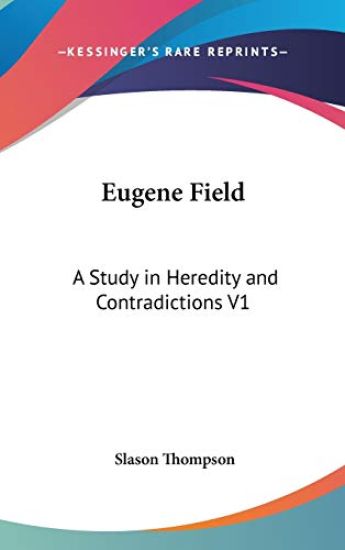
Delve into the life of Eugene Field, the celebrated 19th-century American journalist and literary critic, in "Eugene Field, A Study In Heredity And Contradictions, Vol. 1 of 2," penned by Slason Thompson. This biography explores the complexities of Field's character, examining the influences that shaped his remarkable career. Through meticulous research, Thompson unveils the man behind the famed name, revealing both his inherent talents and the internal conflicts that defined him. This volume offers a fascinating study of Field's early years and rise to prominence, making it a vital resource for those interested in American literature, journalistic history, and the lives of influential figures. Discover the enduring story of a man whose legacy continues to inspire. A valuable addition to any collection of biographies and literary memoirs.This work has been selected by scholars as being culturally important, and is part of the knowledge base of civilization as we know it.This work is in the public domain in the United States of America, and possibly other nations. Within the United States, you may freely copy and distribute this work, as no entity (individual or corporate) has a copyright on the body of the work.Scholars believe, and we concur, that this work is important enough to be preserved, reproduced, and made generally available to the public. We appreciate your support of the preservation process, and thank you for being an important part of keeping this knowledge alive and relevant.
Eugene Field, a Study in Heredity and Contradictions
Delve into the life of Eugene Field, the celebrated 19th-century American journalist and literary critic, in "Eugene Field, A Study In Heredity And Contradictions, Vol. 1 of 2," penned by Slason Thompson. This biography explores the complexities of Field's character, examining the influences that shaped his remarkable career. Through meticulous research, Thompson unveils the man behind the famed name, revealing both his inherent talents and the internal conflicts that defined him. This volume offers a fascinating study of Field's early years and rise to prominence, making it a vital resource for those interested in American literature, journalistic history, and the lives of influential figures. Discover the enduring story of a man whose legacy continues to inspire. A valuable addition to any collection of biographies and literary memoirs.This work has been selected by scholars as being culturally important, and is part of the knowledge base of civilization as we know it.This work is in the public domain in the United States of America, and possibly other nations. Within the United States, you may freely copy and distribute this work, as no entity (individual or corporate) has a copyright on the body of the work.Scholars believe, and we concur, that this work is important enough to be preserved, reproduced, and made generally available to the public. We appreciate your support of the preservation process, and thank you for being an important part of keeping this knowledge alive and relevant.