Kirjojen hintavertailu. Mukana 12 390 323 kirjaa ja 12 kauppaa.

Kirjahaku

Etsi kirjoja tekijän nimen, kirjan nimen tai ISBN:n perusteella.

1000 tulosta hakusanalla Euripides

Euripides' Alcestis

Euripides' Alcestis

Euripides

University of Oklahoma Press
2003
nidottu
Euripides' Alcestis - perhaps the most anthologized Attic drama--is an ideal text for students reading their first play in the original Greek. Literary commentaries and language aids in most editions are too advanced or too elementary for intermediate students of the language, but in their new student edition, C. A. E. Luschnig and H. M. Roisman remedy such deficiencies.The introductory section of this edition provides historical and literary perspective; the commentary explains points of grammar, syntax, and vocabulary, as well as elucidating background features such as dramatic conventions and mythology; and a discussion section introduces the controversies surrounding this most elusive drama. In their presentation, Luschnig and Roisman have initiated a new method for introducing students to current scholarship. This edition also includes a glossary, an index, a bibliography, and grammatical reviews designed specifically for students of Greek language and culture in their second year of university study or third year of high school. Luschnig and Roisman, who have published numerous articles and books on Greek literature, bring to this volume decades of experience teaching classical Greek. ""General readers could well benefit from using this book, as it contains valuable literary discussion and explication of the conventions of Greek drama."" - Daniel H. Garrison, author of Sexual Culture in Ancient GreeceC. A. E. Luschnig, Professor of Classics at the University of Idaho in Moscow, is the author of An Introduction to Ancient Greek and The Gorgon's Severed Head: Studies in Euripides' Alcestis, Electra, and Phoenissae. H. M. Roisman, Professor of Classics at Colby College in Waterville, Maine, is the author of Loyalty in Early Greek Epic and Tragedy and Nothing Is As It Seems: The Tragedy of the Implicit in Euripides' Hippolytus.
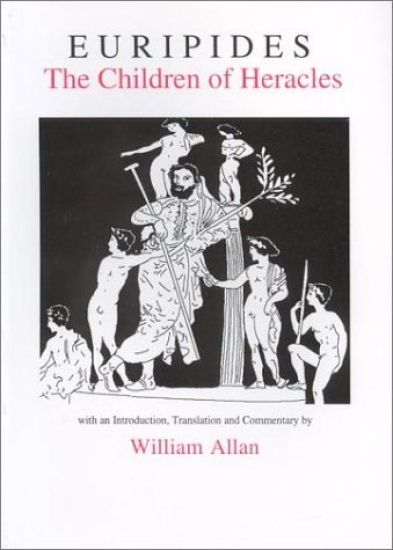
Euripides: The Children of Heracles

Euripides: The Children of Heracles

Euripides

Aris Phillips Ltd
2001
nidottu
The Children of Heracles is a powerful and challenging tragedy of exile and supplication. Driven from their homeland by Eurystheus, king of Argos, the children of Heracles flee as fugitives throughout Greece until they are granted protection in Athens. However, their acceptance as political refugees threatens to cause civil revolt among the Athenians and hostile invasion from the Argives. The self-sacrifice of Heracles' daughter ensures a victory for Athens and the Heraclidae, but Heracles’ mother Alcmene refuses to spare the life of Eurystheus, although he is a prisoner of war protected by Athenian law. The play shows the amorality of the powerful and the vulnerability of refugees in the most disturbing terms, making for a drama of continuing moral and political relevance to the modern world. Greek text with facing-page English translation, introduction and commentary.
Euripides

Euripides

Cambridge University Press
2010
pokkari
Frederick Apthorp Paley (1815–1888) published Volume 1 of his English commentary on Euripides in 1857. It contains the Greek text of seven of Euripides' most popular plays: Rhesus, Medea, Hippolytus, Alcestis, Heraclidae, Supplices and Troades, each with an introductory essay. Paley's detailed commentary is given at the foot of each page of Greek text. It discusses Euripides' language and style, explaining difficult grammatical structures, syntax and vocabulary; poetic form and Euripides' innovative approach to composing tragedy; textual variation between manuscripts; the historical and literary context of each play; and their reception history. Paley's work greatly influenced Euripidean scholarship: for over a century it was a widely used teaching tool in schools and universities. An outstanding piece of classical scholarship and a key text in the history of Euripidean interpretation, it deserves continued consideration by future generations of scholars and students.
Euripides

Euripides

Cambridge University Press
2010
pokkari
Frederick Apthorp Paley (1815–1888) published Volume 2 of his English commentary on Euripides in 1858. It contains the Greek text of Euripides' plays Ion, Helena, Andromache, Electra, Bacchae, and Hecuba, each with an introductory essay. Paley's detailed commentary is given at the foot of each page of Greek text. It discusses Euripides' language and style, explaining difficult grammatical structures, syntax and vocabulary; poetic form and Euripides' innovative approach to composing tragedy; textual variation between manuscripts and critical editions; the historical and literary context of each play; and their reception history. Paley's work greatly influenced Euripidean scholarship: for over a century it was a widely used teaching tool in schools and universities. An outstanding piece of classical scholarship and a key text in the history of Euripidean interpretation, it deserves continued consideration by future generations of scholars and students.
Euripides

Euripides

Cambridge University Press
2010
pokkari
Frederick Apthorp Paley (1815–1888) published Volume 3 of his English commentary on Euripides in 1860. It contains the Greek text of Euripides' plays Hercules Furens, Phoenissae, Orestes, Iphigenia in Tauris, Iphigenia in Aulide, and Cyclops, each with an introductory essay. Paley's detailed commentary is given at the foot of each page of Greek text. It discusses Euripides' language and style, explaining difficult grammatical structures, syntax and vocabulary; poetic form and Euripides' innovative approach to composing tragedy; textual variation between manuscripts; the historical and literary context of each play; and their reception history. Paley's work greatly influenced Euripidean scholarship: for over a century it was a widely used teaching tool in schools and universities. An outstanding piece of classical scholarship and a key text in the history of Euripidean interpretation, it deserves continued consideration by future generations of scholars and students.