Kirjojen hintavertailu. Mukana 11 244 527 kirjaa ja 12 kauppaa.

Kirjahaku

Etsi kirjoja tekijän nimen, kirjan nimen tai ISBN:n perusteella.

1000 tulosta hakusanalla Evripides

Euripides Plays: 3

Euripides Plays: 3

Euripides

Methuen Drama
1997
nidottu
Published in the new Methuen Classical Dramatists series The three plays in this volume straddle the borders between comedy and tragedy. Alkestis is a moving "romance" with death; it has parallels to Shakespeare's The Winter's Tale. Helen, an alternative version of the tragic portrayal of the Trojan War, shows Helen "relocated in a delightful comedy" (Observer) - as an innocent victim of her own beauty, hidden in Egypt by the gods while her image has been abducted by Paris. In Ion, a father who thought he was childless discovers his son, and a son who thought he was motherless finds his mother.
Euripides Plays: 4

Euripides Plays: 4

Euripides

Methuen Drama
1997
nidottu
"Euripides, the Athenian playwright who dared to question the whims of wanton gods, has always been the most intriguing of the Greek tragedians. Now, with translations aimed at the stage rather than the page, his restless intellect strikes the chord This volume contains some of Euripides' most famous works: Elektra, which reverses previous notions of 'heroic' behaviour; Orestes, in which almost all the characters are driven by base motives of cowardice or revenge; Iphigeneia in Tauris who presumes her brother Orestes dead and her mother Klytemnestra and stepfather Aigisthos still living, is visited by a surprise guest. Elektra, Oresetes and Iphigeneia in Tauris were performed together as Agamemnon's children at The Gate Theatre in 1995 and show the consequences of Agamemnon's "sacrifice" of his daughter at the start of the Trojan war.
Euripides Plays: 5

Euripides Plays: 5

Euripides

Methuen Drama
1997
nidottu
Published in the new Methuen Classical Dramatists series Written at the height of the Peloponnesian War, the three plays in this volume highlight the trivial causes and dire consequences of war and the fate of the innocent. In Andromache, Hektor's widow struggles to survive as the concubine of her husband's killer. Herakles' Children and Herakles show his two young families, without his powerful protection at the mercy of his enemies. Full of humanity and subtle characterisation, these new translations by Robert Cannon and Kenneth McLeish which are intended both for performer and student, Euripides is reaffirmed as a fresh and compelling dramatist.
Euripides Plays: 6

Euripides Plays: 6

Euripides

Methuen Drama
1997
nidottu
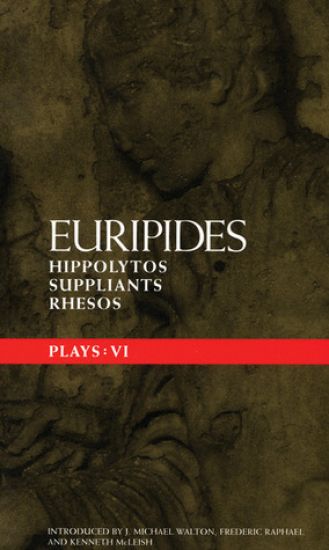
Published in the new Methuen Classical Dramatists series A dramatist whose trademark was the unexpected, Euripides has constantly challenged and intrigued audiences, from Athens of the fifth century BC to the present. The three plays in this volume demonstrate Euripides' versatility. Hippolytos (which was turned into Phedre by Racine), deals with sexual passion, incest and abstinence; Suppliants (a version of the Antigone story) sets the play in Eleusis and dramatises the moment when the mothers of the dead sons of Oedipus beg Theseus to go to Thebes and demand their sons' bodies for burial. In Rhesos, all the confusion of sentry duty, the intrigue of spies and intruders, disguises and deceptions are crammed into a single night when the fortunes of war turn against the Trojans by a mixture of devious behaviour and sheer bad luck.
Euripides Plays: 1

Euripides Plays: 1

Euripides

Methuen Drama
2000
nidottu
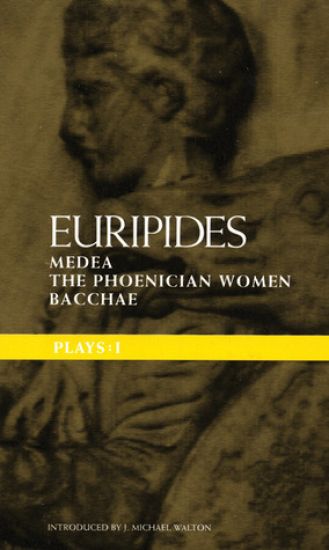
Published in the new Methuen Classical Dramatists series. Always controversial, Euripides' plays are now celebrated for the subtlety of their characterisation and their unorthodox dramatic style. This volume contains three of his finest tragedies: Medea, the abandoned wife, who murders her own children; The Phoenician Women, a further twist in the story of Oedipus and Jocasta; and Bacchae, a macabre and complex play, about the power and irrationality of Dionysos. These translations are by David Thompson and J. Michael Walton.With an introduction by J. Michael Walton
Euripides, Women and Sexuality
Euripides' interest in the psychology and social position of women is well known. Of the great Greek playwrights, he most directly reflects contemporary philosophical and social debates, and his work is of great value as a source for social history. The important new studies in this volume explore Euripides' treatment of sexuality and Greek ideals of women's behaviour. Using a wide range of analytic techniques, seven scholars direct new light not only on Euripides' own views of women but also on the ideals and preoccupations of his contemporaries in this area. Athenian women of the classical period were used, in Plato's phrase, 'to a life in the shadows'. This book helps us to see how far the influence of these cloistered women extended into the sunlit world of men.
Euripides, Women and Sexuality
Euripides' interest in the psychology and social position of women is well known. Of the great Greek playwrights, he most directly reflects contemporary philosophical and social debates, and his work is of great value as a source for social history. The important new studies in this volume explore Euripides' treatment of sexuality and Greek ideals of women's behaviour. Using a wide range of analytic techniques, seven scholars direct new light not only on Euripides' own views of women but also on the ideals and preoccupations of his contemporaries in this area. Athenian women of the classical period were used, in Plato's phrase, 'to a life in the shadows'. This book helps us to see how far the influence of these cloistered women extended into the sunlit world of men.
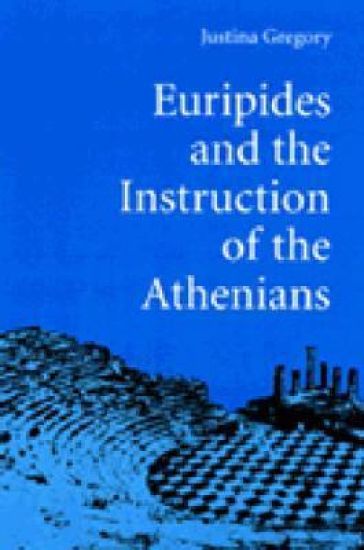
Euripides and the Instruction of the Athenians

Euripides and the Instruction of the Athenians

Justina Gregory

The University of Michigan Press
1997
nidottu
Political by its very nature, Greek tragedy reflects on how life should be lived in the polis, and especially the polis that was democratic Athens. Instructional as well, drama frequently concerns itself with the audience's moral education. Euripides and the Instruction of the Athenians draws on these political and didactic functions of tragedy for a close analysis of five plays: Alcestis, Hippolytus, Hecuba, Heracles, and Trojan Women. Clearly written and persuasively argued, this volume addresses itself to all who are interested in Greek tragedy. Nonspecialists and scholars alike will deepen their understanding of this complex writer and the tumultuous period in which he lived. ". . . a lucid presentation of the positive side of Euripidean tragedy, and a thoughtful reminder of the political implications of Greek tragedy." --American Journal of Philology ". . . the principal defect of [this] otherwise excellent study is that it is too short." --Erich Segal, Classical Review". . . a most stimulating book throughout . . . ." --Greece and RomeJustina Gregory is Professor of Classics, Smith College, where she is head of the department. She has been the recipient of Fulbright and Woodrow Wilson fellowships.
Euripides: Hecuba

Euripides: Hecuba

Cambridge University Press
2018
pokkari
Hecuba was the most widely read play of Euripides from antiquity to the Renaissance, appealing to readers and spectators for its controversial treatment of moral themes: revenge, war and slavery, violence, human sacrifice, gender and ethnic relations. It narrates the death of Hecuba's daughter Polyxena, sacrificed by the Greeks to placate the ghost of Achilles, and that of her son Polydorus, killed out of greed by the Thracian king who was supposed to protect him. Hecuba successfully plots a cruel and shocking revenge against the killer. The play is now at the centre of the attention of scholars and performing artists. This edition offers new textual and interpretive suggestions, and provides detailed guidance on problems of language as well as employing conceptual tools from contemporary linguistics. It will be useful for upper-level undergraduates and graduate students, as well as of interest to scholars.
Euripides: Hecuba

Euripides: Hecuba

Cambridge University Press
2018
sidottu
Hecuba was the most widely read play of Euripides from antiquity to the Renaissance, appealing to readers and spectators for its controversial treatment of moral themes: revenge, war and slavery, violence, human sacrifice, gender and ethnic relations. It narrates the death of Hecuba's daughter Polyxena, sacrificed by the Greeks to placate the ghost of Achilles, and that of her son Polydorus, killed out of greed by the Thracian king who was supposed to protect him. Hecuba successfully plots a cruel and shocking revenge against the killer. The play is now at the centre of the attention of scholars and performing artists. This edition offers new textual and interpretive suggestions, and provides detailed guidance on problems of language as well as employing conceptual tools from contemporary linguistics. It will be useful for upper-level undergraduates and graduate students, as well as of interest to scholars.
Bacchae of Euripides

Bacchae of Euripides

Euripides

Cambridge University Press
1979
sidottu
The Bacchae is the last and greatest of Euripides' plays. Its theme of the cost of resisting the gods who reside in human nature itself is still of immediate interest to audiences and readers and has inspired modern interpretations. Professor Kirk has made a translation which is both accurate and readable. This he supports with an analytic commentary and a substantial introductory essay which provide the Greek-less reader with essential background information and offer interpretation of a kind usually found only in Greek editions. This is a translation for students of Greek tragedy, particularly in courses on classics in translations or classical civilisation. It will also be useful for students of drama and of English and other literatures.
Euripides: Phoenissae

Euripides: Phoenissae

Euripides

Cambridge University Press
1994
sidottu
This volume provides a thorough philological and dramatic commentary on Euripides' Phoenissae, the first detailed commentary in English since 1911. Phoenissae is of special interest both as a specimen of late Euripidean dramaturgy, and as the subject of longstanding disputes over the extent of interpolation and rewriting to be detected in it. This commentary aims to offer a balanced treatment of issues of language, style, structure, and dramatic technique as well as to explain the reasons for and uncertainties of the constitution of the text. The introduction treats the play's structure and themes, the possible date, the features of the original production, the varied background of Theban myth against which Euripides' choices and innovations may be judged, and general issues relevant to the problem of interpolation. The Greek text is that of the author's 1988 Teubner edition.
Euripides: 'Helen'

Euripides: 'Helen'

Euripides

Cambridge University Press
2008
pokkari
This up-to-date edition offers a detailed literary and cultural analysis of Euripides' Helen, a work which arguably embodies the variety and dynamism of fifth-century Athenian tragedy more than any other surviving play. The story of an exemplary wife (not an adulteress) who went to Egypt (not to Troy), Euripides' 'new Helen' skilfully transforms and supplants earlier currents of literature and myth. The Introduction elucidates Euripides' treatment of Helen and sets the play in its wider intellectual context. It also discusses questions of genre and reception, rejecting such descriptions as 'tragicomedy' or 'romantic tragedy', and showing how later artists have responded to Euripides' unorthodox heroine and her phantom double. The Commentary's notes on language and style are intended to make Helen fully accessible to readers of Greek at all levels, while the edition as a whole is designed for use by anyone with an interest in Greek tragedy.
Euripides: Ion

Euripides: Ion

Euripides

Cambridge University Press
2019
sidottu
Ion is one of Euripides' most appealing and inventive plays. With its story of an anonymous temple slave discovered to be the son of Apollo and Creusa, an Athenian princess, it is a rare example of Athenian myth dramatized for the Athenian stage. It explores the Delphic oracle and Greek piety; the Athenian ideology of autochthony and empire; and the tragic suffering and longing of the mythical foundling and his mother, whose experiences are represented uniquely in surviving Greek literature. The plot anticipates later Greek comedy, while the recognition scene builds on a tradition founded by Homer's Odyssey and Aeschylus' Oresteia. The introduction sets out the main issues in interpretation and discusses the play's contexts in myth, religion, law, politics, and society. By attending to language, style, meter, and dramatic technique, this edition with its detailed commentary makes Ion accessible to students, scholars, and readers of Greek at all levels.
Euripides: Ion

Euripides: Ion

Euripides

Cambridge University Press
2019
pokkari
Ion is one of Euripides' most appealing and inventive plays. With its story of an anonymous temple slave discovered to be the son of Apollo and Creusa, an Athenian princess, it is a rare example of Athenian myth dramatized for the Athenian stage. It explores the Delphic oracle and Greek piety; the Athenian ideology of autochthony and empire; and the tragic suffering and longing of the mythical foundling and his mother, whose experiences are represented uniquely in surviving Greek literature. The plot anticipates later Greek comedy, while the recognition scene builds on a tradition founded by Homer's Odyssey and Aeschylus' Oresteia. The introduction sets out the main issues in interpretation and discusses the play's contexts in myth, religion, law, politics, and society. By attending to language, style, meter, and dramatic technique, this edition with its detailed commentary makes Ion accessible to students, scholars, and readers of Greek at all levels.
Euripides: Phaethon

Euripides: Phaethon

Euripides

Cambridge University Press
2004
pokkari
The surviving text of the fragmentary Phaethon of Euripides depends chiefly on two sources: two pages from a Euripidean manuscript, written about A.D. 500, and a papyrus of the third century B.C., which contains a substantial part of the parodos. These sources are supplemented by a number of citations in classical authors and by a recently published fragmentary hypothesis. Professor Diggle has examined all the manuscript evidence and offers many decipherments. He gives a text of the play and of the hypothesis, an exegetical commentary, prolegomena and appendices, in which he discusses the treatment of the Phaethon myth in classical literature and attempts a reconstruction of the plot of the play.
Euripides: Phoenissae

Euripides: Phoenissae

Euripides

Cambridge University Press
2004
pokkari
This volume provides a thorough philological and dramatic commentary on Euripides’ Phoenissae, the first detailed commentary in English since 1911. Phoenissae is of special interest both as a specimen of late Euripidean dramaturgy, and as the subject of longstanding disputes over the extent of interpolation and rewriting to be detected in it. This commentary aims to offer a balanced treatment of issues of language, style, structure, and dramatic technique as well as to explain the reasons for and uncertainties of the constitution of the text. The introduction treats the play’s structure and themes, the possible date, the features of the original production, the varied background of Theban myth against which Euripides’ choices and innovations may be judged, and general issues relevant to the problem of interpolation. The Greek text is that of the author’s 1988 Teubner edition.
Euripides: Medea

Euripides: Medea

Cambridge University Press
2002
pokkari
This up-to-date edition makes Euripides’ most famous and influential play accessible to students of Greek reading their first tragedy as well as to more advanced students. The introduction analyzes Medea as a revenge-plot, evaluates the strands of motivation that lead to her tragic insistence on killing her own children, and assesses the potential sympathy of a Greek audience for a character triply marked as other (barbarian, witch, woman). A unique feature of this book is the introduction to tragic language and style. The text, revised for this edition, is accompanied by an abbreviated critical apparatus. The commentary provides morphological and syntactic help for inexperienced students and more advanced observations on vocabulary, rhetoric, dramatic techniques, stage action, and details of interpretation, from the famous debate of Medea and Jason to the ‘unmotivated’ entrance of Aegeus and the controversial monologue of Medea.
Euripides: Medea

Euripides: Medea

Euripides

Cambridge University Press
2000
pokkari
Cambridge Translations from Greek Drama aims to eliminate the boundary between classics students and drama students. Euripides: Medea is the first in the series, and is aimed at A-level students in the UK and college students in North America. Features of the book include full commentary running alongside the translation, notes on pronunciation, and a plot synopsis. Background information is also provided, along with suggestions to encourage discussion.
Euripides: Bacchae

Euripides: Bacchae

Euripides

Cambridge University Press
2000
pokkari
Treating ancient plays as living drama. Classical Greek drama is brought vividly to life in this series of new translations. Students are encouraged to engage with the text through detailed commentaries, including suggestions for discussion and analysis. In addition, numerous practical questions stimulate ideas on staging and encourage students to explore the play's dramatic qualities. Bacchae is suitable for students of both Classical Civilisation and Drama. Useful features include full synopsis of the play, commentary alongside translation for easy reference and a comprehensive introduction to the Greek Theatre. Bacchae is aimed primarily at A-level and undergraduate students in the UK, and college students in North America.