Kirjojen hintavertailu. Mukana 11 699 587 kirjaa ja 12 kauppaa.

Kirjahaku

Etsi kirjoja tekijän nimen, kirjan nimen tai ISBN:n perusteella.

1000 tulosta hakusanalla Flora

Flora of Middle-Earth

Flora of Middle-Earth

Walter S. Judd; Graham A. Judd

Oxford University Press Inc
2017
sidottu
The book considers the importance of plants in Tolkien's conception of Middle-earth. It develops the theme that Middle-earth is our own world - and will awaken the reader to the connection between the plants of Tolkien's legendarium and those growing in our gardens and local natural areas of the Northern Hemisphere. It also demonstrates the connection between the various plant communities of Middle-earth and the elven and human cultures that occupy them, including those environments degraded by warfare, industrialization or pollution. The heart of the book is an alphabetical listing, arranged by common names, of all of the plants mentioned in Tolkien's legendarium; for each of these plants the treatment will include: 1) common and scientific name, along with an indication of the family to which the plant belongs, 2) a brief quote from one of Tolkien's works in which the plant is referenced, 3) a discussion of the significance of the plant in the context of Tolkien's legendarium, 4) the etymology relating to both English common name and the scientific name, and where relevant, the name in one or more of the languages of Middle-earth, 5) a brief statement of the plant's distribution and ecology (along with mention of major species), 6) economic uses, both traditional and current, and 7) an easy-to-understand description of the plant. The book provides guidelines to the use of plant descriptions, and the few technical terms used are carefully defined. Many plants are illustrated by original artwork, in the style of a woodcut print. The description along with an identification key, when used with the illustrations, allow easy identification of each plant, adding to the reader's understanding and appreciation of Tolkien's works. A glossary of descriptive terms is also included.

Flora Unveiled

Flora Unveiled

Lincoln Taiz; Lee Taiz

Oxford University Press Inc
2017
sidottu
Sex in animals has been known for at least ten thousand years, and this knowledge was put to good use during animal domestication in the Neolithic period. In stark contrast, sex in plants wasn't discovered until the late 17th century, long after the domestication of crop plants. Even after its discovery, the "sexual theory" continued to be hotly debated and lampooned for another 150 years, pitting the "sexualists" against the "asexualists". Why was the notion of sex in plants so contentious for so long? "Flora Unveiled" is a deep history of perceptions about plant gender and sexuality, beginning in the Ice Age and ending in the middle of the nineteenth century, with the elucidation of the complete plant life cycle. Linc and Lee Taiz show that a gender bias that plants are unisexual and female (a "one-sex model") prevented the discovery of plant sex and delayed its acceptance long after the theory was definitively proven. The book explores the various sources of this gender bias, beginning with women's role as gatherers, crop domesticators, and the first farmers. In the myths and religions of the Bronze and Iron Ages, female deities were strongly identified with flowers, trees, and agricultural abundance, and during Middle Ages and Renaissance, this tradition was assimilated into Christianity in the person of Mary. The one-sex model of plants continued into the Early Modern Period, and experienced a resurgence during the eighteenth century Enlightenment and again in the nineteenth century Romantic movement. Not until Wilhelm Hofmeister demonstrated the universality of sex in the plant kingdom was the controversy over plant sex finally laid to rest. Although "Flora Unveiled" focuses on the discovery of sex in plants, the history serves as a cautionary tale of how strongly and persistently cultural biases can impede the discovery and delay the acceptance of scientific advances.
Flora of North America: Volume 1: Introduction
The Flora of North America will be a unique compendium of taxonomic information about the more than 17,000 species of plants that grow in the United States and Canada. This introductory volume presents information on the physical and biological factors that have affected the evolution and distribution of plant life throughout North America. Essays on such topics as geography, paleofloristics, and human impact are written to summarize current knowledge and to provide access to the relevant literature. The almost 100 drawings that accompany the introductory essays were taken from various 19th and 20th century works. They were chosen in part to illustrate plants mentioned within the text and in part as historical examples of the style and quality of botanical illustration from an earlier era to the present. Future volumes of Flora of North America will contain full descriptions of each species, along with information about the species' habitat, geographical range, and basic ecology.
Flora of North America: Volume 2: Pteridophytes and Gymnosperms
This is the second volume of what will be a magnificent compendium of taxonomic information about the more than 17,000 species of plants that grow in the United States and Canada. Volume 2 presents taxonomic treatments for the pteridophytes and gymnosperms (whisk ferns, horsetails, clubmosses, ferns, cycads, ginkgos, conifers, and gnetophytes). As in the first volume, identification keys, summaries of habitats and geographic ranges, distribution maps, pertinent synonymies, descriptions, chromosome numbers, phenological information, and other significant details are given for each species. Line drawings are included for species with special morphological characteristics. Treatments are written and reviewed by distinguished experts in systematic botany and are based on original observations of herbarium specimens supplemented by critical reviews of the literature. The 12 volumes that will comprise this compendium are uniquely important in that no comprehensive flora of North America currently exists. This volume is an essential addition to the libraries of professional and amateur botanists and plant taxonomists.
Flora of North America: Volume 3: Magnoliophyta: Magnoliidae and Hamamelidae
Flora of North America, Volume 3, provides information on many of the most familiar wildflowers and trees in North America. Included are treatments of the buttercup family (Ranunculacaeae), with such plants as delphiniums and columbines, and the poppy family (Papveraceae). Most of the important broadleaf tree species are covered, including the oaks (Fagaceae), elms (Ulmaceae), birches (Betulaceae), walnuts (Juglandaceae), plane trees (Plantanaceae), and magnolias (Magnoliaceae). Many striking families are covered, such as the dutchman's pipe family (Aristochiaceae), and the aquatic families Nymphaeceae (water lilies), and Melumbonaceae (lotus). Identification keys, summaries of habitats and geographic ranges, distribution maps, pertinent synonymies, descriptions, chromosome numbers, phenological information, and other significant biological observations are given for each species. The treatments, written and reviewed by experts throughout the systematic botanical community, are based on original observations of herbarium specimens, and wherever possible, on living plants. These observations are supplemented by critical reviews of the literature.
Flora of North America: Volume 22: Magnoliophyta: Alismatidae, Arecidae, Commelinidae(in part), and Zingiberidae
Flora of North America^ brings together for the first time ever in a concise and easy to understand format information on all the plants growing spontaneously in North America north of Mexico. Volume 22 is the first of five volumes covering monocots in North America north of Mexico. The volume comprises many groups of aquatic plants and the North American relatives of groups that have their richest number of species in the New World tropics. Included among the treatments are the rush family (Juncaceae), which include important indicator species in wetland habitats, the cat-tails (Typhaceae), spiderworts (Commelinaceae), aroids (Araceae), and pondweeds (eel-grasses) to stately Arecaceae (palms) and the naturalised exotic Zingiberaceae (gingers), Heliconiaceae (heliconias), and Musaceae (bananas). Identification keys, summaries of habitats and geographic ranges, distribution maps, pertinent synonymies, descriptions, chromosome numbers, phenological information, and other significant biological observations are given for each species. The treatments, written and reviewed by experts throughout the systematic botanical community, are based on original observations of herbarium specimens and, whenever possible, on living plants. These observations are supplemented by critical reviews of the literature.
Flora of North America: Volume 23: Magnoliophyta: Commelinidae (in part): Cyperaceae
The first complete treatment of the sedges of North America in more than half a century, this volume tackles the notoriously difficult to identify Cyperaceae with illustrations of all species in the group, emphasizing its great ecological importance. With extensive information on the more than 460 species of Carex, this third volume out of five covering the monocots of North America also includes 96 species of Cyperus, 68 species of Rhynchospora, 66 species of Eleocharis, and the monotypic, North American endemic Cymophyllus. The treatments--written and reviewed by experts--all contain identification keys, summaries of habitats and geographic ranges, distribution maps, pertinent synonymies, descriptions, chromosome numbers, and phenological information. Over 100 illustrations and 945 individual species distribution maps provide ecologists, applied biologists, and other readers with an authoritative account of the Cyperaceae.
Flora of North America: Volume 25: Magnoliophyta: Commelinidae (in part): Poaceae, part 2
Volume 25 of Flora North America is one of two volumes on grasses to be published in this series. Together they will provide a comprehensive, authoritative, illustrated account of this important group of plants. Most of the species treated are either native to North America north of Mexico or are introduced species that are now established in the region, but there are many that do not fit into these categories. Among the additional species are several that the USDA has identified as major weed threats; and others that are known only as cultivated plants, some being cultivated for their ornamental value, others as sources for human food or animal forage. For instance, volume 25 includes such ecologically important species as Big and Little Bluestem, economically important species of Sorghum and Corn, ornamental species such as Job's Tears and Hakonechloa, and noxious weeds such as Itchgrass. The volume includes identification keys, descriptions, line drawings, and ecological characteristics for each of the species; distribution maps for the native and established species; and a list of the synonyms currently in use for the accepted names. The treatments, each of which has been extensively reviewed, are based on a combination of original observations and critical review of the literature.
Flora of North America: Volume 4: Magnoliophyta: Caryophyllidae, part 1
Volume 4 of the critically acclaimed Flora of North America series is one of 19 volumes on dicots to be published in this collection. Together they will provide a comprehensive, authoritative, illustrated account of this important group of plants. Most of the species treated are either native to North America north of Mexico or are introduced species that are now established in the region. It also includes many important species that do not fit into these categories.
Flora of North America: Volume 5: Magnoliophyta: Caryophyllidae, part 2
"A major event in botany." - The New York Times "...will be the definitive work well into the next century." -Library Journal "Flora of North America moves forward steadily, remorselessly, impressively....The level of detail makes the work accessible to a range of users, and the text is clearly written and set out for the non-specialist." - Plant Talk Volume 5 is the third volume of nineteen on dicots to be published in the Flora of North America series. It treats more than 740 species in 74 genera and three families in the following orders of the subclass Caryophyllidae: Caryophyllales (Pink order); Polygonales (Buckwheat order); and Plumbaginales (Leadwort order). Approximately 60% of the species are endemic to North America north of Mexico, and 19% are known as naturalized elements of the flora. Of the 74 genera treated, 20 are represented in the flora by introduced species, and 13 of the genera have all their species endemic to the region. One of the five largest genera in North America, Eriogonum (Polygonaceae), is represented in the flora area by 225 of its 248 species, with nearly 200 of them endemic. Each of the genera treated in the volume has one or more representative species illustrated with a line drawing. These, in combination with the key and descriptions, will facilitate identification of the group of plants.
Flora of North America: Volume 19: Magnoliophyta: Asteridae, Part 6: Asteraceae, Part 1
To be published in 30 volumes, Flora of North America represents the first and only comprehensive taxonomic guide to the extraordinary diversity of plant life blanketing our continent north of Mexico. The collaborative effort of more than 30 major U.S. and Canadian botanical institutions, this ground-breaking scholarly series revises and synthesizes literally thousands of floristic monographs and regional floras published over the last three centuries. In addition, this series distills the original herbarium, laboratory, and field work of hundreds of contributors -- all of them leading botanists and taxonomic authorities who have joined forces to develop this century's premier tool for identifying, understanding, and conserving North America's priceless floristic heritage. Concise, easy to use, and beautifully bound and illustrated, Flora of North America is an indispensable working resource for botanists, conservationists, ecologists, agronomists, foresters, range and land managers, horticulturists -- anyone with a series interest in the distribution, habitat, morphology, and survival of the wide-ranging plant life around us. New lower price! The list price of all volumes in the Flora of North America series have now been reduced to $95 (from $120)
Flora of North America: Volume 20: Magnoliophyta: Asteridae, Part 7: Asteraceae, Part 2
To be published in 30 volumes, Flora of North America represents the first and only comprehensive taxonomic guide to the extraordinary diversity of plant life blanketing our continent north of Mexico. The collaborative effort of more than 30 major U.S. and Canadian botanical institutions, this ground-breaking scholarly series revises and synthesizes literally thousands of floristic monographs and regional floras published over the last three centuries. In addition, this series distills the original herbarium, laboratory, and field work of hundreds of contributors -- all of them leading botanists and taxonomic authorities who have joined forces to develop this century's premier tool for identifying, understanding, and conserving North America's priceless floristic heritage. Concise, easy to use, and beautifully bound and illustrated, Flora of North America is an indispensable working resource for botanists, conservationists, ecologists, agronomists, foresters, range and land managers, horticulturists -- anyone with a series interest in the distribution, habitat, morphology, and survival of the wide-ranging plant life around us. New lower price! The list price of all volumes in the Flora of North America series have now been reduced to $95 (from $120)
Flora of North America: Volume 21: Magnoliophyta: Asteridae, Part 8: Asteraceae, Part 3
To be published in 30 volumes, Flora of North America represents the first and only comprehensive taxonomic guide to the extraordinary diversity of plant life blanketing our continent north of Mexico. The collaborative effort of more than 30 major U.S. and Canadian botanical institutions, this ground-breaking scholarly series revises and synthesizes literally thousands of floristic monographs and regional floras published over the last three centuries. In addition, this series distills the original herbarium, laboratory, and field work of hundreds of contributors -- all of them leading botanists and taxonomic authorities who have joined forces to develop this century's premier tool for identifying, understanding, and conserving North America's priceless floristic heritage. Concise, easy to use, and beautifully bound and illustrated, Flora of North America is an indispensable working resource for botanists, conservationists, ecologists, agronomists, foresters, range and land managers, horticulturists -- anyone with a series interest in the distribution, habitat, morphology, and survival of the wide-ranging plant life around us. New lower price! The list price of all volumes in the Flora of North America series have now been reduced to $95 (from $120)
Flora of North America, North of Mexico

Flora of North America, North of Mexico

Oxford University Press Inc
2006
sidottu
Flora of North America brings together for the first time ever in a concise and easy to understand format information on all of the plants growing spontaneously in North America north of Mexico. Volume 24 of Flora North America is one of two volumes on grasses to be published in this series (Volume 25, though it follows sequentially, was published in 2003). Together they will provide a comprehensive, authoritative, illustrated account of this important group of plants. Most of the species treated are either native to North America north of Mexico or are introduced species that are now established in the region, but there are many that do not fit into these categories. Among the additional species are several that the USDA has identified as major weed threats; and others that are known only as cultivated plants, some being cultivated for their ornamental value, others as sources for human food or animal forage. For instance, volume 24 includes such ecologically important genera as Elymus (wheatgrasses), Poa (bluegrasses), and Festuca (fescues), economically important species such as Triticum (wheat), Hordeum (barley), Oryza (rice), and Zizania (wild rice), several ornamental species, including some bamboos, and noxious weeds such as Elymus repens (quackgrass), and Bromus tectorum (cheatgrass). The volume includes identification keys, descriptions, line drawings, and ecological characteristics for each of the species; distribution maps for the native and established species; and a list of commonly encountered synonyms for the accepted names. The treatments, each of which has been extensively reviewed, are based on a combination of original observations and critical review of the literature.
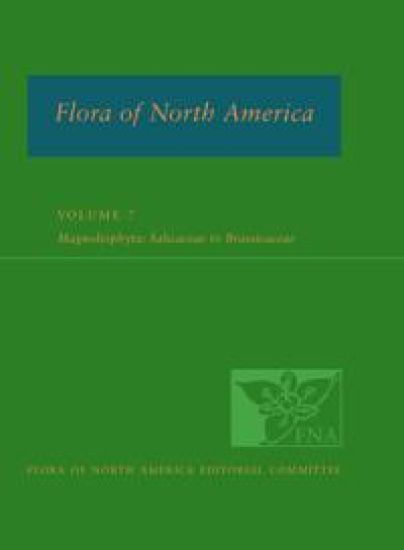
Flora of North America: Volume 7: Magnoliophyta: Dilleniidae, Part 2
Flora of North America Volume 7 is the seventh volume of nineteen on dicotyledons to be published in the Flora of North America series. It treats more than 910 species classified among 114 genera in five families in the following two orders of the subclass Dilleniidae: Salicales (Willow order) and Capparales (Caper order). The families covered in Volume 7 include Salicaceae, Capparaceae, Brassicaceae, Moringaceae, and Resedaceae. Each genus has representative species illustrated with a line drawing that, in combination with keys and descriptions, will facilitate identifications of these groups of plants. Even though many genera of mustards (Brassicaceae-nearly 100 genera with c. 750 species) are known in the flora area due to introduced species, many quite species-rich genera-Draba (140 species), Boechera (109 spp.), Physaria (90 spp.), Lepidium (40 spp.), Streptanthus (33 spp.), and Rorippa (23 spp.)-have many endemic species that are known from quite restricted areas within North America. The volume includes identification keys, descriptions, line drawings, and ecological characteristics for each of the species; distribution maps for the native and established species; and a list of the synonyms currently in use for the accepted names. The treatments, each of which has been extensively reviewed, are based on a combination of original observations and critical review of the literature.
Flora of North America: Volume 27: Bryophytes: Mosses, Part 1
Flora of North America Volume 27 is the first volume of three on the bryphytes (mosses, hornworts, and liverworts). Thirty-five authors treat the first half of the mosses, including 32 of the acrocarpous families, with introductory chapters on bryophyte morphology, the history of North America floristic bryology, and economic uses. The 84 species of sphagnum, of considerable economic importance, are fully treated. The number of taxa total 37 genera and 621 species. The taxa are fully described and keyed, illustrated with an estimated 136 panels of detailed line drawings of two or more species each, and geographic distributions are provided at the province and state level. This is the first installment of a full compilation of the mosses for North America since A. J. Grout's Moss Flora of North America of 60 years ago, and is sure to be an invaluable reference. The volume includes identification keys, descriptions, line drawings, and ecological characteristics for each of the species; distribution maps for the native and established species; and a list of the synonyms currently in use for the accepted names.
Flora of North America: Volume 8

Flora of North America: Volume 8

FNA Ed Committee

Oxford University Press Inc
2009
sidottu
Flora of North America Volume 8 will be the seventh of 19 volumes on dicotyledons to be published in the Flora of North America North of Mexico series. It treats 680 species classified among 125 genera in 19 families The larger families covered in Volume 8 include Crassulaceae (Stonecrop family), Ericaceae (Heath family), Grossulariaceae (Currant family), Myrsinaceae (Myrsine family), Primulaceae (Primrose family), and Saxifragaceae (Saxifrage family). Each genus has representative species illustrated with a line drawing that, in combination with keys and descriptions, will facilitate identifications of these groups of plants. Some of the genera treated in this volume with the most species in the flora include: Ribes (Grossulariaceae) with 53 species; Dudleya and Sedum (Crassulaceae) with 26 and 41 species, respectively; Heuchera, Micranthes, and Saxifraga (Saxifragaceae) with 31, 45, and 25 species, respectively; and Arctostaphylos, Rhododendron, and Vaccinium (Ericaceae) with 62, 25, and 25 species, respectively. Additionally, ten of the 46 genera of Ericaceae are endemic to the flora area. The ongoing publishing project Flora of North America is the first comprehensive taxonomic guide to the extraordinary diversity of plant life covering our continent north of Mexico. This ground breaking scholarly series is a collaborative effort by researchers at more than 30 U.S. and Canadian botanical institutions. The Flora provides revisions of many plant groups and synthesizes the results from studies published in hundreds of research papers over the last three centuries. The series, based on herbarium, laboratory and field studies by hundreds of leading botanists and taxonomic authorities, is this century's premier tool for identifying, understanding, and conserving North America's floristic heritage. Flora of North America, with beautiful illustrations accompanying many species, is concise and easy to use. It is an indispensable resource for botanists, conservationists, ecologists, agronomists, foresters, range and land managers, and horticulturists.
Flora of North America

Flora of North America

FNA Ed Committee

Oxford University Press Inc
2015
sidottu
To be published in 30 volumes,Flora of North America represents the first and only comprehensive taxonomic guide to the extraordinary diversity of plant life blanketing our continent north of Mexico. The collaborative effort of more than 30 major U.S. and Canadian botanical institutions, this ground-breaking scholarly series revises and synthesizes literally thousands of floristic monographs and regional floras published over the last three centuries. family, Rosaceae. Flora of North America Volume 9 includes four families - Picramniaceae (bitter-bush family), Staphyleaceae (bladdernut family), Crossosomataceae (crossosoma family), and Rosaceae (rose family). This volume contains treatments of nearly 700 species with over 98% of them being species of Rosaceae. Every genus has representative taxa illustrated to aid in plant identification and to demonstrate the morphological variation that exists for these families in North America.by Many economically important plants with edible fruits are members of the Rosaceae, with both native and introducede species known and consumed by people: apples, pears,clature, peaches, almonds, apricots, plums, cherries, strawberries,e blackberries, and raspberries are probably the most commonly utilized. Other members of the Rosaceae, many of greatare horticultural interest worldwide, are also noteworthy in the North American flora, including roses, hawthorns,h keys to cinquefoils, firethorns, quinces, chokecherries, shadbushes, mountain ashes, and loquats. Concise, easy to use, and beautifully bound and illustrated, Flora of North America is an indispensable working resource for botanists, conservationists, ecologists, agronomists,now foresters, range and land managers, horticulturists -- anyone with a series interest in the distribution, habitat, morphology, and survival of the wide-ranging plant life around us.
Flora of North America: Volume 10, Magnoliophyta: Proteaceae to Elaeagnaceae

Flora of North America: Volume 10, Magnoliophyta: Proteaceae to Elaeagnaceae

Flora of North America Editorial Committee

Oxford University Press Inc
2021
sidottu
Flora of North America represents the first and only comprehensive taxonomic guide to the extraordinary diversity of plant life in North America north of Mexico. The collaborative effort of more than 30 major U.S. and Canadian botanical institutions, this series revises and synthesizes literally thousands of floristic monographs and regional floras published over the last three centuries. Flora of North America North of Mexico Volume 10: Magnoliophyta: Proteaceae to Elaeagnaceae includes treatments prepared by 24 authors covering 454 species in 66 genera classified in 12 families. Onagraceae, the largest family in the volume, with 277 species in 17 genera, is especially richly represented in North America. The family comprises annual and perennial herbs, with some shrubs and a few small to medium-sized trees. Other families included in the volume are Buxaceae (3 species), Combretaceae (8 species), Elaeagnaceae (9 species), Gunneraceae (1 species), Haloragaceae (17 species), Lythraceae (31 species), Melastomataceae (15 species), Myrtaceae (38 species), Polygalaceae (53 species), Proteaceae (1 species), and Surianaceae (1 species). Descriptions for all of the families, genera, species, and recognized infraspecies are provided, as are occurrence maps for all species and infraspecies. Every genus and more than 25% of the species are illustrated. Keys are included to aid in the identification of genera in families and species within the genera. Volume 10 is the twenty-second volume to be published in the planned 30-volume Flora of North America North of Mexico series.
Flora of North America

Flora of North America

OXFORD UNIVERSITY PRESS INC
2023
sidottu
Flora of North America North of Mexico Volume 11: Magnoliophyta: Fabaceae, Parts 1 and 2 includes treatments prepared by 70 authors covering 1,345 species in 153 genera. The Fabaceae, or bean family, is the third largest plant family in the world. Its economic importance as a source of food, medicine, and materials is second only to grasses, it is ecologically vital in nearly all ecosystems, and it contains many major invasive species. All genera, native and naturalized, are treated in this volume, including Astragalus, the largest genus in the world, with 350+ species in the Flora. The collaborative product of an international team of experts, this is the first comprehensive treatment of this family in North America to reflect the extensive changes to its classification resulting from contemporary research and current understanding of its diversity and distribution. Descriptions for all genera, species, and recognized infraspecies are provided, as are occurrence maps for all species and infraspecies. Every genus and 15% of the species are illustrated. Keys are included to aid in the identification of genera in families and species within the genera. Volume 11, parts 1 and 2, is the twenty-third volume to be published in the planned 30-volume Flora of North America North of Mexico series.