Public bondage, Kinky fun and BDSM play. Cristina's Crises follow the adventures of Sparky Italian submissive Cristina as she starts a fiery S&M relationship with Gavin. Along the way he introduces her to Bondage and outdoor sex while she indulges in blowjobs, creampies, facials and other acts of erotic humiliation. Features MF, FF, MFF. Contains the stories: Bound In Plain Sight Through The Eyepiece (Part 1) Through The Eyepiece (Part 2)
As transmission speed and capacity increase, it is necessary to review all potential contamination points and sources. One of these is the test and inspection equipment itself. These instruments have various "ports" that connection the fiber assembly for test and inspection. Ports are not protected and can become "soil points" of cross contamination. This work studies cross contamination and suggests ways and means to effectively assure that the test gear is not a "part of the problem".
There are many facets to a fiber optic design and installation. One of them is precision cleaning the connector "end face". Another is precision cleaning prior to the fusion splice operation. It once was where the fusion splicer was a monstrous device and the procedure of joining two bare fibers (barely the size of a human hair) was somewhere between "magic" and "craft" and efficacy of the instrument. In these times, much as end face cleaning, fusion splicing reality exceeds what was once thought theoretical only a few years ago. In these times there are various units some with like features and other unique features such as having "explosion proof" capacity or mini-sizes that can be used even in an inverted position. There are v-groove, core and cladding alignment machines as well as those that can 'plasma weld' multiple ribbon fibers. Precision cleaning the slicer components as well as proper preparation of the 'bare glass' contribute in concert to a low-loss, first-time fusion splice. This brief tutorial discusses the differences between "precision cleaning" and "cosmetic cleaning" and how one can cross-contaminate to the other. Also noted is a discussion of precision cleaning solvents and wiping materials. As with precision cleaning the fiber optic end face, proper preparation of the fiber and maintenance of the fusion splicer itself are critical considerations to "future proof" fiber optic designs and installations.
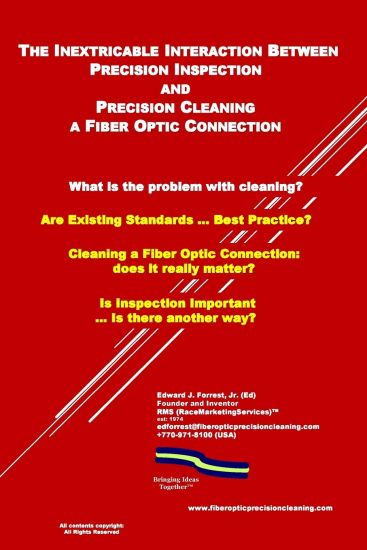
A follow up work on previous books, this edition speaks about exsiting standards for inspection and cleaning a fiber optic connection. Current standards are important, but also outdated at the time they are published. For rapidly evolving industries such as fiber optics, an existing standard can take five to seven years of expert input and then is in place for as long as ten years. For industries such as fiber optic high speed and ever increasing capacities if these standards are not outdated at the time they are published, surely they are at the end of their ten year life cycle This book discusses various cleaning methods and procedures and proposes a new type standard that may be applicable and important for all such industries. The work goes on to discuss "best practice" in a way to "future proof" one of the most critical functions of a fiber optic deployment: testing which has accuracy in the actual cleaning process. The work has an open-ended invitation to all readers to participate in this new standards process which can begin as an Internet "blog" and then be approved by Subject Matter Experts before annual updates after an initial publication. Based on valuable existing standards, the author projects a six month time frame to initiate this new "Rapid Technology Standard".
Rubber analysis plays a vital part in ensuring that manufactured products are fit for purpose. This comprehensive, application-based book with up-to-date referencing covers all important applications and subject area associated with the analysis of rubber compounds and rubber products. Includes characterization of rubber polymers, rubber fumes, identification of extractables and leachables, as well as reverse engineering on compounded products.
Polyethylene terephthalate (PET) is the most recycled plastic in the world. This book covers all from the world market of PET to the many technologies and processes developed for separation, decontamination, recycling and manufacturing into food-grade and non-food-grade products of PET. Also, regulations, testing methods and analytical procedures according to the current regulatory framework are presented.
Recycling of rubber materials is necessary from both an environmental and economic perspective. This book describes everything from the world market to the many novel technologies and processes developed for the re-use and recycling of our common rubber materials. Devulcanization, production of rubber crumbs, reprocessing and manufacture of new materials are thoroughly described and discussed.
International Human Rights and Humanitarian Law: Treaties, Cases, and Analysis introduces the reader to the international legal instruments and case law governing the substantive and procedural dimensions of international human rights and humanitarian law, including economic, social, and cultural rights. The book, which was originally published in 2006, also discusses the history and organisational structure of human rights and humanitarian law enforcement mechanisms. A chapter is devoted a chapter to the issues surrounding the incorporation of international law into U.S. law, including principles of constitutional and statutory interpretation, conflict rules, and the self-execution doctrine. Questions and comments sections provide critical analyses of issues raised in the materials. The last chapter addresses theoretical issues facing contemporary international human rights and humanitarian law and its enforcement.
International Human Rights and Humanitarian Law: Treaties, Cases, and Analysis introduces the reader to the international legal instruments and case law governing the substantive and procedural dimensions of international human rights and humanitarian law, including economic, social, and cultural rights. The book, which was originally published in 2006, also discusses the history and organisational structure of human rights and humanitarian law enforcement mechanisms. A chapter is devoted a chapter to the issues surrounding the incorporation of international law into U.S. law, including principles of constitutional and statutory interpretation, conflict rules, and the self-execution doctrine. Questions and comments sections provide critical analyses of issues raised in the materials. The last chapter addresses theoretical issues facing contemporary international human rights and humanitarian law and its enforcement.
The authors examine the ethical considerations, benefits, and risks of military applications of artificial intelligence. Comparing development efforts in the United States, China, and Russia (as well as various positions on proposals to regulate or ban autonomous weapons), the authors point to a need for the United States to continue to pursue advantages in the field and explore confidence-building and risk-reduction measures with other states.
The authors examine the ethical considerations, benefits, and risks of military applications of artificial intelligence. Comparing development efforts in the United States, China, and Russia (as well as various positions on proposals to regulate or ban autonomous weapons), the authors point to a need for the United States to continue to pursue advantages in the field and explore confidence-building and risk-reduction measures with other states.
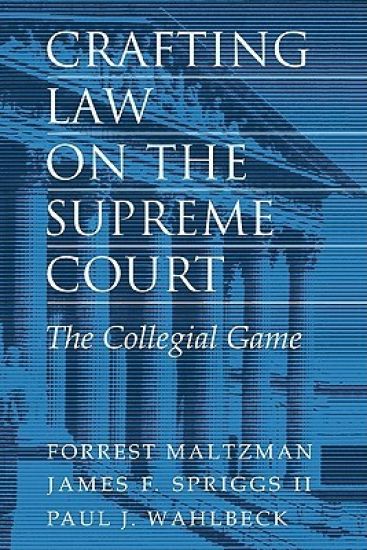
Material is gleaned from internal memos circulated among justices on the Supreme Court to systematically account for the building of majority opinions. The authors argue that at the heart of this process are policy-seeking justices who are constrained by the choices made by the other justices. By strategically using threats, signals, and persuasion, justices attempt to influence the behavior of their colleagues on the bench. Evidence derived from the recently released papers of justices Brennan, Douglas, Marshall, and Powell is used to test the authors' theory of opinion writing. The portrait of the Supreme Court that emerges stands in sharp contrast to the conventional portrait where justices act solely on the basis of the law or their personal policy preferences. This book provides a fascinating glimpse of how the Court crafts the law.