Kirjojen hintavertailu. Mukana 12 400 263 kirjaa ja 12 kauppaa.

Kirjahaku

Etsi kirjoja tekijän nimen, kirjan nimen tai ISBN:n perusteella.

1000 tulosta hakusanalla Foulcault Publisher

Foucault and Derrida

Foucault and Derrida

Roy Boyne

Routledge
1990
nidottu
The writings of Michel Foucault and Jacques Derrida pose a serious challenge to the old established, but now seriously compromised forms of thought. In this compelling book, Roy Boyne explains the very significant advances for which they have been responsible, their general importance for the human sciences, and the forms of hope that they offer for an age often characterized by scepticism, cynicism and reaction. The focus of the book is the dispute between Foucault and Derrida on the nature of reason, madness and 'otherness'. The range of issues covered includes the birth of the prison, problems of textual interpretation, the nature of the self and contemporary movements such as socialism, feminism and anti-racialism. Roy Boyne argues that whilst the two thinkers chose very different paths, they were in fact rather surprisingly to converge upon the common ground of power and ethics. Despite the evident honesty, importance and adventurousness of the work of Foucault and Derrida, many also find it difficult and opaque. Roy Boyne has performed a major service for students of their writings in this compelling and accessible book.

Foucault, Health and Medicine
The reception of Michel Foucault's work in the social sciences and humanities has been phenomenal. Foucault's concepts and methodology have encouraged new approaches to old problems and opened up new lines of enquiry. This book assesses the contribution of Foucault's work to research and thinking in the area of health and medicine, and shows how key researchers in the sociology of health and illness are currently engaging with his ideas.Foucault, Health and Medicine explores such important issues as: Foucault's concept of 'discourse', the critique of the 'medicalization' thesis, the analysis of the body and the self, Foucault's concept of 'bio-power' in the analysis of health education, the implications of Foucault's ideas for feminist research on embodiment and gendered subjectivities, the application of Foucault's notion of governmentality to the analysis of health policy, health promotion, and the consumption of health.Foucault, Health and Medicine offers a `state of the art' overview of Foucaldian scholarship in the area of health and medicine. It will provide a key reference for both students and researchers working in the areas of medical sociology, health policy, health promotion and feminist studies.
Foucault, Health and Medicine
The reception of Michel Foucault's work in the social sciences and humanities has been phenomenal. Foucault's concepts and methodology have encouraged new approaches to old problems and opened up new lines of enquiry. This book assesses the contribution of Foucault's work to research and thinking in the area of health and medicine, and shows how key researchers in the sociology of health and illness are currently engaging with his ideas.Foucault, Health and Medicine explores such important issues as: Foucault's concept of 'discourse', the critique of the 'medicalization' thesis, the analysis of the body and the self, Foucault's concept of 'bio-power' in the analysis of health education, the implications of Foucault's ideas for feminist research on embodiment and gendered subjectivities, the application of Foucault's notion of governmentality to the analysis of health policy, health promotion, and the consumption of health.Foucault, Health and Medicine offers a `state of the art' overview of Foucaldian scholarship in the area of health and medicine. It will provide a key reference for both students and researchers working in the areas of medical sociology, health policy, health promotion and feminist studies.
Foucault and Social Dialogue

Foucault and Social Dialogue

Chris Falzon

Routledge
1998
sidottu
Foucault and Social Dialogue; Beyond Fragmentation is a compelling yet extremely clear investigation of these options and offers a new way forward. Christopher Falzon argues that the proper alternative to foundationalism is not fragmentation but dialogue and that such a dialogical picture can be found in the work of Michel Foucault. Such a reading of Foucault allows us to see, for the first time, the ethical and political position implicit in Foucault's work and how his work contributes to the larger debate concerning the death of man.
Foucault and Social Dialogue

Foucault and Social Dialogue

Chris Falzon

Routledge
1998
nidottu
Foucault and Social Dialogue; Beyond Fragmentation is a compelling yet extremely clear investigation of these options and offers a new way forward. Christopher Falzon argues that the proper alternative to foundationalism is not fragmentation but dialogue and that such a dialogical picture can be found in the work of Michel Foucault. Such a reading of Foucault allows us to see, for the first time, the ethical and political position implicit in Foucault's work and how his work contributes to the larger debate concerning the death of man.
Foucault and Religion

Foucault and Religion

Jeremy Carrette

Routledge
1999
sidottu
Foucault and Religion is the first major study of Michel Foucault in relation and response to Religion. Jeremy Carrette offers us a challenging new look at Foucault's work and addresses a religious dimension that has previously been neglected. We see that prior to Foucault's infamous unpublished volume in the 'History of Sexuality', on the theme of Christianity, there is a complex religious sub-text which anticipates this final unseen work.Jeremy Carrette argues that Foucault offers a twofold critique of Christianity by bringing the body and sexuality into religious practice and exploring a political spirituality of the self. He shows us that Foucault's creation of a body theology through the death of God, reveals how religious beliefs reflect the sexual body, questions the notion of a mystical archaeology and exposes the political technology of confession.Anyone interested in understanding Foucault's thought in a new light will find this book a truly fascinating read.
Foucault and Religion

Foucault and Religion

Jeremy Carrette

Routledge
1999
nidottu
Foucault and Religion is the first major study of Michel Foucault in relation and response to Religion. Jeremy Carrette offers us a challenging new look at Foucault's work and addresses a religious dimension that has previously been neglected. We see that prior to Foucault's infamous unpublished volume in the 'History of Sexuality', on the theme of Christianity, there is a complex religious sub-text which anticipates this final unseen work.Jeremy Carrette argues that Foucault offers a twofold critique of Christianity by bringing the body and sexuality into religious practice and exploring a political spirituality of the self. He shows us that Foucault's creation of a body theology through the death of God, reveals how religious beliefs reflect the sexual body, questions the notion of a mystical archaeology and exposes the political technology of confession.Anyone interested in understanding Foucault's thought in a new light will find this book a truly fascinating read.
Foucault, Christianity and Interfaith Dialogue
Foucault, Christianity and Interfaith Dialogue develops a new model for interfaith dialogue using the work of the French historian of ideas, Michel Foucault. The author argues that it is the injustice done to the 'Other' by Roman Catholic, Protestant and other centred and unitary models of religious pluralism that allows the introduction of Foucault's de-centring of transcendence and human reason as an alternative model for understanding religious diversity and the role it ought to play, in the constitution of the self and the making of society. This Foucaultian approach provides a new direction for interfaith dialogue in the modern world and leads to an ethical rather than a nihilistic position while fostering a non-unitary theology of religious pluralism and an open-textured process of self-transformation.The author's original and imaginative application and expansion of Foucault's concept of the 'More' from The Archaeology of Knowledge (1969) makes important and original contributions to academic work on Foucault and contemporary theology.
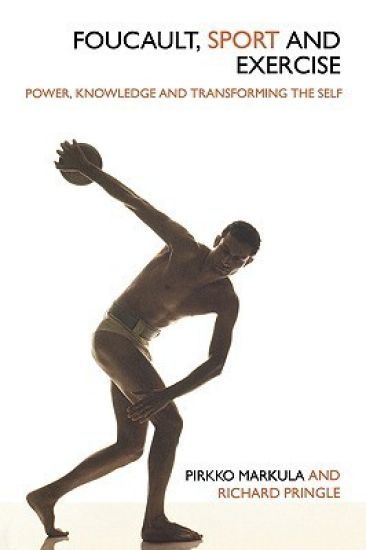
Foucault, Sport and Exercise

Foucault, Sport and Exercise

Pirkko Markula-Denison; Richard Pringle

Routledge
2006
sidottu
Michel Foucault’s work profoundly influences the way we think about society, in particular how we understand social power, the self, and the body. This book gives an innovative and entirely new analysis of is later works making it a one-stop guide for students, exploring how Foucauldian theory can inform our understanding of the body, domination, identity and freedom as experienced through sport and exercise. Divided into three themed parts, this book considers:Foucault’s ideas and key debatesFoucault’s theories to explore power relations, the body, identity and the construction of social practices in sport and exercisehow individuals make sense of the social forces surrounding them, considering physical activity, fitness and sport practices as expressions of freedom and sites for social change. Accessible and clear, including useful case studies helping to bring the theory to real-life, Foucault, Sport and Exercise considers cultures and experiences in sports, exercise and fitness, coaching and health promotion. In addition to presenting established Foucauldian perspectives and debates, this text also provides innovative discussion of how Foucault’s later work can inform the study and understanding of sport and the physically active body.
Foucault, Sport and Exercise

Foucault, Sport and Exercise

Pirkko Markula-Denison; Richard Pringle

Routledge
2006
nidottu
Michel Foucault’s work profoundly influences the way we think about society, in particular how we understand social power, the self, and the body. This book gives an innovative and entirely new analysis of is later works making it a one-stop guide for students, exploring how Foucauldian theory can inform our understanding of the body, domination, identity and freedom as experienced through sport and exercise. Divided into three themed parts, this book considers:Foucault’s ideas and key debatesFoucault’s theories to explore power relations, the body, identity and the construction of social practices in sport and exercisehow individuals make sense of the social forces surrounding them, considering physical activity, fitness and sport practices as expressions of freedom and sites for social change. Accessible and clear, including useful case studies helping to bring the theory to real-life, Foucault, Sport and Exercise considers cultures and experiences in sports, exercise and fitness, coaching and health promotion. In addition to presenting established Foucauldian perspectives and debates, this text also provides innovative discussion of how Foucault’s later work can inform the study and understanding of sport and the physically active body.
Foucault and Lifelong Learning
Over the last twenty years there has been increasing interest in the work of Michel Foucault in the social sciences and in particular with relation to education. This, the first book to draw on his work to consider lifelong learning, explores the significance of policies and practices of lifelong learning to the wider societies of which they are a part.With a breadth of international contributors and sites of analysis, this book offers insights into such questions as:What are the effects of lifelong learning policies within socio-political systems of governance?What does lifelong learning do to our understanding of ourselves as citizens?How does lifelong learning act in the regulation and re-ordering of what people do?The book suggests that understanding of lifelong learning as contributory to the knowledge economy, globalisation or the new work order may need to be revised if we are to understand its impact more fully. It therefore makes a significant contribution to the study of lifelong learning.
Foucault and Lifelong Learning
Over the last twenty years there has been increasing interest in the work of Michel Foucault in the social sciences and in particular with relation to education. This, the first book to draw on his work to consider lifelong learning, explores the significance of policies and practices of lifelong learning to the wider societies of which they are a part.With a breadth of international contributors and sites of analysis, this book offers insights into such questions as:What are the effects of lifelong learning policies within socio-political systems of governance?What does lifelong learning do to our understanding of ourselves as citizens?How does lifelong learning act in the regulation and re-ordering of what people do?The book suggests that understanding of lifelong learning as contributory to the knowledge economy, globalisation or the new work order may need to be revised if we are to understand its impact more fully. It therefore makes a significant contribution to the study of lifelong learning.
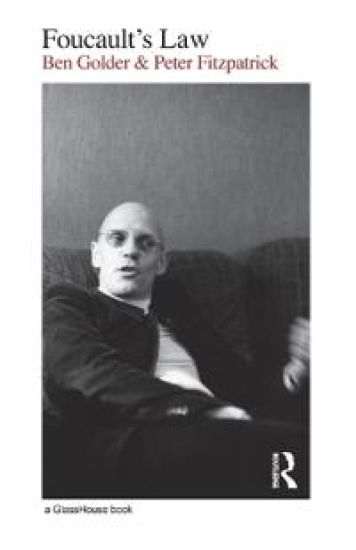
Foucault's Law

Foucault's Law

Ben Golder; Peter Fitzpatrick

Routledge Cavendish
2009
sidottu
Foucault’s Law is the first book in almost fifteen years to address the question of Foucault’s position on law. Many readings of Foucault’s conception of law start from the proposition that he failed to consider the role of law in modernity, or indeed that he deliberately marginalized it. In canvassing a wealth of primary and secondary sources, Ben Golder and Peter Fitzpatrick rebut this argument. They argue that rather than marginalize law, Foucault develops a much more radical, nuanced and coherent theory of law than his critics have acknowledged. For Golder and Fitzpatrick, Foucault’s law is not the contained creature of conventional accounts, but is uncontainable and illimitable. In their radical re-reading of Foucault, they show how Foucault outlines a concept of law which is not tied to any given form or subordinated to a particular source of power, but is critically oriented towards alterity, new possibilities and different ways of being.Foucault’s Law is an important and original contribution to the ongoing debate on Foucault and law, engaging not only with Foucault’s diverse writings on law and legal theory, but also with the extensive interpretive literature on the topic. It will thus be of interest to students and scholars working in the fields of law and social theory, legal theory and law and philosophy, as well as to students of Foucault’s work generally.
Foucault's Law

Foucault's Law

Ben Golder; Peter Fitzpatrick

Routledge Cavendish
2009
nidottu
Foucault’s Law is the first book in almost fifteen years to address the question of Foucault’s position on law. Many readings of Foucault’s conception of law start from the proposition that he failed to consider the role of law in modernity, or indeed that he deliberately marginalized it. In canvassing a wealth of primary and secondary sources, Ben Golder and Peter Fitzpatrick rebut this argument. They argue that rather than marginalize law, Foucault develops a much more radical, nuanced and coherent theory of law than his critics have acknowledged. For Golder and Fitzpatrick, Foucault’s law is not the contained creature of conventional accounts, but is uncontainable and illimitable. In their radical re-reading of Foucault, they show how Foucault outlines a concept of law which is not tied to any given form or subordinated to a particular source of power, but is critically oriented towards alterity, new possibilities and different ways of being.Foucault’s Law is an important and original contribution to the ongoing debate on Foucault and law, engaging not only with Foucault’s diverse writings on law and legal theory, but also with the extensive interpretive literature on the topic. It will thus be of interest to students and scholars working in the fields of law and social theory, legal theory and law and philosophy, as well as to students of Foucault’s work generally.
Foucault's Monsters and the Challenge of Law

Foucault's Monsters and the Challenge of Law

Alex Sharpe

Routledge Cavendish
2009
sidottu
In contrast to other figures generated within social theory for thinking about outsiders, such as Rene Girard’s ‘scapegoat’ and Zygmunt Bauman’s ‘stranger’, Foucault’s Monsters and the Challenge of Law suggests that the figure of ‘the monster’ offers greater analytical precision and explanatory power in relation to understanding the processes whereby outsiders are constituted. The book draws on Michel Foucault’s theoretical and historical treatment of the category of the monster, in which the monster is regarded as the effect of a double breach: of law and nature. For Foucault, the monster does not simply refer to a particular kind of morphological or psychological irregularity; for the body or psyche in question must also pose a threat to the categorical structure of law. In chronological terms, Foucault moves from a preoccupation with the bestial human in the Middle Ages to a concern over Siamese or conjoined twins in the Renaissance period, and ultimately to a focus on the hermaphrodite in the Classical Age. But, although Foucault’s theoretical framework for understanding the monster is affirmed here, this book's study of an English legal history of the category ‘monster’ challenges some of Foucault’s historical claims. In addition to considering this legal history, the book also addresses the contemporary relevance of Foucault’s theoretical framework. Structured around Foucault’s archetypes and the category crises they represent – admixed embryos, conjoined twins and transsexuals – the book analyses their challenge to current distinctions between human and animal, male and female, and the idea of the ‘proper’ legal subject as a single embodied mind. These contemporary figures, like the monsters of old, are shown to threaten the rigidity and binary structure of a law that still struggles to accommodate them.
Foucault and Criminology

Foucault and Criminology

Voruz Veronique

Routledge Cavendish
2021
nidottu
Foucault and Criminology: An Introduction provides an introduction to Michel Foucault, written from the perspective of criminology’s engagement with his work. Foucault’s writing has become a central reference in theoretical and sociological criminology generally and, more specifically, in what Jock Young has called `control theory’. The main purpose of this book is to offer a better, clearer and deeper understanding of ongoing criminological debates to both undergraduate and research students in criminology by outlining the theoretical framework which criminologists have taken from Foucault. Its second purpose is to trace the evolution of Foucault’s political project and to counterpose the thrust of his elaborations to the more pedestrian applications of his critical analyses of the present in the field of criminology. In these respects, Foucault and Criminology offers a 'map' to guide students and practitioners of criminology: both through Foucault's own writings and those of contemporary criminologists whose work may be characterised as Foucauldian. In so doing, it also pursues the argument that Foucault’s historical and theoretical analyses of discipline, power and governance must be understood in the context of his overall project if criminologists are to avoid reducing Foucault’s radicality, and to reclaim the critical, and resistive, potential of his work.
Foucault & the Politics of Hearing

Foucault & the Politics of Hearing

Lauri Siisiäinen

Routledge
2012
sidottu
The issue of the senses and sensual perception in Michel Foucault’s thought has been a source of prolific discussion already for quite some time. Often, Foucault has been accused of overemphasizing the centrality of sight, and has been portrayed as yet another thinker representative of Western ocularcentricism. This innovative new work seeks to challenge this portrait by presenting an alternative view of Foucault as a thinker for whom the sound, voice, hearing, and listening, the auditory-sonorous, actually did matter.Illustrating how the auditory-sonorous relates most integrally to the most pertinent issues of Foucault - the intertwinement and confrontations of power, knowledge, and resistance - the book both presents novel readings of some of Foucault’s most widely read and commented-on works (such as Discipline and Punish, the first volume of History of Sexuality), and discusses the variety of his lectures, essays, and interviews, some of which have not been noted before. Moving beyond a commentary on Foucault, Siisiainen goes on to examine other philosophers and political thinkers (including Roland Barthes, Jean-Luc Nancy and Jacques Rancière) in this context in order to bring to the fore the potentials in Foucault’s work for the generation of a new perspective for the political genealogy of the sound, hearing, and listening, approaching the former as a key locus of contemporary political struggles.This work will be of great interest to students and scholars in a range of areas including political theory, philosophy, and cultural studies.
Foucault and Education
First published in 1990, this book was the first to explore Foucault's work in relation to education, arguing that schools, like prisons and asylums, are institutions of moral and social regulation, complex technologies of disciplinary control where power and knowledge are crucial. Original and challenging, the essays assess the relevance of Foucault's work to educational practice, and show how the application of Foucauldian analysis to education enables us to see the politics of educational reform in a new light.
Foucault and Education
First published in 1990, this book was the first to explore Foucault's work in relation to education, arguing that schools, like prisons and asylums, are institutions of moral and social regulation, complex technologies of disciplinary control where power and knowledge are crucial. Original and challenging, the essays assess the relevance of Foucault's work to educational practice, and show how the application of Foucauldian analysis to education enables us to see the politics of educational reform in a new light.
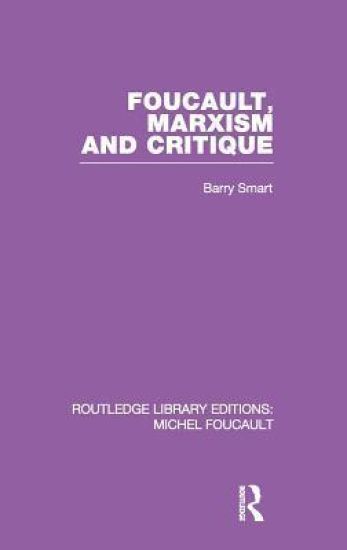
Foucault, Marxism and Critique

Foucault, Marxism and Critique

Barry Smart

Routledge
2009
sidottu
In this work, originally released in 1983, Barry Smart examines the relevance of Foucault's work for developing an understanding of those issues which lie beyond the limits of Marxist theory and analysis - issues such as 'individualising' forms of power, power-knowledge relations, the rise of 'the social', and the associated socialisation of politics. He argues that there exist clear and substantial differences between Foucault's genealogical analysis and that of Marxist theory. Smart thus presents Foucault's work as a new form of critical theory, whose object is a critical analysis of rationalities, and of how relations of power are rationalised.