Kirjahaku
Etsi kirjoja tekijän nimen, kirjan nimen tai ISBN:n perusteella.
1000 tulosta hakusanalla Frances Stocker Hopkins
New Zealand-born Frances Hodgkins (1869–1947) arrived in London in 1901 and, by the 1920s, had become a leading British modernist, exhibiting frequently with avant-garde artists such as Ben Nicholson, Barbara Hepworth and Henry Moore. This book explores Hodgkins as a traveller across cultures and landscapes – teaching and discovering the cubists in Paris, absorbing the landscape and light of Ibiza and Morocco, and exhibiting with the progressive Seven & Five Society in London. Complete with a rich visual chronology of the artist’s encounters abroad, alongside over one hundred of Hodgkins’ key paintings and drawings, the book is an illuminating journey that moves us from place to place through the writings of a number of distinguished national and international art historians, curators and critics: Frances Spalding (University of Cambridge, England), Alexa Johnston (Auckland-based writer and curator), Elena Taylor (University of New South Wales, Australia), Antoni Ribas Tur (Ara newspaper, Spain), and Julia Waite, Sarah Hillary, Catherine Hammond and Mary Kisler (Auckland Art Gallery Toi o Tamaki, New Zealand).
Treating Frances Burney (1752–1840) with the seriousness usually reserved for later novelists of the nineteenth and twentieth centuries, Margaret Anne Doody combines biographical narrative with informed literary criticism as she analyzes not only Burney's published novels, but her plays, fragments of novels, poems, and other works never published. Doody also draws upon a mine of letters and diaries for detailed and sometimes surprising biographical information. Burney's feelings and emotions forcefully emerge in her sophisticated and complex late novels, Camilla and The Wanderer. Her novels all relate to personal experience; as an artist she is attracted to the violent, the grotesque, and the macabre. She is a powerful comic writer, but her comedy is far from reflecting a shallow cheerfulness. Bringing a novelist's perspective to her material, in this 1989 book Doody shows an appreciation of the many dimensions of a predecessor's writings and she tells her story with force and conviction.
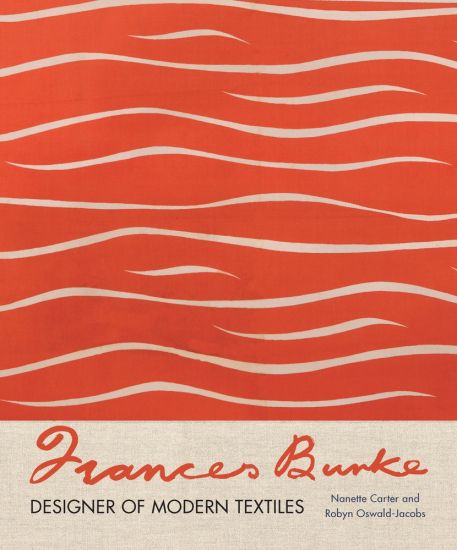
Frances Burke was Australia's most influential and celebrated textile designer of the 20th century. From the late 1930s to 1970, her designs achieved a prominence unparalleled in Australia before or since. Displaying imagery and colours from native flora, marine objects, Indigenous artefacts and designs of pure abstraction, Burke's innovative fabrics remain fresh and appealing, distinctive and evocative of Australia. In New Design, her fabric showroom and interior design consultancy, Burke presented modern furniture by emerging local designers of the postwar period. Drawing on regular visits to the US, UK, Europe, Japan and Taiwan she became an authoritative advocate for modern design.Burke also collaborated with leading architects and interior designers, including Robin Boyd, her fabrics making arresting contributions to influential modern buildings. In this long-awaited, richly illustrated work, Nanette Carter and Robyn Oswald-Jacobs have located and unpacked the different components of a body of work never presented as art or intended simply for display, but which contributed so much to the felt experience of Australian life in the middle decades of the twentieth century.
Frances and Bernard meet in the summer of 1957. Afterward, he writes her a letter. Soon they are immersed in the kind of fast, deep friendship that can change the course of our lives.They find their way to New York and, for a few whirling years, each other. The city is a wonderland for young people with dreams: cramped West Village kitchens, parties stocked with the sharp-witted and glamorous, taxis that can take you anywhere at all, long talks along the Hudson as the lights of the Empire State Building blink on above.Inspired by the lives of Flannery O'Connor and Robert Lowell, Frances and Bernard imagines, through new characters with charms entirely their own, what else might have happened. In the grandness of the fall, can we love another person so completely that we lose our dreams?In witness to all the wonder of kindred spirits and bittersweet romance, Frances and Bernard is a tribute to the power of friendship and the people who help us discover who we are.
Letters by the Late Frances Ridley Havergal
Frances Ridley Havergal; Maria Vernon Graham (EDT) Havergal
Kessinger Pub
2007
pokkari
Letters by the Late Frances Ridley Havergal
Frances Ridley Havergal; Maria Vernon Graham (EDT) Havergal
Kessinger Pub
2007
sidottu
Correspondence Between Frances, Countess Of Hartford, Afterwards Duchess Of Somerset And Henrietta Louisa, Countess Of Pomfret, Between The Years 1738 And 1741
Frances Seymour Somerset; Henrietta Louisa Jeffreys Fermor Pomfret
Kessinger Pub
2007
pokkari
Poems By Frances Sargent Osgood
Frances Sargent Locke Osgood; Samuel Stillman (ILT) Osgood; Darley (ILT)
Kessinger Pub
2008
pokkari
Brilliants Selected From The Writings Of Frances Elizabeth Willard
Frances Elizabeth Willard; Alice L. (EDT) Williams
Kessinger Pub
2008
pokkari
Biography about the novelist who wrote one of the best-loved childrens books, "The Secret Garden".
Frances Partridge: the last survivor of the Bloomsbury group - the authorised biography.Frances Partridge was one of the great British diarists of the 20th century. She became part of the Bloomsbury group encountering Virginia Woolf, Lytton Strachey, the Bells, Roger Fry, Maynard Keynes, Dora Carrington and Ralph Partridge. She and Ralph fell in love and married in 1933. During the Second World War they were committed pacifists and they enjoyed the happiest times of their lives together, entertaining friends such as E.M. Forster, Robert Kee and Duncan Grant.Despite losing both her husband and son, Frances maintained an astonishing appetite for life, whether for her friends, travelling, botany, or music. Her diaries (which she continued to write until her death in 2004) chronicle her life from the 1930s onwards. Their publication brought her recognition and acclaim, and earned her the right to be seen not as a minor character on the Bloomsbury stage but standing at the centre of her own.
Frances L. Goodrich's Brown Book of Weaving Drafts
Barbara Miller
Schiffer Publishing Ltd
2014
sidottu
A collection of traditional eighteenth and nineteenth century weaving drafts, written sequences of the threading order on the loom used to create specific patterns. They are presented here in their original form as gathered by Frances L. Goodrich and illustrated in over 160 color photos. This volume also contains over 200 valuable modern translations of the same drafts for use by today’s weavers. In 1890, Frances L. Goodrich came to the southern mountains in North Carolina from a life of culture to live and work among people who had little opportunity for education or social enrichment. Through her work for the Presbyterian Home Mission Board, she grew to love and respect these neighbors who worked so hard and had so little. She established schools, a small hospital, and the Allanstand Cottage Industries. As she traveled the mountain roads and trails on horseback, Miss Goodrich collected these precious weaving drafts from the women who wove for Allanstand Cottage Industries. In your hands is the heart of that collection.
Frances L. Goodrich’s Coverlet and Counterpane Drafts
Barbara Miller; Deb Schillo
Schiffer Publishing Ltd
2016
sidottu
This collection of nineteenth- and early twentieth-century weaving drafts from the Southern Highlands region of Appalachia includes 112 overshot drafts and drawdowns, and 31 drafts and drawdowns for the all-white summertime cotton bedspreads called counterpanes. Color photos of the original samples are shown side by side with valuable modern translations of the drafts, which enable today's weavers to make them. A vibrant example of our weaving heritage, these drafts were originally gathered in the nine states of the Southern Highlands region between 1892 and 1918 by the legendary Frances L. Goodrich. Handwoven counterpanes and coverlets were important possessions, and often were the only items of beauty in the women's otherwise impoverished living conditions. These are drafts Goodrich carefully collected but did not include in her classic Brown Book. Dozens of vintage photographs of Goodrich, the communities she served, and the women who invented the drafts help bring this part of our American craft heritage to life.