Kirjahaku
Etsi kirjoja tekijän nimen, kirjan nimen tai ISBN:n perusteella.
1000 tulosta hakusanalla Fulton Sheen
Why is it, asks Bishop Fulton Sheen, that one hears so often the expression "Go to hell " and almost never the expression "Go to heaven " Here, at his most penetrating, challenging, and illuminating best is Bishop Sheen with his answer, in a book that breathes new meaning into the truths about heaven and hell, and new life into the concepts of faith, tolerance, love, prayer, suffering, and death. Beginning with "The First Faint Summons to Heaven," Sheen shows how unpopular it is today to be a true Christian, and describes the struggle for living our faith amid the disorders of our times. Keenly aware of evil in the myriad forms it takes in today's world, Bishop Sheen writes about the constant battle man faces with the "seven pallbearers of character" - pride, avarice, envy, lust, anger, gluttony and sloth - linking them with the corrosive forces that never cease in their attacks on the Church and those who earnestly desire to be serious Christians. In Go to Heaven, a great spiritual teacher and writer, deeply aware of the human and spiritual conflicts being waged in the world, shows us the way to heaven in a most eloquent book, encouraging the reader to choose heaven now, and to understand the "reality of hell."

2022 Reprint of the 1940 Edition. Exact facsimile of the original edition and not reproduced with Optical Recognition Software. In this title Archbishop Sheen provides a collection of his sermons on the subject of the seven virtues. He encourages the reader to practice and reflect on each. These are the three theological virtues of faith, hope and charity as well as the four cardinal virtues of prudence, temperance, justice, and fortitude.Sheen draws the reader's attention to the connection between these seven virtues and the Seven Last Words spoken by Jesus from the Cross. He correlates Jesus' last seven words to the seven virtues. CONTENTSPREFACEINTRODUCTIONTHE FIRST VIRTUE - FORTITUDE - "Father, forgive them, for they know not what they do."THE SECOND VIRTUE - HOPE - "This day thou shalt be with Me in Paradise."THE THIRD VIRTUE - PRUDENCE - "Woman, behold thy son (Son) Behold thy mother ."THE FOURTH VIRTUE - FAITH - "My God My God Why hast Thou hast abandoned Me?"THE FIFTH VIRTUE - TEMPERANCE - I thirst." THE SIXTH VIRTUE - JUSTICE - "It is finished."THE SEVENTH VIRTUE - CHARITY - "Father, into Thy Hands, I commend My Spirit."

2022 Reprint of the 1944 Edition. Exact facsimile of the original edition and not reproduced with Optical Recognition Software. In Love One Another Bishop Sheen offers an inspiring solution to the problem of intolerance among men-one of the most pressing problems of his time. Hate and distrust dominated the minds and actions of man and kept the world in a state of constant social strife and unrest. Much of this is still true today."The solution of the problem is not the carrying on of anti-hate campaigns for, unless there is love, how can hate be abolished...The discords and hates among classes and races and creeds can be sublimated and abolished only by a love of God."Bishop Sheen makes clear that what mankind needs today is a new philosophy of life; one based upon a commandmentgiven to man by God, Himself, who said: "A new commandment I give unto you, that you love one another; that as I haveloved you, you also love one another." (John 13: 34-35)This book is another excellent example of the brilliance and scope of Bishop Sheen's mind and the eloquence of his pen. His practical contribution to the growing universal movement against intolerance makes important, as well asinspiring reading.Contents: The foundation of love: God -- Some characteristics of God's love -- Man fleeing God's love -- God's love pursuing man -- Divine friendship -- Ways of preserving friendships -- Disciplining myself for love -- Love of neighbor in general -- Friendship of Christians with Jews -- Friendship of Jews with Christians -- Friendship of Catholics with Protestants -- Friendship of non-Catholics with Catholics -- Friendship with all peoples, races, classes and colors -- Necessary basis of love of neighbor: love of God -- Prayers.

"In Christ and through Christ God has revealed himself fully to mankind and has definitively drawn close to it." Although written three decades after Life of Christ first appeared, these words of Pope St. John Paul II could very well stand as its epigraph. Diligently attending to the Gospel sequences, Fulton J. Sheen expands and enlivens the narrative to illuminate the central truth of the Incarnation. Namely, that in the life of Jesus of Nazareth, God has shown Himself to man-and man to himself-in every time and place, without limitation. Life of Christ also features Sheen's customary timeliness, offering a rebuke and correction of the two defining atheistic systems of modernity: the one which takes up the Cross but denies Christ, reducing it to a harsh, unloving discipline; the other which accepts Christ but rejects his Cross, making the Gospel merely a "brotherhood without tears." Following Christ's ministry through to its culmination in the Paschal Mystery, Sheen shows how God "desires all men to be saved and to come to the knowledge of the truth." The fruit of more than twenty-five years of devoted research and writing, Life of Christ succeeds as few books have in uniting labor and love. The result is a beam of light that illuminates the mystery of life, suffering, and death-the light of Christ, which "shines in the darkness, and the darkness has not overcome it."

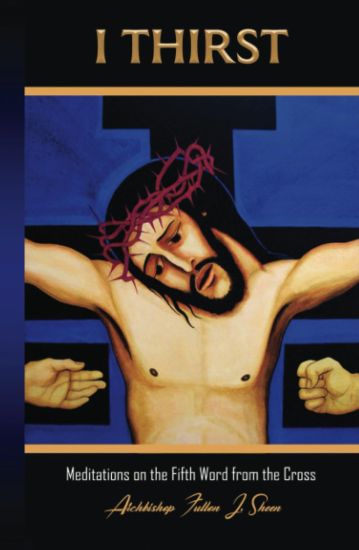
"I thirst." (John 19:28)Meditations on the Fifth Word from the Cross by Archbishop Fulton J. Sheen For years, Archbishop Sheen gave a series of powerful presentations on Christ's Passion and His seven last words from the Cross. During his last recorded Good Friday address in 1979, Archbishop Sheen spoke of having given this type of reflection on the subject of Christ's seven last words from the Cross "for the fifty-eighth consecutive time." Given their importance and the impact they had on society, it seemed appropriate to bring together in this anthology some of Archbishop Sheen's meditations on the Seven Last Words Our Blessed Lord spoke from the Cross on Calvary.This anthology has been arranged to provide nine unique reflections for study and meditation on the words "I Thirst." (John 19:28)These meditations are taken from several books and articles written by Sheen between 1933 and 1945.The Seven Last Words (New York: Century, 1933)The Seven Last Words and the Our Father (Huntington, Indiana: Our Sunday Visitor 1935)Calvary and the Mass (New York: P. J. Kenedy and Sons, 1936)The Cross and the Beatitudes (New York: P. J. Kenedy and Sons, 1937)The Rainbow of Sorrow (New York: P. J. Kenedy and Sons, 1938)Victory over Vice (New York: P. J. Kenedy and Sons, 1939)The Seven Virtues (New York: P. J. Kenedy and Sons, 1940)Seven Words to the Cross (New York: P. J. Kenedy and Sons, 1944)Seven Words of Jesus and Mary (New York: P. J. Kenedy and Sons, 1945)Each meditation will offer the reader a mini-retreat on the following topics.First Meditation - A reflection on the words "I Thirst".Second Meditation - A reflection on a passage from the Lord's Prayer. (Give us this day our daily bread).Third Meditation - A reflection on a part of the Mass (The Communion).Fourth Meditation - A reflection on one of the Beatitudes (Blessed are they that hunger and thirst after justice).Fifth Meditation - A reflection about the need of zeal.Sixth Meditation - A reflection addressing one of the seven deadly sins (Gluttony).Seventh Meditation - A reflection on the virtues (Temperance).Eighth Meditation - A reflection on dealing with individuals who reject the Church and Christ's teachings (A word to Moderns).Ninth Meditation - A reflection on the unity of Jesus and Mary and the "Religion is a Quest".