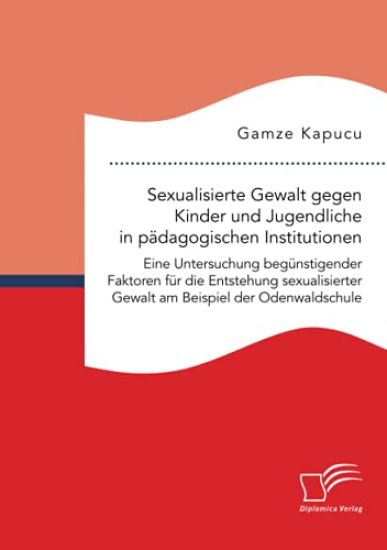
Wie kann sexualisierte Gewalt gegen Kinder und Jugendliche - welche auch in famili rem Kontext auftritt - in p dagogischen Institutionen vorkommen, wo Heranwachsende professionell-p dagogischen Fachkr ften und einem p dagogischen System anvertraut werden? Das Ziel dieser Arbeit war es, beg nstigende Faktoren f r die Entstehung sexualisierter Gewalt gegen Kinder und Jugendliche in p dagogischen Institutionen auf theoretisch-wissenschaftlicher Grundlage am Beispiel der Odenwaldschule zu untersuchen. Diese ist zwar ein historisches Ph nomen, sie beinhaltet jedoch Strukturen, die auf die Gegenwart anwendbar sind. Die Arbeit legt zun chst die gesch tzte Pr valenz von sexualisierter Gewalt dar, danach werden theoretisch-allgemein bertragbare Faktoren f r die Entstehung sexualisierter Gewalt in Institutionen sowie weitere (allgemeine) Faktoren am Beispiel der Odenwaldschule herausgearbeitet. Im Sinne der allgemeinen Faktoren untersucht die Autorin T terprofil, den Charakter totaler Institutionen, asymmetrische Machtkonstellationen zwischen Erziehern und Kindern, Familialisierung und unreflektierte N he-Distanz-Verh ltnisse. Darauf aufbauend steht im zweiten Teil der Untersuchung das System Odenwaldschule im Fokus. Hierzu betrachtet die Autorin binnenstrukturelle Faktoren, die Instrumentalisierung des p dagogischen Eros, das Wegschauen von Mitwissenden und zuletzt die Sprechbarrieren von Betroffenen.
This thoroughly updated second edition presents a comprehensive legal perspective on the inherently interdisciplinary field of children’s rights. Chapters provide an article-by-article analysis of the Convention on the Rights of the Child, including its Optional Protocols, as well as contextualised advice on the interpretation and implementation of its provisions.The Commentary critically engages with the Convention, exploring its position within the wider context of human rights law and other multidisciplinary fields such as the sociology of childhood. This second edition includes a revised introduction focusing on contemporary challenges and opportunities for children’s rights, new material on children in conflict with the law and the individual complaints procedure, and updated discussions of recent case law in regional human rights systems.Drawing on global perspectives, this new edition is an invaluable resource for students and researchers in family law, human rights, public international law and the sociology of law. It will also be of great interest to practitioners and policymakers in children’s services, education, social work, psychology and healthcare.
This comprehensive Commentary presents a contemporary legal perspective on the inherently interdisciplinary field of children's rights. Chapters analyse each article of the Convention on the Rights of the Child, along with its Optional Protocols, providing contextualised information on the interpretation and implementation of the children's rights provisions therein. A detailed introduction examines the history of the Convention and places it within the wider landscape of human rights and other disciplinary approaches such as the sociology of childhood. The Commentary critically engages with the text of the Convention, exploring commonly used concepts and defining pertinent terminology. The authors draw on multiple perspectives and refer to disciplines outside of law to enrich the analysis of the articles, their interpretation and the study of children's rights as a discipline. Featuring examples of case law from regional human rights systems this Commentary provides a well-rounded insight into the status of children's rights on a global scale. Written in an accessible style, this Commentary will be a valuable reference work for students, researchers, practitioners and policymakers alike. The Commentary will be of great interest to those working within children's rights law and human rights law. Researchers in politics, sociology and international studies who are seeking further information and insight on the rights of children will also find this Commentary to be a useful point of reference.