Kirjojen hintavertailu. Mukana 11 627 380 kirjaa ja 12 kauppaa.

Kirjahaku

Etsi kirjoja tekijän nimen, kirjan nimen tai ISBN:n perusteella.

1000 tulosta hakusanalla George Evans; Ron Briscoe

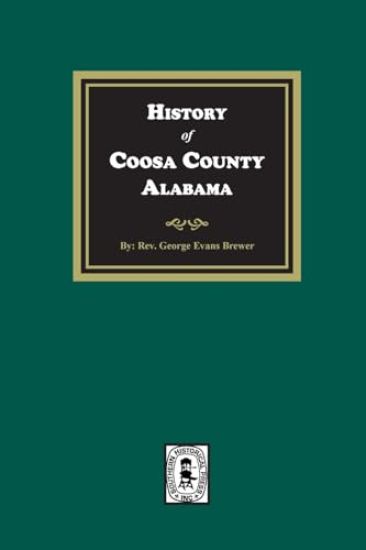
History of Coosa County, Alabama

History of Coosa County, Alabama

George Evans Brewer

Southern Historical Press
2023
nidottu
By: Rev. George Evans Brewer, Pub. 1942, reprinted 2023, 356 pages, New Index, soft cover, ISBN #978-1-63914-138-8. The history of Coosa County has been reproduced from a revised edition of the Alabama Historical Quarterly, published by the State Department of Archives and History in Montgomery, AL. Coose County was created in 1832 from land acquired in the Creek Cession of 1832 and named for the Coosa River which shapes the western boundary of the county. In 1900 all court records were destroyed by fire. Marriages and Wills date from 1834, Inventory of Estates from 1897; Orphans Court records from 1843. Contents: Early settlement, organizations, Acts of early courts, opening roads, etc; Wetumpka (its history and leaders); Settlements and Settlers of Coosa (Nixburg, Kellyton, Goodwater, Hatchett, Mt. Olive, Weogufka, Stewartville, Rockford, Marble Valley, Travler's Rest, Boyckville); Offices of Coosa County, 1837-1907, including early customs (i.e. social events); Military records of Coosa 1832-1862, War Records of Coosa, Mexican, War, Confederate War Roster and Companies of Men from Coosa County; Schools and Churches; Times of Political Excitement; Men of Special Note in Coosa (i.e. early prominent settlers, their forebearers and descendants).

A French Grammar Workbook

A French Grammar Workbook

Dulcie Engel; George Evans; Valerie Howells

Blackwell Publishers
1998
nidottu
Developing on the success of Byrne and Churchill's Comprehensive French Grammar , revised and rewritten by Glanville Price, this book is designed to be used either as a companion volume to the reference grammar or independently
Visitors' Companion at Our Nation's Capital. a Complete Guide for Washington, and Its Environs. with ... Illustrations ... Edited by the Publisher. (G. G. Evans.).
Title: Visitors' Companion at our Nation's Capital. A complete Guide for Washington, and its environs. With ... illustrations ... Edited by the Publisher. (G. G. Evans.).Publisher: British Library, Historical Print EditionsThe British Library is the national library of the United Kingdom. It is one of the world's largest research libraries holding over 150 million items in all known languages and formats: books, journals, newspapers, sound recordings, patents, maps, stamps, prints and much more. Its collections include around 14 million books, along with substantial additional collections of manuscripts and historical items dating back as far as 300 BC.The GENERAL HISTORICAL collection includes books from the British Library digitised by Microsoft. This varied collection includes material that gives readers a 19th century view of the world. Topics include health, education, economics, agriculture, environment, technology, culture, politics, labour and industry, mining, penal policy, and social order. ++++The below data was compiled from various identification fields in the bibliographic record of this title. This data is provided as an additional tool in helping to insure edition identification: ++++ British Library Evans, George Greenlief; 1892. 192. 94 p.; 8 . 10410.dd.12.
The Pattern Under the Plough

The Pattern Under the Plough

George Ewart Evans

Faber Faber
2008
pokkari
Following his two classics, Ask the Fellows Who Cut the Hay and The Horse in the Furrow, renowned oral historian George Ewart Evans continues his study of the vanishing customs, working habits and rich language of the farming communities of East Anglia with The Pattern Under the Plough (Faber, 1966). Although based on East Anglia, this book was and remains of wider interest, for - as the author pointed out at the time - similar changes were occurring in North America, and also happening with remarkable speed in Africa.In chronicling the old culture George Ewart Evans has taken its two chief aspects, the home and the farm. He describes the house with its fascinating constructional details, the magic invoked for its protection, the mystique of the hearth, the link of the bees with the people of the house, and some of their fears and pre-occupations. Among the chapters on the farm is one of Evans's most original pieces of research: the description of the secret horse societies. Beautifully illustrated by David Gentleman, this book is important not only for the material it reveals about the past but for the implications for present-day society.'As real (and as valuable) as the evidence unearthed by the spadework of archaeology.' Observer
The Days That We Have Seen

The Days That We Have Seen

George Ewart Evans

Faber Faber
2008
nidottu
George Ewart Evans's pioneer work in oral history has been widely acclaimed; the importance of this source of historical knowledge has long been recognized both in this country and the United States. In The Days That We Have Seen (Faber, 1975) he shows the way in which oral history works and illustrates his point by printing some exceptionally valuable recorded talks by old men and women in East Anglian villages, whose tools and customs - and indeed whose ways of speech, which often survived from the times of Shakespeare and even Chaucer - repeated what had been familiar to many generations before them.The use of common land hardly changed for centuries. Who today understands the importance of hay in the farm economy, when we are concerned with a different sort of fuel? The author also investigates the activities of those who went to sea: the herring industry, farm workers who became sailors after the harvest, and migratory labour from Scotland.As fascinating to the general reader as it is valuable to the historian, the book is imaginatively illustrated throughout with photographs and black and white line drawings.
From Mouths of Men

From Mouths of Men

George Ewart Evans

Faber Faber
2008
nidottu
From Mouths of Men (Faber, 1976) is the culmination of George Ewart Evans's studies in oral history. It rounds off and complements the author's previous book, The Days That We Have Seen - which dealt with 'the country' and 'land and sea' - by applying the same methods to 'the town' and 'mining'. The result is a valuable extension of the oral history technique, giving authentic pictures of the lives of domestic servants, business methods at the beginning of the century (there is a vivid contribution by Lord Rhodes), horse-transport in a small town (Aldeburgh when it was a fashionable watering place), clothes of the period, and the hard life of the miners in Wales.Widely acclaimed as classics, George Ewart Evans's pioneering books on oral history have been as avidly read as the great diarists and chroniclers of the past, by a succession of generations. The book is illustrated by a remarkable series of photographs and vivid black and white line drawings.
The Farm and the Village

The Farm and the Village

George Ewart Evans

Faber Faber
2008
nidottu
In a sense all history begins in the soil; and we cannot understand the development of our own home county or region unless we know something of the story of its farming. The Farm and the Village (Faber, 1969) is an introduction to farming as it was carried on in East Anglia before the large-scale use of self-propelled machines. Up to roughly the beginning of the twentieth century, the preparation of the land, the sowing of the seed and the harvesting of the corn had not changed to any great extent since the time of the Romans.George Ewart Evans, in addition to investigating the usual sources, listened to the memories of many men and women who were brought up under the old system of farming, taking them as authentic historical records. From them we learn how farming supported and bound together the people of the village into a community.Imaginatively illustrated with integrated photographs and black and white line drawings, this is the fourth book in the author's classic series about the farm and the old farming community in East Anglia. The Farm and the Village was written primarily for younger readers, but adult devotees of his earlier works will also find much to enjoy.
The Horse in the Furrow

The Horse in the Furrow

George Ewart Evans

Faber Faber
2008
nidottu
The Suffolk Punch - that sturdy, compact draft horse of noble ancestry - was, until mechanisation, the powerhouse of the East Anglian farming community. In The Horse in the Furrow (1960), renowned social historian George Ewart Evans explores this potent symbol of a bygone era, and the complex network - farmer, horseman, groom, smith, harness-maker and tailor - which surrounded it. Evans charts a fascinating course, demonstrating the connectedness of husbandry, custom and dialect, and arguing for an organic, inclusive study of these aspects of rural life. In particular, the section on folklore sheds light on some of the most obscure practices, with the Punch standing proudly at its centre.With beautiful illustrations by Charles Tunnicliffe, The Horse in the Furrow is an engaging and subtle portrait of an animal at the heart of its community
Where Beards Wag All

Where Beards Wag All

George Ewart Evans

Faber Faber
2008
nidottu
From his landmark study of rural life in East Anglia, Ask the Fellows Who Cut the Hay (1956), George Ewart Evans set about, in a series of books, unveiling the sylvan round of myth and merriment, plenty and hardship, that informed the traditions and texture of country living.Core to his chronicles is the oral tradition, echoing through the years, and it is this that he concentrates upon in Where Beards Wag All (1970). Here are the memories, unmediated and raw, of the craftsman, the drover, the marshman - a chorus to the seasons' constant turn. And it is by no means an idyll they describe: thrift and want, poverty and subjection are often their lyric. The depression of the 1930s is vividly brought to life, and a particularly affecting section details the migration of East Anglian farm-workers to the maltings of Burton-on-Trent.Sympathetically illustrated by David Gentleman, and containing fascinating period photographs, Where Beards Wag All is a touching and faithful portrait of the countryside of fading memory.