Kirjojen hintavertailu. Mukana 11 627 469 kirjaa ja 12 kauppaa.

Kirjahaku

Etsi kirjoja tekijän nimen, kirjan nimen tai ISBN:n perusteella.

1000 tulosta hakusanalla Gerald L Vano

A Place to Belong

A Place to Belong

Gerald L. Pocius

McGill-Queen's University Press
2001
nidottu
By accepted standards of tradition, Calvert's culture is declining. Old structures are regularly torn down or renovated; antique household items are replaced with modern conveniences. Pocius argues, however, that the tangible expressions of a culture can be misleading. Calvert's essence is not in the things owned and used by its residents but in the spaces in which those things abide and in the attitudes, values, and obligations that delineate the order of those spaces. From woodlands, water, and fields to yards, gardens, and homes, Calvert's physical and social structure is governed by shared concerns about the community's livelihood and welfare. As a resident of Calvert puts it, "Where you're working in the same space with people you know ...it's just not practical to be falling out with everyone." The sense of community that pervades Calvert is best exemplified by its annual draw for fishing berths. Because productivity varies among offshore fishing grounds, there is no private ownership of fishing rights. Rather, a lottery instituted in 1919 ensures each family the same chances for periodic access to the best fishing berths. The draw continues until all the fishing berths are awarded, but it is common for a family to opt out once they have drawn enough good berths. There are also instances of the most successful fishing operations sharing their catches. From his observations of Calvert's people at work and leisure, Pocius provides evidence to confirm the viability and durability of their culture. He reveals that standard assumptions about culture are inadequate, particularly those based on the primacy of artifacts and on sharp dichotomies between tradition and modernity. Calvert, he shows, belies our notion that declining cultural values and social segmentation are unavoidable side-effects of modernization and a rise in material well-being. A Place to Belong will promote a constructive scepticism about the ways we perceive and interpret cultures and, most important, will remind us of what it really means to belong to a place.
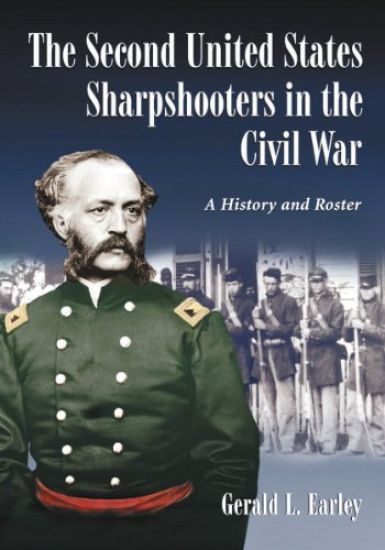
The Second United States Sharpshooters in the Civil War
The Second United States Sharpshooters was a hodgepodge regiment, composed of companies raised in several New England states. The regiment was trained for a specific mission and armed with specially ordered breech-loading target rifles. This book covers the origin, recruitment, training, and battle record of the regiment and features 32 photographs, four battlefield maps, and a regimental roster.
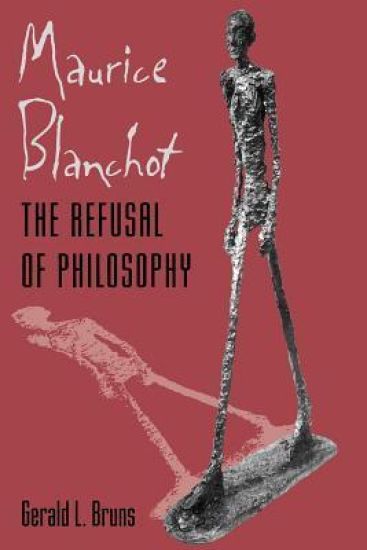
Maurice Blanchot:

Maurice Blanchot:

Gerald L. Bruns

Johns Hopkins University Press
2005
nidottu
As a novelist, essayist, critic, and theorist, Maurice Blanchot has earned tributes from authors as diverse as Jacques Derrida, Giles Deleuze, and Emmanuel Levinas. But their praise has told us little about what Blanchot's work actually says and why it has been so influential. In the first comprehensive study of this important French writer to appear in English, Gerald Bruns ties Blanchot's writings to each other and to the works of his contemporaries, including the poet Paul Celan. Blanchot belongs to the generation of French intellectuals who came of age during the 1930s, survived the Occupation, and flourished during the quarter century or so after World War II. He was one of the first French intellectuals to take a systematic interest in questions of language and meaning. His focus in the mid-1930s on extreme situations-death, madness, imprisonment, exile, revolution, catastrophe-anticipated the later interest of the existentialists. Like Nietzsche, Wittgenstein, and Adorno, Blanchot was a self-conscious writer of fragments, and he has given us one the most developed investigations that we have on the fragment as a kind of writing. In a series of close readings, Bruns addresses the philosophical and political questions that have surrounded Blanchot and his writings for decades. He describes what is creative in Blanchot's readings of Heidegger's controversial works and examines Blanchot's conception of poetry as an inquiry into the limits of philosophy, rationality, and power.
This Is Where I Came In

This Is Where I Came In

Gerald L. Early

University of Nebraska Press
2003
sidottu
The fascinating and turbulent black America of the 1960s emerges in these essays, through the lenses of dissent and its contradictions. Gerald L. Early revisits this volatile time in American history, when class, culture, and race ignited conflagrations of bitterness and hatred across the nation. The lives of three active and influential people are given special attention: Cecil B. Moore, advocate and agitator in the 'racial tinderbox' of black Philadelphia; Muhammad Ali, promoter of a 'colored' consciousness; and, Sammy Davis Jr., survivor of black vaudeville and liberator of black performers. The fiercely independent Moore, who rebuffed the black political establishment because it failed to address the concerns and needs of the majority of the black populace, used the authority of the NAACP to forge a militant, populist organization at the local level.Ali, one of the most widely recognized athletes of all time, combined protest and action to become a hero for black and 'colored' people throughout the world and became a type of ambassador to the Third World. Davis mirrored America's emancipation, confusion, and self-destructiveness, and, most important, its self-consciousness, which transcended even his remarkable accomplishments as an entertainer. As Early demonstrates, the careers and lives of Moore, Ali, and Davis illustrate and embody the ambiguity and struggle of American identity in the 1960s. Gerald L. Early is Merle Kling Professor of Modern Letters at Washington University. He also serves as Director of African and Afro-American Studies at Washington University and is the author of many books, including "The Culture of Bruising: Essays on Literature", "Prizefighting", and "Modern American Culture", and the editor of "Miles Davis" and "American Culture".
This Is Where I Came in

This Is Where I Came in

Gerald L. Early

University of Nebraska Press
2003
pokkari
The fascinating and turbulent black America of the 1960s emerges in these essays, through the lenses of dissent and its contradictions. Gerald L. Early revisits this volatile time in American history, when class, culture, and race ignited conflagrations of bitterness and hatred across the nation. The lives of three active and influential people are given special attention: Cecil B. Moore, advocate and agitator in the "racial tinderbox" of black Philadelphia; Muhammad Ali, promoter of a "colored" consciousness; and Sammy Davis Jr., survivor of black vaudeville and liberator of black performers. The fiercely independent Moore, who rebuffed the black political establishment because it failed to address the concerns and needs of the majority of the black populace, used the authority of the NAACP to forge a militant, populist organization at the local level. Ali, one of the most widely recognized athletes of all time, combined protest and action to become a hero for black and "colored" people throughout the world, and became a type of ambassador to the Third World. Davis mirrored America's emancipation, confusion, and self-destructiveness, and, most important, its self-consciousness, which transcended even his remarkable accomplishments as an entertainer. As Early demonstrates, the careers and lives of Moore, Ali, and Davis illustrate and embody the ambiguity and struggle of American identity in the 1960s.
Oneida Lives

Oneida Lives

Gerald L. Hill

University of Nebraska Press
2005
pokkari
In this intimate volume the long-lost voices of Wisconsin Oneida men and women speak of all aspects of life: growing up, work and economic struggles, family relations, belief and religious practice, boarding-school life, love, sex, sports, and politics. These voices are drawn from a collection of handwritten accounts recently rediscovered after more than fifty years, the result of a WPA Federal Writers' Project undertaking called the Oneida Ethnological Study (1940–42) in which a dozen Oneida men and women were hired to interview their families and friends and record their own experiences and observations. Selected from more than five hundred biographical narratives, these sixty-five chronicles, told by fifty-eight women and men, present a picture of Oneida Indian life from the 1880s, before the Dawes Allotment Act, through World War I and the Great Depression, to the beginning of World War II. Despite the narrators' struggles against harsh economic conditions, the theft of their land, and neglect, their firsthand histories are rendered with frankness and wit and present a remarkable picture of an era and a people.
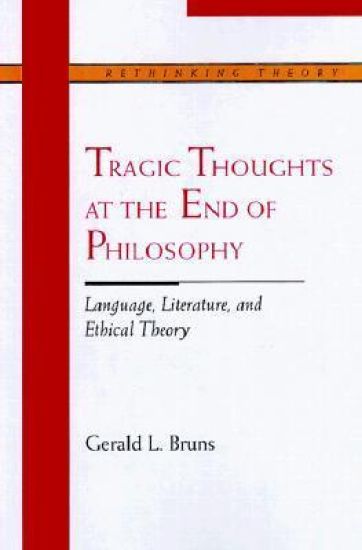
Tragic Thoughts at the End of Philosophy

Tragic Thoughts at the End of Philosophy

Gerald L. Bruns

Northwestern University Press
1999
sidottu
Bruns, perhaps one of most insightful of contemporary literary theorists, investigates the recent phenomenon of philosophers taking an interest in literature and literary theory. Beginning with the premise that philosophy and literature are internal to one another's histories, starting with Plato's ""Republic"", Bruns examines diverse thinkers and topics such as Stanley Cavell on Shakespeare, Donald Davidson on James Joyce and Richard Rorty on the Poetizing of culture. The book offers a view of what happens when philosophers begin looking at the world from the ground level - that is, as inhabitants, rather than as disengaged observers.
Tragic Thoughts at the End of Philosophy

Tragic Thoughts at the End of Philosophy

Gerald L. Bruns

Northwestern University Press
1999
nidottu
Bruns, perhaps one of most insightful of contemporary literary theorists, investigates the recent phenomenon of philosophers taking an interest in literature and literary theory. Beginning with the premise that philosophy and literature are internal to one another's histories, starting with Plato's ""Republic"", Bruns examines diverse thinkers and topics such as Stanley Cavell on Shakespeare, Donald Davidson on James Joyce and Richard Rorty on the Poetizing of culture. The book offers a view of what happens when philosophers begin looking at the world from the ground level - that is, as inhabitants, rather than as disengaged observers.
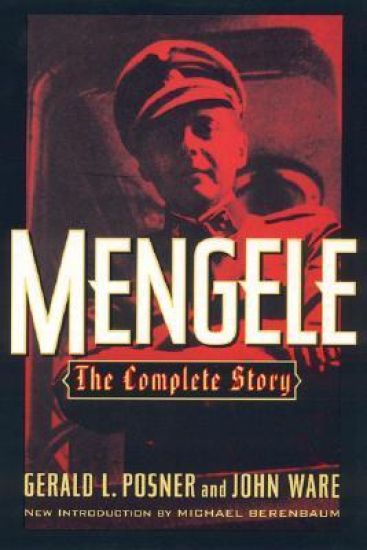
Mengele

Mengele

Gerald L. Posner; John Ware

Cooper Square Publishers Inc.,U.S.
2000
pokkari
Based on exclusive and unrestricted access to more than 5,000 pages of personal writings and family photos, this definitive biography of German physician and SS-Hauptsturmfuhrer Josef Mengele (1911-1979) probes the personality and motivations of Auschwitz's "Angel of Death." From May 1943 through January 1945, Mengele selected who would be gassed immediately, who would be worked to death, and who would serve as involuntary guinea pigs for his spurious and ghastly human experiments (twins were Mengele's particular obsession). With authority and insight, Mengele examines the entire life of the world's most infamous doctor.
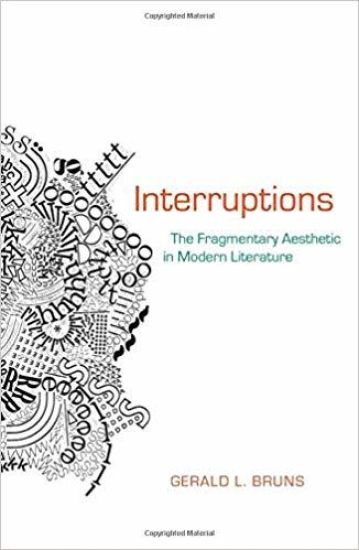
Interruptions

Interruptions

Gerald L. Bruns

The University of Alabama Press
2018
nidottu
A history of fragmentary—or interrupted—writing in avant-garde poetry and prose by a renowned literary critic. In Interruptions: The Fragmentary Aesthetic in Modern Literature, Gerald L. Bruns explores the effects of parataxis, or fragmentary writing as a device in modern literature. Bruns focuses on texts that refuse to follow the traditional logic of sequential narrative. He explores numerous examples of self-interrupting composition, starting with Friedrich Schlegel's inaugural theory and practice of the fragment as an assertion of the autonomy of words, and their freedom from rule-governed hierarchies. Bruns opens the book with a short history of the fragment as a distinctive feature of literary modernism in works from Gertrude Stein to Paul Celan to present-day authors. The study progresses to the later work of Maurice Blanchot and Samuel Beckett, and argues, controversially, that Blanchot's writings on the fragment during the 1950s and early 1960s helped to inspire Beckett’s turn toward paratactic prose. The study also extends to works of poetry, examining the radically paratactic arrangements of two contemporary British poets, J. H. Prynne and John Wilkinson, focusing chiefly on their most recent, and arguably most abstruse, works. Bruns also offers a close study of the poetry and poetics of Charles Bernstein. Interruptions concludes with two chapters about James Joyce. First, Bruns tackles the language of Finnegans Wake, namely the break-up of words themselves, its reassembly into puns, neologisms, nonsense, and even random strings of letters. Second, Bruns highlights the experience of mirrors in Joyce’s fiction, particularly in Dubliners, Portrait of the Artist as a Young Man, and Ulysses, where mirrored reflections invariably serve as interruptions, discontinuities, or metaphorical displacements and proliferations of self-identity.
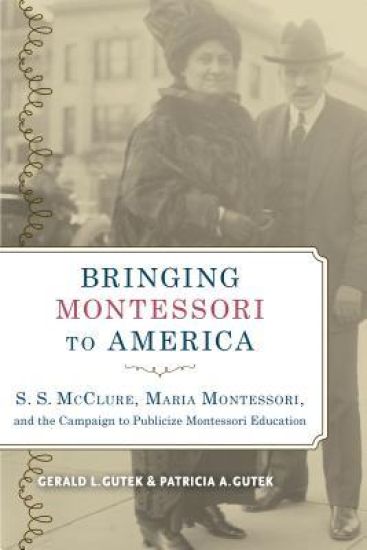
Bringing Montessori to America

Bringing Montessori to America

Gerald L. Gutek; Patricia A. Gutek

The University of Alabama Press
2017
nidottu
2016 Choice Outstanding Academic Title! Bringing Montessori to America traces in engrossing detail one of the most fascinating partnerships in the history of American education–that between Maria Montessori and S. S. McClure, from their first meeting in 1910 until their final acrimonious dispute in 1915. Born on the Adriatic, Montessori first entered the world stage in 1906 as the innovator of a revolutionary teaching method that creates an environment where children learn at their own pace and initiate skills like reading and writing in a spontaneous way. As her school in Rome swiftly attracted attention, curiosity, and followers, Montessori recruited disciples whom she immersed in a rigorous and detailed teacher-training regimen of her own creation. McClure was an Irish-born media baron of America's Gilded Age, best known as the founder and publisher of McClure's Magazine . Against the backdrop of Theodore Roosevelt's Bull Moose insurgency, the brilliant and mercurial McClure used his flagship publication as a vehicle to advance Progressive Party causes. After meeting in 1910, McClure and Montessori embarked on a five-year collaboration to introduce Montessori's innovative teaching style in the United States. Gerald and Patricia Gutek trace the dramatic arc of the partnership between the Italian teacher and American publisher united by a vision of educational change in the United States. After her triumphal lecture tour in 1913, Montessori, secure in her trust of her American partner, gave McClure her power of attorney and returned to Italy. The surge in popularity of Montessori education in America, however, deeply concerned Montessori, who had heretofore exerted total control over her method, apparatus, schools, and teacher training. The American entrepreneurial spirit, along with a desire to disseminate the Montessori Method quickly, led to major conflicts between the Italian educator and American businesspeople, particularly McClure. Feeling betrayed, Montessori ended her relationship with her erstwhile collaborator. Gutek and Gutek describe the fascinating story of this first wave of Montessori education in the United States, which did not sustain itself during Montessori's lifetime. It would not be until the 1950s that Montessori education was revived with the successful establishment of Montessori academies throughout the United States.
The Material of Poetry

The Material of Poetry

Gerald L. Bruns

University of Georgia Press
2012
pokkari
Poetry is philosophically interesting, writes Gerald L. Bruns, "when it is innovative not just in its practices, but, before everything else, in its poetics (that is, in its concepts or theories of itself)." In The Material of Poetry, Bruns considers the possibility that anything, under certain conditions, may be made to count as a poem. By spelling out such enabling conditions he gives us an engaging overview of some of the kinds of contemporary poetry that challenge our notions of what language is: sound poetry, visual or concrete poetry, and "found" poetry.Poetry's sense and meaning can hide in the spaces in which it is written and read, says Bruns, and so he urges us to become anthropologists, to go afield in poetry's social, historical, and cultural settings. From that perspective, Bruns draws on works by such varied poets as Gertrude Stein, Ezra Pound, Steve McCaffery, and Francis Ponge to argue for three seemingly competing points. First, poetry is made of language but is not a use of it. That is, poetry is made of words but not of what we use words to produce: concepts, narratives, expressions of feeling, and so on. Second, as the nine sound poems on the online audio recordings included with the book demonstrate, poetry is not necessarily made of words but is rooted in, and in fact already fully formed by, sounds the human body can produce. Finally, poetry belongs to the world alongside ordinary things; it cannot be confined to some aesthetic, neutral, or disengaged dimension of human culture.Poetry without frontiers, unmoored from expectations, and sometimes even written in imaginary languages: Bruns shows us why, for the sake of all poetry, we should embrace its anarchic, vitalizing ways.
On the Anarchy of Poetry and Philosophy

On the Anarchy of Poetry and Philosophy

Gerald L. Bruns

Fordham University Press
2007
sidottu
Marcel Duchamp once asked whether it is possible to make something that is not a work of art. This question returns over and over in modernist culture, where there are no longer any authoritative criteria for what can be identified (or excluded) as a work of art. As William Carlos Williams says, "A poem can be made of anything," even newspaper clippings. At this point, art turns into philosophy, all art is now conceptual art, and the manifesto becomes the distinctive genre of modernism. This book takes seriously this transformation of art into philosophy, focusing upon the systematic interest that so many European philosophers take in modernism. Among the philosophers Gerald Bruns discusses are Theodor W. Adorno, Maurice Blanchot, Arthur Danto, Stanley Cavell, Hans-Georg Gadamer, Michel Foucault, Gilles Deleuze and Felix Guattari, Jacques Derrida, Jean-François Lyotard, Jean-Luc Nancy, Philippe Lacoue-Labarthe, and Emmanuel Levinas. As Bruns demonstrates, the difficulty of much modern and contemporary poetry can be summarized in the idea that a poem is made of words, not of any of the things that we use words to produce: meanings, concepts, propositions, narratives, or expressions of feeling. Many modernist poets have argued that in poetry language is no longer a form of mediation but a reality to be explored and experienced in its own right. But what sort of experience, philosophically, might this be? The problem of the materiality or hermetic character of poetic language inevitably leads to questions of how philosophy itself is to be written and what sort of community defines the work of art—or, for that matter, the work of philosophy. In this provocative study, Bruns answers that the culture of modernism is a kind of anarchist community, where the work of art is apt to be as much an event or experience—or, indeed, an alternative form of life—as a formal object. In modern writing, philosophy and poetry fold into one another. In this book, Bruns helps us to see how.
On the Anarchy of Poetry and Philosophy

On the Anarchy of Poetry and Philosophy

Gerald L. Bruns

Fordham University Press
2007
pokkari
Marcel Duchamp once asked whether it is possible to make something that is not a work of art. This question returns over and over in modernist culture, where there are no longer any authoritative criteria for what can be identified (or excluded) as a work of art. As William Carlos Williams says, "A poem can be made of anything," even newspaper clippings. At this point, art turns into philosophy, all art is now conceptual art, and the manifesto becomes the distinctive genre of modernism. This book takes seriously this transformation of art into philosophy, focusing upon the systematic interest that so many European philosophers take in modernism. Among the philosophers Gerald Bruns discusses are Theodor W. Adorno, Maurice Blanchot, Arthur Danto, Stanley Cavell, Hans-Georg Gadamer, Michel Foucault, Gilles Deleuze and Felix Guattari, Jacques Derrida, Jean-François Lyotard, Jean-Luc Nancy, Philippe Lacoue-Labarthe, and Emmanuel Levinas. As Bruns demonstrates, the difficulty of much modern and contemporary poetry can be summarized in the idea that a poem is made of words, not of any of the things that we use words to produce: meanings, concepts, propositions, narratives, or expressions of feeling. Many modernist poets have argued that in poetry language is no longer a form of mediation but a reality to be explored and experienced in its own right. But what sort of experience, philosophically, might this be? The problem of the materiality or hermetic character of poetic language inevitably leads to questions of how philosophy itself is to be written and what sort of community defines the work of art—or, for that matter, the work of philosophy. In this provocative study, Bruns answers that the culture of modernism is a kind of anarchist community, where the work of art is apt to be as much an event or experience—or, indeed, an alternative form of life—as a formal object. In modern writing, philosophy and poetry fold into one another. In this book, Bruns helps us to see how.
Worship in the New Testament

Worship in the New Testament

Gerald L. Borchert

Chalice Press
2008
pokkari
Gerald Borchert provides a unique survey of the New Testament by centering on its understanding, teaching, language, and reflections of worship. He seeks to show how worship language and action lie behind much of the New Testament and how the modern church can gain a new power in worship through renewed reflection on the New Testament. Borchert first looks at the larger New Testament unit-gospels, Pauline letters, pastorals, etc. Then he takes each book in the section, passage by passage, and shows how worship constantly enters into the author's style and purpose in bringing that author's unique meaning to the individual context. He concludes each section with a terse Worship Summary of the biblical book and with questions for the reader to contemplate. Thus Borchert invites the reader to enter into the worship discussion and find ways to give depth, meaning, and hope to personal and congregational worship. At each step, Borchert underlines the deep connection between worship and life.
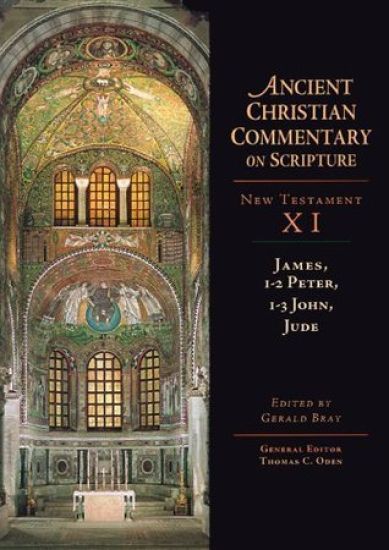
James, 1–2 Peter, 1–3 John, Jude

James, 1–2 Peter, 1–3 John, Jude

Gerald L. Bray; Thomas C. Oden

IVP Academic
2000
sidottu
Christianity Today Award of Merit winner Because the Catholic Epistles focus on orthodox faith and morals, the Fathers drew on them as a means of defense against the rising challenge of heretics. Many of the Fathers saw in these letters anticipatory attacks on Marcion and strong defenses against the Arians. They did so quite naturally because in their view truth was eternal and deviations from it had existed from the beginning. Above all, the Fathers found in the Catholic Epistles a manual for spiritual warfare, counsel for the faithful in the cosmic struggle between good and evil. In them was sound instruction in the ways of self-sacrifice, generosity, and humility, through which the cosmic forces could be defeated. Allusions to these letters go back as far as Justin Martyr, Irenaeus, and Tertullian, but the first commentary derives from Clement of Alexandria. Didymus the Blind was the next significant Greek-speaking commentator, though his commentary is fully extant only in Latin translation. Many of the comments from the early centuries have been passed on to us through Latin catenae, or chain commentaries, in which a later commentator collected comments from a variety of sources and chained them together in a fashion much like that of the Ancient Christian Commentary on Scripture in English. Among Latin commentators on these letters, pride of place must be given to Bede the Venerable. This volume opens up a treasure house of ancient wisdom that allows these faithful witnesses, some appearing here in English translation for the first time, to speak with eloquence and intellectual acumen to the church today.
The Doctrine of God

The Doctrine of God

Gerald L. Bray

INTERVARSITY PRESS
1993
nidottu
What is theology? What is the nature of God? How should we think about the relationships among the persons of the Trinity? In a carefully reasoned style Gerald Bray distills the essence of these questions and introduces readers to a theological understanding of the personal, trinitarian existence of God. Engaging classical and contemporary theology along the way, Bray also leads us into conversation with the Eastern Orthodox tradition, where he finds valuable insights sadly neglected by evangelical theology.Here is a substantial introduction to the nature and subject of God, and a compelling call for evangelicals to renew their commitment to the solid foundation of a truly trinitarian theology.
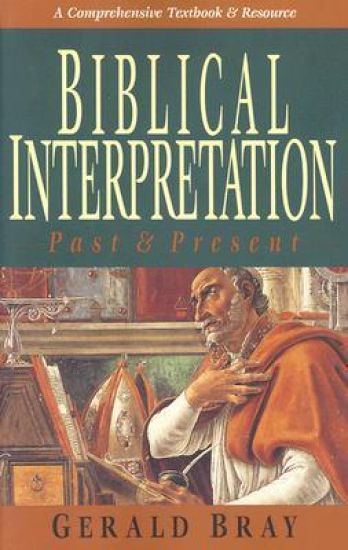
Biblical Interpretation: Past & Present

Biblical Interpretation: Past & Present

Gerald L. Bray

INTERVARSITY PRESS
2000
nidottu
Christianity Today Book of the YearNever before has there been so much scholarly effort devoted to the study of the Bible. And yet, ironically, the church is in perilous danger of forgetting its rich inheritance of biblical interpretation. With this textbook, Gerald Bray sounds the call to draw biblical interpretation back to the heart of the church. Evangelical in perspective but ecumenical in both its historical breadth and its vision of the future, Bray's work is a comprehensive guide to biblical interpretation, past and present.Bray begins by introducing basic concepts in biblical interpretation that have remained constant through the ages: divine revelation, the nature of the canon, the relation of the biblical text to the life of Christian churches, and the tensions inherent in the act of biblical interpretation. He follows this introduction with three main sections, each covering an epoch of development within the history of biblical interpretation. The first surveys the period from the ancient church to the beginnings of modern historical-critical interpretation in the Renaissance and Reformation. The second engages the rise of modern historical-critical interpretation from the late seventeenth century through the twentieth century. The third investigates current trends in biblical interpretation that seek to offer alternatives to the dominant school of historical criticism.Each section is divided into chapters focusing on periods or schools of interpretation. And, as a further aid to readers, each chapter is divided into standard subsections: an introduction to the period or school of interpretationa brief who's who of major interpreters and their worksan introduction to key critical, doctrinal or hermeneutical issuesdiscussion and illustration of principal interpretive methodsan examination of an particular book or passage that played a crucial role in biblical interpretation for the period or school under discussionBray's organizational scheme allows readers to quickly grasp the issues, methods and interpreters of each period or school and to observe how classic issues and pivotal questions have shaped the church's use of the Bible in various historical contexts. Seminarians, pastors, teachers and lay leaders will welcome Biblical Interpretation: Past and Present as an instructive guide to both the high points and the impasses of biblical interpretation. Here is history with a clear message, written out of the conviction that biblical interpretation and Christian doctrine go hand in hand.
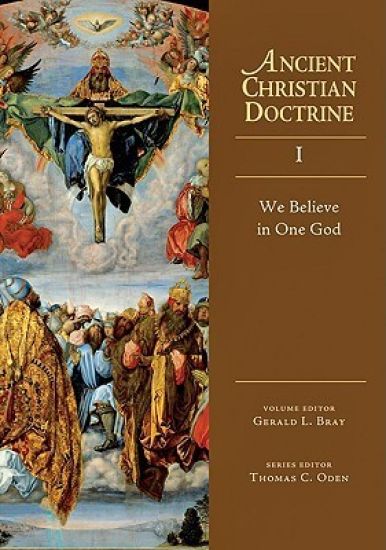
We Believe in One God

We Believe in One God

Gerald L. (EDT) Bray

Inter-Varsity Press,US
2009
sidottu
The first article of the Nicene Creed also presupposes that there is an objective body of teaching that Christians are expected to confess as their faith. This idea seems normal and natural to us, but it was a novelty in the ancient world. Neither Judaism nor any pagan religion or philosophy could claim to have a closely defined set of beliefs that everyone adhering to it was expected to profess publicly and defend against all comers. While this article on God the Father is the shortest and arguably oldest portion of the Creed, it fully sets forth the fundamental understanding of God as creator and originator of all that is. This commentary in its selection of texts from the early church highlights the common understanding of the One God in three Persons, elucidating the church's understanding of divine attributes and trinitarian relations.