Kirjojen hintavertailu. Mukana 12 363 183 kirjaa ja 12 kauppaa.

Kirjahaku

Etsi kirjoja tekijän nimen, kirjan nimen tai ISBN:n perusteella.

1000 tulosta hakusanalla Gerard A. Hauser

Classroom Activators

Classroom Activators

Gerard A. Evanski

SAGE Publications Inc
2008
sidottu
This handy guide puts a new twist on your teaching and training practices and shows how you can stimulate and invigorate learners through state-changing activities engaging techniques to help refocus the brain and create a receptive state of mind that enhances learning. Each section presents specific state-changing activities and the brain research behind them. While the strategies are geared for secondary classrooms, all can be adapted across grade levels. Classroom Activators illustrates how simple changes in delivering instruction or designing the classroom environment can help capture student interest and keep learners focused. The author examines state-changing activities within four categories: Energizing the Environment: examines ways to keep the learning environment fresh Getting Your Students' Attention: offers ideas to help students focus on the task at hand Energizing Your Students: presents techniques to use when the students may need a to refocus attention in the middle of a lesson Building Teams and Community: includes activities for community building, team building, and rapport building
Classroom Activators

Classroom Activators

Gerard A. Evanski

SAGE Publications Inc
2008
nidottu
This handy guide puts a new twist on your teaching and training practices and shows how you can stimulate and invigorate learners through state-changing activities engaging techniques to help refocus the brain and create a receptive state of mind that enhances learning. Each section presents specific state-changing activities and the brain research behind them. While the strategies are geared for secondary classrooms, all can be adapted across grade levels. Classroom Activators illustrates how simple changes in delivering instruction or designing the classroom environment can help capture student interest and keep learners focused. The author examines state-changing activities within four categories: Energizing the Environment: examines ways to keep the learning environment fresh Getting Your Students' Attention: offers ideas to help students focus on the task at hand Energizing Your Students: presents techniques to use when the students may need a to refocus attention in the middle of a lesson Building Teams and Community: includes activities for community building, team building, and rapport building
Configurational Forces

Configurational Forces

Gerard A. Maugin

Taylor Francis Inc
2010
sidottu
Exploring recent developments in continuum mechanics, Configurational Forces: Thermomechanics, Physics, Mathematics, and Numerics presents the general framework for configurational forces. It also covers a range of applications in engineering and condensed matter physics. The author presents the fundamentals of accepted standard continuum mechanics, before introducing Eshelby material stress, field theory, variational formulations, Noether’s theorem, and the resulting conservation laws. In the chapter on complex continua, he compares the classical perspective of B.D. Coleman and W. Noll with the viewpoint linked to abstract field theory. He then describes the important notion of local structural rearrangement and its relationship to Eshelby stress. After looking at the relevance of Eshelby stress in the thermodynamic description of singular interfaces, the text focuses on fracture problems, microstructured media, systems with mass exchanges, and electromagnetic deformable media. The concluding chapters discuss the exploitation of the canonical conservation law of momentum in nonlinear wave propagation, the application of canonical-momentum conservation law and material force in numerical schemes, and similarities of fluid mechanics and aerodynamics.Written by a long-time researcher in mechanical engineering, this book provides a detailed treatment of the theory of configurational forces—one of the latest and most fruitful advances in macroscopic field theories. Through many applications, it shows the depth and efficiency of this theory.
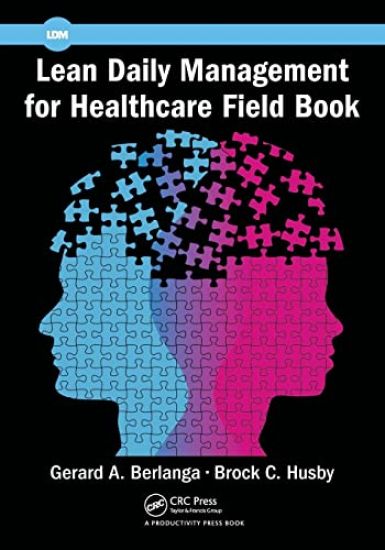
Lean Daily Management for Healthcare Field Book

Lean Daily Management for Healthcare Field Book

Gerard A. Berlanga; Brock C. Husby

Productivity Press
2016
nidottu
This book gives healthcare leaders a practical guide to implementing the 4 key components of lean daily management system - 1. LDM boards; 2. Leadership rounds 3. Leader daily disciplines and 4. Lean projects. Although lean is not new to healthcare, effective LDM is just now taking hold with the best lean healthcare organizations in the U.S. and Canada. Leaders are realizing that sustaining their lean projects over time has proven to be a challenge without first addressing the organizations management system/model. LDM gives leaders a straightforward approach to do just that as well as improve their ability to spread and deploy lean to other areas of the organization and tie back to strategy.
Hoshin Kanri for Healthcare

Hoshin Kanri for Healthcare

Gerard A. Berlanga; Brock C. Husby; Heather K. Anderson

Productivity Press
2018
nidottu
The best healthcare organizations have developed effective approaches to develop compelling strategic visions and strategies based on long-term thinking and continue to apply Lean principles across their organizations to create a culture of continuous improvement. Establishing effective strategies and Toyota style Hoshin Kanri enables healthcare organizations to align everyone in the organizations and creates a unique competitive advantage. This book follows a regional hospital's journey through the creation of long-term strategic goals and Toyota Style strategy deployment.
Whiplash

Whiplash

Gerard A. Malanga; Scott Nadler

Hanley Belfus Inc.
2002
sidottu
Cervical whiplash injuries continue to be a common problem throughout the industrialized world. Despite recent scientific developments, unhelpful treatment of whiplash injuries such as prolonged immobilization, passive modalities, and unnecessary surgery exist. Many patients with chronic pain are labelled as having "psychological problems." Overtreatment and excessive use of diagnostic imaging are common. Relatively recent developments in this field, backed by extensive study, have initiated an evolution in the treatment of whiplash injury. Dr. Malanga is a well-known expert in the field of physical medicine and rehabilitation, particularly in spinal medicine and orthopedics. The entire book focuses only on whiplash, providing an extremely in-depth treatment. Relatively recent developments in this field, backed by extensive study, have initiated an evolution in the treatment of whiplash injury. Thus, there is a need for a comprehensive presentation of the changed thinking. Includes coverage of the Quebec Whiplash Study.
The Art of Hosting

The Art of Hosting

Gerard A Pollion

Universal Publishers
2002
pokkari
Whether you're new to the business or you've been a server for years, The Art of Hosting will give you the tools you need to walk, talk and act like a seasoned pro. Filled with insider tips and info, this book will show you in clear, concise and easy-to-understand terms how to be an outstanding server in even the finest restaurants-and get the biggest tips! Includes sections on Table Set-up, Taking Guest Orders, Serving Drinks and Wine, Increasing Your Tips and more.
My Word!

My Word!

Gerard A Burst

Page Publishing, Inc.
2021
pokkari
Hidden inside his shy and retiring mindis a lifetime of words come alive.Just the right wordssaid just the right waygives you a little glimpsea new rayto brighten how you look at the every day.This book is full of humor and romance, fantasy and fun, heartbreak and hope, and a longing for home.You can read a melody behind those words.Open this bookif you want it to be heard.
"Liberty and Justice for All": How I learned to participate...

"Liberty and Justice for All": How I learned to participate...

Gerard a. Pisani Jr

Createspace Independent Publishing Platform
2018
nidottu
"Liberty and Justice for All" is a capstone idea in documents of the United States of America and in many other countries and people around the world. The origin of liberty and justice for all is found in both Faith and Science, in the Bible and other scriptures, and in many forms of literature like poetry, songs, writings. This booklet attempts to describe the framework from which justice may come in a variety of familiar places like popular music, research in universities, and in religions. Our human history bears many ideas and conflicts around the theme of Justice, especially in the evolution of religions. How it may become the experience for all peoples throughout our world is sought in the conclusions our understanding of God, the universal story displayed through science and in our recognition that our world is "one" planet for all specimens and species. It concludes with a suggestion of a "Covenantal Faith" that is growing today: "There is no way to conceive of LIFE Living Into Future Expression] without these three words: LIBERTY, JUSTICE, and for ALL "
The Third Law of Evolution and The Future of Life

The Third Law of Evolution and The Future of Life

Gerard A. J. M. Jagers op Akkerhuis

Springer International Publishing AG
2024
sidottu
This book offers a step-by-step introduction to an integrated theory of physical and biological evolution, from the early universe to the world we know today. To this end, the well-known laws of variation and selection are supplemented by a third law. This law describes the increase in complexity based on the transitions from quarks to hadrons, to atoms, to molecules, to bacteria, to eukaryotic cells, and so on. These insights revolutionize existing theoretical frameworks for analyzing organization in nature, accelerating developments in natural philosophy. In this way, the author develops a basic framework for thinking about evolution, which can be applied to current debates in various research fields. For example, the new approach finally helps to find the systems-based definitions of organism and life that have been sought for so long. By extrapolating the framework one can even hypothesize about future evolution and our place as humans in it. An exciting read for both philosophers and scientists.
Continuum Mechanics Through the Eighteenth and Nineteenth Centuries

Continuum Mechanics Through the Eighteenth and Nineteenth Centuries

Gérard A. Maugin

Springer International Publishing AG
2014
sidottu
Conceived as a series of more or less autonomous essays, the present book critically exposes the initial developments of continuum thermo-mechanics in a post Newtonian period extending from the creative works of the Bernoullis to the First World war, i.e., roughly during first the “Age of reason” and next the “Birth of the modern world”. The emphasis is rightly placed on the original contributions from the “Continental” scientists (the Bernoulli family, Euler, d’Alembert, Lagrange, Cauchy, Piola, Duhamel, Neumann, Clebsch, Kirchhoff, Helmholtz, Saint-Venant, Boussinesq, the Cosserat brothers, Caratheodory) in competition with their British peers (Green, Kelvin, Stokes, Maxwell, Rayleigh, Love,..). It underlines the main breakthroughs as well as the secondary ones. It highlights the role of scientists who left essential prints in this history of scientific ideas. The book shows how the formidable developments that blossomed in the twentieth century (and perused in a previous book of the author in the same Springer Series: “Continuum Mechanics through the Twentieth Century”, Springer 2013) found rich compost in the constructive foundational achievements of the eighteenth and nineteenth centuries. The pre-WWI situation is well summarized by a thorough analysis of treatises (Appell, Hellinger) published at that time. English translations by the author of most critical texts in French or German are given to the benefit of the readers.
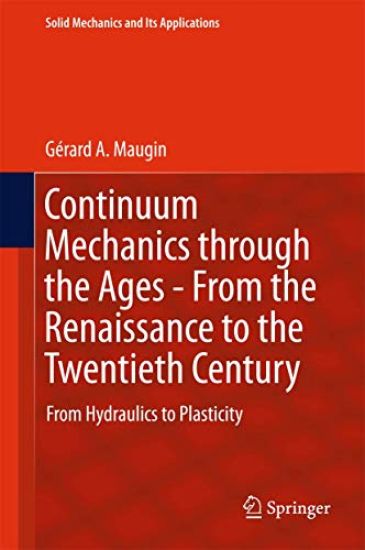
Continuum Mechanics through the Ages - From the Renaissance to the Twentieth Century
Mixing scientific, historic and socio-economic vision, this unique book complements two previously published volumes on the history of continuum mechanics from this distinguished author. In this volume, Gérard A. Maugin looks at the period from the renaissance to the twentieth century and he includes an appraisal of the ever enduring competition between molecular and continuum modelling views. Chapters trace early works in hydraulics and fluid mechanics not covered in the other volumes and the author investigates experimental approaches, essentially before the introduction of a true concept of stress tensor. The treatment of such topics as the viscoelasticity of solids and plasticity, fracture theory, and the role of geometry as a cornerstone of the field, are all explored. Readers will find a kind of socio-historical appraisal of the seminal contributions by our direct masters in the second half of the twentieth century. The analysis of the teaching and research texts by Duhem, Poincaré and Hilbert on continuum mechanics is key: these provide the most valuable documentary basis on which a revival of continuum mechanics and its formalization were offered in the late twentieth century. Altogether, the three volumes offer a generous conspectus of the developments of continuum mechanics between the sixteenth century and the dawn of the twenty-first century. Mechanical engineers, applied mathematicians and physicists alike will all be interested in this work which appeals to all curious scientists for whom continuum mechanics as a vividly evolving science still has its own mysteries.
Continuum Mechanics Through the Eighteenth and Nineteenth Centuries

Continuum Mechanics Through the Eighteenth and Nineteenth Centuries

Gérard A. Maugin

Springer International Publishing AG
2016
nidottu
Conceived as a series of more or less autonomous essays, the present book critically exposes the initial developments of continuum thermo-mechanics in a post Newtonian period extending from the creative works of the Bernoullis to the First World war, i.e., roughly during first the “Age of reason” and next the “Birth of the modern world”. The emphasis is rightly placed on the original contributions from the “Continental” scientists (the Bernoulli family, Euler, d’Alembert, Lagrange, Cauchy, Piola, Duhamel, Neumann, Clebsch, Kirchhoff, Helmholtz, Saint-Venant, Boussinesq, the Cosserat brothers, Caratheodory) in competition with their British peers (Green, Kelvin, Stokes, Maxwell, Rayleigh, Love,..). It underlines the main breakthroughs as well as the secondary ones. It highlights the role of scientists who left essential prints in this history of scientific ideas. The book shows how the formidable developments that blossomed in the twentieth century (and perused in a previous book of the author in the same Springer Series: “Continuum Mechanics through the Twentieth Century”, Springer 2013) found rich compost in the constructive foundational achievements of the eighteenth and nineteenth centuries. The pre-WWI situation is well summarized by a thorough analysis of treatises (Appell, Hellinger) published at that time. English translations by the author of most critical texts in French or German are given to the benefit of the readers.