

Kirjahaku
Etsi kirjoja tekijän nimen, kirjan nimen tai ISBN:n perusteella.
1000 tulosta hakusanalla Gilbert Trichet



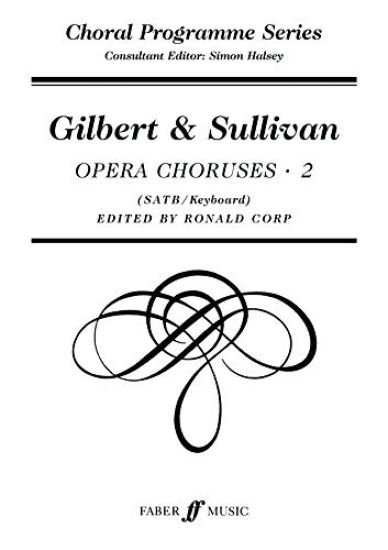
Gilbert and Sullivan Choruses 2
Faber Music Ltd
1992
muu
Gilbert and Sullivan Choruses 2 contains six of the best choruses written for the stage by W.S. Gilbert and Arthur Sullivan from some of their most popular Savoy Operas, including The Pirates of Penzance, Princess Ida and Ruddigore. The pieces have been suitably arranged for choral groups of any size. Some of the pieces, originally composed for solo voice ensembles, are equally effective when sung 'tutti'. The arrangements provide fun and imaginative repertoire for choirs looking for lively and rewarding concert material. The Choral Programme Series is a well-established programming tool for many choirs as it offers a wealth of fresh material from many eras and in many styles, at great value for money

Includes Yorkshire fishcakes, Dorset jugged steak, cock-a-leekie pie, Mrs Beeton's barbecue chicken, London Pride battered cod, gingerbread pudding, Kendal mint cake choc ices and the best lemon drizzle cake. This title allows you to celebrate these recipes at home, be it for brunch, lunch, or a terrific cocktail to ease you into your meal.


Correspondence of Gilbert Wakefield with Charles James Fox, in the Years 1796 ... 1801, Chiefly, on Subjects of Classical Literature
Gilbert Wakefield
Trieste Publishing
2018
nidottu


Maisie Ward's biography of Gilbert Keith Chesterton has long been a cornerstone in Chesterton studies, as well as in the publishing house she and her husband, Frank Sheed, founded in 1926. Originally published in 1942, just six years after Chesterton's untimely death, this book combines Ward's unique perspective as the author's friend and publisher with an examination of his personal correspondence and interviews with his closest friends and family. Here are Chesterton's childhood and school days, the friendship and foolery of youth, his early theological development, high spirited love letters, the variety and richness of his travel and life abroad, his lectures, his writings, and his indominable spirit. A Sheed & Ward Classic, this re-release of Ward's definitive biography is sure to delight existing 'Chestertonians' and introduce a new generation to one of Catholicism's brightest lights. From the new introduction by Andrew Greeley: 'This book had a decisive impact on me and on my life when I read it at the age of sixteen—and not merely because my fictional detective Blackie Ryan is an American cousin of GKC's Father Brown. Ms. Ward's biography introduced me not only to a world of literature of which I had been unaware, but to a perspective on literature and life which was enormously attractive because it confirmed many of the insights, instincts, inclinations, biases, and loves which were knocking around in my adolescent skull. I have been a Chestertonian all my life in part because I had been one without knowing it even before I read Ms. Ward's biography.'

Maisie Ward's biography of Gilbert Keith Chesterton has long been a cornerstone in Chesterton studies, as well as in the publishing house she and her husband, Frank Sheed, founded in 1926. Originally published in 1942, just six years after Chesterton's untimely death, this book combines Ward's unique perspective as the author's friend and publisher with an examination of his personal correspondence and interviews with his closest friends and family. Here are Chesterton's childhood and school days, the friendship and foolery of youth, his early theological development, high spirited love letters, the variety and richness of his travel and life abroad, his lectures, his writings, and his indominable spirit. A Sheed & Ward Classic, this re-release of Ward's definitive biography is sure to delight existing "Chestertonians" and introduce a new generation to one of Catholicism's brightest lights. From the new introduction by Andrew Greeley: "This book had a decisive impact on me and on my life when I read it at the age of sixteen—and not merely because my fictional detective Blackie Ryan is an American cousin of GKC's Father Brown. Ms. Ward's biography introduced me not only to a world of literature of which I had been unaware, but to a perspective on literature and life which was enormously attractive because it confirmed many of the insights, instincts, inclinations, biases, and loves which were knocking around in my adolescent skull. I have been a Chestertonian all my life in part because I had been one without knowing it even before I read Ms. Ward's biography."

Gilbert Simondon
Edinburgh University Press
2012
sidottu
The first sustained exploration of Simondon's work in English Gilbert Simondon's work has recently come to prominence in America and around the Anglophone work, having been of great importance in France for many years. This first collection of essays, by renowned critics and philosophers, outlines the central tenets of Simondon's thought, the implication of his thought in numerous disciplines and his relationship to other thinkers such as Heidegger, Deleuze and Canguilhem. This book offers an entry point to this influential thinker and will appeal to people working in philosophy, philosophy of science, media studies, social theory and political philosophy. Includes * a contextualising introduction * an important essay by Simondon himself * a glossary of 50 key terms in Simondon's work Keywords Gilbert Simondon; Technology; Individuation; Ontogenesis; Technicity

Gilbert Simondon's Psychic and Collective Individuation
David Scott
Edinburgh University Press
2014
nidottu
One of the most innovative and brilliant philosophers of his generation, but largely neglected until he was brought to public attention by Gilles Deleuze, Gilbert Simondon presents a challenge to nearly every category and method of traditional philosophy. 'Psychic and Collective Individuation' is undoubtedly his most important work and its influence, clearly felt in Stiegler and DeLanda, has continued to grow. David Scott provides the first full introduction to this work, which will inspire as well as instruct philosophers working in Continental thought, philosophy of science, social theory and political philosophy. He introduces Simondon's challenging text by clarifying its complex terminology and structure through a chapter-by-chapter commentary. By placing Simondon and the book in their historical context, Scott invites a dialogue with thinkers including Bergson, Deleuze, Heidegger, Sartre, Merleau-Ponty and Negri, and explains Simondon's relevance to current discussions about biopolitics and post-Nietzschean ethics.
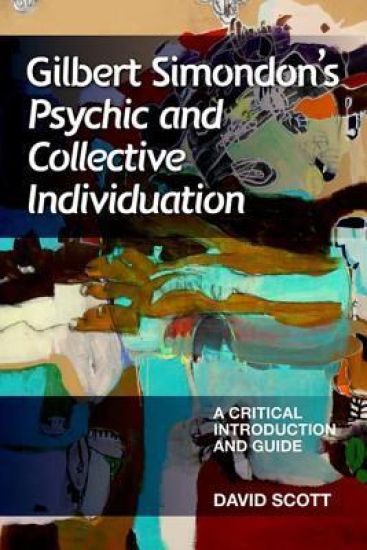
Gilbert Simondon's Psychic and Collective Individuation
David Scott
Edinburgh University Press
2014
sidottu
One of the most innovative and brilliant philosophers of his generation, but largely neglected until he was brought to public attention by Gilles Deleuze, Gilbert Simondon presents a challenge to nearly every category and method of traditional philosophy. 'Psychic and Collective Individuation' is undoubtedly his most important work and its influence, clearly felt in Stiegler and DeLanda, has continued to grow. David Scott provides the first full introduction to this work, which will inspire as well as instruct philosophers working in Continental thought, philosophy of science, social theory and political philosophy. He introduces Simondon's challenging text by clarifying its complex terminology and structure through a chapter-by-chapter commentary. By placing Simondon and the book in their historical context, Scott invites a dialogue with thinkers including Bergson, Deleuze, Heidegger, Sartre, Merleau-Ponty and Negri, and explains Simondon's relevance to current discussions about biopolitics and post-Nietzschean ethics.

Gilbert Simondon
Edinburgh University Press
2013
nidottu
This is the first sustained exploration of Simondon's work to be published in English. The work of French philosopher Gilbert Simondon (1924-1989) has recently come to prominence in America and around the English-speaking world, having been of great importance in France for many years. Now available in paperback, this is the first collection of essays on this important thinker. They outline the central tenets of Simondon's thought, his influence on philosophy, philosophy of science, media studies, social theory and political philosophy, and his relationship to other thinkers such as Heidegger, Deleuze and Canguilhem. It includes a contextualising introduction and a glossary of technical terms.

The author of The Pirates of Penzance, The Mikado, HMS Pinafore and the other great Savoy libretti, W.S. Gilbert, witty, caustic and disrespectful, was one of the celebrities of the late Victorian age. In his time he had been many things: journalist, theatre critic, cartoonist, comic poet, stage director, writer of short stories and dramatist; a political satire he wrote was banned by the Lord Chamberlain at the personal insistence of the Prince of Wales. He wrote the most brilliantly inventive plays of his time. With Arthur Sullivan he wrote comic operas that defined the age. He became richer and more famous than he could have imagined, but at the price of his artistic freedom. This is the story of an angry and quarrelsome man, discontented with himself and the age he lived in, raging at life’s absurdities and laughing at them. In this book his glorious, contradictory character is explored and brought vividly to life.

The author of The Pirates of Penzance, The Mikado, HMS Pinafore and the other great Savoy libretti, W.S. Gilbert, witty, caustic and disrespectful, was one of the celebrities of the late Victorian age. In his time he had been many things: journalist, theatre critic, cartoonist, comic poet, stage director, writer of short stories and dramatist; a political satire he wrote was banned by the Lord Chamberlain at the personal insistence of the Prince of Wales. He wrote the most brilliantly inventive plays of his time. With Arthur Sullivan he wrote comic operas that defined the age. He became richer and more famous than he could have imagined, but at the price of his artistic freedom. This is the story of an angry and quarrelsome man, discontented with himself and the age he lived in, raging at life’s absurdities and laughing at them. In this book his glorious, contradictory character is explored and brought vividly to life.

Making use of archival resources in the United Kingdom and the United States, Regina B. Oost examines advertisements, promotional materials, and programs, as well as letters, diaries, and account books, to reconstruct the ways in which Richard D'Oyly Carte, W.S. Gilbert, and Arthur Sullivan attracted and shaped the expectations of theatergoers. Her findings place the Savoy operas in the context of other West End productions, considering similarities between Carte's promotional methods and those of managers Henry Irving, John Hollingshead, and Marie and Squire Bancroft. While all of these managers astutely understood patronage of a middle-class audience to be key to their success, the Savoy collaborators made strategic use of circumstances unique to their situation to distinguish Gilbert and Sullivan operas from contemporary theatrical fare. From Trial by Jury (1875) through The Grand Duke (1896), the Savoy operas celebrated the commodity culture beloved of the urban middle classes, validated a moral code that secured the social privileges audience members cherished, and ultimately provided a new model of British national identity that replaced the agrarian ideal espoused by earlier generations. Written in admirably accessible and jargon-free prose, Oost's book will appeal to scholars of theater history, literature, music, and popular culture, as well as general readers interested in Gilbert and Sullivan and the history of the D'Oyly Carte Opera Company.

Gilbert has almost everything his fishy heart could desire: a castle, a chest filled with treasure, and food that falls from the sky. But there's one BIG thing missing from his life: a pet. And so begins Gilbert's harrowing search for the perfect fishbowl companion - a search filled with loud barking, quiet buzzing, and one giant whiskered surprise With snappy, rhythmic text and the most irresistible goldfish in picture book history, this tale of fish woe and triumph will make readers long for a pet as lovable as Gilbert. Watch a Video

Gilbert Austin's "Chironomia" Revisited
Sara Newman; Sigrid Streit
Southern Illinois University Press
2020
nidottu
This first book-length study of Irish educator, clergyman, and author Gilbert Austin as an elocutionary rhetor investigates how his work informs contemporary scholarship on delivery, rhetorical history and theory, and embodied communication. Authors Sara Newman and Sigrid Streit study Austin’s theoretical system, outlined in his 1806 book Chironomia; or A Treatise on Rhetorical Delivery—an innovative study of gestures as a viable, independent language—and consider how Austin’s efforts to incorporate movement and integrate texts and images intersect with present-day interdisciplinary studies of embodiment. Austin did not simply categorize gesture mechanically, separating delivery from rhetoric and the discipline’s overall goals, but instead he provided a theoretical framework of written descriptions and illustrations that positions delivery as central to effective rhetoric and civic interactions. Balancing the variable physical elements of human interactions as well as the demands of communication, Austin’s system fortuitously anticipated contemporary inquiries into embodied and nonverbal communication. Enlightenment rhetoricians, scientists, and physicians relied on sympathy and its attendant vivacious and lively ideas to convey feelings and facts to their varied audiences. During the seventeenth and eighteenth-centuries, as these disciplines formed increasingly distinct, specialized boundaries, they repurposed existing, shared communication conventions to new ends. While the emerging standards necessarily diverged, each was grounded in the subjective, embodied bedrock of the sympathetic, magical tradition.