

Kirjahaku
Etsi kirjoja tekijän nimen, kirjan nimen tai ISBN:n perusteella.
1000 tulosta hakusanalla Gottfried Selig


Gottfried Keller Und Conrad Ferdinand Meyer in Ihrem Personlichen Und Literarischen Verhaltnis
Paul W St; Paul Wust
Nabu Press
2011
pokkari



Gottfried Keller, Psychoanalyse Des Dichters, Seiner Gestalten Und Motive
Eduard Hitschmann
Nabu Press
2011
pokkari

Gottfried Kellers Leben, Seine Briefe Und Tagebucher
Jacob Baechtold; Gottfried Keller
Nabu Press
2011
pokkari




Gottfried Daniel Hoffmann ... Eröfnet Seine Wintervorlesungen Der Staatsgeschichte Des Teutschen Reichs Mittelst Nöthiger Unterscheidung Derjenigen Römischen Könige Sonderlich Heinrichen Welche Noch Als Solche, Ehe Sie Kaysere Geworden, Wieder
Gottfried Daniel Hoffmann
Palala Press
2018
pokkari
This work has been selected by scholars as being culturally important, and is part of the knowledge base of civilization as we know it. This work was reproduced from the original artifact, and remains as true to the original work as possible. Therefore, you will see the original copyright references, library stamps (as most of these works have been housed in our most important libraries around the world), and other notations in the work.This work is in the public domain in the United States of America, and possibly other nations. Within the United States, you may freely copy and distribute this work, as no entity (individual or corporate) has a copyright on the body of the work.As a reproduction of a historical artifact, this work may contain missing or blurred pages, poor pictures, errant marks, etc. Scholars believe, and we concur, that this work is important enough to be preserved, reproduced, and made generally available to the public. We appreciate your support of the preservation process, and thank you for being an important part of keeping this knowledge alive and relevant.

Leonora. A Tale, Translated Freely From the German of Gottfried Augustus Bürger. By J. T. Stanley, Esq. F.R.S. Second Edition
Gottfried August Bürger
Gale Ecco, Print Editions
2018
sidottu
The 18th century was a wealth of knowledge, exploration and rapidly growing technology and expanding record-keeping made possible by advances in the printing press. In its determination to preserve the century of revolution, Gale initiated a revolution of its own: digitization of epic proportions to preserve these invaluable works in the largest archive of its kind. Now for the first time these high-quality digital copies of original 18th century manuscripts are available in print, making them highly accessible to libraries, undergraduate students, and independent scholars.Western literary study flows out of eighteenth-century works by Alexander Pope, Daniel Defoe, Henry Fielding, Frances Burney, Denis Diderot, Johann Gottfried Herder, Johann Wolfgang von Goethe, and others. Experience the birth of the modern novel, or compare the development of language using dictionaries and grammar discourses. ++++The below data was compiled from various identification fields in the bibliographic record of this title. This data is provided as an additional tool in helping to insure edition identification: ++++British LibraryT090566"A few copies of the German text will be printed, which may be had, sewed up with the translation, .. " Preface, p.vii.London: printed for William Miller, 1796. viii,13, 1]p., plate: ill.; 8

Leibniz is known to the wide public and to many scholars mainly as a logician and mathematician, and as the creator of a fascinating but strange metaphysical system. In these, as well as in other fields, his remarkable innovations were achieved by painstaking efforts to establish a fruitful critical dialogue with the leading contemporary thinkers. He was no less important, however, in his practical endeavor to bring opponents to negotiate reasonable solutions to key political and religious conflicts of his time. Both his theoretical and practical activities were informed by a philosophical mind that sought in all circumstances the most general underlying principles; by a juridical mind that sought to bring order and structure to human interaction, without sacrificing the necessary flexibility; by an argumentative mind that knows that persuading is often more important than proving; by a scientific mind eager to organize past and present knowledge so as not to miss any bit of information capable of pointing the way to new discoveries; by a theologian mind that refuses to admit that religious conflicts between true believers are irresolvable; and by an ethical and political mind whose major concern is to direct all our intellectual work towards improving the well-being of humankind.

Leibniz is known to the wide public and to many scholars mainly as a logician and mathematician, and as the creator of a fascinating but strange metaphysical system. In these, as well as in other fields, his remarkable innovations were achieved by painstaking efforts to establish a fruitful critical dialogue with the leading contemporary thinkers. He was no less important, however, in his practical endeavor to bring opponents to negotiate reasonable solutions to key political and religious conflicts of his time. Both his theoretical and practical activities were informed by a philosophical mind that sought in all circumstances the most general underlying principles; by a juridical mind that sought to bring order and structure to human interaction, without sacrificing the necessary flexibility; by an argumentative mind that knows that persuading is often more important than proving; by a scientific mind eager to organize past and present knowledge so as not to miss any bit of information capable of pointing the way to new discoveries; by a theologian mind that refuses to admit that religious conflicts between true believers are irresolvable; and by an ethical and political mind whose major concern is to direct all our intellectual work towards improving the well-being of humankind.


Gottfried's Pilgrimage: An Allegory (1868)
Wyndham Madden Hutton
KESSINGER PUBLISHING, LLC
2008
nidottu

Gottfried Wilhelm Leibniz
Taylor Francis Inc
2011
sidottu
Gottfried Wilhelm Leibniz: The Polymath Who Brought Us Calculus focuses on the life and accomplishments of one of the seventeenth century’s most influential mathematicians and philosophers. The book, which draws on Leibniz’s written works and translations, and reconstructs dialogues Leibniz may have had based on the historical record of his life experiences, portrays Leibniz as both a phenomenal genius and a real person.Suitable for middle school age readers, the book traces Leibniz’s life from his early years as a young boy and student to his later work as a court historian. It discusses the intellectual and social climate in which he fought for his ideas, including his rather contentious relationship with Newton (both claimed to have invented calculus). The text describes how Leibniz developed the first mechanical calculator that could handle addition, subtraction, multiplication, and division. It also examines his passionate advocacy of rational arguments in all controversial matters, including the law, expressed in his famous exclamation calculemus: let us calculate to see who is right.Leibniz made groundbreaking contributions to mathematics and philosophy that have shaped our modern views of these fields.

Gottfried Benn's Static Poetry
Mark William Roche
The University of North Carolina Press
2020
pokkari
This book consists of close readings of four poems illustrating Gottfried Benn's developing conception of stillness or stasis: Trunkene Flut (1927), Wer allein ist-- (1936), Statische Gedichte (1944), and Reisen (1950). Mark Roche pays particular attention to the interrelation of form and content, and he uncovers previously overlooked allusions to thinkers such as Aristotle, Seneca, and Meister Eckhart.Benn's supposedly pure poetry of stasis is in reality an expression of opposition to nazi ideology, Roche argues, and should be viewed in the context of inner emigration. Nevertheless, Benn's opposition to nazism unwittingly rests on the same decisionistic foundation as the power positivism he deplores. Benn's well-intentioned critique of nazism is ultimately unsuccessful. The book concludes with a theoretical postscript that suggest ways in which intellectual history could be made productive for literary interpretation and provides arguments in favor of an "aesthetic" analysis attentive to both formal structures and philosophical coherence.
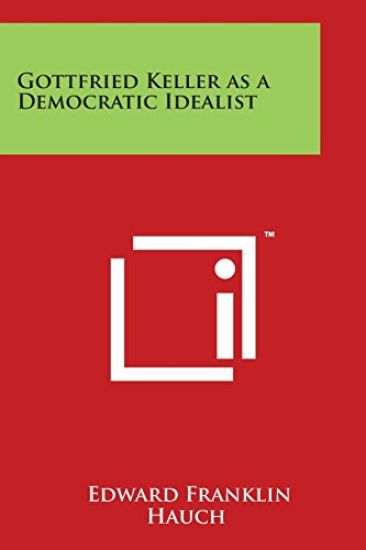
Gottfried Keller as a Democratic Idealist
Edward Franklin Hauch
Literary Licensing, LLC
2014
nidottu

Gottfried Wilhelm Leibniz, the humanist agenda and scientific method: The unity of humanism, theism and science
Kundan Misra
Createspace Independent Publishing Platform
2014
nidottu