'Zero 921: A Collection of Poetry of Just About Everything' is a heartfelt journey through the ups and downs of life, told through the eyes of someone who has seen the world and lived its stories. From the quiet moments of reflection to the chaos of adventure, each poem captures the raw emotions of a life spent exploring new places and old memories. This collection dives into love, loss, discovery, and growth themes, blending the personal with the universal. Whether you've travelled far or stayed close to home, 'Zero 921'invites you to pause and find pieces of your story within its pages.
CORE CONSERVATISM: Edmund Burke's Landmark Definition asserts the classic view that Edmund Burke defined the foundations of modern conservative thought. It does so by citing extensively the historic evidence provided by Burke himself in his Reflections on the Revolution in France. CORE CONSERVATISM defies the revisionist doubts of academic historians like Dr Emily Jones in her 2019 paperback, "Edmund Burke and the invention of Modern Conservatism 1830-1914". CORE CONSERVATISM makes the full text of Edmund Burke's classic statement of Conservative thinking accessible and more comprehensible by providing - A Structure and Contents index to the 96,000 word text written originally as a continuous letter without any chapters or headings - A universal number referencing system for the 400 paragraphs of the original text - An Introduction for those with no previous knowledge of Edmund Burke or his Reflections - A 10,000 word summary of Edmund Burke's political philosophy, citing extensively from Edmund Burke's own Reflections - The author's personal distillation of Edmund Burke's thinking in his Reflections to 3 Primary Principles and 10 key tenets of modern Conservative doctrine CORE CONSERVATISM is essential reading for both convinced Conservatives and for students of politics and history. It highlights the critical role of Christianity in the formation of Conservative thinking in the English speaking nations and challenges the Materialistic worldview of today's western intelligentsia.
The "Book of Aneirin" is a thirteenth-century manuscript collection of Welsh praise-poetry. In comparison with other Welsh sources of similar date, the language of this text exhibits a number of features which have been interpreted as archaisms and taken as indications of great antiquity for the text. However, particularly in syntax, claims about the status of these 'archaisms' have not been discussed in the context of the grammatical organisation of the text as a whole. This book approaches various aspects of grammar against the background of a comprehensive edition of the finite verbal clauses of the text. Syntactic analysis of the data-base so established takes its point of departure from the relationship of the verb with its arguments in the clause, and is concentrated on two issues: 1. the type and status of basic word order in the text; 2. the interaction of the semantics of the predication with the pragmatics of communication of information. It is argued that, as would be expected for a Welsh text, the basic order is VSO, but also, and more importantly, that the text does not contain 'archaic' evidence of any earlier, different basic orders. Rather it is argued that word-order variation in the text can be rigorously analysed in terms of a model of functional syntax which is sensitive to both the pragmatics of the text and the semantics of the predications involved. In the light of these results, argumentation concerning historical syntax and especially reconstruction of syntax are evaluated, both in the field of Celtic and in wider cross-language perspective. Finally, the edition of the finite clauses of the text is followed by a number of notes discussing historical and synchronic aspects of the material presented, with particular emphasis on morphology and etymology.
Ballads of The North Countrie is an unchanged, high-quality reprint of the original edition of 1888. Hansebooks is editor of the literature on different topic areas such as research and science, travel and expeditions, cooking and nutrition, medicine, and other genres. As a publisher we focus on the preservation of historical literature. Many works of historical writers and scientists are available today as antiques only. Hansebooks newly publishes these books and contributes to the preservation of literature which has become rare and historical knowledge for the future.
--Amazon Best Seller --"After suffering from heart burn/indigestion for a long time, I noticed that this went away almost overnight. Following this plan will make you feel better for sure." Sarah Y. Witt, Botswana, Africa --"AIEP is a step-by-step plan that can make all the difference for those needing to know EXACTLY what to do." Kim Watson, Slidell, LA --"I am totally free from pain, and I continue to notice improvements in every area of my health (including sleep, digestion, skin, teeth, endurance, and energy)." Karen Gearreald, Norfolk, VA --"Her wisdom has assisted me to make food choices that excellent for my body and I experience the result in energy and superb health." Marianne Chalk, Chesapeake, VA --"I decided to put the AIEP plan into action. Within two days, my fasting glucose numbers were reduced to what is considered the 'normal' range, and have been there ever since." John Chasteen, Oklahoma City, OK --"AIEP has made an amazing difference in my body and my life. This is a must read." Zelle Phillips, Virginia Beach, VA ------------------------------------------------------- Anti Inflammatory Diet Relieves Symptoms of Chronic Disease In Weeks Without the Danger of Drugs Are you tired of fighting the symptoms of the #1 killer, heart disease? Or the symptoms of the most feared disease, cancer? Or how about the disease which has become a major concern in America, dementia? What about the multitude of other chronic diseases such as arthritis, allergies, asthma, diabetes, and obesity? Then there are the symptoms of aging as well as other every-day aches and pains. Fortunately, a simple shift to an anti inflammatory diet can provide an answer to these maladies that does not involve the use of pharmaceutical drugs. Sounds too good to be true? Sounds like "snake oil?" Well, quite the contrary There is a growing body of strong research linking low-grade inflammation in the body with all, and more, of the health challenges mentioned above. Indeed, there are a growing number of widely respected health care professionals acknowledging this connection, and more and more "how to" books are becoming available touting the effectiveness of switching to an anti inflammation diet (aka anti inflammatory diet). This book is not one of those "how to" books. Rather it is a diary or journal written by the well-known wellness coach, Sharon Graham, as she and her husband set out on a four-week journey to switch their already healthy eating habits to consuming nothing but anti inflammatory foods. Follow this couple as the author outlines her plan, lists the foods within the plan, and provides a day-by-day, meal-by-meal description (often with photos) of what they ate and the benefits they observed along the way.
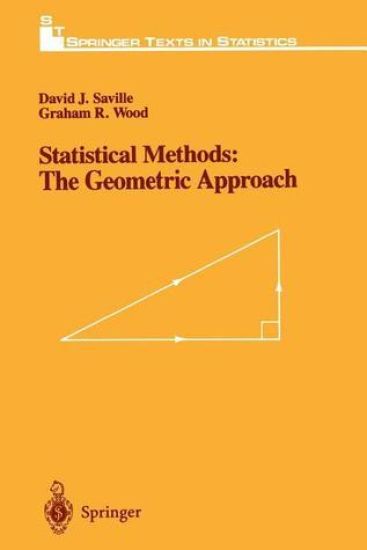
The aim of this book is to present the mathematics underlying elementary statistical methods in as simple a manner as possible. These methods include independent and paired sample t-tests, analysis of variance, regression, and the analysis of covariance. The author's principle tool is the use of geometric ideas to provide more visual insight and to make the theory accessible to a wider audience than is usually possible.
This book is a novel exposition of the traditional workhorses of statistics: analysis of variance and regression. The key feature is that these tools are viewed in their natural mathematical setting, the geometry of finite dimensions. The Authors To introduce ourselves, Dave Saville is a practicing statistician working in agricultural research; Graham Wood is a university lecturer involved in the teaching of statistical methods. Each of us has worked for sixteen years in our current field. Features of the Book People like pictures. One picture can present a set of ideas at a glance, while a series of pictures, each building on the last, can unify a wealth of ideas. Such a series we present in this text by means of a systematic geometric approach to the presentation of the theory of basic statistical methods. This approach fills the void between the traditional extremes of the "cookbook" approach and the "matrix algebra" approach, providing an elementary but at the same time rigorous view of the subject. It combines the virtues of the traditional methods, while avoiding their vices.
This book is a novel exposition of the traditional workhorses of statistics: analysis of variance and regression. The key feature is that these tools are viewed in their natural mathematical setting, the geometry of finite dimensions. The Authors To introduce ourselves, Dave Saville is a practicing statistician working in agricultural research; Graham Wood is a university lecturer involved in the teaching of statistical methods. Each of us has worked for sixteen years in our current field. Features of the Book People like pictures. One picture can present a set of ideas at a glance, while a series of pictures, each building on the last, can unify a wealth of ideas. Such a series we present in this text by means of a systematic geometric approach to the presentation of the theory of basic statistical methods. This approach fills the void between the traditional extremes of the "cookbook" approach and the "matrix algebra" approach, providing an elementary but at the same time rigorous view of the subject. It combines the virtues of the traditional methods, while avoiding their vices.
Darlington from Anglo-Saxon settlement to thriving town, via the middle ages and the coming of the railway. It is exactly a thousand years since Darlington first appeared in written records. During the following millennium, the small Anglo-Saxon settlement grew into today's thriving town, its history now generally linked in the public mind with entrepreneurial Quakers and the birth of railways. But as this book shows, Darlington's history encompasses many more diverse aspects in the change from medieval village to modern town. Through a survey of its physical development, the book describes how the town flourished in the middle ages; was largely destroyed by fire in 1585; and grew again in the seventeenth and eighteenth centuries, before the coming of the railway in the mid-1800s reinforced its prosperity. Its story is taken up to the present day, showing how Darlington is characterised by residential suburbs, with a town centre where Victorian and eighteenth-century buildings populate the original medieval streets. Dr GILL COOKSON is the County Editor for the Victoria County History of Durham.