Kirjahaku
Etsi kirjoja tekijän nimen, kirjan nimen tai ISBN:n perusteella.
1000 tulosta hakusanalla Hans-Peter Ullmann
This book is the first to present every rocket aircraft flown in Germany and the rocket systems developed by Walter and BMW, as well as several of the most interesting projects drawn up by Germany’s aviation industry. In 1940 the Deutsche Forschungsanstalt für Segelflug launched the DFS 194, developed by Alexander Lippisch, and the tests with this experimental plane laid the foundation for the Messerschmitt Me 163, the world’s first operational rocket fighter. Using a Walter rocket engine, the Me 163 achieved hitherto unimaginable climb rates and speeds. It was in this rocket powered plane that, on 2 October 1941, Heini Dittmar reached 1003 km/h and thus became the first pilot in the world to break the magic mark of 1000 km/h. In so doing, he also brushed against the sound barrier. The technology incorporated into Germany’s rocket planes – the Messerschmitt Me 163 Bs and Cs, the Me 263, and Bachem Ba 349 Natter – was recognized throughout the world as cutting edge and after the war had a major impact on the technological development of other countries. This book is a must-have for every aviation enthusiast.
Event History Analysis
Hans-Peter Blossfeld; Alfred Hamerle; Karl Ulrich Mayer
Psychology Press
1988
sidottu
Serving as both a student textbook and a professional reference/handbook, this volume explores the statistical methods of examining time intervals between successive state transitions or events. Examples include: survival rates of patients in medical studies, unemployment periods in economic studies, or the period of time it takes a criminal to break the law after his release in a criminological study. The authors illustrate the entire research path required in the application of event-history analysis, from the initial problems of recording event-oriented data to the specific questions of data organization, to the concrete application of available program packages and the interpretation of the obtained results. Event History Analysis: * makes didactically accessible the inclusion of covariates in semi-parametric and parametric regression models based upon concrete examples * presents the unabbreviated close relationship underlying statistical theory * details parameter-free methods of analysis of event-history data and the possibilities of their graphical presentation * discusses specific problems of multi-state and multi-episode models * introduces time-varying covariates and the question of unobserved population heterogeneity * demonstrates, through examples, how to implement hypotheses tests and how to choose the right model.
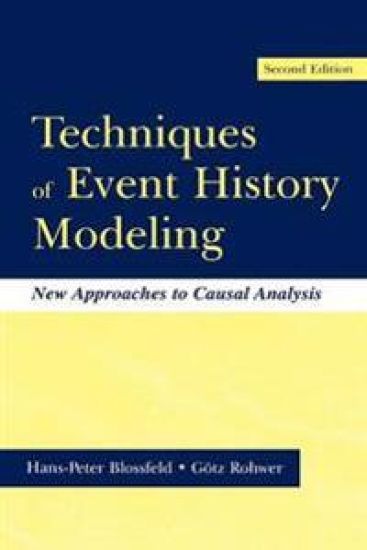
Including new developments and publications which have appeared since the publication of the first edition in 1995, this second edition: *gives a comprehensive introductory account of event history modeling techniques and their use in applied research in economics and the social sciences; *demonstrates that event history modeling is a major step forward in causal analysis. To do so the authors show that event history models employ the time-path of changes in states and relate changes in causal variables in the past to changes in discrete outcomes in the future; and *introduces the reader to the computer program Transition Data Analysis (TDA). This software estimates the sort of models most frequently used with longitudinal data, in particular, discrete-time and continuous-time event history data. Techniques of Event History Modeling can serve as a student textbook in the fields of statistics, economics, the social sciences, psychology, and the political sciences. It can also be used as a reference for scientists in all fields of research.
Development and operations of the German Mistel aircraft were kept under the tightest security, in an era fraught with the chaotic turmoil of a losing war. Aside from the limited space available - which precludes a detailed account of this unusual variant of the air war - it should also be mentioned that the quality of the photographic material often leaves something to be desired. This concession, which should be considered the exception rather than the rule, is necessary in the interest of providing a good general overview.
Knud Lyne Rahbek, Kamma Rahbek Og Livet Paa Bakkehuset...
Hans Peter Kyrre
Hutson Street Press
2025
sidottu
Knud Lyne Rahbek, Kamma Rahbek Og Livet Paa Bakkehuset...
Hans Peter Kyrre
Hutson Street Press
2025
pokkari
Collectarius Perpetuarum Formarum Johannis De Geylnhusen...
Hans Peter Kaiser
Hutson Street Press
2025
sidottu
Causal Analysis with Event History Data Using Stata
Hans-Peter Blossfeld; Götz Rohwer; Gwendolin J. Blossfeld
TAYLOR FRANCIS LTD
2025
nidottu
This third edition of Causal Analysis with Event History Data Using Stata provides an updated introduction to event history modeling along with many instructive Stata examples. Using the latest Stata software, each of these practical examples develops a research question, points to useful contextual background information, gives a brief account of the underlying statistical concepts, describes the organization of input data and the application of Stata statistical procedures, and assists the reader in interpreting the content of the results obtained. Emphasizing the strengths and limitations of continuous-time event history analysis in different fields of social science applications, this book demonstrates that event history models provide a useful approach to uncover causal relation- ships or to map a system of causal relationships. In particular, this book demonstrates how long-term processes can be studied, how different forms of duration dependencies can be estimated using nonparametric, parametric and semiparametric models, and how parallel and interdependent dynamic systems can be analyzed from a causal-analytical point of view using the method of episode splitting. The book also shows how changing contextual information at the micro, meso and macro levels can be easily integrated into a dynamic analysis of longitudinal data. Finally, the book addresses the problem of unobserved heterogeneity of time-constant and time-dependent omitted variables and makes suggestions for dealing with these sometimes difficult methodological problems.Causal Analysis with Event History Data Using Stata is an invaluable resource for both novice and experienced researchers from a variety of fields (e.g. sociology, economics, political science, education, psychology, demography, epidemiology, management research and organizational studies, as well as medicine and clinical applications) who need an introductory textbook on continuous-time event history analysis and who are looking for a practical handbook for their longitudinal research.
Causal Analysis with Event History Data Using Stata
Hans-Peter Blossfeld; Götz Rohwer; Gwendolin J. Blossfeld
TAYLOR FRANCIS LTD
2025
sidottu
This third edition of Causal Analysis with Event History Data Using Stata provides an updated introduction to event history modeling along with many instructive Stata examples. Using the latest Stata software, each of these practical examples develops a research question, points to useful contextual background information, gives a brief account of the underlying statistical concepts, describes the organization of input data and the application of Stata statistical procedures, and assists the reader in interpreting the content of the results obtained. Emphasizing the strengths and limitations of continuous-time event history analysis in different fields of social science applications, this book demonstrates that event history models provide a useful approach to uncover causal relation- ships or to map a system of causal relationships. In particular, this book demonstrates how long-term processes can be studied, how different forms of duration dependencies can be estimated using nonparametric, parametric and semiparametric models, and how parallel and interdependent dynamic systems can be analyzed from a causal-analytical point of view using the method of episode splitting. The book also shows how changing contextual information at the micro, meso and macro levels can be easily integrated into a dynamic analysis of longitudinal data. Finally, the book addresses the problem of unobserved heterogeneity of time-constant and time-dependent omitted variables and makes suggestions for dealing with these sometimes difficult methodological problems.Causal Analysis with Event History Data Using Stata is an invaluable resource for both novice and experienced researchers from a variety of fields (e.g. sociology, economics, political science, education, psychology, demography, epidemiology, management research and organizational studies, as well as medicine and clinical applications) who need an introductory textbook on continuous-time event history analysis and who are looking for a practical handbook for their longitudinal research.
Universities, Rankings and the Dynamics of Global Higher Education
Hans Peter Hertig
Palgrave Macmillan
2016
sidottu
Global university rankings are now more than a decade old and this book uses the data they have produced to examine how the international landscape of universities has changed over the years. It offers new insights into the power and limits of league tables, a key element of globalized higher education that can be deplored but hardly ignored. Case studies from Asia, Europe and North America are explored to highlight the issues raised by a quantitative exercise that decontextualizes what is linked so strongly to local factors.
Nowadays, event history analysis can draw on a well-established set of statistical tools for the description and causal analysis of event history data. The second edition of Event History Analysis with Stata provides an updated introduction to event history modeling, along with many instructive Stata examples. Using the latest Stata software, each of these practical examples develops a research question, refers to useful substantive background information, gives a short exposition of the underlying statistical concepts, describes the organization of the input data and the application of the statistical Stata procedures, and assists the reader in performing a substantive interpretation of the obtained results. Emphasising the strengths and limitations of event history model techniques in each field of application, this book demonstrates that event history models provide a useful approach with which to uncover causal relationships or to map out a system of causal relations. It demonstrates how long-term processes can be studied and how changing context information on the micro, meso, and macro levels can be integrated easily into a dynamic analysis of longitudinal data. Event History Analysis with Stata is an invaluable resource for both novice students and researchers who need an introductory textbook and experienced researchers (from sociology, economics, political science, pedagogy, psychology, or demography) who are looking for a practical handbook for their research.
The CRC Handbook of Chromatography is a series of work-bench references for scientists and researchers using chromatographic systems for the analysis of organic and inorganic compounds.This handbook is an assemblage of tables where, besides data obtained by modern separation methods, older sources often difficult to access have been included to give maximum information. For use in scientific research and routine analysis where the exact determination of plant pigments, because of their light absorbing properties and defined tasks, is necessary.
Event History Analysis
Hans-Peter Blossfeld; Alfred Hamerle; Karl Ulrich Mayer
Psychology Press Ltd
2016
nidottu
Serving as both a student textbook and a professional reference/handbook, this volume explores the statistical methods of examining time intervals between successive state transitions or events. Examples include: survival rates of patients in medical studies, unemployment periods in economic studies, or the period of time it takes a criminal to break the law after his release in a criminological study. The authors illustrate the entire research path required in the application of event-history analysis, from the initial problems of recording event-oriented data to the specific questions of data organization, to the concrete application of available program packages and the interpretation of the obtained results. Event History Analysis: * makes didactically accessible the inclusion of covariates in semi-parametric and parametric regression models based upon concrete examples * presents the unabbreviated close relationship underlying statistical theory * details parameter-free methods of analysis of event-history data and the possibilities of their graphical presentation * discusses specific problems of multi-state and multi-episode models * introduces time-varying covariates and the question of unobserved population heterogeneity * demonstrates, through examples, how to implement hypotheses tests and how to choose the right model.
Holst, H: Sicilianische Novellen Und Skizzen (1855)
Hans Peter Holst
KESSINGER PUBLISHING, LLC
2010
nidottu