

Kirjahaku
Etsi kirjoja tekijän nimen, kirjan nimen tai ISBN:n perusteella.
1000 tulosta hakusanalla Hartmut Ulle

Sozialsemiotik der Typographie. Interpretationen von Bildaufnahmen nach Hartmut Stöckl
Marko Stevic
Grin Publishing
2014
pokkari

Die Veränderung des deutschen Bildungssystems zu einem Wettbewerbsmarkt. Hartmut Rosas Theorie der sozialen Beschleunigung
Julien Dietrich
Grin Publishing
2015
pokkari

"Erfahrungsoffene Lebensschule" statt "langweiliger Unterrichtsanstalt". Zu Hartmut von Hentigs Versuch, die Schule "neu zu denken"
Michael Kuhlmann
Grin Publishing
2015
pokkari
Studienarbeit aus dem Jahr 1996 im Fachbereich P dagogik - Allgemeine Didaktik, Erziehungsziele, Methoden, Note: 1,0, Westf lische Wilhelms-Universit t M nster (Institut f r Erziehungswissenschaft), Veranstaltung: Hauptseminar "Allgemeine Didaktik und p dagogische Ausbildung, Sprache: Deutsch, Abstract: Peter Struck mahnt eine "Wiederentdeckung der Lehre von den sinnvollen Gr en in der P dagogik" an. Von einem "enormen Reformstau" spricht Rainer Winkel. Klaus Hurrelmann warnt, viele Sch ler betrachteten ihre Schulzeit als "verlorene Lebenszeit". Eine Umfrage von 1990/91 ergab, dass gerade einmal ein Drittel der westdeutschen Jugendlichen gerne in die Schule gehen bzw. gingen. Die seit Mitte der sechziger Jahre laufende Bildungsreform in der BRD scheint steckengeblieben zu sein. Die Diskussion dar ber ist so alt wie die Reform selbst und wird nicht leichter dadurch, dass Lautst rke und Publizit t einer u erung oft im Gegensatz zu ihrer Differenziertheit und ihrem Gehalt stehen. In der ffentlichkeit dominiert ein Gemisch von Halbbildung und Weltanschauung. Zu den gleichwohl zahlreichen Stimmen, die differenziertere Thesen f r eine fortgesetzte oder auch neue Reform entwickelt haben, geh rt der Bielefelder P dagoge Hartmut von Hentig, dessen Schulprojekte gro e Aufmerksamkeit erregt haben. 1994 wandte sich von Hentig mit neuen Anregungen an die Fachwelt. Un berlegte Ver nderungen in der Schule hielt er f r Kurieren an Symptomen. N tig sei, die Schule "neu zu denken". Die folgende Arbeit skizziert von Hentigs Ansatz, erg nzt ihn um ltere berlegungen und stellt ihm u erungen einiger seiner Fachkollegen gegen ber. Daneben beleuchtet sie kurz die Frage, inwieweit sich einige der Reformans tze praktisch verwirklichen lassen. Da ich im Verlauf einer einw chigen Hospitation an meinem alten Gymnasium noch einmal verschiedene Arten von Unterricht miterlebt habe - darunter

Soziologische Konzepte zur Modernisierung. Essay zu Hartmut Rosas "Kulturen der Moderne. Soziologische Perspektive der Gegenwart"
Conni Endres
Grin Publishing
2016
pokkari

Versuch eines pädagogischen Berufsethos. Der Sokratische Eid von Hartmut von Hentig unter Berücksichtigung der Kritik von Hermann Giesecke
Timo Bleckwedel
Grin Verlag
2018
pokkari

'Iwein, das gute und das schlechte Regiment' - Eine Auseinandersetzung mit Hartmut Kuglers gleichnamigem Aufsatz
Sonja Riedel
Grin Verlag
2008
pokkari

Zur Demokratisierung Indiens und Abgleich mit dem Theorie-Ansatz von Dr. Hartmut Elsenhans
Andre Herrmann
Grin Verlag
2011
nidottu
Studienarbeit aus dem Jahr 2009 im Fachbereich Politik - Internationale Politik - Region: S dasien, Note: 1,3, Universit t Leipzig, Sprache: Deutsch, Abstract: Diese Hausarbeit soll den Demokratisierungsprozess Indiens seit seiner Unabh ngigkeit veranschaulichen. Es sollen Hemmnisse, wie auch Besonderheiten aufgezeigt und problematisiert werden. Dazu soll zuerst und kurz die geschichtliche Entwicklung Indiens seit der Unabh ngigkeit nachgezeichnet werden, um besondere Ereignisse hervor zu heben und sp ter auf vereinzelte F lle eingehen zu k nnen. Dieser kurze Abschnitt erhebt bewusst keinen Anspruch auf Vollst ndigkeit, um den Rahmen einer Hausarbeit nicht zu sprengen. Anschlie end soll der entwicklungstheoretische Ansatz von Dr. Hartmut Elsenhans beschrieben werden, um so eine theoretische Grundlage f r weitere Betrachtungen zu schaffen. Hierbei wird insbesondere auf die in seiner Theorie zentralen Begriffe Marginalit t, Rente und Staatsklasse eingegangen. Au erdem sollen Ma nahmen beschrieben werden, die Elsenhans f r die berwindung von Marginalit t, Renten konomie und Staatsklasse vorsieht. Weiterhin soll auf m gliche Probleme bei der Umsetzung dieser Ma nahmen eingegangen werden. Schlie lich soll die Elsenhanssche Theorie auf die wirtschaftlichen und politischen Entwicklungen Indiens angewendet werden. Dabei wird eine zeitliche Trennlinie am Beginn der wirtschaftlichen Liberalisierung Indiens gesetzt, um Ver nderungen noch besser deutlich machen zu k nnen. Auch hierbei k nnen nur bestimmte zentrale Vorkommnisse und Probleme angesprochen werden.

Der Einfluss unterschiedlicher Familientypen auf die Entwicklung des Kindes. Zu "Pubertat und Adoleszenz von Hartmut Kasten
T Woodpecker
Grin Publishing
2016
nidottu

Versicherungsaufsichtsgesetz. Was u.a. Hartmut Koschyk dazu sagt
Dictus Publishing
2011
pokkari


Konkrete Progressionen. François Morellet, Vera Molnar, Manfred Mohr, Hartmut Böhm
Holger Kube Ventura
Dr. Cantz'sche Verlagsges
2023
nidottu

Contemporary theory of international politics faces a twofold problem: the critical engagement with legacies of national power politics in connection to 20th Century International Relations and the regeneration of notions of humanity. This book contributes to this engagement by a genealogy of thoughts on war, peace, and ethics.
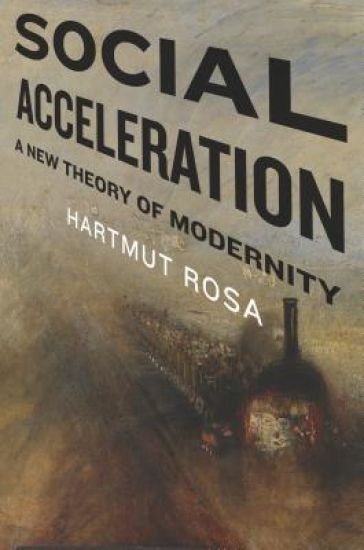
Hartmut Rosa advances an account of the temporal structure of society from the perspective of critical theory. He identifies three categories of change in the tempo of modern social life: technological acceleration, evident in transportation, communication, and production; the acceleration of social change, reflected in cultural knowledge, social institutions, and personal relationships; and acceleration in the pace of life, which happens despite the expectation that technological change should increase an individual's free time. According to Rosa, both the structural and cultural aspects of our institutions and practices are marked by the "shrinking of the present," a decreasing time period during which expectations based on past experience reliably match the future. When this phenomenon combines with technological acceleration and the increasing pace of life, time seems to flow ever faster, making our relationships to each other and the world fluid and problematic. It is as if we are standing on "slipping slopes," a steep social terrain that is itself in motion and in turn demands faster lives and technology. As Rosa deftly shows, this self-reinforcing feedback loop fundamentally determines the character of modern life.

Hartmut Rosa advances an account of the temporal structure of society from the perspective of critical theory. He identifies three categories of change in the tempo of modern social life: technological acceleration, evident in transportation, communication, and production; the acceleration of social change, reflected in cultural knowledge, social institutions, and personal relationships; and acceleration in the pace of life, which happens despite the expectation that technological change should increase an individual's free time. According to Rosa, both the structural and cultural aspects of our institutions and practices are marked by the "shrinking of the present," a decreasing time period during which expectations based on past experience reliably match the future. When this phenomenon combines with technological acceleration and the increasing pace of life, time seems to flow ever faster, making our relationships to each other and the world fluid and problematic. It is as if we are standing on "slipping slopes," a steep social terrain that is itself in motion and in turn demands faster lives and technology. As Rosa deftly shows, this self-reinforcing feedback loop fundamentally determines the character of modern life.
A German writer's aphoristic, poetic, and difficult reflections on Heidegger's Being and Time.There is a beyond of reason and unreason. It is the human psyche.-Positive NihilismLike many German intellectuals, Hartmut Lange has long grappled with Heidegger. Positive Nihilism is the result of a lifetime of reading Being and Time and offers a series of reflections that are aphoristic, poetic, and (appropriately, considering his object of study) difficult. Lange begins with an abyss ("There is an abyss of the finite. It is temporality") and proceeds almost immediately to extremity: "The twentieth century was governed by psychopaths. They collapsed the boundaries of moral reason and refuted Kant's analysis of consciousness." He reflects further: "But who shall punish whom? One man's virtue is another man's crime. Thus Hitler could feel unwaveringly, as he wiped out entire populations, the starry sky above him and the moral law within him, as stipulated by Kant." He considers the concept of civilization ("misleading"; "how should one oppose the remedies of civilization to the egomania, the murderous appetites of such outright psychopaths as Stalin or Pol Pot?"), the act of thinking (a fata morgana), the psyche, and Heidegger's Dasein.Positive Nihilism can be considered a pocket companion to Being and Time. "Heidegger's understanding of Being is nihilistic," Lange writes, and then explains his assertion. He draws on Kant, Nietzsche, Kierkegaard, and Shakespeare's Othello for supporting arguments and illustrations. "Everyone is possessed of the courage to have angst about death. The question is whether this courage necessarily secures those vital advantages Heidegger alleges"-that "self-understanding [is] the mental anticipation of death." Lange wrestles with Heidegger's position, calling on Tolstoy, Georg Trakl, Herman Bang, and Heinrich von Kleist to argue against it.

The historic detection of gravitational waves on September 14, 2015, prompted by the highly energetic fusion of two black holes, has made events in the universe "audible" for the first time. This expansion of the scientific sensorium has opened a new chapter in astronomy and already led to, among others, fascinating new insights about the abundance of black holes, the collision of neutron stars, and the origin of heavy chemical elements.The history of this event, which is epochal for physics, is reconstructed in this book, along with a walk-through of the main principles of how the detectors operate and a discussion of how the search for gravitational waves is conducted. The book concludes with an update of the latest detections and developments to date and a brief look into the future of this exciting research field.This book is accessible to non-specialist readers from a general audience and is also an excellent introduction to the topic for undergraduates in physics. Features: Provides an introduction to the historic discovery of gravitational waves Explains the inner workings of the detectors and the search to find the waves hidden in the data Authored by a renowned specialist involved in the ground-breaking discoveryHartmut Grote is a Professor of physics at Cardiff University, UK. His main expertise is in experimental gravitational-wave physics, and he has worked on building and improving gravitational wave detectors for over 20 years. From 2009 to 2017, he was the scientific leader of the British-German gravitational-wave detector: GEO600.

The historic detection of gravitational waves on September 14, 2015, prompted by the highly energetic fusion of two black holes, has made events in the universe "audible" for the first time. This expansion of the scientific sensorium has opened a new chapter in astronomy and already led to, among others, fascinating new insights about the abundance of black holes, the collision of neutron stars, and the origin of heavy chemical elements.The history of this event, which is epochal for physics, is reconstructed in this book, along with a walk-through of the main principles of how the detectors operate and a discussion of how the search for gravitational waves is conducted. The book concludes with an update of the latest detections and developments to date and a brief look into the future of this exciting research field.This book is accessible to non-specialist readers from a general audience and is also an excellent introduction to the topic for undergraduates in physics. Features: Provides an introduction to the historic discovery of gravitational waves Explains the inner workings of the detectors and the search to find the waves hidden in the data Authored by a renowned specialist involved in the ground-breaking discoveryHartmut Grote is a Professor of physics at Cardiff University, UK. His main expertise is in experimental gravitational-wave physics, and he has worked on building and improving gravitational wave detectors for over 20 years. From 2009 to 2017, he was the scientific leader of the British-German gravitational-wave detector: GEO600.

This book is a comprehensive tool both for self-study and for use as a text in classical geometry. It explains the concepts that form the basis for computer-aided geometric design.