Kirjojen hintavertailu. Mukana 11 627 373 kirjaa ja 12 kauppaa.

Kirjahaku

Etsi kirjoja tekijän nimen, kirjan nimen tai ISBN:n perusteella.

1000 tulosta hakusanalla Heinrich Weinel

Heinrich Rudolf Hertz (1857-1894)
Published in 1994: This book is to commemorate the one hundredth anniversary of Heinrich Hertz’s death at the terribly young age of thirty-six. The introductory biography together with eleven papers by Hertz and seven about him are intended to highlight the importance of Hertz’s contributions to physics and at the same time to serve the needs of anyone interested in doing research on this highly gifted scientist.
Heinrich Rudolf Hertz (1857-1894)
Published in 1994: This book is to commemorate the one hundredth anniversary of Heinrich Hertz’s death at the terribly young age of thirty-six. The introductory biography together with eleven papers by Hertz and seven about him are intended to highlight the importance of Hertz’s contributions to physics and at the same time to serve the needs of anyone interested in doing research on this highly gifted scientist.
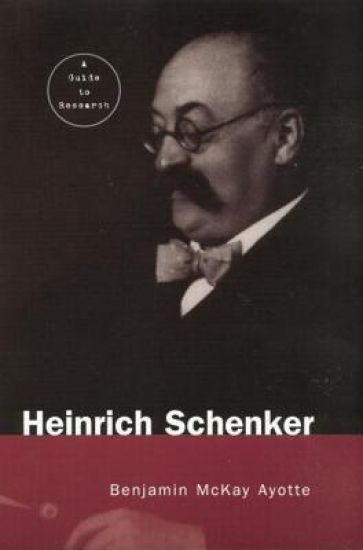
Heinrich Schenker

Heinrich Schenker

Benjamin Ayotte

Routledge
2014
nidottu
Heinrich Schenker: A Research and Information Guide is an annotated bibliography concerning both the nature of primary sources related to the composer and the scope and significance of the secondary sources which deal with him, his compositions, and his influence as a composer and theorist.
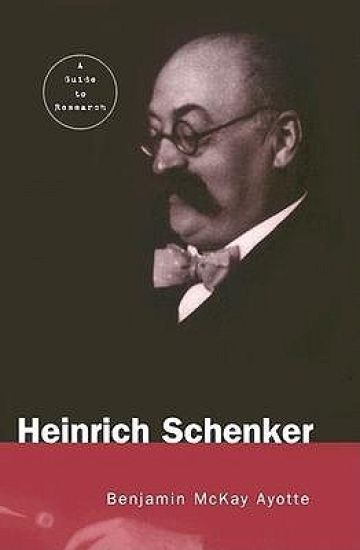
Heinrich Schenker

Heinrich Schenker

Benjamin Ayotte

Routledge
2003
sidottu
This book consists of over 1,500 citations to both primary sources and the burgeoning secondary literature of Heinrich Schenker, annotated and subdivided by category. The citations are supplemented with indices cross-referencing entries according to individual works and analytical topic.
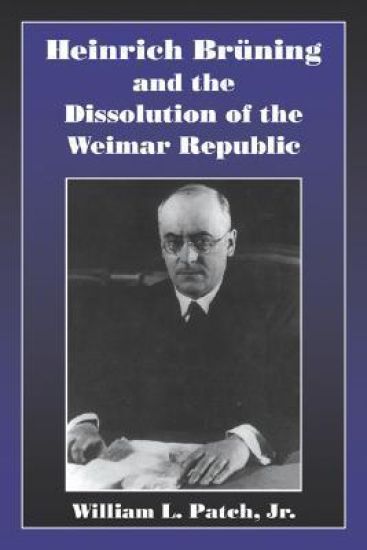
Heinrich Bruning and the Dissolution of the Weimar Republic
Scholars have long debated whether Heinrich Brüning, head of the German government from 1930 to 1932, was the 'last democratic chancellor'of the Weimar Republic or the trailblazer of the Nazi dictatorship. His memoirs (published in 1970) damaged his reputation badly by terming the restoration of monarchy the 'crux' of his policies. This 1998 book is the first scholarly biography of Bruning in any language and offers a systematic analysis of the economic, social, foreign, and military policies of his cabinet as it sought to cope with the Great Depression. With the help of newly available sources, it clarifies the peculiar distortions in the memoirs, showing that Chancellor Brüning intended to restore parliamentary democracy intact when the economic crisis passed. He was curbing the Nazi menace successfully when President Hindenburg, reactionary landowners, and army generals eager for massive rearmament made the disastrously misguided decision to topple him.
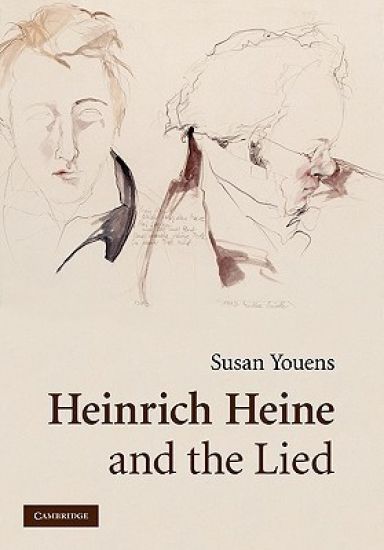
Heinrich Heine and the Lied

Heinrich Heine and the Lied

Youens Susan

Cambridge University Press
2011
pokkari
More than any other poet, Heinrich Heine has provided composers for almost two hundred years with texts for music: more than eight thousand compositions to date. Nineteenth-century composers were drawn in particular to a limited selection of Heine's early lyrical works from the Buch der Lieder and the Neue Gedichte for their songs; poems such as 'Du bist wie eine Blume', 'The sea hath its pearls' and 'Was will die einsame Träne' were set to music over and over again. In this book, Youens examines some of the reasons for Heine's popularity, especially the fact that composers in the second quarter of the nineteenth century were drawn to him for songs in radical styles, songs that redefined what Lied could be and do. Specific topics of this book include Schubert's fusion of reinvented song traditions with radical tonal procedures and the political meanings of poetry and song in Schumann's time.
Heinrich Bruning and the Dissolution of the Weimar Republic
Scholars have long debated whether Heinrich Brüning, head of the German government from 1930 to 1932, was the 'last democratic chancellor'of the Weimar Republic or the trailblazer of the Nazi dictatorship. His memoirs (published in 1970) damaged his reputation badly by terming the restoration of monarchy the 'crux' of his policies. This 1998 book is the first scholarly biography of Bruning in any language and offers a systematic analysis of the economic, social, foreign, and military policies of his cabinet as it sought to cope with the Great Depression. With the help of newly available sources, it clarifies the peculiar distortions in the memoirs, showing that Chancellor Brüning intended to restore parliamentary democracy intact when the economic crisis passed. He was curbing the Nazi menace successfully when President Hindenburg, reactionary landowners, and army generals eager for massive rearmament made the disastrously misguided decision to topple him.
Heinrich Heine and the Lied

Heinrich Heine and the Lied

Youens Susan

Cambridge University Press
2007
sidottu
More than any other poet, Heinrich Heine has provided composers for almost two hundred years with texts for music: more than eight thousand compositions to date. Nineteenth-century composers were drawn in particular to a limited selection of Heine's early lyrical works from the Buch der Lieder and the Neue Gedichte for their songs; poems such as 'Du bist wie eine Blume', 'The sea hath its pearls' and 'Was will die einsame Träne' were set to music over and over again. In this book, Youens examines some of the reasons for Heine's popularity, especially the fact that composers in the second quarter of the nineteenth century were drawn to him for songs in radical styles, songs that redefined what Lied could be and do. Specific topics of this book include Schubert's fusion of reinvented song traditions with radical tonal procedures and the political meanings of poetry and song in Schumann's time.
Heinrich Zimmer

Heinrich Zimmer

Princeton University Press
2014
pokkari
Heinrich Zimmer (1890-1943) is best known in the English-speaking world for the four posthumous books edited by Joseph Campbell and published in the Bollingen Series: Myths and Symbols in Indian Art and Civilization, Philosophies of India, The Art of Indian Asia, and The King and the Corpse. These works have inspired several generations of students of Indian religion and culture. All the papers in this volume testify to Zimmer's originality and to his rightful place in that small group of great scholars who were part of the first generation to confront the end of European empires in India and the rest of Asia. In her introduction, Margaret Case contrasts Zimmer's approach to India with that of Jung. There follow two recollections of Zimmer, one by his daughter Maya Rauch, the other by a close friend and supporter in Germany, Herbert Nette. Then William McGuire describes Zimmer's connections with Mary and Paul Mellon and with the Jungian circles in Switzerland and New York. A brief talk by Zimmer, previously unpublished, describes his admiration for Jung. Wendy Doniger picks up the question of Zimmer's intellectual legacy, especially in the light of Campbell's editorial work on his English publications. Gerald Chapple raises another question about how his influence was felt: the division between what is known of his work in the German-and the English-speaking worlds. Kenneth Zysk then summarizes and analyzes his contribution to Western knowledge of Hindu medicine; Matthew Kapstein evaluates his place in the West's appreciation of Indian philosophy; and Mary Linda discusses his contributions to the study of Indian art in the light of A. K. Coomaraswamy's work and more recent research. Originally published in 1994. The Princeton Legacy Library uses the latest print-on-demand technology to again make available previously out-of-print books from the distinguished backlist of Princeton University Press. These editions preserve the original texts of these important books while presenting them in durable paperback and hardcover editions. The goal of the Princeton Legacy Library is to vastly increase access to the rich scholarly heritage found in the thousands of books published by Princeton University Press since its founding in 1905.
Heinrich Heine

Heinrich Heine

Jeffrey L. Sammons

Princeton University Press
2014
pokkari
Heinrich Heine has been one of the liveliest topics in German literary studies for the past fifteen years. His life was marked by an exceptionally high pitch of constant public controversy and an extraordinary quantity of legend and speculation surround his reputation. This biography, the first in English in over twenty years and the first fully documented one in over a century, makes full use of the newest material in contemporary studies as well as of older scholarship. Originally published in 1980. The Princeton Legacy Library uses the latest print-on-demand technology to again make available previously out-of-print books from the distinguished backlist of Princeton University Press. These editions preserve the original texts of these important books while presenting them in durable paperback and hardcover editions. The goal of the Princeton Legacy Library is to vastly increase access to the rich scholarly heritage found in the thousands of books published by Princeton University Press since its founding in 1905.
Heinrich Zimmer

Heinrich Zimmer

Princeton University Press
2016
sidottu
Heinrich Zimmer (1890-1943) is best known in the English-speaking world for the four posthumous books edited by Joseph Campbell and published in the Bollingen Series: Myths and Symbols in Indian Art and Civilization, Philosophies of India, The Art of Indian Asia, and The King and the Corpse. These works have inspired several generations of students of Indian religion and culture. All the papers in this volume testify to Zimmer's originality and to his rightful place in that small group of great scholars who were part of the first generation to confront the end of European empires in India and the rest of Asia. In her introduction, Margaret Case contrasts Zimmer's approach to India with that of Jung. There follow two recollections of Zimmer, one by his daughter Maya Rauch, the other by a close friend and supporter in Germany, Herbert Nette. Then William McGuire describes Zimmer's connections with Mary and Paul Mellon and with the Jungian circles in Switzerland and New York. A brief talk by Zimmer, previously unpublished, describes his admiration for Jung. Wendy Doniger picks up the question of Zimmer's intellectual legacy, especially in the light of Campbell's editorial work on his English publications. Gerald Chapple raises another question about how his influence was felt: the division between what is known of his work in the German-and the English-speaking worlds. Kenneth Zysk then summarizes and analyzes his contribution to Western knowledge of Hindu medicine; Matthew Kapstein evaluates his place in the West's appreciation of Indian philosophy; and Mary Linda discusses his contributions to the study of Indian art in the light of A. K. Coomaraswamy's work and more recent research. Originally published in 1994. The Princeton Legacy Library uses the latest print-on-demand technology to again make available previously out-of-print books from the distinguished backlist of Princeton University Press. These editions preserve the original texts of these important books while presenting them in durable paperback and hardcover editions. The goal of the Princeton Legacy Library is to vastly increase access to the rich scholarly heritage found in the thousands of books published by Princeton University Press since its founding in 1905.
Heinrich Heine

Heinrich Heine

Jeffrey L. Sammons

Princeton University Press
2016
sidottu
Heinrich Heine has been one of the liveliest topics in German literary studies for the past fifteen years. His life was marked by an exceptionally high pitch of constant public controversy and an extraordinary quantity of legend and speculation surround his reputation. This biography, the first in English in over twenty years and the first fully documented one in over a century, makes full use of the newest material in contemporary studies as well as of older scholarship. Originally published in 1980. The Princeton Legacy Library uses the latest print-on-demand technology to again make available previously out-of-print books from the distinguished backlist of Princeton University Press. These editions preserve the original texts of these important books while presenting them in durable paperback and hardcover editions. The goal of the Princeton Legacy Library is to vastly increase access to the rich scholarly heritage found in the thousands of books published by Princeton University Press since its founding in 1905.
Heinrich Schenker and Beethoven's 'Hammerklavier' Sonata

Heinrich Schenker and Beethoven's 'Hammerklavier' Sonata

Nicholas Marston

Ashgate Publishing Limited
2013
sidottu
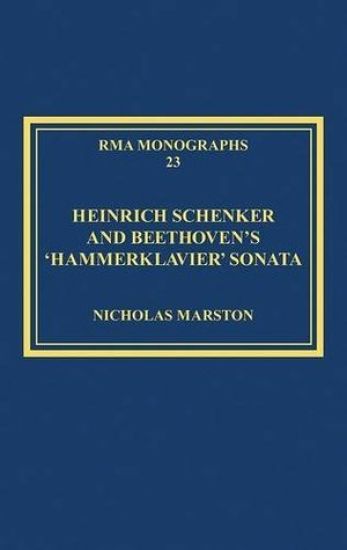
In 1912 Heinrich Schenker contracted with the Viennese publisher Universal Edition to provide an 'elucidatory edition' (Erläuterungsausgabe) of Beethoven's last five piano sonatas. Each publication would comprise a score, newly edited by Schenker and using the composer's autograph manuscript as principal source, together with a substantial commentary combining analytical, text-critical and performance-related matter. Four of the five editions appeared between 1913 and 1921, but that of the 'Hammerklavier' Sonata, op. 106, was never published. It has generally been assumed that this was simply because Schenker was unable to locate the autograph manuscript, which remains missing to this day. But as Nicholas Marston shows in a detailed history of the Erläuterungsausgabe project, other factors were involved also, including financial considerations, Schenker's health concerns, and his broader theoretical ambitions. Moreover, despite the missing autograph he nevertheless developed a voice-leading analysis of the complete sonata during the years 1924-1926, a crucial period in the development of his mature theory of tonal music. Marston's book provides the first in-depth study of this rich analysis, which is reproduced in full in high-quality digital images. The book draws on hundreds of letters and documents from Schenker's Nachlaß; it both adds to our biographical knowledge of Schenker and illuminates for the first time the response of this giant of music theory to one of the most significant masterworks in all music.
Heinrich Scheidemann's Keyboard Music

Heinrich Scheidemann's Keyboard Music

Pieter Dirksen

Ashgate Publishing Limited
2007
sidottu
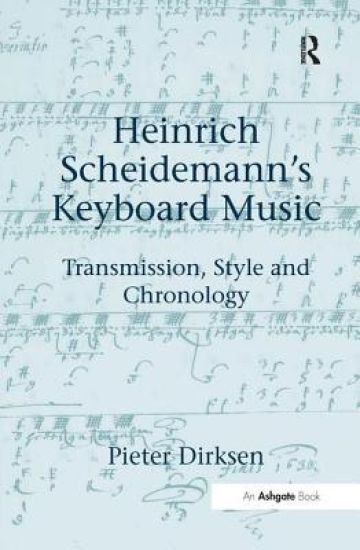
One of the most remarkable tales of recent resurrections in the field of early keyboard music concerns the music of Heinrich Scheidemann (c. 1595-1663). Long considered a minor master overshadowed by such figures as his teacher Jan Pieterszoon Sweelinck or his fellow student Samuel Scheidt, a number of major source discoveries made in the second half of the twentieth century - the most important one being the discovery of the Zellerfield tablatures - have gradually raised his stature towards what it should now be, namely that of the paramount figure in North German organ music of the first half of the seventeenth century, equalled only by Buxtehude in the second half. Pieter Dirksen, one of the leading scholars on early German keyboard music, shows how Scheidemann was a central personality in the rich musical life of Hamburg and stood on friendly terms with colleagues such as Jacob and Johannes Praetorius, Ulrich Cernitz, Thomas Selle, Johann Schop and Johann Rist. The sources for Scheidemann are for the most part contemporary and stem from all periods of his career, and beyond that until one or two decades after his death. His keyboard music was never published in his lifetime but circulated widely within professional circles. Dirksen considers the transmission of Scheidemann's music as a whole in Part One, where each source is analyzed individually, and the repertoire itself is examined in Part Two. A number of specialized studies, including a detailed investigation into the background of one of the sources as well as adressing questions of organology (an account of the famous Catharinen organ as it was during Scheidemann's era) and performance practice (a study of the fingering indications and observations on registration practice) form Part Three. A wealth of appendices also detail a relative chronology of the music; a geographic overview of the transmission and two hitherto unpublished, fragmentarily transmitted Scheidemann pieces. The book will therefore a
Heinrich Wilhelm Ernst: Virtuoso Violinist

Heinrich Wilhelm Ernst: Virtuoso Violinist

Mark Rowe

Ashgate Publishing Limited
2008
sidottu
From 1840-57, Heinrich Ernst was one of the most famous and significant European musicians, and performed on stage, often many times, with Berlioz, Mendelssohn, Chopin, Liszt, Wagner, Alkan, Clara Schumann, and Joachim. It is a sign of his importance that, in 1863, Brahms gave two public performances in Vienna of his own and Ernst's music to raise money for the now mortally ill violinist. Berlioz described Ernst as 'one of the artists whom I love the most, and with whose talent I am most sympathetique', while Joachim was in no doubt that Ernst was 'the greatest violinist I ever heard; he towered above the others'. Many felt that he surpassed the expressive and technical achievements of Paganini, but Ernst, unlike his great predecessor, was also a tireless champion of public chamber music, and did more than any other early nineteenth-century violinist to make Beethoven's late quartets widely known and appreciated. Ernst was not only a great virtuoso but also an accomplished composer. He wrote two of the most popular pieces of the nineteenth century - the Elegy and the Carnival of Venice - and he is best known today for two solo pieces which represent the ne plus ultra of technical difficulty: the transcription of Schubert's Erlking, and the sixth of his Polyphonic Studies, the variations on The Last Rose of Summer. Perhaps he made his greatest contribution to music through his influence on Liszt's outstanding masterpiece, the B minor piano sonata. In 1849, Liszt conducted Ernst playing his own Concerto Pathétique, a substantial single-movement work, in altered sonata form, using thematic transformation. Soon after this performance, Liszt wrote his Grosses Konzertsolo (1849-50), his first extended single-movement work, using altered sonata form, and thematic transformation. This is now universally acknowledged to be the immediate forerunner of the sonata, which refines and develops all these techniques. Liszt made his debt clear when, three years after completi
Heinrich Heshusius and Confessional Polemic in Early Lutheran Orthodoxy
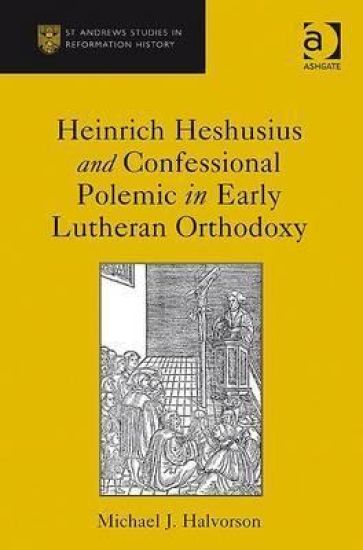
Heinrich Heshusius (1556-97) became a leading church superintendent and polemicist during the early age of Lutheran orthodoxy, and played a major role in the reform and administration of several German cities during the late Reformation. As well as offering an introduction to Heshusius's writings and ideas, this volume explores the wider world of late-sixteenth-century German Lutheranism in which he lived and worked. In particular, it looks at the important but inadequately understood network of Lutheran clergymen in North Germany centred around universities such as Rostock, Jena, Königsberg, and Helmstedt, and territories such as Braunschweig-Wolfenbüttel, in the years after the promulgation of the Formula of Concord (1577). In 1579, Heshusius followed his father Tilemann to the newly founded University of Helmstedt, where Heinrich served as a professor on the philosophy faculty and established lasting connections within the Gnesio-Lutheran party. In the 1590s, Heshusius completed his doctoral degree in theology and worked as a pastor and superintendent in Tonna and Hildesheim, publishing over seventy sermons as well as a popular catechism based on the Psalms and Luther's Small Catechism. As confessional tensions mounted in Hildesheim, Heshusius worked as a polemicist for the Lutheran cause, pressing for the conversion or expulsion of local Jews. At the same time, Heshusius began to argue aggressively for the expulsion of Jesuits, who had been increasing in number due to the activities of the local bishop and administrator, Ernst II of Bavaria. By discussing the connection between these two expulsion efforts, and the practical activities Heshusius undertook as a preacher, catechist, and administrator, this study portrays Heshusius as a zealous protector of Lutheran traditions in the face of confessional rivals. Understanding this zeal, and the policies, piety, and propaganda that came as a result, is an important factor in relating how Lutheran orthodoxy gained momentum within Germany in the last decades of the sixteenth century. In all this book will reveal the complex characteristics of an important (but virtually unknown) Lutheran superintendent and theologian active during the era of confessionalization, providing a useful resource for the ongoing efforts of scholars hoping to understand the nature of orthodoxy and its importance for early modern Europeans.f
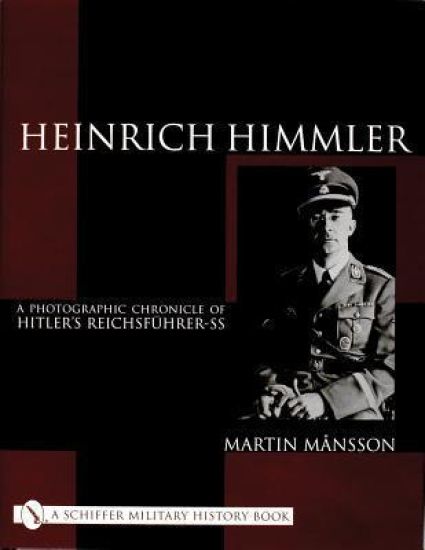
Heinrich Himmler

Heinrich Himmler

Martin Månsson

Schiffer Publishing Ltd
2001
sidottu
Many books have been written about Heinrich Himmler and the SS though, strangely, no photographic study has ever been assembled. Contained within this volume are over 380 photographs of Himmler, illustrating his entire career – from a soldier during the First World War period through the years when he was the second most powerful man in Europe. At the zenith of the Third Reich, all of Germany was under the controlling influence of Himmler and the SS. This photo chronicle records the entire Third Reich period in the life and death of Heinrich Himmler.