Kirjojen hintavertailu. Mukana 12 445 397 kirjaa ja 12 kauppaa.

Kirjahaku

Etsi kirjoja tekijän nimen, kirjan nimen tai ISBN:n perusteella.

1000 tulosta hakusanalla Henry-F

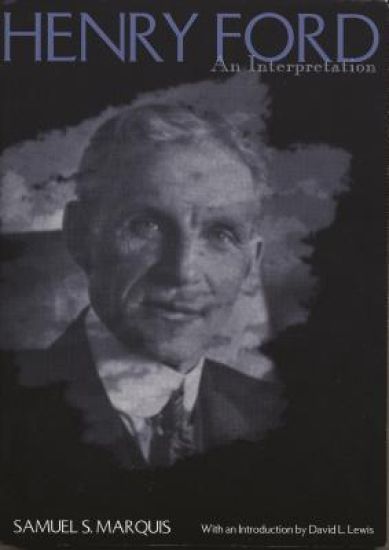
Henry Ford

Henry Ford

Samuel S. Marquis

Wayne State University Press
2007
nidottu
Regarded by many automotive historians as the finest and most dispassionate character study of Henry Ford ever written, Henry Ford: An Interpretation has long been out of print and priced out of the reach of many collectors. Published at the height of Ford's success in 1923, the volume was written by the Reverend Samuel S. Marquis, an Episcopalian minister who was also the head of the sociology department at Ford Motor Company. Instead of a history of Ford Motor Company or a simple retelling of Ford's life story, Marquis claims that his collection of essays is intended to analyze the "psychological puzzle such as the unusual mind and personality of Henry Ford presents." In insightful chapters that can be read in any order, Marquis examines Ford's mastery of self-promotion, his invincible reputation, his religious views, and his "elusive" personality. He also considers Ford through the lens of his corporation by commenting on its industrial operations, its charitable causes, and its "executive scrap heap." According to many accounts, Henry Ford was greatly pained by the criticism in some of Marquis's essays, which led him to suppress the wide distribution of the volume. Indeed, so many copies of Henry Ford: An Interpretation were borrowed from the Detroit Public Library and never returned that the library was forced to remove the volume from its shelves. Not surprisingly, the original edition of this book is very expensive and hard to find as a result of these sorts of actions. Ford history enthusiasts as well as readers who are interested in historical biography will be grateful for the reprint of this significant volume.

Henry Ford

Henry Ford

Jonatha A. Brown

Gareth Stevens Publishing
2004
sidottu
A complete translation of People We Should Know, Gente que hay que conocer is a series of first biographies designed for beginning readers. Each book introduces one of the most important individuals in recent times and explains what makes her or him so remarkable. Historic photos and easy-to-read text help readers understand each person's life and times.
Henry Ford's Plan for the American Suburb

Henry Ford's Plan for the American Suburb

Heather Barrow

Northern Illinois University Press
2015
sidottu
Around Detroit, suburbanization was led by Henry Ford, who not only located a massive factory over the city's border in Dearborn, but also was the first industrialist to make the automobile a mass consumer item. So, suburbanization in the 1920s was spurred simultaneously by the migration of the automobile industry and the mobility of automobile users. A welfare capitalist, Ford was a leader on many fronts—he raised wages, increased leisure time, and transformed workers into consumers, and he was the most effective at making suburbs an intrinsic part of American life. The decade was dominated by this new political economy—also known as "Fordism"—linking mass production and consumption. The rise of Dearborn demonstrated that Fordism was connected to mass suburbanization as well. Ultimately, Dearborn proved to be a model that was repeated throughout the nation, as people of all classes relocated to suburbs, shifting away from central cities. Mass suburbanization was a national phenomenon. Yet the example of Detroit is an important baseline since the trend was more discernable there than elsewhere. Suburbanization, however, was never a simple matter of outlying communities growing in parallel with cities. Instead, resources were diverted from central cities as they were transferred to the suburbs. The example of the Detroit metropolis asks whether the mass suburbanization which originated there represented the "American dream," and if so, by whom and at what cost. This book will appeal to those interested in cities and suburbs, American studies, technology and society, political economy, working-class culture, welfare state systems, transportation, race relations, and business management.
Henry Ford's Plan for the American Suburb

Henry Ford's Plan for the American Suburb

Heather Barrow

Northern Illinois University Press
2018
pokkari
Around Detroit, suburbanization was led by Henry Ford, who not only located a massive factory over the city's border in Dearborn, but also was the first industrialist to make the automobile a mass consumer item. So, suburbanization in the 1920s was spurred simultaneously by the migration of the automobile industry and the mobility of automobile users. A welfare capitalist, Ford was a leader on many fronts—he raised wages, increased leisure time, and transformed workers into consumers, and he was the most effective at making suburbs an intrinsic part of American life. The decade was dominated by this new political economy—also known as "Fordism"—linking mass production and consumption. The rise of Dearborn demonstrated that Fordism was connected to mass suburbanization as well. Ultimately, Dearborn proved to be a model that was repeated throughout the nation, as people of all classes relocated to suburbs, shifting away from central cities. Mass suburbanization was a national phenomenon. Yet the example of Detroit is an important baseline since the trend was more discernable there than elsewhere. Suburbanization, however, was never a simple matter of outlying communities growing in parallel with cities. Instead, resources were diverted from central cities as they were transferred to the suburbs. The example of the Detroit metropolis asks whether the mass suburbanization which originated there represented the "American dream," and if so, by whom and at what cost. This book will appeal to those interested in cities and suburbs, American studies, technology and society, political economy, working-class culture, welfare state systems, transportation, race relations, and business management.
Henry Fielding

Henry Fielding

Cleary Thomas R.

WILFRID LAURIER UNIVERSITY PRESS
1984
sidottu
An accurate and comprehensive study of the political aspects of Fielding's art has been sorely needed. As a result of decades of work by literary scholars and a series of great historians, such a study is finally possible. This volume addresses that need, and, in the light of a recent revival of interest in Fielding's work, it arrives most opportunely. The author offers here a wide-ranging focus and a firm grip on the shifting complexities of Fielding's political situations--the loyalties and enmities, factional alignments and fractious rhetoric--that allow the satisfactory understanding of Fielding's political writing. Political writing in Fielding's day, as in ours, was topical, concerned with evanescent problems and day-to-day needs that were familiar to contemporaries, but that are now recaptured only with greatest difficulty. This study constitutes a thorough reconstruction of Fielding's political context and extricates from the context Fielding's own political endeavours. Cleary's work will make many of Fielding's previously unstudied works accessible to students and scholars of eighteenth-century English literature. A necessary point of reference to both literary specialists and historians concerned with eighteenth-century England.
Henry Francis Lyte

Henry Francis Lyte

Basil Garnett Skinner

University of Exeter Press
1974
sidottu
Henry Francis Lyte moved to All-Saints Church in Brixham, Devon in 1824, where he became chairman of the schools committee, established the first Sunday school in the Torbay area and created a Sailors' Sunday School. The primary object of both schools was to provide education for children and seamen for whom other schooling was almost impossible. He organised an Annual Treat for the 800-1000 Sunday school children, which included a short religious service followed by tea and sports in the field. Shortly after Lyte's arrival in Brixham, he attracted such large crowds that the church had to be enlarged. Lyte was an expert flute player, spoke Latin, Greek, and French; enjoyed discussing literature; and was knowledgeable about wild flowers. At his Brixham home, Berry Head House, a former military hospital, Lyte created a magnificent library largely of theology and old English poetry, described in his obituary as one of the most extensive and valuable in the West of England. Nevertheless, Lyte was also able to identify with his parish of fishermen, visiting their homes and their ships in harbour, supplying every vessel with a Bible, and compiling songs and a manual of devotions for use at sea. A friend of Samuel Wilberforce, he also opposed slavery, organising an 1833 petition to Parliament requesting it be abolished in Great Britain. In poor health throughout his life, Lyte suffered various respiratory illnesses including asthma and bronchitis, and by the 1840s, he was spending much of his time in the warmer climates of France and Italy. Lyte spent the summer of 1847 at Berry Head, writing his best known hymn, Abide With Me. After one final sermon to his congregation he left again for Italy, and died at Nice on 20 November 1847. Other well-known hymns include Praise, my Soul, the King of Heaven and Pleasant are Thy Courts Above.
Henry Fisher Family of Kentucky. By Charles Brunk Heinemann.

Henry Fisher Family of Kentucky. By Charles Brunk Heinemann.

Charles Brunk 1882- Heinemann

Hassell Street Press
2021
nidottu
This work has been selected by scholars as being culturally important and is part of the knowledge base of civilization as we know it.This work is in the public domain in the United States of America, and possibly other nations. Within the United States, you may freely copy and distribute this work, as no entity (individual or corporate) has a copyright on the body of the work.Scholars believe, and we concur, that this work is important enough to be preserved, reproduced, and made generally available to the public. To ensure a quality reading experience, this work has been proofread and republished using a format that seamlessly blends the original graphical elements with text in an easy-to-read typeface.We appreciate your support of the preservation process, and thank you for being an important part of keeping this knowledge alive and relevant.
Henry Frost Carriel, M.D., His Ancestors and Descendants, by ... Charles Arthur Carriel.
This work has been selected by scholars as being culturally important and is part of the knowledge base of civilization as we know it.This work is in the public domain in the United States of America, and possibly other nations. Within the United States, you may freely copy and distribute this work, as no entity (individual or corporate) has a copyright on the body of the work.Scholars believe, and we concur, that this work is important enough to be preserved, reproduced, and made generally available to the public. To ensure a quality reading experience, this work has been proofread and republished using a format that seamlessly blends the original graphical elements with text in an easy-to-read typeface.We appreciate your support of the preservation process, and thank you for being an important part of keeping this knowledge alive and relevant.