Kirjojen hintavertailu. Mukana 11 627 363 kirjaa ja 12 kauppaa.

Kirjahaku

Etsi kirjoja tekijän nimen, kirjan nimen tai ISBN:n perusteella.

1000 tulosta hakusanalla Herbert Workman

Herbert Spencer and Social Theory

Herbert Spencer and Social Theory

J. Offer

Palgrave Macmillan
2010
sidottu
Herbert Spencer remains a significant but poorly understood figure in 19th century intellectual life. His ideas on evolution ranged across the natural sciences and philosophy, and he pioneered new ideas in psychology and sociology. This book comprehensively examines his work and strips away common misconceptions about his sociology.
Herbert Homes and The Picts Book of Spells
'Herbert, are you sure you left it here' asked his one and only friend Rob, 'because if you did then it's not here now, is it' 'Blind I'm not, so if it's not here then someone must have either borrowed it or we have a no-good thief in our midst, so who do you think that could be' was what Herbert wanted to know. So what was it and would they find it before they and the entire universe went boom-bang-boom.
Herbert Aptheker on Race and Democracy

Herbert Aptheker on Race and Democracy

Herbert Aptheker

University of Illinois Press
2010
nidottu
This reader collects fourteen influential essays by Herbert Aptheker (1915–2003) on the African American experience. Written with passion and eloquence, they are full of ideas originally dismissed by a white, segregated academy that have now become part of the scholarly mainstream. Covering topics including slave resistance, black abolitionists, Reconstruction, and W. E. B. Du Bois, these essays demonstrate the critical connection between political commitment and the advancement of scholarship, while restoring Aptheker's central place as one of the founding scholars in the development of African American studies.
Herbert Hoover

Herbert Hoover

Patrick Obrien

Greenwood Press
1992
sidottu
Considered an irredeemably flawed and catastrophic president during the Depression era, Herbert Hoover has been studied more objectively by postwar historians, with revisionist scholarship culminating in his rehabilitation as a practitioner of one variety of progressivism. Even Hoover's sharpest critics recognize many of his once unheeded accomplishments. This extensive bibliography, including more than 2600 entries, provides access to an astronomical amount of Hoover-related materials attesting to extraordinary public service and longevity. Selective in approach, the volume cites sources depicting the continuum of contemporary and historical viewpoints and includes all key writings in Hoover historiography.Following a brief introduction and chronology of Hoover's life, the work begins with chapters covering manuscript and archival sources, writings of Herbert Hoover, and biographical publications. Chapters 4 and 5 are devoted to his early years and to his mature years prior to his election. The Presidential election of 1928 is covered in chapter 6; chapter 7 cites sources on the Hoover Administration; and chapter 8 covers the election of 1932. Hoover's administration associates are covered in chapter 9, and his post-presidential years covered in chapter 10. Concluding chapters are devoted to Hoover's philosophy, the personal lives of the Hoovers, historiographical materials, and iconography of the Hoovers. The work also includes a section on periodicals and author and subject indexes.
Herbert E. Bolton and the Historiography of the Americas

Herbert E. Bolton and the Historiography of the Americas

Russell Magnaghi

Praeger Publishers Inc
1998
sidottu
The comparative approach to the understanding of history is increasingly popular today. This study details the evolution of comparative history by examining the career of a pioneer in this area, Herbert E. Bolton, who popularized the notion that hemispheric history should be considered from pole to pole. Bolton traced the study of the history of the Americas back to 16th century European accounts of efforts to bring civilization to the New World, and he argued that only within this larger context could the histories of individual nations be understood. After American entry into the Spanish-American War in 1898, historians such as Bolton promoted the idea of comparative history, and it remains to this day a significant historiographical approach.Consideration of the history of the Americas as a whole dates back to 16th century European treatises on the New World. Chapter one of this study provides an overview of pre-Bolton formulations of such history. In chapter two one sees the forces that shaped Bolton's thinking and brought about the development of the concept. Chapters three and four focus upon the evolution of the approach through Bolton's history course at the University of California at Berkeley and the reception of the concept among Bolton's contemporaries. Unfortunately, Bolton never fully developed the theoretical side of his arguement; thus, chapter five chronicles the decline of his ideas after his death. The final chapter reveals the survival of the concept, which is now embraced by a new generation of historians who are largely unfamiliar with Bolton's instrumental role in the promotion of comparative history.
Herbert Hoover and Franklin D. Roosevelt

Herbert Hoover and Franklin D. Roosevelt

Dwight Miller; Timothy Walch

Praeger Publishers Inc
1998
sidottu
Both Herbert Hoover and Franklin D. Roosevelt were giants in public life. From strikingly different backgrounds, and sharply contrasting styles and approaches, each man left his unique mark upon the presidency. This collection of historical materials chronicles the connections between the lives of Hoover and Roosevelt from their early collaboration during the Wilson administration to their heated competition during the 1932 presidential election and beyond. Letters, reports, and telegrams between the two men and their wives tell a story of both communication and miscommunication between 1917 and 1945. In 12 chapters, plus an introduction and a conclusion, the editors present documents which reveal the sometimes tense relations between Hoover and Roosevelt. Chapter one includes materials from their work on housing and homebuilding issues during the Harding and Coolidge administrations. The next two chapters focus upon Hoover's presidency and Roosevelt's rise as govenor of New York. Chapter four recounts the strong rivalry during the 1932 campaign, and that rivalry is even more apparent in chapter five. The remaining six chapters include material from Roosevelt's tenure as president. These documents reveal Hoover's attitudes toward Roosevelt's New Deal domestic policies, the threatening international situation of the 1930s, and U.S. involvement in the Second World War.
Herbert Rosenfeld at Work

Herbert Rosenfeld at Work

Herbert A. Rosenfeld

Routledge
2019
sidottu
Between 1978 and 1985 Dr Herbert Rosenfeld was one of a number of British analysts invited by a group of Societa di Psicoanalisi Italiani members to conduct a series of seminars and supervisions for the purpose of deepening and refining that group's clinical skills and theoretical understanding. This book is an illuminating record of that encounter, and a warm tribute to the significant influence of Rosenfeld's contribution. It is divided into two parts - 'Theoretical' and 'Clinical', and based on a selection of verbatim transcripts recorded at the time. These transcripts, with their dialogical form, succeed in capturing much of the specificity of oral exchange, and thus convey a strong impression of Rosenfeld the man as much as clinician or theoretician. Rosenfeld remained to the end a continuously creative analyst and these 'last thoughts' provide the reader with ample evidence of his undimmed gifts. His subtle intuitions, meticulously close attention to both patient's and analyst's interpretations, and fine appreciation of the intricacies of the analytic encounter, are abundantly present.
The Rediscovered Psychoanalytic Work of Herbert Silberer
Charles Corliss presents, for the first time, the complete English translation of Herbert Silberer’s work on dreams, Der Traum: Einführung in die Traumpsychologie. Based on lectures delivered at the majestic Urania Star Observatory in Vienna in 1918, Der Traum was a wide-ranging, accessible introduction to the meaning of dreams, with examples from Silberer’s practice providing a rich source of illustration. One hundred years after the work was first published in Silberer’s native German, Corliss rescues his voice from obscurity and adds key supplementary information to place the work in context.The book begins with an introduction which surveys the range of Silberer’s contributions to psychoanalysis and sets out what is known of his life, before presenting the full original text. Presented in eight parts, each with preliminary remarks by Corliss, the book covers several topics including differing viewpoints on dreams, Silberer’s concept of the hypnagogic phenomenon, experimental dreams, and aspects of his own theory. Der Traum ends with a philosophical exploration of how dream content relates to the core moral fiber of our being, with the work as a whole reflecting Silberer’s optimistic, depth-oriented, and at times, almost mystical stance. Corliss concludes the book with a reflection on the rich, teleologically optimistic, and refreshingly panoramic value of Der Traum.This unique book will be of interest to analytical psychologists and Jungian psychotherapists in practice and training, as well as to academics and students of Jungian studies and the history of psychoanalysis, psychoanalytic studies, theology, philosophy, and the history of psychology.
The Rediscovered Psychoanalytic Work of Herbert Silberer
Charles Corliss presents, for the first time, the complete English translation of Herbert Silberer’s work on dreams, Der Traum: Einführung in die Traumpsychologie. Based on lectures delivered at the majestic Urania Star Observatory in Vienna in 1918, Der Traum was a wide-ranging, accessible introduction to the meaning of dreams, with examples from Silberer’s practice providing a rich source of illustration. One hundred years after the work was first published in Silberer’s native German, Corliss rescues his voice from obscurity and adds key supplementary information to place the work in context.The book begins with an introduction which surveys the range of Silberer’s contributions to psychoanalysis and sets out what is known of his life, before presenting the full original text. Presented in eight parts, each with preliminary remarks by Corliss, the book covers several topics including differing viewpoints on dreams, Silberer’s concept of the hypnagogic phenomenon, experimental dreams, and aspects of his own theory. Der Traum ends with a philosophical exploration of how dream content relates to the core moral fiber of our being, with the work as a whole reflecting Silberer’s optimistic, depth-oriented, and at times, almost mystical stance. Corliss concludes the book with a reflection on the rich, teleologically optimistic, and refreshingly panoramic value of Der Traum.This unique book will be of interest to analytical psychologists and Jungian psychotherapists in practice and training, as well as to academics and students of Jungian studies and the history of psychoanalysis, psychoanalytic studies, theology, philosophy, and the history of psychology.
Herbert Hoover and the Great Depression

Herbert Hoover and the Great Depression

Harris Gaylord Warren

WW Norton Co
2007
nidottu
In this balanced evaluation of the Hoover Administration and its efforts to deal with the domestic problems of the Great Depression, Harris Gaylord Warren cuts through the myths that surround a crucial and insufficiently understood period of American political history. He outlines the conditions that produced the depression, and the political and economic philosophy that underlay Hoover’s actions. Although sharply critical of Hoover’s lack of vision, he demonstrates that in many ways Hoover has been unfairly judged. For, Mr. Warren notes, Hoover, “the Great Humanitarian, the Great Engineer, the Great Secretary,” was “the embodiment of an idea, a legendary ideal, a portrait of intentions and not a picture of realities.”
Herbert Spencer: Collected Writings
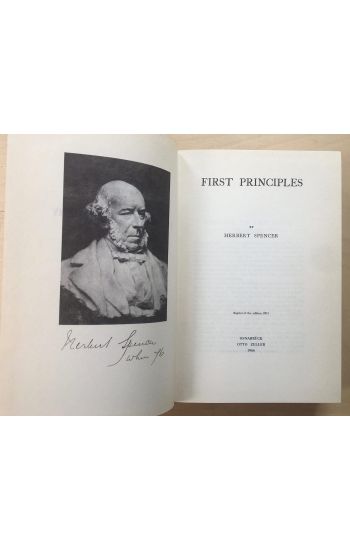
Herbert Spencer (1820-1903) was regarded by the Victorians as the foremost philosopher of the age, the prophet of evolution at a time when the idea had gripped the popular imagination. Until recently Spencer's posthumous reputation rested almost excusively on his social and political thought, which has itself frequently been subject to serious misrepresentation. But historians of ideas now recognise that an acquaintance with Spencer's thought is essential for the proper understanding of many aspects of Victorian intellectual life, and the present selection is designed to answer this need. It provides a cross-section of Spencer's works from his more popular and approachable essays to a number of the volumes of the Synthetic Philosophy itself.
Herbert Spencer
Herbert Spencer (1820-1903) was a major figure in the early development of sociology, famous for work which likened society to an organism and analysed it in evolutionary terms. In this context he was contributing to evolutionary theory before as well as after Darwin and argued consistently that society would be perfected through the operation of the principle that every man should be left free to do what he would as long as he did not interfere with another man's freedom. Spencer's work has been neglected in recent years, but its indirect influence lives on both in libertarian political thought and in the discipline of sociology itself particularly through the work of Durkheim who was heavily influenced by Spencer. This major set traces that influence from the reaction of Spencer's contemporaries to the present day. Contributions come from across the social science disciplines and are often taken from difficult to access contemporary sources.
Herbert Marcuse
The Legacy of Herbert Marcuse: A Critical Reader is a collection of brand new papers by seventeen Marcuse scholars, which provides a comprehensive reassessment of the relevance of Marcuse's critical theory at the beginning of the 21st century.Although best known for his reputation in critical theory, Herbert Marcuse's work has had impact on areas as diverse as politics, technology, aesthetics, psychoanalysis and ecology. This collection addresses the contemporary relevance of Marcuse's work in this broad variety of fields and from an international perspective. In Part One, veteran scholars of Marcuse and the Frankfurt school examine the legacy of various specific areas of Marcuse's thought, including the quest for radical subjectivity, the maternal ethic and the negative dialectics of imagination. Part Two focuses on a very new trend in Marcuse scholarship: the link between Marcuse's ideas and environmental thought. The third part of this collection is dedicated to the work of younger Marcuse scholars, with the aim of documenting Marcuse's reception among the next generation of critical theorists. The final section of the book contains recollections on Marcuse's person rather than his critical theory, including an informative look back over his life by his son, Peter.
Herbert Marcuse
The Legacy of Herbert Marcuse: A Critical Reader is a collection of brand new papers by seventeen Marcuse scholars, which provides a comprehensive reassessment of the relevance of Marcuse's critical theory at the beginning of the 21st century.Although best known for his reputation in critical theory, Herbert Marcuse's work has had impact on areas as diverse as politics, technology, aesthetics, psychoanalysis and ecology. This collection addresses the contemporary relevance of Marcuse's work in this broad variety of fields and from an international perspective. In Part One, veteran scholars of Marcuse and the Frankfurt school examine the legacy of various specific areas of Marcuse's thought, including the quest for radical subjectivity, the maternal ethic and the negative dialectics of imagination. Part Two focuses on a very new trend in Marcuse scholarship: the link between Marcuse's ideas and environmental thought. The third part of this collection is dedicated to the work of younger Marcuse scholars, with the aim of documenting Marcuse's reception among the next generation of critical theorists. The final section of the book contains recollections on Marcuse's person rather than his critical theory, including an informative look back over his life by his son, Peter.
Herbert Eugene Bolton

Herbert Eugene Bolton

Albert L. Hurtado

University of California Press
2012
sidottu
This definitive biography offers a new critical assessment of the life, works, and ideas of Herbert E. Bolton (1870-1953), a leading historian of the American West, Mexico, and Latin America. Bolton, a famous pupil of Frederick Jackson Turner, formulated a concept - the borderlands - that is a foundation of historical studies today. His research took him not only to the archives and libraries of Mexico but out on the trails blazed by Spanish soldiers and missionaries during the colonial era. Bolton helped establish the reputation of the University of California and the Bancroft Library in the eyes of the world and was influential among historians during his lifetime, but interest in his ideas waned after his death. Now, more than a century after Bolton began to investigate the Mexican archives, Albert L. Hurtado explores his life against the backdrop of the cultural and political controversies of his day.