Kirjojen hintavertailu. Mukana 11 699 587 kirjaa ja 12 kauppaa.

Kirjahaku

Etsi kirjoja tekijän nimen, kirjan nimen tai ISBN:n perusteella.

1000 tulosta hakusanalla Herman Van Rompuy

Bijdragen Tot Eene Geschiedenis Der Bataven.

Bijdragen Tot Eene Geschiedenis Der Bataven.

Herman Diederik Johan Van Schevichaven

British Library, Historical Print Editions
2011
pokkari
Title: Bijdragen tot eene geschiedenis der Bataven. With two maps.]Publisher: British Library, Historical Print EditionsThe British Library is the national library of the United Kingdom. It is one of the world's largest research libraries holding over 150 million items in all known languages and formats: books, journals, newspapers, sound recordings, patents, maps, stamps, prints and much more. Its collections include around 14 million books, along with substantial additional collections of manuscripts and historical items dating back as far as 300 BC.The HISTORY OF EUROPE collection includes books from the British Library digitised by Microsoft. This collection includes works chronicling the development of Western civilisation to the modern age. Highlights include the development of language, political and educational systems, philosophy, science, and the arts. The selection documents periods of civil war, migration, shifts in power, Muslim expansion into Central Europe, complex feudal loyalties, the aristocracy of new nations, and European expansion into the New World. ++++The below data was compiled from various identification fields in the bibliographic record of this title. This data is provided as an additional tool in helping to insure edition identification: ++++ British Library Schevichaven, Herman Diederik Johan van.; 1875. 8 . 9405.ee.1.
The Book of Clerical Anecdotes, by Jacob Larwood

The Book of Clerical Anecdotes, by Jacob Larwood

Herman Diederik J Van Schevichaven

Palala Press
2018
pokkari
This work has been selected by scholars as being culturally important, and is part of the knowledge base of civilization as we know it. This work was reproduced from the original artifact, and remains as true to the original work as possible. Therefore, you will see the original copyright references, library stamps (as most of these works have been housed in our most important libraries around the world), and other notations in the work.This work is in the public domain in the United States of America, and possibly other nations. Within the United States, you may freely copy and distribute this work, as no entity (individual or corporate) has a copyright on the body of the work.As a reproduction of a historical artifact, this work may contain missing or blurred pages, poor pictures, errant marks, etc. Scholars believe, and we concur, that this work is important enough to be preserved, reproduced, and made generally available to the public. We appreciate your support of the preservation process, and thank you for being an important part of keeping this knowledge alive and relevant.
De Geschiedenis Van Vlaanderen
De Geschiedenis van Vlaanderen beslaat 36 hoofdstukken en loopt van de Romeinse tijd tot het eind van de 14e eeuw wanneer Vlaanderen verdwijnt als zelfstandige staat. Dit boek beschrijft de geschiedenis van Vlaanderen als een roman. Maar het is geen fictie. Alle gebeurtenissen zijn exact gebeurd zoals verteld. Een must voor wie de echte geschiedenis van ons landsdeel wil kennen.
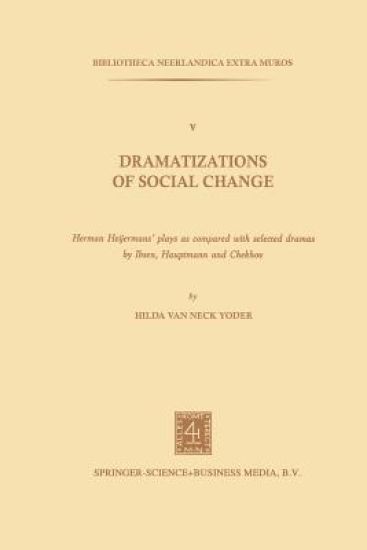
Dramatizations of Social Change: Herman Heijermans’Plays as Compared with Selected Dramas by Ibsen, Hauptmann and Chekhov
Herman Heijermans (1864-1924) was convinced that he lived in an "overgangs­ 1 tijdperk," a transitional period. As a young man in the eighteen nineties, he rejected those values and life styles which he felt belonged to the past period dominated by the bourgeoisie, and sought out situations and a profession which would attune him to the future when, he hoped, the proletariat would 2 be in power. He left the conservative business milieu of Rotterdam in 1892 and went to Amsterdam- then teeming with radical ideas. At first, Heijermans was attracted to a group of poets, de tachtigers, who were claiming to have enlivened the stale tradition of Dutch poetry by discovering language and beauty in a totally new way; but soon he felt them to be elitist. Then, in 1895, he became a member of the newly founded Dutch Social Democratic Workers Party. He alienated himself from the literary circles by claiming that art should be socialistic and by rejecting the class separation between artists and workers. He felt himself to be one with the proletariat and, through them, with "The New Life" and "The New Humanity. " Stimulated by the ongoing theater revival, which he interpreted as an attempt to challenge the bourgeois smugness and moral self-righteousness, he had started to write plays before becoming interested in the Socialist Party.