Kirjojen hintavertailu. Mukana 11 244 527 kirjaa ja 12 kauppaa.

Kirjahaku

Etsi kirjoja tekijän nimen, kirjan nimen tai ISBN:n perusteella.

1000 tulosta hakusanalla J. Stephanini

How Not to Kill a Peony: An Owner's Manual

How Not to Kill a Peony: An Owner's Manual

Stephanie J. Weber

Stephanie J. Weber
2018
nidottu
This no-nonsense narrative cheerfully demystifies every aspect of the peony and its unusual life cycle, succinctly navigating the obstacles to success. Get a jump on the spring season by learning how to dig, divide and plant peony roots. Explore how to choose peonies for landscaping, cut flowers or both, and check out recommended varieties. Read up on how to cut fresh flowers, and how to cold-store buds for up to 7 weeks. How Not to Kill a Peony" follows the author from clueless peony-obsessed beginner to seasoned peony farm owner determined to help educate others. This is not your grandmother's coffee table book ... it's a delightfully pithy owner's manual portable enough to schlep right out to the garden for quick reference. "How Not ..." is densely packed with vital instructions, useful wisdom and insights, and hundreds of true-to-life color photos sure to spark your own obsession with the magical and magnificent peony. kansasgardenmusings.blogspot.com, February 25, 2020, Dr. James K. Roush, Professor of Veterinary Medicine at Kansas State University, author, Master Gardener and self-proclaimed garden curmudgeon: "I've read several garden books this winter, but none better than this one. As a testament to its engaging prose, I read 'How Not to Kill a Peony' in a single sitting, learning more in an hour about how to choose peonies than I did in my previous lifespan. I've never seen a better presented "How-To" that will help you grow peonies that are the envy of the neighborhood. 'How Not to Kill a Peony' is a delicious, straightforward, and sometimes snarky 98 page read that quickly brought me to understand many useful things. Every important fact about growing peonies is covered, and covered in straightforward fact. And the most important advice? Plant peony varieties that don't flop Who knew? Now, darn it, where did I leave that Song Sparrow catalog? I just don't have enough peonies in my front yard...." For peony art prints check out Stephanie Weber Art on FineArtAmerica.com
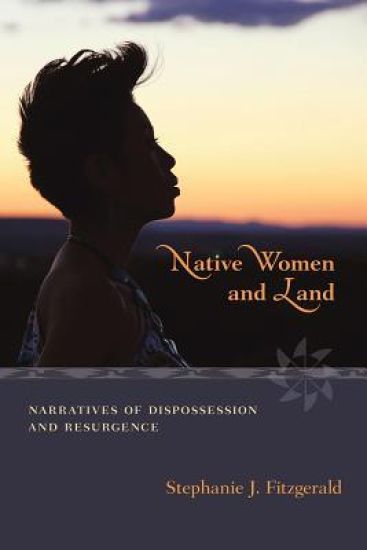
Native Women and Land

Native Women and Land

Stephanie J. Fitzgerald

University of New Mexico Press
2015
nidottu
Winner of the 2015 Wordcraft Circle Honor and Award for Academic Book.“What roles do literary and community texts and social media play in the memory, politics, and lived experience of those dispossessed?” Fitzgerald asks this question in her introduction and sets out to answer it in her study of literature and social media by (primarily) Native women who are writing about and often actively protesting against displacement caused both by forced relocation and environmental disaster. By examining a range of diverse materials, including the writings of canonical Native American writers such as Louise Erdrich, Linda Hogan, and Elizabeth Cook-Lynn, and social media sites such as YouTube and Facebook, this work brings new focus to analyzing how indigenous communities and authors relate to land, while also exploring broader connections to literary criticism, environmental history and justice, ecocriticism, feminist studies, and new media studies.
Spending to Win

Spending to Win

Stephanie J. Rickard

Cambridge University Press
2018
sidottu
Governments in some democracies target economic policies, like industrial subsidies, to small groups at the expense of many. Why do some governments redistribute more narrowly than others? Their willingness to selectively target economic benefits, like subsidies to businesses, depends on the way politicians are elected and the geographic distribution of economic activities. Based on interviews with government ministers and bureaucrats, as well as parliamentary records, industry publications, local media coverage, and new quantitative data, Spending to Win: Political Institutions, Economic Geography, and Government Subsidies demonstrates that government policy-making can be explained by the combination of electoral institutions and economic geography. Specifically, it shows how institutions interact with economic geography to influence countries' economic policies and international economic relations. Identical institutions have wide-ranging effects depending on the context in which they operate. No single institution is a panacea for issues, such as income inequality, international economic conflict, or minority representation.
Spending to Win

Spending to Win

Stephanie J. Rickard

Cambridge University Press
2020
pokkari
Governments in some democracies target economic policies, like industrial subsidies, to small groups at the expense of many. Why do some governments redistribute more narrowly than others? Their willingness to selectively target economic benefits, like subsidies to businesses, depends on the way politicians are elected and the geographic distribution of economic activities. Based on interviews with government ministers and bureaucrats, as well as parliamentary records, industry publications, local media coverage, and new quantitative data, Spending to Win: Political Institutions, Economic Geography, and Government Subsidies demonstrates that government policy-making can be explained by the combination of electoral institutions and economic geography. Specifically, it shows how institutions interact with economic geography to influence countries' economic policies and international economic relations. Identical institutions have wide-ranging effects depending on the context in which they operate. No single institution is a panacea for issues, such as income inequality, international economic conflict, or minority representation.
W. E. B. Du Bois and The Souls of Black Folk

W. E. B. Du Bois and The Souls of Black Folk

Shaw Stephanie J.

The University of North Carolina Press
2015
nidottu
In this book, Stephanie J. Shaw brings a new understanding to one of the great documents of American and black history. While most scholarly discussions of The Souls of Black Folk focus on the veils, the color line, double consciousness, or Booker T. Washington, Shaw reads Du Bois' book as a profoundly nuanced interpretation of the souls of black Americans at the turn of the twentieth century. Demonstrating the importance of the work as a sociohistorical study of black life in America through the turn of the twentieth century and offering new ways of thinking about many of the topics introduced in Souls, Shaw charts Du Bois' successful appropriation of Hegelian idealism in order to add America, the nineteenth century, and black people to the historical narrative in Hegel's philosophy of history. Shaw adopts Du Bois' point of view to delve into the social, cultural, political, and intellectual milieus that helped to create The Souls of Black Folk.
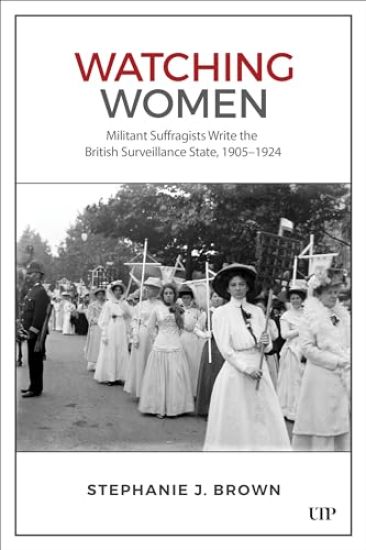
Watching Women

Watching Women

Stephanie J. Brown

UNIVERSITY OF TORONTO PRESS
2024
sidottu
Historians of the early twentieth century often focus on the surveillance of anarchist, communist, and anti-colonial movements, overlooking the resource-intensive policing of the women’s suffrage movement as a significant expansion of the state’s surveillance activities. Bridging that gap in the historical record, Watching Women draws on recently declassified Home Office documents to present a fuller picture of the British domestic surveillance practices. The book maps the history of state surveillance of the British women’s suffrage movement and its leaders, explaining how militant activists used various forms of writing – novels, short stories, journalism, and memoirs – to represent and resist state surveillance. These genres in the book enable specific, strategic responses to the state’s repression of suffrage militancy. The book explores the aftermath of suffrage surveillance by tracing the diverging activist careers of two prominent suffragettes, Sylvia Pankhurst and Mary Allen, during and after World War I, as they continued their engagement with the state’s surveillance apparatuses. In doing so, Watching Women illuminates histories of the suffrage campaign through women’s experiences of navigating surveillance.