Kirjojen hintavertailu. Mukana 11 244 527 kirjaa ja 12 kauppaa.

Kirjahaku

Etsi kirjoja tekijän nimen, kirjan nimen tai ISBN:n perusteella.

1000 tulosta hakusanalla Janet B. Pascal

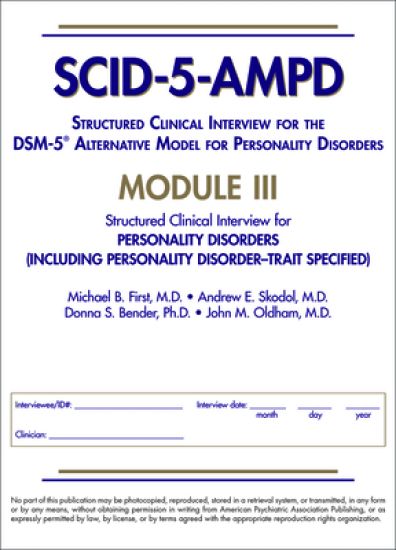
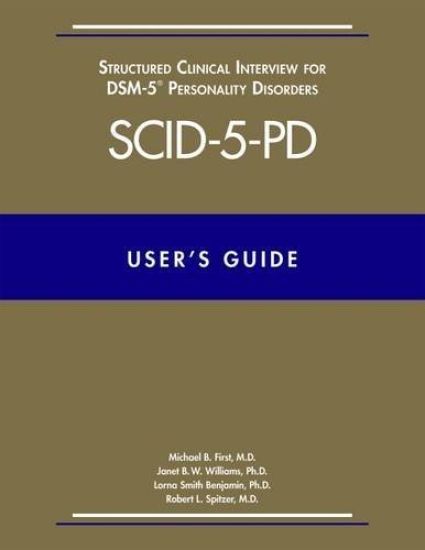
User’s Guide for the Structured Clinical Interview for DSM-5 Personality Disorders (SCID-5-PD)

User’s Guide for the Structured Clinical Interview for DSM-5 Personality Disorders (SCID-5-PD)

Michael B. First; Janet B. W. Williams; Lorna Smith Benjamin; Robert L. Spitzer

American Psychiatric Association Publishing
2015
pokkari
The Structured Clinical Interview for DSM-5 Personality Disorders (SCID-5-PD) is a semistructured diagnostic interview for clinicians and researchers to assess the 10 DSM-5 Personality Disorders across Clusters A, B, and C as well as Other Specified Personality Disorder. Designed to build rapport, the SCID-5-PD can be used to make personality disorder diagnoses, either categorically (present or absent) or dimensionally. The SCID-5-PD includes the indispensable User's Guide for the SCID-5-PD, as well as a handy self-report screening questionnaire for patients or subjects, the Structured Clinical Interview for DSM-5 Screening Personality Questionnaire (SCID-5-SPQ). The SCID-5-PD is the updated version of the former Structured Clinical Interview for DSM-IV Axis II Personality Disorders (SCID-II). The SCID-5-PD name reflects the elimination of the multiaxial system in DSM-5. Although the DSM-IV Personality Disorder criteria are unchanged in DSM-5, the SCID-5-PD interview questions have been thoroughly reviewed and revised to optimally capture the construct embodied in the diagnostic criteria. In addition, a dimensional scoring component has been added to the SCID-5-PD. The basic structure of the SCID-5-PD is similar to the other SCID-5 interviews (such as the Research Version, SCID-5-RV; and the Clinician Version, SCID-5-CV) that cover non–personality DSM-5 disorders. Features include the following: • Questions assessing the DSM-5 criteria for each of the 10 personality disorders: Avoidant Personality Disorder, Dependent Personality Disorder, Obsessive-Compulsive Personality Disorder, Paranoid Personality Disorder, Schizotypal Personality Disorder, Schizoid Personality Disorder, Histrionic Personality Disorder, Narcissistic Personality Disorder, Borderline Personality Disorder, and Antisocial Personality Disorder.• A User's Guide for the SCID-5-PD containing essential guidance for use of the SCID-5-PD, including an appendix of a completed SCID-5-PD and SCID-5-SPQ for a sample patient.• An optional SCID-5-SPQ that serves as a brief, 20-minute self-report screening tool to reduce the time of the SCID-5-PD clinical interview. The SCID-5-SPQ requires an eighth grade or higher reading level (as determined by the Flesch-Kincaid formula). Its 106 questions correspond directly to each first question in the full SCID-5-PD. The SCID-5-PD can be used in various types of research studies, just as the SCID-II. It has been used to investigate patterns of Personality Disorders co-occurring with other mental disorders or medical conditions; select a group of study subjects with a particular Personality Disorder; investigate the underlying structure of personality pathology; and compare with other assessment methods for Personality Disorders. The SCID-5-PD will serve as a valuable resource to help clinicians and researchers more accurately diagnose Personality Disorders.
User's Guide for the Structured Clinical Interview for DSM-5® Disorders—Clinician Version (SCID-5-CV)

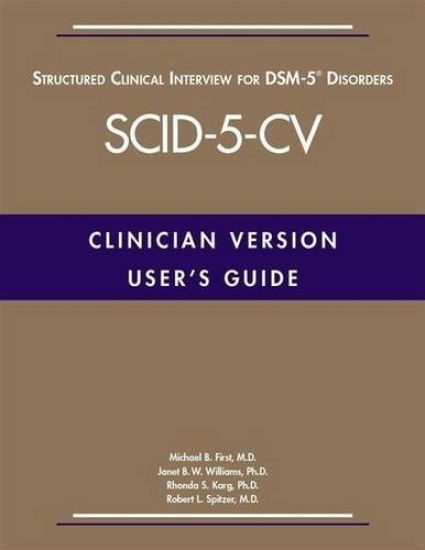
User's Guide for the Structured Clinical Interview for DSM-5® Disorders—Clinician Version (SCID-5-CV)

Michael B. First; Janet B. W. Williams; Rhonda S. Karg; Robert L. Spitzer

American Psychiatric Publishing
2016
pokkari
The Structured Clinical Interview for DSM-5 Disorders—Clinician Version (SCID-5-CV) guides the clinician step-by-step through the DSM-5 diagnostic process. Interview questions are provided conveniently along each corresponding DSM-5 criterion, which aids in rating each as either present or absent. A unique and valuable tool, the SCID-5-CV covers the DSM-5 diagnoses most commonly seen in clinical settings. The User's Guide for the SCID-5-CV provides comprehensive instructions on how to use the SCID-5-CV effectively and accurately. It not only describes the rationale, structure, conventions, and usage of the SCID-5-CV, but also discusses in detail how to interpret and apply the specific DSM-5 criteria for each of the disorders included in the SCID-5-CV. A number of sample role-play and homework cases are also included to help clinicians learn how to use the SCID-5-CV. Together with the SCID-5-CV, the User's Guide for the SCID-5-CV will prove invaluable to clinicians, researchers, interviewers, and students in the mental health professions who seek to integrate time-tested interview questions corresponding to the DSM-5 criteria into their DSM-5 diagnostic assessment process.
Quick Structured Clinical Interview for DSM-5 Disorders (QuickSCID-5)

Quick Structured Clinical Interview for DSM-5 Disorders (QuickSCID-5)

Michael B. First; Janet B. W. Williams

American Psychiatric Association Publishing
2020
pokkari
QuickSCID-5 is a fully structured diagnostic instrument that employs interview questions adapted from the Structured Clinical Interview for DSM-5® (SCID-5), widely regarded to be the "gold standard" structured psychiatric diagnostic interview since the initial release of SCID in 1985. The impetus for developing the QuickSCID-5 was to create a briefer, more time-efficient version of the SCID designed to be administered usually in 30 minutes or less. The shorter administration time results from the fact that QuickSCID-5 consists almost entirely of closed-ended questions that can be answered "YES" or "NO" by the patient, dispensing with the requirement in the standard SCID that the interviewer elicit descriptive examples and ask enough follow-up questions until the interviewer has enough information to determine whether the DSM-5 diagnostic criteria are met. Consequently, unlike the standard SCID, which requires the interviewer to have specialized training in diagnostic interviewing, QuickSCID can be administered by any clinician, including those in training. Other features include a visually appealing format and easy to follow skip instructions.QuickSCID has a modular design so that only modules of interest need be administered. Modules include an optional Overview, Module A (Mood Episodes and Disorders), Module B (Psychotic Symptoms Screen), Module C (Alcohol and Other Substance Use Disorders), Module D (Anxiety Disorders), Module E (Obsessive-Compulsive Disorder); Module F (Adult Attention-Deficit/Hyperactivity Disorder), Module G (Posttraumatic Stress Disorder), Module H (Eating Disorders), Module I (Screening for Other Disorders), and Module J (Rule Out Mental Disorders Due to a Medical Condition and Substance/Medication-induced Mental Disorders). In recognition of the fact that it is not recommended to make a diagnosis of a psychotic disorder such as schizophrenia using questions that can only be answered "YES" or "NO," QuickSCID-5 only screens for psychotic symptoms and is not intended to be used to diagnose psychotic disorders. These diagnoses are not included in QuickSCID-5.Although the absence of a requirement for the interviewer to elicit descriptive examples may lead to more false positives than the standard SCID, the savings in administration time and its allowance for it to be administered by less trained interviewers can constitute a reasonable trade-off depending on the setting (e.g., for screening patients for the presence of a mental disorder).
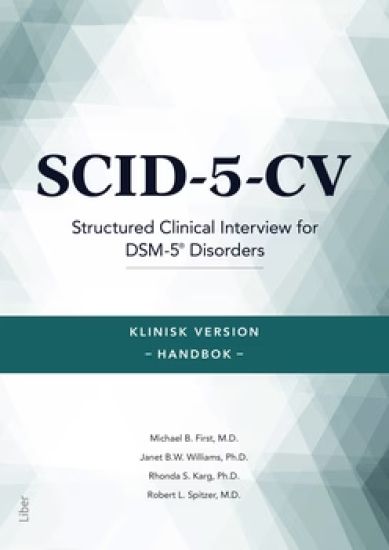
SCID-5-CV Klinisk version Handbok

SCID-5-CV Klinisk version Handbok

Michael B. First; Janet B. W. Williams; Rhonda S. Karg; Robert L. Spitzer

Liber
2022
nidottu
SCID-5-CV Handbok presenterar principerna för SCID-5-CV Intervju, som är en semistrukturerad intervju för psykiatrisk diagnostik enligt DSM-5.Här ges detaljerade, praktiska anvisningar för hur intervjun ska genomföras och svaren bedömas. I handboken finns vägledning i hur patienternas svar på intervjufrågor ska bedömas med utgångspunkt i kriterierna för DSM-5. Ett korrekt användande av SCID-5-CV ökar reliabiliteten vid diagnostik av psykiatriska syndrom.SCID-5-CV Handbok innehåller också utbildningsmaterial med fallbeskrivningar och övningsuppgifter. Handboken kan dels användas av sjukvårdspersonal i det kliniska arbetet med psykiatrisk diagnostik, dels i utbildning av studenter på universitetsutbildningar och vid vidareutbildning av professionella inom vården.Bokenger detaljerade instruktioner för SCID-5-CV Intervju och bedömning av DSM-5-diagnoskriterierinnehåller utbildningsmaterial för att träna bedömning av diagnoskriterierunderlättar en reliabel och valid diagnostisk bedömning.I SCID-5-CV Handbok anges DSM-5-kriterierna ordagrant så som de översatts i MINI-D 5 (utgiven av Pilgrim Press). ICD-koder har översatts till dess svenska motsvarighet ICD-10-SE, enligt Socialstyrelsens riktlinjer och i enlighet med översättningen i MINI-D 5.Om författarnaMichael B. First, M.D. Janet B.W. Williams, PhD, Rhonda S. Karg, Ph.D. Robert L. Spitzer, M.D.Texten är faktagranskad och bearbetad av: Johanna Motilla Hoppe; leg. psykolog, filosofie doktor, Mia Ramklint; leg. läkare, specialist i psykiatri, professor och Linda Bylin; leg. psykolog, specialist i klinisk psykologi, leg. psykoterapeut, psykoterapihandledare.Först publicerad i USA av American Psychiatric Association (APA), Washington DC. Copyright ©2015 (SCID-5-CV). Alla rättigheter reserverade. Först publicerad i Sverige av Liber AB på svenska. Liber AB har exklusiv förlagsrätt till SCID-5-CV, Klinisk version Handbok första utgåvan (copyright ©2015) författad av Michael B. First, M.D., Janet B. W. Williams, Ph.D., Rhonda S. Karg, Ph.D. och Robert L. Spitzer, M.D. på svenska för distribution över hela världen. Skriftligt tillstånd från Liber AB krävs för återgivning i någon form av material från det översatta verket. APA har inte på något sätt bidragit till översättningen av det här verket från engelska till svenska och ansvarar inte för eventuella felaktigheter, utelämnanden eller andra möjliga brister i översättningen av verket.
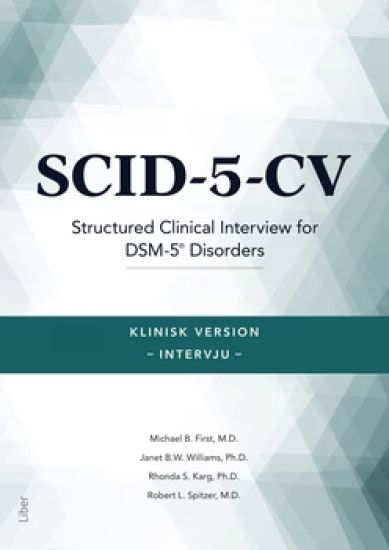
SCID-5-CV Klinisk version Intervju

SCID-5-CV Klinisk version Intervju

Michael B. First; Janet B. W. Williams; Rhonda S. Karg; Robert L. Spitzer

Liber
2022
nidottu
SCID-5-CV Intervju är en semistrukturerad diagnostisk intervju som kan användas av personer utbildade i psykiatrisk diagnostik för att ställa de vanligaste psykiatriska diagnoserna i DSM-5.SCID-5-CV Intervju inleds med en översiktsintervju med öppna frågor, där patienten får möjlighet att beskriva sina besvär med egna ord. Därefter är intervjun indelad i 10 olika diagnostiska moduler som innehåller frågor som intervjuaren ställer för att värdera om patienten uppfyller diagnoskriterierna i DSM-5. Resultaten dokumenteras i SCID-5-CV Sammanställningsprotokoll som finns i intervjuprotokollets början.SCID-5-CV är en del i en diagnostisk process som möjliggör en reliabel och valid diagnostik av psykiatriska syndrom.Intervjun kan dels användas av sjukvårdspersonal i det kliniska arbetet med psykiatrisk diagnostik, dels i utbildning av studenter på universitetsutbildningar och vid vidareutbildning av professionella inom vården.Bokenär ett semistrukturerat intervjustöd för psykiatrisk diagnostik enligt DSM-5underlättar en reliabel och valid diagnostisk psykiatrisk bedömningger den senaste versionen av SCID-5-CV på svenska.I SCID-5-CV Intervju anges DSM-5-kriterierna ordagrant så som de översatts i MINI-D 5 (utgiven av Pilgrim Press). ICD-koder har översatts till dess svenska motsvarighet ICD-10-SE, enligt Socialstyrelsens riktlinjer och i enlighet med översättningen i MINI-D 5.Om författarnaMichael B. First, M.D. Janet B.W. Williams, PhD, Rhonda S. Karg, Ph.D. Robert L. Spitzer, M.D.Texten är faktagranskad och bearbetad av: Johanna Motilla Hoppe; leg. psykolog, filosofie doktor, Mia Ramklint; leg. läkare, specialist i psykiatri, professor och Linda Bylin; leg. psykolog, specialist i klinisk psykologi, leg. psykoterapeut, psykoterapihandledare.Först publicerad i USA av American Psychiatric Association (APA), Washington DC. Copyright ©2015 (SCID-5-CV). Alla rättigheter reserverade. Först publicerad i Sverige av Liber AB på svenska. Liber AB har exklusiv förlagsrätt till SCID-5-CV, Klinisk version Intervju första utgåvan (copyright ©2015) författad av Michael B. First, M.D., Janet B. W. Williams, Ph.D., Rhonda S. Karg, Ph.D. och Robert L. Spitzer, M.D. på svenska för distribution över hela världen. Skriftligt tillstånd från Liber AB krävs för återgivning i någon form av material från det översatta verket. APA har inte på något sätt bidragit till översättningen av det här verket från engelska till svenska och ansvarar inte för eventuella felaktigheter, utelämnanden eller andra möjliga brister i översättningen av verket.
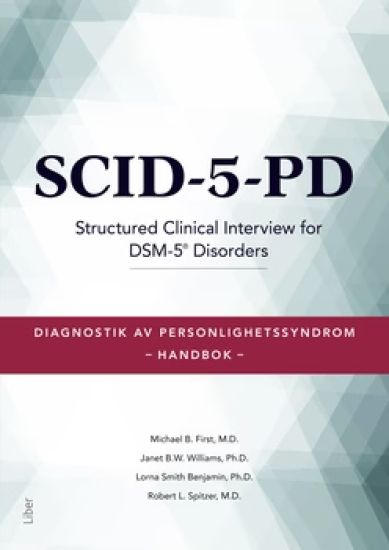
SCID-5-PD Handbok

SCID-5-PD Handbok

Michael B. First; Janet B.W. Williams; Lorna Smith Benjamin; Robert L. Spitzer

Liber
2023
nidottu
Presenterar principerna för SCID-5-PD; en semistrukturerad intervju för psykiatrisk diagnostik av personlighetssyndrom enligt DSM-5. Här ges detaljerade, praktiska anvisningar för hur intervjun ska genomföras och anvisningar för självskattningsformuläret Structured Clinical Interview for DSM-5 Screening Personality Questionnaire (SCID-5-SPQ). I handboken finns också vägledning i hur patienternas svar på intervjufrågor ska bedömas med utgångspunkt i kriterierna för DSM-5. Ett korrekt användande av SCID-5-PD ökar reliabiliteten vid diagnostik av personlighetssyndrom.Handboken kan dels användas av sjukvårdspersonal i det kliniska arbetet med psykiatrisk diagnostik, dels i utbildning av studenter på universitetsutbildningar och vid vidareutbildning av professionella inom vården.I SCID-5-PD Handbok anges DSM-5-kriterierna ordagrant så som de översatts i MINI-D 5 (utgiven av Pilgrim Press). ICD-koder har översatts till dess svenska motsvarighet ICD-10-SE, enligt Socialstyrelsens riktlinjer och i enlighet med översättningen i MINI-D 5.Om författarnaMichael B. First, M.D. Janet B.W. Williams, Ph.D. Lorna Smith Benjamin, Ph.D. Robert L. Spitzer, M.D.Faktagranskning och textbearbetningJohanna Motilla Hoppe; leg. psykolog, filosofie doktor,Mia Ramklint; leg. läkare, specialist i psykiatri, professor och Linda Bylin; leg. psykolog, specialist i klinisk psykologi, leg. psykoterapeut, psykoterapihandledare.RättigheterFörst publicerad i USA av American Psychiatric Association (APA), Washington DC. Copyright 2016 (SCID-5-PD). Alla rättigheter reserverade. Först publicerad i Sverige av Liber AB på svenska. Liber AB har exklusiv förlagsrätt till SCID-5-PD Intervju samt SCID-5-PD Handbok första utgåvan (copyright 2016) författad av Michael B. First, M.D., Janet B. W. Williams, Ph.D., Lorna Smith Benjamin, Ph.D. och Robert L. Spitzer, M.D. på svenska för distribution över hela världen.Skriftligt tillstånd från Liber AB krävs för återgivning i någon form av material från det översatta verket. APA har inte på något sätt bidragit till översättningen av det här verket från engelska till svenska och ansvarar inte för eventuella felaktigheter, utelämnanden eller andra möjliga brister i översättningen av verket.
Friendship Magic

Friendship Magic

Jeanette Perkins B. 1887 Brown; Janet B. 1893 Smalley

Hassell Street Press
2021
sidottu
This work has been selected by scholars as being culturally important and is part of the knowledge base of civilization as we know it.This work is in the public domain in the United States of America, and possibly other nations. Within the United States, you may freely copy and distribute this work, as no entity (individual or corporate) has a copyright on the body of the work.Scholars believe, and we concur, that this work is important enough to be preserved, reproduced, and made generally available to the public. To ensure a quality reading experience, this work has been proofread and republished using a format that seamlessly blends the original graphical elements with text in an easy-to-read typeface.We appreciate your support of the preservation process, and thank you for being an important part of keeping this knowledge alive and relevant.
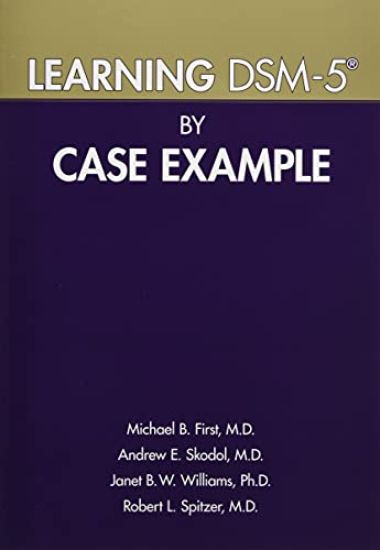
Learning DSM-5® by Case Example

Learning DSM-5® by Case Example

Michael B. First; Andrew E. Skodol; Janet B. W. Williams; Robert L. Spitzer

American Psychiatric Association Publishing
2016
pokkari
With at least one case presentation for each of the mental disorders catalogued in DSM-5—and multiple cases for nearly half of the disorders—Learning DSM-5 by Case Example has been meticulously designed to aid practitioners and students of all levels in psychology, psychiatry, social work, counseling, and psychiatric nursing develop internalized prototypes of DSM-5 disorders by first describing each disorder in relatable terms and subsequently illustrating how these symptom constellations manifest in real-life settings using clinical case material. The nearly 200 cases featured in this guide are drawn from the clinical experience of well over 100 clinicians, many of whom are well-known experts in particular areas of diagnosis and treatment. Sensitive to the fact that one of the hallmarks of mental disorders is the wide range of presentations that are encountered in a real-world setting, many of the disorders described include multiple cases that vary in symptom presentation, gender, age, clinical course, associated impairment in psychosocial functioning, and developmental factors, thus giving readers an appreciation for the heterogeneity typical of these disorders. Each case is complemented by a discussion that elaborates the ways in which the case conforms to the DSM-5 prototype or highlights those features of the case that illustrate the heterogeneity. With definitions of potentially unfamiliar medical and psychiatric terms, Learning DSM-5 by Case Example is an accessible resource for readers of all disciplines. And because it guides the reader through the organizational structure of DSM-5, it is also an ideal reference for courses on psychopathology or abnormal psychology.
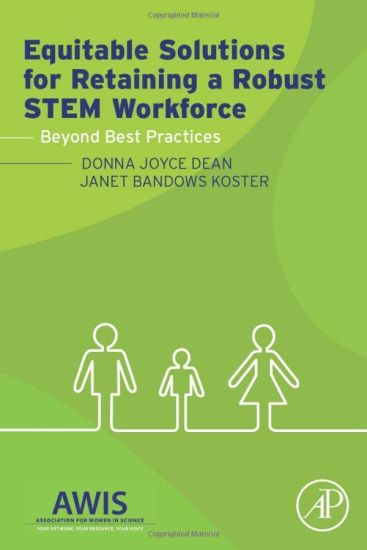
Equitable Solutions for Retaining a Robust STEM Workforce

Equitable Solutions for Retaining a Robust STEM Workforce

Donna J. Dean; Janet B. Koster

Academic Press Inc
2014
nidottu
Equitable Solutions for Retaining a Robust STEM Workforce offers strategies and proven recommendations to accommodate work/life satisfaction for those in the STEM fields. Using real-life case studies, this book discusses universal issues such as dual careers and strategic decision making, childcare/dependent care in professional contexts, promoting family-friendly policies, as well as mentoring and networking. Equitable Solutions for Retaining a Robust STEM Workforce provides data and tools to drive successful programs relaying proactive solutions that STEM employers, academic institutions, policy-makers, and individuals can utilize.
Listening to Sexual Minorities – A Study of Faith and Sexual Identity on Christian College Campuses

Listening to Sexual Minorities – A Study of Faith and Sexual Identity on Christian College Campuses

Mark A. Yarhouse; Janet B. Dean; Stephen P. Stratton; Michael Lastoria

IVP Academic
2018
nidottu
Students arrive on campus with various boxes of belongings to unpack, some heavy, some tidy, some more valuable, some more private. For many students, two of these boxes could be labeled "My Faith" and "My Sexuality"—and these two can be among the most cumbersome to handle. How to balance the two without having to set one down? How to hold them both closely, both securely, but still move forward to settle in with new friends in a new environment? How to keep from dropping one or the other, spilling its embarrassing contents for all to see? Such can be the struggle for any student, but especially for any sexual minority who identifies or struggles with an LGB+ identity or same-sex attraction on a Christian college campus. For these students their faith and their sexuality often feel both tender and in acute tension. Who is God making them to be? What do they need to grow in to develop faithfully, and what might they need to leave behind? How can they truly flourish? The research team of Yarhouse, Dean, Stratton, and Lastoria draw on their decades of experience both in the psychology of sexual identity and in campus counseling to bring us the results of an original longitudinal study into what sexual minorities themselves experience, hope for, and benefit from. Rich with both quantitative and qualitative data, their book gives an unprecedented opportunity to listen to sexual minorities in their own words, as well as to observe patterns and often surprising revelations about life and personal development both on campus and after graduation. Listening to Sexual Minorities will be an indispensable resource not only for counselors and psychologists but also for faculty, student-development leaders, and administrators in higher education as well as leaders in the church and wider Christian community who want to create an intentional environment to hear from and contribute to the spiritual flourishing of all. Christian Association for Psychological Studies (CAPS) Books explore how Christianity relates to mental health and behavioral sciences including psychology, counseling, social work, and marriage and family therapy in order to equip Christian clinicians to support the well-being of their clients.
Telephone Fund Raising

Telephone Fund Raising

Jonathan A. Segal; Janet B. Allen

Springer-Verlag New York Inc.
2011
nidottu
There was a time when bake sales, raffles, and the like provided non­ profit-making organizations with the funds they needed to flourish. Those days have long passed. Non-profit-making organizations now find themselves competing with one another for public and private sup­ port just to survive. The organizations that will survive are the ones that are not afraid of sophisticated fund-raising methods. Telephone fund raising is such a method. There is virtually no limit to the amount of money telephone fund raising can bring your organization. Telephone fund raising is so successful because it is personal. It allows for dialogue. More specifical­ ly, it allows the caller to answer questions, deal with complaints, negoti­ ate hard, and stress those aspects of the program that interest the poten­ tial contributor most. No method of fund raising other than a personal visit can do this. And, of course, visiting all your potential contributors personally would be impossible. This book provides you with all the information you need to devel­ op and maintain a lucrative telephone fund-raising program on your own. The general principles of telephone fund raising apply universally. Therefore, the principles will work for you, whatever your cause. They also will apply whatever your need. Whether you need a long-term telephone fund-raising program bringing in money at a steadily increas­ ing rate over the years or a short-term program lasting one month, one week, or even one day, this book is for you.
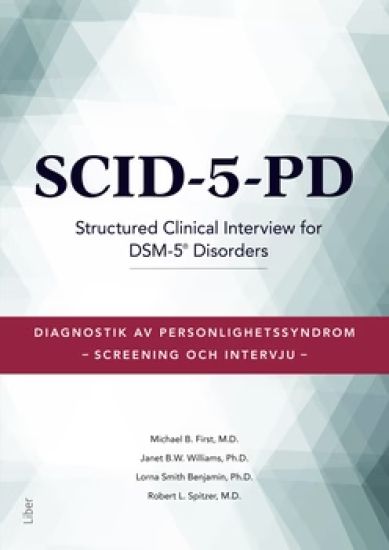
SCID-5-PD Intervju

SCID-5-PD Intervju

Robert L. Spitzer; Michael B. First; Janet B.W. Williams; Lorna Smith Benjamin

Liber
2023
kierre
SCID-5-PD Intervju är en semistrukturerad diagnostisk intervju som kan användas av personer som är utbildade i psykiatrisk diagnostik för att diagnostisera personlighetssyndrom enligt DSM-5.SCID-5-PD Intervju inleds med en översiktsintervju med öppna frågor, där patienten får möjlighet att beskriva sina besvär med egna ord. Därefter följer intervjufrågor för bedömning av de generella diagnostiska kriterierna för personlighetssyndrom samt frågor för att värdera de diagnostiska kriterierna för vart och ett av de specifika personlighetssyndromen i DSM-5.Resultaten dokumenteras i SCID-5-PD Sammanställningsprotokoll som finns i intervjuprotokollets början. SCID-5-PD är en del i en diagnostisk process som möjliggör en reliabel och valid diagnostik av personlighetssyndrom.I SCID-5-PD Intervju ingår SPQ som är ett självskattningsformulär utformat för att användas som screening av personlighetssyndrom inför intervjun.Intervjun kan dels användas av sjukvårdspersonal i det kliniska arbetet med psykiatrisk diagnostik, dels i utbildning av studenter på universitetsutbildningar och vid vidareutbildning av professionella inom vården.I SCID-5-PD Intervju anges DSM-5-kriterierna ordagrant så som de översatts i MINI-D 5 (utgiven av Pilgrim Press). ICD-koder har översatts till dess svenska motsvarighet ICD-10-SE, enligt Socialstyrelsens riktlinjer och i enlighet med översättningen i MINI-D5.Om författarnaMichael B. First, M.D. Janet B.W. Williams, Ph.D. Lorna Smith Benjamin, Ph.D. Robert L. Spitzer, M.D.Faktagranskning och textbearbetningJohanna Motilla Hoppe; leg. psykolog, filosofie doktor,Mia Ramklint; leg. läkare, specialist i psykiatri, professor ochLinda Bylin; leg. psykolog, specialist i klinisk psykologi, leg. psykoterapeut, psykoterapihandledare.RättigheterFörst publicerad i USA av American Psychiatric Association (APA), Washington DC. Copyright 2016 (SCID-5-PD). Alla rättigheter reserverade. Först publicerad i Sverige av Liber AB på svenska. Liber AB har exklusiv förlagsrätt till SCID-5-PD Intervju första utgåvan (copyright 2016) författad av Michael B. First, M.D., Janet B. W. Williams, Ph.D., Lorna Smith Benjamin, Ph.D. och Robert L. Spitzer, M.D. på svenska för distribution över hela världen.Skriftligt tillstånd från Liber AB krävs för återgivning i någon form av material från det översatta verket. APA har inte på något sätt bidragit till översättningen av det här verket från engelska till svenska och ansvarar inte för eventuella felaktigheter, utelämnanden eller andra möjliga brister i översättningen av verket.
Janet Jackson's Yorkshire B&B

Janet Jackson's Yorkshire B&B

Becky Papworth

Cancan Press
2023
nidottu
Welcome to the quirky market town of Hebden Bridge, in the heart of West Yorkshire, England. Meet Janet Jackson, the lovable and determined mum, sister, coper, cleaner, receptionist, wannabe lover who has just achieved her lifelong dream of opening her own bed and breakfast. But as she soon discovers, be careful of what you wish for Running a B&B isn't easy, especially when you're juggling a crazy family life, second-chance romances and nightmare holiday guests. Janet has to give up a lot to pursue her dream, but with humour, resilience and a lot of heart, she is determined to make it work.In this heart-warming and laugh-out-loud novel, you'll join Janet on her crazy ride. The perfect read for any woman who dreams of following her heart and living life on her own terms. If you love to laugh at the misadventures of Adrian Mole, enjoy the quirky community of Virgin River, or revel in the dysfunctional family relationships of Marian Keyes' Grown Ups, then you won't be able to put down Janet Jackson's Yorkshire B&B.This is a charming escape into the ups and downs of family life, romance after divorce and the hilarious trials and tribulations of looking after the wild and wonderful guests who frequent her Yorkshire B&B. Readers fall in love with Janet, cheering her on as she follows her dreams whilst navigating the chaos of family, romance and work. If you're looking for a heart-warming and entertaining read that will have you hooked from the first page, then don't miss out on Janet Jackson's Yorkshire B&B.Don't wait any longer, grab your copy now and join Janet on her adventure to run the best B&B in Yorkshire.
Cambridge Primary Mathematics Starter Activity Book B

Cambridge Primary Mathematics Starter Activity Book B

Cherri Moseley; Janet Rees

Cambridge University Press
2016
pokkari
Cambridge Primary Mathematics is a flexible and engaging course written for the Cambridge Primary Maths Curriculum. Cambridge Primary Mathematics is a flexible and engaging course written specifically for the Cambridge Primary Mathematics Curriculum Framework. Cambridge Primary Starters are complementary activity books which are specifically designed as preparatory activity books before children embark on the Cambridge Primary Curriculum at Grade 1. The Starters provide a range of activities which will help children acquire the vital numeracy skills they will need for primary school, such as numbers, counting, identifying shapes and comparing sizes and quantities. They include discreet activity guidance for teacher and parent as they support their child in completing the activities.