The year 1947 was a crucial one for Christian Dior. It was then that the fashion designer simultaneously founded his maison and his perfume factory in Paris. The success of Christian Dior's first essence, Miss Dior, was so outstanding as to leave its permanent mark in history. Ten years on from the founding of his perfume factory, on 24 October 1957, Christian Dior's untimely death conferred a new dimension to a decade characterised by an uncommon destiny. Text in English and French.
In the years 1945-1963, Jean Dubuffet set about documenting his collection of Art Brut. He had the pieces photographed by recognised photographers on the Paris art scene, including Henry Bonhotal and Emile Savitry. But he also had pieces photographed that were not in his own collection, including works that interested him because, like Art Brut, they were marginal to the official art world. These notably include works of popular and naïve art, children's drawings, tattoos, graffiti photographed by Brassaï and graphic works from the Solomon Islands. Dubuffet arranged these photographs of artworks by over a hundred artists - including Gaston Chaissac, Aloïse Corbaz, Joseph Crépin, Auguste Forestier, Somuk and Adolf Wölfli as well as anonymous artists - in extraordinary sequences contained in 14 albums (755 pages in total). These have been preserved since 1976 in the archives of the Collection de l'Art Brut, Lausanne. Classified by artist, the images document paintings, drawings, embroideries, sculptures and collages. In assembling this image bank in the years 1945-1963, Dubuffet set up a dialogue between highly diverse forms of expression of his period, all of which flowered away from the more familiar terrains of art history and culture. This facsimile edition of the Photographic Albums of Jean Dubuffet is combined with a booklet of essays by specialists: preface by Sarah Lombardi, Director of the Collection de l'Art Brut and essays by Baptiste Brun, Nicolas Garnier, Karoline Lewandowska, Jean-Hubert Martin, Jérôme Pierrat and Michel Thévoz. Text in English and French.
This book has been considered important throughout the human history, and so that this work is never forgotten we have made efforts in its preservation by republishing this book in a modern format for present and future generations. This whole book has been reformatted, retyped and designed. These books are not made of scanned copies and hence the text is clear and readable.
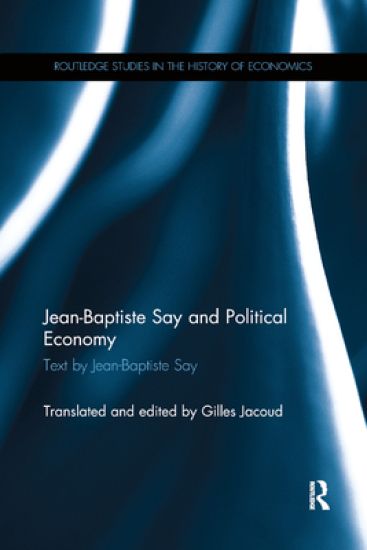
Jean-Baptiste Say (1767–1832) was one of the first great economists to have laid down the foundations of economic science. Author of the famous Treatise on Political Economy in 1803, which was revised and re-edited on several occasions, he published numerous other works including a voluminous Complete Course in Practical Political Economy in 1828–9. He also taught political economy successively from 1815 until his death in three Parisian establishments: the Athénée, the Conservatory of Arts and Trades, and the Collège de France.The texts in which Say exposes his approach to political economy have not been available in the English language until now except for the fourth edition of the ‘Preliminary Discourse’ which serves as an introduction to the Treatise. This book presents a translation which renders his works accessible to the English speaking world. For the first time, English readers will be able to become directly immersed in Say’s principal texts, where he develops his conception of political economy. Jean-Baptiste Say and Political Economy proposes a translation of a selection of eleven of Say’s texts. The first three are versions of the ‘Preliminary Discourse’ from the Treatise’s editions of 1803, 1814 and 1826 with the variations of the editions of 1817, 1819 and 1841. The following four texts are the opening discourses pronounced at the Conservatory in 1820 and 1828 and the Collège de France in 1831 and 1832. The eighth text is the ‘General Considerations’ which open the Complete Course in Practical Political Economy of 1828, with the variations of the 1840 re-edition. The final three texts are those Say devotes to ‘the progress of political economy’ in what is akin to a history of economic thought.This volume is of great importance to economic historians and people studying Jean-Baptiste Say, as well as those who are interested in economic theory and philosophy
Jean-Baptiste Say (1767-1832) is remembered primarily for Say's Law, one of the cornerstones of classical economics. The success of his Traite d'economie Politique made Say the best-known expositor of Adam Smith in Europe and America, and he became France's first professor of political economy.The set covers the following themes:* Say in the history of economics* classical statements on Say's Law* later statements on Say's Law (the prelude to the General Theory)* the Keynesian Revolution and the attack on Say's Law* Lange, Say's Law and the demand for money* modern reconstructions of Say's Law* commentaries on classical views relating to Say's Law* Retrieving the classical understanding of Say's Law.
This book explores the perceived paradigmatic conflict within British classical economics between the so called 'Ricardo School' and the contemporary French Economics of Jean-Baptiste Say. Samuel Hollander provides the reader with extensive evidence, utilizing all editions of Say's main texts and his lesser-known writings in order to demonstrate his adherence to much of Ricardian theory. This intriguing book focuses on selected doctorinal issues and surrounding debates, and will interest all serious historians of economic thought, finding a place on the bookshelves of many economists across the world.
This book explores the perceived paradigmatic conflict within British classical economics between the so called 'Ricardo School' and the contemporary French Economics of Jean-Baptiste Say. Samuel Hollander provides the reader with extensive evidence, utilizing all editions of Say's main texts and his lesser-known writings in order to demonstrate his adherence to much of Ricardian theory. This intriguing book focuses on selected doctorinal issues and surrounding debates, and will interest all serious historians of economic thought, finding a place on the bookshelves of many economists across the world.