

Kirjahaku
Etsi kirjoja tekijän nimen, kirjan nimen tai ISBN:n perusteella.
1000 tulosta hakusanalla Jefferson Hack

Jefferson Davis, Ex-president of the Confederate States of America
Varina Jefferson Davis
Kessinger Pub
2007
sidottu
Jefferson Davis, Ex-president of the Confederate States of America
Varina Howell Davis
Kessinger Pub
2007
sidottu

Life Of Jefferson S. Batkins, Member From Cranberry Centre
Jefferson S. Batkins
Nobel Press
2010
nidottu
This book, "Life Of Jefferson S. Batkins, Member From Cranberry Centre", by Jefferson S. Batkins, is a replication of a book originally published before 1871. It has been restored by human beings, page by page, so that you may enjoy it in a form as close to the original as possible. This book was created using print-on-demand technology. Thank you for supporting classic literature.
Jefferson And The American Democracy: An Historical Study
Cornelis De Witt
KESSINGER PUBLISHING, LLC
2007
nidottu

Life Of Jefferson S. Batkins, Member From Cranberry Centre
Jefferson S. Batkins
KESSINGER PUBLISHING, LLC
2007
sidottu
Jefferson And The American Democracy: An Historical Study
Cornelis De Witt
KESSINGER PUBLISHING, LLC
2007
sidottu
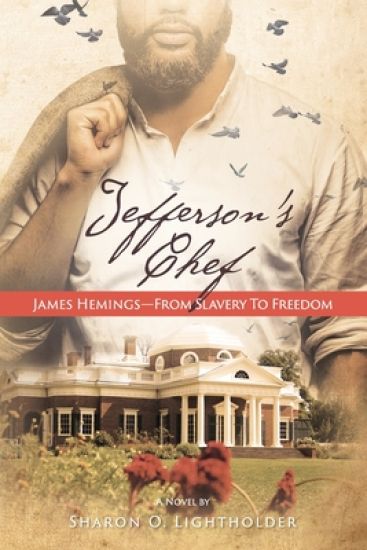
Jefferson's Chef - James Hemings From Slavery to Freedom
Sharon O Lightholder
Albedo Press
2020
pokkari
When Thomas Jefferson travels to Paris in 1784 to negotiate trade treaties for America, he takes the enslaved James Hemings with him as his manservant. Living in Paris, where the French had abolished slavery, Hemings discovers an independence, a skill, and a romance beyond his imagination. Torn between family and freedom as the French Revolution erupts, Hemings makes a choice that changes Jefferson and America.Sharon O. Lightholder's imagined biography, Jefferson's Chef: James Hemings--From Slavery to Freedom, is based on extensive legal, culinary, and historical research into Hemings's life and times, including primary materials from the Library of Congress, the National Archives, and the Thomas Jefferson Foundation at Monticello.Combining the political and the personal, Jefferson's Chef: James Hemings--From Slavery to Freedom creates a unique and intimate portrait of two exceptional men and discloses why Hemings was the only one of Jefferson's hundreds of slaves who was unconditionally freed during Jefferson's lifetime. Lightholder uses fiction to expose the astounding story of James Hemings and how his fierce desire for freedom changed his world and ours.
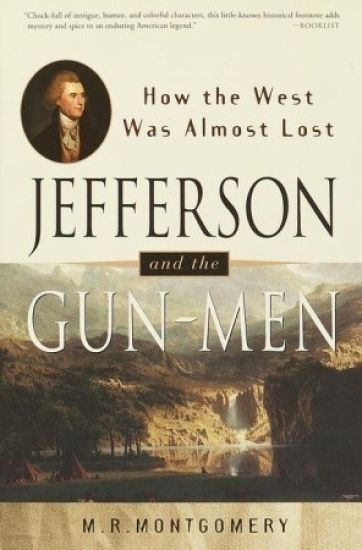
Jefferson and the Gun-Men: How the West Was Almost Lost
M. R. Montgomery
Crown Publishing Group (NY)
2001
nidottu
Contrary to popular opinion, the opening of the American frontier was not a simple land purchase; it was actually a hardscrabble fight. Even as Meriwether Lewis and William Clark set out on their legendary journey to the Pacific Ocean, other forces were taking the measure of the land with far darker ambitions. Aaron Burr, the charming and treacherous former vice president, determined that if he could not be master of his nation, he would instead become emperor of the next best thing: the Louisiana Territory. Slyly working with the powerful and ambitious commander of the U.S. Army, General James Wilkinson, Burr instigated a plot to seize not only Louisiana, but all of Mexico as well. Told from a time when the wildest plots and the most grandiose dreams thrived, as schemers and revolutionaries conspired to create a new country, Jefferson and the Gun-Men is the riveting tale of this unlikely story
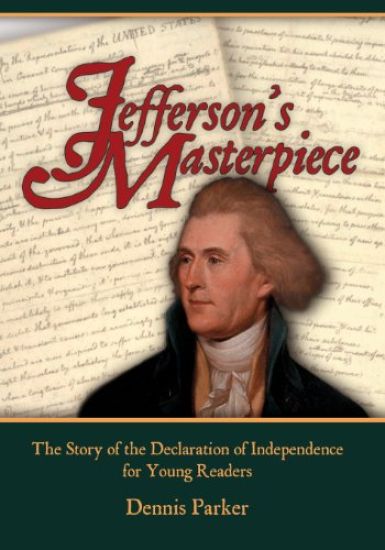
Jefferson's Masterpiece: The Story of the Declaration of Independence for Young Readers
Dennis Parker
Dennis Parker
2013
nidottu
Jefferson's Masterpiece is the amazing story of Thomas Jefferson and the Declaration of Independence. Readers take a historical journey that begins on June 11, 1776, when the Committee of Five met to choose the person to write the Declaration of Independence. It concludes on August 2, when 56 delegates signed America's birth certificate, after spending days editing, debating and voting on Jefferson's draft. The new American citizens joyfully celebrated the Declaration of Independence.
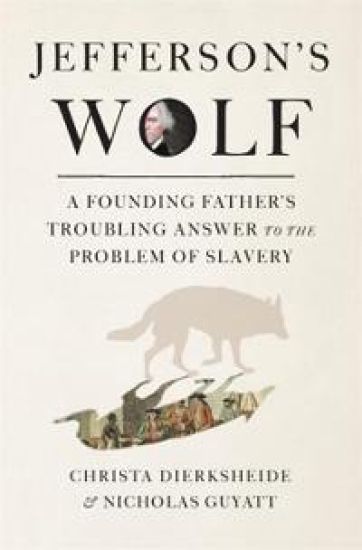
A decisive reassessment of Thomas Jefferson's long-debated views on slavery, showing that his chief antislavery strategy was racial exclusion: the removal of emancipated Black people from the United States. Toward the end of his life, Thomas Jefferson made his most famous statement about American slavery: "We have the wolf by the ear, and we can neither hold him safely, nor let him go." Presenting abolition as both necessary and perilous, the phrase has long been relied upon to explain an apparent paradox: despite publicly opposing slavery for four decades, Jefferson had made no progress toward Black freedom in his political career by the time he died in 1826. Nor had he done so in his expansive household, where he enslaved more than 600 people, including Sally Hemings and the four children he fathered with her. Christa Dierksheide and Nicholas Guyatt argue that the key to understanding Jefferson's antislavery position is his commitment to racial exclusion. Jefferson believed that the principal reason to abolish slavery was the threat of a massive slave revolt, but he viewed the presence of free Black people in the new nation as no less dangerous. To avert racial violence, Jefferson argued, the gradual abolition of slavery had to be paired with Black exile. Even when challenged by white and Black contemporaries with more expansive views of American belonging, Jefferson held fast to his vision for a white republic. Neither an egalitarian antiracist nor a proslavery apologist, Jefferson became the most influential advocate for racial separation in the early United States. Charting the evolution of his thought across the nation's formative decades, Jefferson's Wolf is a surprising and provocative account of the problem of slavery in the founding era.

As a law student and young lawyer in the 1760s, Thomas Jefferson began writing abstracts of English common law reports. Even after abandoning his law practice, he continued to rely on his legal commonplace book to document the legal, historical, and philosophical reading that helped shape his new role as a statesman. Indeed, he made entries in the notebook in preparation for his mission to France, as president of the United States, and near the end of his life. This authoritative volume is the first to contain the complete text of Jefferson’s notebook. With more than 900 entries on such thinkers as Beccaria, Montesquieu, and Lord Kames, Jefferson’s Legal Commonplace Book is a fascinating chronicle of the evolution of Jefferson’s searching mind.Jefferson’s abstracts of common law reports, most published here for the first time, indicate his deepening commitment to whig principles and his incisive understanding of the political underpinnings of the law. As his intellectual interests and political aspirations evolved, so too did the content and composition of his notetaking.Unlike the only previous edition of Jefferson’s notebook, published in 1926, this edition features a verified text of Jefferson’s entries and full annotation, including essential information on the authors and books he documents. In addition, the volume includes a substantial introduction that places Jefferson’s text in legal, historical, and biographical context.

Jefferson's Parliamentary Writings
Princeton University Press
2014
pokkari
This volume in the Second Series of The Papers of Thomas Jefferson contains the two important parliamentary documents he prepared during his lifelong study of the subject. Jefferson compiled the first document, called the Parliamentary Pocket-Book," while he was president of the Senate by virtue of his position as Vice- President of the United States. This informal guide was the basis for the Manual of Parliamentary Practice, which Jefferson completed in its earliest form by 1800 and which he had published in 1801. The Manual was the new nation's first full parliamentary rule book and is American democracy's reliable guide to its English parliamentary tradition. Still cited on the floors of Congress. Originally published in 1988. The Princeton Legacy Library uses the latest print-on-demand technology to again make available previously out-of-print books from the distinguished backlist of Princeton University Press. These editions preserve the original texts of these important books while presenting them in durable paperback and hardcover editions. The goal of the Princeton Legacy Library is to vastly increase access to the rich scholarly heritage found in the thousands of books published by Princeton University Press since its founding in 1905.
Among the Second Series of The Papers of Thomas Jefferson, this volume has the most detailed coverage of his day-to-day life. These disciplined records of personal expenditures, and of various other daily observations, furnish valuable information about prices and availability of commodities of the period and provide abundant evidence of Jefferson's devotion to a systematic way of living and of his insatiable curiosity. Originally published in 1997. The Princeton Legacy Library uses the latest print-on-demand technology to again make available previously out-of-print books from the distinguished backlist of Princeton University Press. These editions preserve the original texts of these important books while presenting them in durable paperback and hardcover editions. The goal of the Princeton Legacy Library is to vastly increase access to the rich scholarly heritage found in the thousands of books published by Princeton University Press since its founding in 1905.

Jefferson's Literary Commonplace Book
Princeton University Press
2014
pokkari
This work is a new edition of Thomas Jefferson's literary commonplace book, a notebook of his literary and philosophical reading. Unlike the only previous edition, published in 1928, it contains full annotation, pertinent information on the authors and works commonplaced, and a rationale for dating the entries. Thus it is now possible to show that most of the four hundred seven passages were entered when Jefferson was a young man, between the ages of fifteen and thirty. As such, they reflect the range of his literary interests from his school days to about the time of his marriage and involvement in politics. As one of the few surviving documents from Jefferson's early years, this notebook assumes special importance as a source of insight into the least known period of his life. In the introduction the editor presents reasons for thinking that the commonplace book was more to Jefferson than a literary sampler and was in some respects a deeply personal notebook with direct connections to the emotional events and preoccupations of his formative years. In addition to the text and annotation, the book contains a register of authors and an illustrated essay on Jefferson's handwriting that provides the rationale for assigning approximate dates to the entries of the commonplace book. Originally published in 1989. The Princeton Legacy Library uses the latest print-on-demand technology to again make available previously out-of-print books from the distinguished backlist of Princeton University Press. These editions preserve the original texts of these important books while presenting them in durable paperback and hardcover editions. The goal of the Princeton Legacy Library is to vastly increase access to the rich scholarly heritage found in the thousands of books published by Princeton University Press since its founding in 1905.
This volume is an important clarification of the controversial religious beliefs of one of our most unorthodox but ethically committed presidents. Printed here are the facsimile texts of Jefferson's two compilations of Jesus' words. Originally published in 1983. The Princeton Legacy Library uses the latest print-on-demand technology to again make available previously out-of-print books from the distinguished backlist of Princeton University Press. These editions preserve the original texts of these important books while presenting them in durable paperback and hardcover editions. The goal of the Princeton Legacy Library is to vastly increase access to the rich scholarly heritage found in the thousands of books published by Princeton University Press since its founding in 1905.
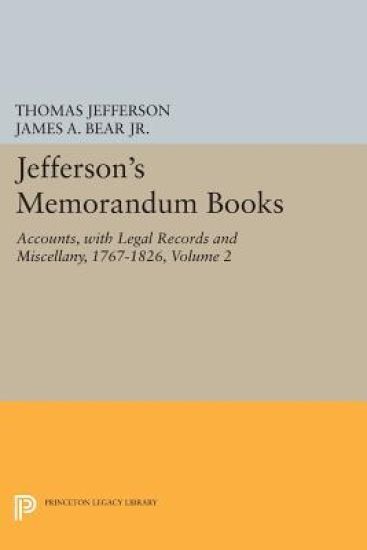
Jefferson's Memorandum Books, Volume 2
Princeton University Press
2017
pokkari
Among the Second Series of The Papers of Thomas Jefferson, this volume has the most detailed coverage of his day-to-day life. These disciplined records of personal expenditures, and of various other daily observations, furnish valuable information about prices and availability of commodities of the period and provide abundant evidence of Jefferson's devotion to a systematic way of living and of his insatiable curiosity. Originally published in 1997. The Princeton Legacy Library uses the latest print-on-demand technology to again make available previously out-of-print books from the distinguished backlist of Princeton University Press. These editions preserve the original texts of these important books while presenting them in durable paperback and hardcover editions. The goal of the Princeton Legacy Library is to vastly increase access to the rich scholarly heritage found in the thousands of books published by Princeton University Press since its founding in 1905.