Kirjojen hintavertailu. Mukana 11 244 527 kirjaa ja 12 kauppaa.

Kirjahaku

Etsi kirjoja tekijän nimen, kirjan nimen tai ISBN:n perusteella.

1000 tulosta hakusanalla Joseph M. Alexander; Benjamin J. Webb

The Day the World Ended at Little Bighorn: A Lakota History
The author of The Journey of Crazy Horse presents a legendary battle through the eyes of the Lakota The saga of Custer's Last Stand, has become ingrained in the lore of the American West, and the key players Crazy Horse, Sitting Bull, and George Armstrong Custer have grown to larger-than-life proportions. Now, award-winning historian Joseph M. Marshall presents the revisionist view of the Battle of the Little Bighorn that has been available only in the Lakota oral tradition. Drawing on this rich source of storytelling, Marshall uncovers what really took place at the Little Big Horn and provides fresh insight into the significance of that bloody day.
Diplomatic History

Diplomatic History

Joseph M. Siracusa

Oxford University Press
2021
nidottu
Diplomatic history explores the management of relations between nation-states by the process of negotiations. From the diplomacy of the American Revolution, the diplomatic origins of the Great War and its aftermath, Versailles, and the personal summitry behind the night Stalin and Churchill Divided Europe, to George W. Bush and the Iraq War, and diplomacy in the age of globalization, the management of power relationships has had an immense impact on our recent history. This Very Short Introduction updates the former Diplomacy: A Very Short Introduction and illustrates international diplomacy in action, exploring the changes in method at key historical junctures, and highlighting the very different demands that circumstances make on the practice of diplomats. Drawing on the case studies above, it makes sense of the way in which skilful diplomacy, as well as hubris, rashness, and excessive caution, can have important ramifications for the fate of nations. Based on the experiences of diplomatic history, it also locates the universal role of negotiations and identifies the key elements of success. As Joseph M. Siracusa shows, diplomacy was and is an indispensable element of statecraft, and without skilful diplomacy political success may remain elusive. Very Short Introductions: Brilliant, Sharp, Inspiring ABOUT THE SERIES: The Very Short Introductions series from Oxford University Press contains hundreds of titles in almost every subject area. These pocket-sized books are the perfect way to get ahead in a new subject quickly. Our expert authors combine facts, analysis, perspective, new ideas, and enthusiasm to make interesting and challenging topics highly readable.
W.B. Yeats and the Muses

W.B. Yeats and the Muses

Joseph M. Hassett

Oxford University Press
2015
nidottu
W.B. Yeats and the Muses explores how nine fascinating women inspired much of W.B. Yeats's poetry. These women are particularly important because Yeats perceived them in terms of beliefs about poetic inspiration akin to the Greek notion that a great poet is inspired and possessed by the feminine voices of the Muses. Influenced by the Pre-Raphaelite idea of woman as 'romantic and mysterious, still the priestess of her shrine', Yeats found his Muses in living women. His extraordinarily long and fruitful poetic career was fuelled by passionate relationships with women to and about whom he wrote some of his most compelling poetry. The book summarizes the different Muse traditions that were congenial to Yeats and shows how his perception of these women as Muses underlies his poetry. Newly available letters and manuscripts are used to explore the creative process and interpret the poems. Because Yeats believed that lyric poetry 'is no rootless flower, but the speech of a man,' exploring the relationship between poem and Muse brings new coherence to the poetry, illuminates the process of its creation, and unlocks the 'second beauty' to which Yeats referred when he claimed that 'works of lyric genius, when the circumstances of their origin is known, gain a second a beauty, passing as it were out of literature and becoming life.' As life emerges from the literature, the Muses are shown to be vibrant, multi-faceted personalities who shatter the idea of the Muse as a passive stereotype and take their proper place as begetters of timeless poetry.
Nuclear Weapons

Nuclear Weapons

Joseph M. Siracusa

Oxford University Press
2020
nidottu
Nuclear weapons have not been used in anger since the United States dropped atomic bombs on Hiroshima and Nagasaki in August 1945. Yet even after the Cold War, the Bomb is still the greatest threat facing humankind. As President Bill Clinton's first secretary of defence, Les Aspin, put it: 'The Cold War is over, the Soviet Union is no more. But the post-Cold War world is decidedly not post-nuclear'. For all the efforts to reduce nuclear stockpiles, the Bomb is here to stay. This Very Short Introduction looks at the science of nuclear weapons and how they differ from conventional weapons. Tracing the story of the nuclear bomb, Joseph Siracusa chronicles the race to acquire the H-bomb, a thermonuclear weapon with revolutionary implications; and the history of early arms control, nuclear deterrence, and non-proliferation. He also tracks the development of nuclear weapons from the origins of the Cold War in 1945 to the end of Moscow-dominated Communism in 1991, and examines the promise and prospect of missile defence, including Ronald Reagan's 'Star Wars' and George W. Bush's National Missile Defence. This third edition includes a new chapter on the development of nuclear weapons and the policies they have generated since the end of the Cold War. ABOUT THE SERIES: The Very Short Introductions series from Oxford University Press contains hundreds of titles in almost every subject area. These pocket-sized books are the perfect way to get ahead in a new subject quickly. Our expert authors combine facts, analysis, perspective, new ideas, and enthusiasm to make interesting and challenging topics highly readable.
W.B. Yeats and the Muses

W.B. Yeats and the Muses

Joseph M. Hassett

Oxford University Press
2010
sidottu
W.B. Yeats and the Muses explores how nine fascinating women inspired much of W.B. Yeats's poetry. These women are particularly important because Yeats perceived them in terms of beliefs about poetic inspiration akin to the Greek notion that a great poet is inspired and possessed by the feminine voices of the Muses. Influenced by the Pre-Raphaelite idea of woman as 'romantic and mysterious, still the priestess of her shrine', Yeats found his Muses in living women. His extraordinarily long and fruitful poetic career was fuelled by passionate relationships with women to and about whom he wrote some of his most compelling poetry. The book summarizes the different Muse traditions that were congenial to Yeats and shows how his perception of these women as Muses underlies his poetry. Newly available letters and manuscripts are used to explore the creative process and interpret the poems. Because Yeats believed that lyric poetry 'is no rootless flower, but the speech of a man,' exploring the relationship between poem and Muse brings new coherence to the poetry, illuminates the process of its creation, and unlocks the 'second beauty' to which Yeats referred when he claimed that 'works of lyric genius, when the circumstances of their origin is known, gain a second a beauty, passing as it were out of literature and becoming life.' As life emerges from the literature, the Muses are shown to be vibrant, multi-faceted personalities who shatter the idea of the Muse as a passive stereotype and take their proper place as begetters of timeless poetry.
Concepts of Personality

Concepts of Personality

Joseph M. Wepman

AldineTransaction
2008
nidottu
The psychologist who pursues an interest in personality is constantly faced by a dilemma. He seeks to investigate what is to him the most intriguing and interesting subject--the multifaceted operations of man in his natural environment. The predicament lies in the discrepancy between the complexity and richness of man's subjective experience, and the pallid analog of these experiences the psychologist is able to study effectively with the research procedures available to him. In Concepts of Personality Joseph M. Wepman and Ralph W. Heine offer a comprehensive survey of classical and contemporary personality theory, including a wide array of examples of these two trends.If the psychologist holds to the premises of strict objectivity through controlled observations, he finds himself driven to the periphery of the very problem he seeks to understand. This is a place where the reliability of measurement and the validity and predictability of his instruments can often be specified, but only at the cost of abandoning the goal of useful generality or of application to the individual in his ordinary life circumstances. Concepts of Personality, unlike most books on the subject, is not limited to broad, general theories. It includes chapters on basic processes--learning, perception, genetics, and drive theory; on the major analytical approaches of psychology and psychiatry; on anthropological and sociological contributions; and on the problems of measurement and assessment. Each chapter is by an authority on the point of view expressed.The editors' introduction, itself a major essay on the complex and divergent patterns and themes of contemporary views of personality, carefully leads the reader through the information at hand. The book as a whole constitutes an encyclopedic summary of the state of the science.
The Mild Voice of Reason

The Mild Voice of Reason

Joseph M. Bessette

University of Chicago Press
1994
sidottu
In recent years, many Americans and more than a few political scientists have come to believe that democratic deliberation in Congress - whereby judgments are made on the merits of policies reflecting the interests and desires of American citizens - is more myth than reality. Rather, pressure from special interest groups, legislative bargaining and the desire of incumbents to be re-elected are thought to originate in American legislative politics. While not denying such influences, Joseph M. Bessette argues that the institutional framework created by the founding fathers continues to foster a government that is both democratic and deliberative, at least to some important degree. Drawing on original research, case studies of policy-making in Congress and portraits of American law-makers, Bessette demonstrates not only the limitations of non-deliberative explanations for how laws are made, but also the continued vitality of genuine reasoning on the merits of public policy. Bessette discusses the contributions of the executive branch to policy deliberation, and looks at the controversial issue of the proper relationship of public opinion to policy-making. Informed by Bessette's nine years of public service in city and federal government, "The Mild Voice of Reason" offers insights into the real workings of American democracy, articulates a set of standards by which to assess the workings of our governing institutions, and clarifies the forces that promote or inhibit the collective reasoning about common goals so necessary to the success of American democracy.
The Mild Voice of Reason

The Mild Voice of Reason

Joseph M. Bessette

University of Chicago Press
1997
nidottu
In recent years, many Americans and more than a few political scientists have come to believe that democratic deliberation in Congress - whereby judgments are made on the merits of policies reflecting the interests and desires of American citizens - is more myth than reality. Rather, pressure from special interest groups, legislative bargaining and the desire of incumbents to be re-elected are thought to originate in American legislative politics. While not denying such influences, Joseph M. Bessette argues that the institutional framework created by the founding fathers continues to foster a government that is both democratic and deliberative, at least to some important degree. Drawing on original research, case studies of policy-making in Congress and portraits of American law-makers, Bessette demonstrates not only the limitations of non-deliberative explanations for how laws are made, but also the continued vitality of genuine reasoning on the merits of public policy. Bessette discusses the contributions of the executive branch to policy deliberation, and looks at the controversial issue of the proper relationship of public opinion to policy-making. Informed by Bessette's nine years of public service in city and federal government, "The Mild Voice of Reason" offers insights into the real workings of American democracy, articulates a set of standards by which to assess the workings of our governing institutions, and clarifies the forces that promote or inhibit the collective reasoning about common goals so necessary to the success of American democracy.
Medical Monopoly

Medical Monopoly

Joseph M. Gabriel

University of Chicago Press
2014
sidottu
In the decades following the Civil War, complex changes in patent and trademark law intersected with the changing sensibilities of both physicians and pharmacists to make intellectual property rights in drug manufacturing scientifically and ethically legitimate. By World War I, patented and trademarked drugs had become essential to the practice of good medicine, aiding in the rise of the American pharmaceutical industry and forever altering the course of medicine. Drawing on a wealth of previously unused archival material, Medical Monopoly combines legal, medical, and business history to offer a sweeping new interpretation of the origins of the complex and often troubling relationship between the pharmaceutical industry and medical practice today. Joseph M. Gabriel provides the first detailed history of patent and trademark law as it relates to the nineteenth-century pharmaceutical industry as well as a unique interpretation of medical ethics, therapeutic reform, and the efforts to regulate the market in pharmaceuticals before World War I. His book will be of interest not only to historians of medicine and science and intellectual property scholars but also to anyone following contemporary debates about the pharmaceutical industry, the patenting of scientific discoveries, and the role of advertising in the marketplace.
The Autonomy of History

The Autonomy of History

Joseph M. Levine

University of Chicago Press
1999
sidottu
In these essays, Joseph M. Levine shows how the idea and method of modern history first began to develop during the Renaissance, when a clear distinction between history and fiction was first proposed. The new claims for history were met by a scepticism in a debate that still echoes today. Levine's first three essays discuss Thomas More's preoccupation with the distinction between history and fiction; Erasmus's biblical criticism and the contribution of Renaissance philology to critical method; and the way in which Renaissance rhetoric, as in Thomas Elyot's "Book of the Governor", continued to inhibit the autonomy of history. He then shows how these issues persisted into the 18th century, even as critical method developed. He concludes with a close description of the great controversy that culminated in Edward Gibbon's day over the authenticity of a biblical text that had been used for centuries to defend the Trinity but which turned out to be a forgery. Levine shows how by then all sides were ready to concede the autonomy of history.
The Catholic Social Imagination

The Catholic Social Imagination

Joseph M. Palacios

University of Chicago Press
2007
sidottu
The reach of the Catholic Church is arguably greater than that of any other religion, extending across diverse political, ethnic, class, and cultural boundaries. But what is it about Catholicism that resonates so profoundly with followers who live under disparate conditions? What is it, for instance, that binds parishioners in America with those in Mexico? For Joseph M. Palacios, what unites Catholics is a sense of being Catholic - a social imagination that motivates them to promote justice and build a better world. In "The Catholic Social Imagination", Palacios gives readers a feeling for what it means to be Catholic and put one's faith into action. Tracing the practices of a group of parishioners in Oakland, California, and another in Guadalajara, Mexico, Palacios reveals parallels - and contrasts - in the ways these ordinary Catholics receive and act on a church doctrine that emphasizes social justice. Whether they are building a supermarket for the low-income elderly or waging protests to promote school reform, these parishioners provide important insights into the construction of the Catholic social imagination. Throughout, Palacios also offers important new cultural and sociological interpretations of Catholic doctrine on issues such as poverty, civil and human rights, political participation, and the natural law.
The Catholic Social Imagination

The Catholic Social Imagination

Joseph M. Palacios

University of Chicago Press
2007
nidottu
The reach of the Catholic Church is arguably greater than that of any other religion, extending across diverse political, ethnic, class, and cultural boundaries. But what is it about Catholicism that resonates so profoundly with followers who live under disparate conditions? What is it, for instance, that binds parishioners in America with those in Mexico? For Joseph M. Palacios, what unites Catholics is a sense of being Catholic - a social imagination that motivates them to promote justice and build a better world. In "The Catholic Social Imagination", Palacios gives readers a feeling for what it means to be Catholic and put one's faith into action. Tracing the practices of a group of parishioners in Oakland, California, and another in Guadalajara, Mexico, Palacios reveals parallels - and contrasts - in the ways these ordinary Catholics receive and act on a church doctrine that emphasizes social justice. Whether they are building a supermarket for the low-income elderly or waging protests to promote school reform, these parishioners provide important insights into the construction of the Catholic social imagination. Throughout, Palacios also offers important new cultural and sociological interpretations of Catholic doctrine on issues such as poverty, civil and human rights, political participation, and the natural law.
Medical Monopoly

Medical Monopoly

Joseph M. Gabriel

University of Chicago Press
2020
nidottu
During most of the nineteenth century, physicians and pharmacists alike considered medical patenting and the use of trademarks by drug manufacturers unethical forms of monopoly; physicians who prescribed patented drugs could be, and were, ostracized from the medical community. In the decades following the Civil War, however, complex changes in patent and trademark law intersected with the changing sensibilities of both physicians and pharmacists to make intellectual property rights in drug manufacturing scientifically and ethically legitimate. By World War I, patented and trademarked drugs had become essential to the practice of good medicine, aiding in the rise of the American pharmaceutical industry and forever altering the course of medicine. Drawing on a wealth of previously unused archival material, Medical Monopoly combines legal, medical, and business history to offer a sweeping new interpretation of the origins of the complex and often troubling relationship between the pharmaceutical industry and medical practice today. Joseph M. Gabriel provides the first detailed history of patent and trademark law as it relates to the nineteenth-century pharmaceutical industry as well as a unique interpretation of medical ethics, therapeutic reform, and the efforts to regulate the market in pharmaceuticals before World War I. His book will be of interest not only to historians of medicine and science and intellectual property scholars but also to anyone following contemporary debates about the pharmaceutical industry, the patenting of scientific discoveries, and the role of advertising in the marketplace.
The Chicago Auditorium Building

The Chicago Auditorium Building

Joseph M. Siry

University of Chicago Press
2004
nidottu
Winner of the Alice Davis Hitchcock Award from the Society of Architectural HistoriansWhen the magnificent Auditorium Building opened on Chicago's Michigan Avenue in December 1889, it marked Chicago's emergence both as the leading city of the Midwest and as a metropolis of international stature. In this lavishly illustrated book, Joseph M. Siry explores not just the architectural history of the Auditorium Building but also the crucial role it played in Chicago's social history. Covering the Auditorium from the early design stage to its opening, its later renovations, its links to culture and politics in Chicago, and its influence on later Adler and Sullivan works (including the Schiller Building and the Chicago Stock Exchange Building), this volume recounts the fascinating tale of a building that helped to define a city and an era.
Carson Pirie Scott

Carson Pirie Scott

Joseph M. Siry

University of Chicago Press
2012
nidottu
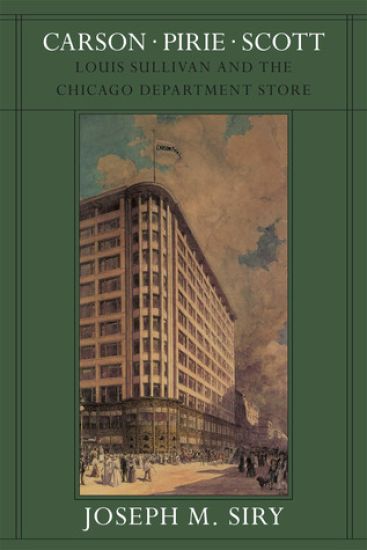
Long recognized as a Chicago landmark, the Carson Pirie Scott Building also represents a milestone in the development of architecture. The last large commercial structure designed by Louis Sullivan, the Carson building reflected the culmination of the famed architect's career as a creator of tall steel buildings. In this study, Joseph M. Siry traces the origins of the building's design and analyzes its role in commercial, urban, and architectural history. Originally constructed to house the Schlesinger and Mayer Store, Sullivan's building was one of a number of large department stores built at the turn of the century along State Street in Chicago's burgeoning retail district. Replacing a generation of commercial architecture that had grown out of the Great Fire of 1871, these new buildings were tall and steel-framed, a construction that posed new aesthetic problems for designers. Handsomely illustrated with more than one hundred photographs and drawings, Carson Pirie Scott provides an illuminating history of a pivotal architectural work and offers an original, revealing assessment of how Sullivan, responding to the commercial culture of his time, created a fresh, distinctive American building.
Beth Sholom Synagogue

Beth Sholom Synagogue

Joseph M. Siry

University of Chicago Press
2011
sidottu
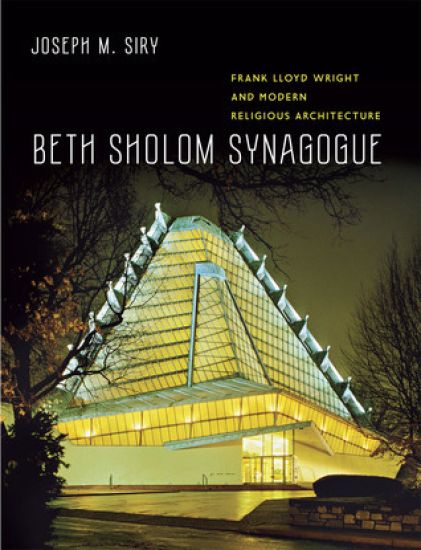
In a suburb just north of Philadelphia stands Beth Sholom Synagogue, Frank Lloyd Wright's only synagogue and one of his finest religious buildings. Designated a National Historic Landmark in 2007, Beth Sholom was one of Wright's last completed projects, and for years it has been considered among his greatest masterpieces. But its full story has never been told. "Beth Sholom Synagogue" provides the first in-depth look at the synagogue's conception and realization in relation to Wright's other religious architecture. Beginning with Wright's early career at Adler and Sullivan's architectural firm in Chicago and his design for Unity Temple and ending with the larger works completed just before or soon after his death, Joseph M. Siry skillfully depicts the architect's exploration of geometric forms and structural techniques in creating buildings for worshiping communities. Siry also examines Wright's engagement with his clients, whose priorities stemmed from their denominational identity, and the effect this had on his designs - his client for Beth Sholom, Rabbi Mortimer Cohen, worked with Wright to anchor the building in the traditions of Judaism even as it symbolized the faith's continuing life in postwar America. With each of his religious projects, Wright considered questions of social history and cultural identity as he advanced his program for an expressive, modern American architecture. His search for a way to combine these agendas culminated in Beth Sholom, where the interplay of light, form, and space create a stunning and inspiring place of worship. Filled with illustrations, this remarkable book takes us deep inside the synagogue's design, construction, and reception to bring us an illuminating portrait of the crowning achievement of this important aspect of Wright's career.
Religion in Japanese History

Religion in Japanese History

Joseph M. Kitagawa

Columbia University Press
1966
sidottu
Tracing Japan's religions from the Hein Period through the middle ages and into modernity, this book explores the unique establishment of Shinto, Buddhism, and Confucianism in Japan, as well as the later influence of Roman Catholicism, and the problem of Restoration--both spiritual and material--following World War II.
Religion in Japanese History

Religion in Japanese History

Joseph M. Kitagawa

Columbia University Press
1990
pokkari
Tracing Japan's religions from the Hein Period through the middle ages and into modernity, this book explores the unique establishment of Shinto, Buddhism, and Confucianism in Japan, as well as the later influence of Roman Catholicism, and the problem of Restoration--both spiritual and material--following World War II.
Force of Words

Force of Words

Joseph M. Brown

Columbia University Press
2020
sidottu
Terrorist groups attain notoriety through acts of violence, but threats of future violence are just as important in attaining their political goals. Force of Words is a groundbreaking examination of the role of threats in terrorist strategies. Joseph M. Brown shows how terrorists use threats, true and false, to achieve key outcomes such as social control, economic attrition, and policy concessions. Brown demonstrates that threats are integral to terrorism on a tactical level as well, distracting security forces, drawing police into traps, and warning civilians out of harm’s way when terrorists seek to limit casualties.Force of Words reorients the field of terrorism studies, prioritizing the symbolic, psychological dimension that makes this form of conflict distinctive. It expands the study of terrorist propaganda by detailing how militants tailor their threats to send the desired political message. Drawing on rich interview data, quantitative evidence, and case studies of the IRA, ETA, the Tamil Tigers, Shining Path, the Túpac Amaru Revolutionary Movement, Boko Haram, the Afghan Taliban, and ISIL, the book offers practical guidance for interpreting terrorists’ threats and assessing their credibility. Force of Words is essential reading for anyone seeking to understand the logic of terrorism.
Force of Words

Force of Words

Joseph M. Brown

Columbia University Press
2020
pokkari
Terrorist groups attain notoriety through acts of violence, but threats of future violence are just as important in attaining their political goals. Force of Words is a groundbreaking examination of the role of threats in terrorist strategies. Joseph M. Brown shows how terrorists use threats, true and false, to achieve key outcomes such as social control, economic attrition, and policy concessions. Brown demonstrates that threats are integral to terrorism on a tactical level as well, distracting security forces, drawing police into traps, and warning civilians out of harm’s way when terrorists seek to limit casualties.Force of Words reorients the field of terrorism studies, prioritizing the symbolic, psychological dimension that makes this form of conflict distinctive. It expands the study of terrorist propaganda by detailing how militants tailor their threats to send the desired political message. Drawing on rich interview data, quantitative evidence, and case studies of the IRA, ETA, the Tamil Tigers, Shining Path, the Túpac Amaru Revolutionary Movement, Boko Haram, the Afghan Taliban, and ISIL, the book offers practical guidance for interpreting terrorists’ threats and assessing their credibility. Force of Words is essential reading for anyone seeking to understand the logic of terrorism.