

Kirjahaku
Etsi kirjoja tekijän nimen, kirjan nimen tai ISBN:n perusteella.
1000 tulosta hakusanalla Joseph Strutt
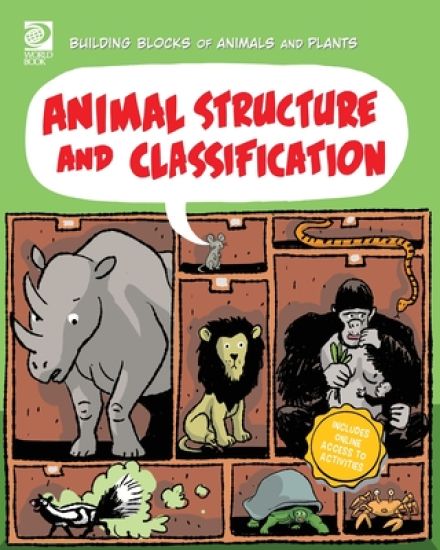
This nonfiction graphic novel introduces animal structure and classification, explaining how to identify different types of animals.

This nonfiction graphic novel introduces plant structure and classification, explaining how to identify different types of plants.
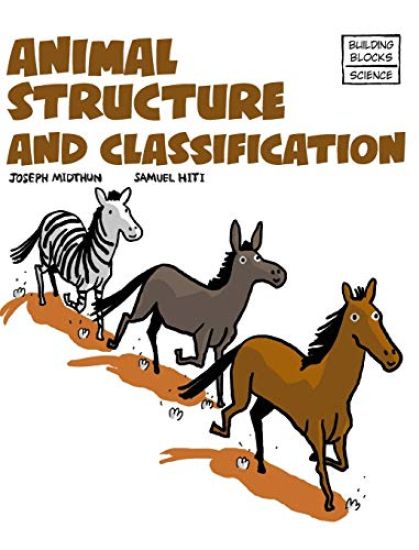
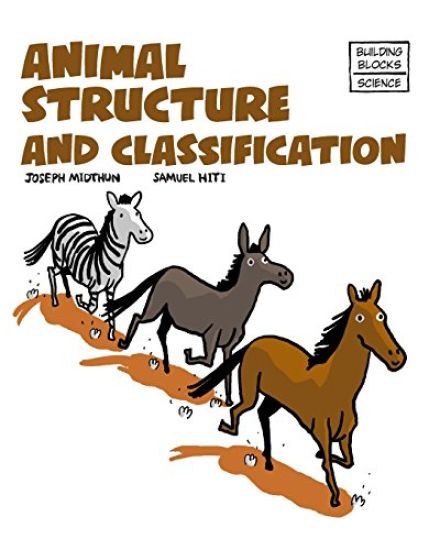

This graphic novel guides young readers through the biology of animals or plants by creatively pairing humor, action, and real-life examples with scientifically accurate illustrations. Surprising fun facts will inspire readers to conduct their own research and investigation. In Animal Structure and Classification, readers will learn about kingdoms, phyla, orders, species and more A fun activity and handy timeline also included.

This graphic novel guides young readers through the biology of animals or plants by creatively pairing humor, action, and real-life examples with scientifically accurate illustrations. Surprising fun facts will inspire readers to conduct their own research and investigation. In Plant Structure and Classification, readers will learn about plant kingdoms and classes, roots and stems, leaves, flowers, seeds, and more A fun activity and handy timeline also included.

Once programmers have grasped the basics of object-oriented programming and C++, the most important tool that they have at their disposal is the Standard Template Library (STL). This provides them with a library of re-usable objects and standard data structures. It has recently been accepted by the C++ Standards Committee. This textbook is an introduction to data structures and the STL. It provides a carefully integrated discussion of general data structures and their implementation and use in the STL. In so doing, the author is able to teach readers the important features of abstraction and how to develop applications using the STL.

Historic Structure Report: Bodie Island Life-Saving Station & Boat House: Cape Hatteras National Seashore
Joseph K. Oppermann; U. S. Department of the Interior
Createspace Independent Publishing Platform
2013
nidottu

Historic Structure Report: Bodie Island Coast Guard Station: Cape Hatteras National Seashore
Joseph K. Oppermann; U. S. Department of the Interior
Createspace Independent Publishing Platform
2013
nidottu

Historic Structure Report: Bodie Island Light Station- Double Keepers Quarters: Cape Hatteras National Seashore
Joseph K. Oppermann; U. S. Department of the Inteior
Createspace Independent Publishing Platform
2013
nidottu

Historic Structure Report: Cape Lookout Lighthouse: Cape Lookout National Seashore
Joseph K. Oppermann; U. S. Department of the Interior
Createspace Independent Publishing Platform
2013
nidottu

German Structural Pacifism examines the influence of Germany’s lessons of the past on its security policy since reunification in an approach that is both novel and timely in the context of the Russia-Ukraine War. Germany’s lessons of the past provide contradictory “right ways” for Germany to overcome its authoritarian past and serve to legitimate political interests in security policy decision-making. Reconciling competing political interests and contradictory narratives results in a security policy that prioritizes “the right way” to do security policy is over its effectiveness. It is the author’s great merit to have defined the past 30 years of German security policy under the term Structural Pacifism. I find this conclusive. Sönke Neitzel, Chair of Military History at the University of Potsdam An accurate depiction of Germany’s systemic neglect of its armed forces since reunification, demonstrating why it is no surprise that our armed forces are naked. A follow up including the Zeitenwende would be very interesting. Hans-Peter Barthels, President of the German Society for Security Policy The book succinctly and accurately addresses the lack of an honest debate on the use of military force in the domain of German security policy, and explores its negative impact on military decision-making from political strategy all the way down to the tactical level. Volker Wieker, Former Chief of Defense of the German Federal Armed Forces (2009-2018)

Quantitative Structure-Pharmacokinetic Relationships - Artificial Neural Network Modeling
Joseph Turner; Snezana Agatonovic-Kustrin
VDM Verlag Dr. Mueller E.K.
2008
pokkari

Market structure and performance of cassava marketers in Cameroon
Joseph Serge Mbarga Evouna
Lap Lambert Academic Publishing
2024
pokkari
This book investigates the structure and efficiency of cassava marketing in Cameroon, focusing on three regions: Centre, Littoral, and West. Data were collected from 326 cassava traders across 15 markets. The analysis used descriptive statistics, the Gini coefficient, and the Lorenz curve to assess market concentration and marketing efficiency. The study recommends organizing cassava retailers into cooperatives to improve market efficiency, enabling them to access credit from agricultural and commercial banks, which could enhance their performance. The findings offer insights that may inform government agricultural market policies.

This book seeks to discover the architectural potential of biological structures as they can be found in nature. The structures that give biological forms strength, movement, firmness, and flexibility are studied, illustrated, and used as an inspiration for a huge number of design experiments of which the thinking, working, and final prototyping process are shown.

Structures which are conceived rationally have an order and logic which do not always fit into real world conditions of the irrational and the unpredictable in architecture. But what if structural ideas were explored as a condition in architecture which challenged the predictable? What if structure were not bound by its rational ethos but instead conceived in alternative approaches relevant to real-world irrationalities? And if the approaches lead to what is possible, then is structural eccentricity a norm or an anomaly in architecture? This book documents a series of design investigations that engage with conditions of shape, change and mutation, giving rise to design propositions dealing with eccentricity in structure. With illustrations and accompanying descriptions of the design process, this book is a useful reference for structural strategies in architecture.

Originally published in 1973, this book was published in two volumes. In the first volume, the author describes what he sees as the rudiments of three deterministic partial theories of structural learning. The first involves competence, partial theories which deal only with the problem of how to account for the various kinds of behavior of which people are typically capable. Special attention is given to mathematical competence. Nothing is said about learning or performance. The second partial theory is concerned with motivation, learning, and performance under idealized conditions, and is obtained from the first partial theory by imposing further structure on it. This theory says nothing about memory of the limited capacity of human subjects to process information. … The final theory is obtained from the second by making additional assumptions, which bring memory and finite information processing into the picture. The theory is still partial, however, since no attempt is made to deal with certain ultra-short-term behavioral phenomena which appear to depend directly on particular physiological characteristics.
Originally published in 1973, this book was published in two volumes. In the first volume, the author describes what he sees as the rudiments of three deterministic partial theories of structural learning. The first involves competence, partial theories which deal only with the problem of how to account for the various kinds of behavior of which people are typically capable. Special attention is given to mathematical competence. Nothing is said about learning or performance. The second partial theory is concerned with motivation, learning, and performance under idealized conditions, and is obtained from the first partial theory by imposing further structure on it. This theory says nothing about memory of the limited capacity of human subjects to process information. … The final theory is obtained from the second by making additional assumptions, which bring memory and finite information processing into the picture. The theory is still partial, however, since no attempt is made to deal with certain ultra-short-term behavioral phenomena which appear to depend directly on particular physiological characteristics.