While most teachers acknowledge the importance of vocabulary in learning a new language, many assume a reading class or other teacher will cover vocabulary. Yet vocabulary plays an essential role in good writing, especially academic writing. Teaching Vocabulary Is the Writing Teacher’s Job explores the serious nature of ESL students’ lexical plight and looks at vocabulary in relation to reading, speaking, listening, and writing proficiency. It also examines the role of vocabulary in ESL writing assessment. In the conclusion, author Keith Folse discusses eight research-based suggestions for writing teachers, including encouraging students to become vocabulary detectives, teaching collocations, testing vocabulary, and teaching paraphrasing and summarizing.
Public discourse receives the concerted attention of linguists, political analysts, and others involved with language as a persuasive tool of communication. Yet sometimes overlooked is the fact that the impact of much modern political communication comes from aesthetic attributes. Effectiveness of delivery, poetry of expression, and emotional investment of the rhetorician give the audience a gauge for determining the speaker's sincerity.Warriors' Words examines leadership in the present century by scrutinizing the oral and written communications of 15 remarkable individuals at critical periods of their lives. Drawing on the words of Mohandas Gandhi, Clarence Darrow, Adolf Hitler, Winston Churchill, Joseph McCarthy, Adlai Stevenson, and Martin Luther King, among others, the author shows how language can dramatically transform listeners into agents of change. Moreover, the author analyzes how exemplary rhetoric can promote the development of motivation, the refinement of thought, and the binding together of peoples into positive forces for action. This study of the use and impact of words by significant social figures will be of interest to all students of rhetoric, politics, and history.
Dr. Kaye and Dr. Dhor have assembled top experts to write about facility planning and management in Part I of their two issues devoted to Infection Prevention and Control in Healthcare. Articles in this issue are devoted to: Building a Successful Infection Control Program: Key Components, Processes and Economics; Hand Hygiene Sterilization; High Level Disinfection and Environmental Cleaning; Environement of Care; Infection Control in Alternative Healthcare Settings (Long Term Care and Ambulatory); Antibiotic Stewardship; Outbreak InvestigationsWater Safety in Healthcare/Legionella in the Healthcare Setting; Construction and Renovation; Bloodborne and Body Fluid Exposures - prevention and management of Occupational Health Issues; and Informatics and Statistics in Infection Control. Part II is devoted to clinical management of infections.
Dr. Kaye and Dr. Dhor have assembled top experts to write about clinical management of infections in Part II of their two issues devoted to Infection Prevention and Control in Healthcare. Articles in this issue are devoted to: CLABSI; UTI; Tuberculosis; Ventilator-Assisted Pneumonia; Surgical Site Infection; MRSA; VRE; Gram-Negative Bacilli; Fungal Infections; C. Difficile, and Emerging Infections including Ebola. Infectious Disease physicians and anyone in the hospital setting will find this issue very useful, as state-of-the-art clinical reviews provide clinical management on these common and emerging infections.
Interpreting Basic Statistics gives students valuable practice in interpreting statistical reporting as it actually appears in peer-reviewed journals. Features of the ninth edition: • Covers a broad array of basic statistical concepts, including topics drawn from the New Statistics • Up-to-date journal excerpts reflecting contemporary styles in statistical reporting • Strong emphasis on data visualization • Ancillary materials include data sets with almost two hours of accompanying tutorial videos, which will help students and instructors apply lessons from the book to real-life scenarios About this book Each of the 63 exercises in the book contain three central components: 1) an introduction to a statistical concept, 2) a brief excerpt from a published research article that uses the statistical concept, and 3) a set of questions (with answers) that guides students into deeper learning about the concept. The questions on the journal excerpts promote learning by helping students • interpret information in tables and figures,• perform simple calculations to further their interpretations, • critique data-reporting techniques, and • evaluate procedures used to collect data. The questions in each exercise are divided into two parts: (1) Factual Questions and (2) Questions for Discussion. The Factual Questions require careful reading for details, while the discussion questions show that interpreting statistics is more than a mathematical exercise. These questions require students to apply good judgment as well as statistical reasoning in arriving at appropriate interpretations. Each exercise covers a limited number of topics, making it easy to coordinate the exercises with lectures or a traditional statistics textbook.
Interpreting Basic Statistics gives students valuable practice in interpreting statistical reporting as it actually appears in peer-reviewed journals. Features of the ninth edition: • Covers a broad array of basic statistical concepts, including topics drawn from the New Statistics • Up-to-date journal excerpts reflecting contemporary styles in statistical reporting • Strong emphasis on data visualization • Ancillary materials include data sets with almost two hours of accompanying tutorial videos, which will help students and instructors apply lessons from the book to real-life scenarios About this book Each of the 63 exercises in the book contain three central components: 1) an introduction to a statistical concept, 2) a brief excerpt from a published research article that uses the statistical concept, and 3) a set of questions (with answers) that guides students into deeper learning about the concept. The questions on the journal excerpts promote learning by helping students • interpret information in tables and figures,• perform simple calculations to further their interpretations, • critique data-reporting techniques, and • evaluate procedures used to collect data. The questions in each exercise are divided into two parts: (1) Factual Questions and (2) Questions for Discussion. The Factual Questions require careful reading for details, while the discussion questions show that interpreting statistics is more than a mathematical exercise. These questions require students to apply good judgment as well as statistical reasoning in arriving at appropriate interpretations. Each exercise covers a limited number of topics, making it easy to coordinate the exercises with lectures or a traditional statistics textbook.
This readable and informative survey of key ideas about students’ thinking in science builds a bridge between theory and practice by offering clear accounts from research, and showing how they relate to actual examples of students talking about widely taught science topics. Focused on secondary students and drawing on perspectives found in the international research literature, the goal is not to offer a comprehensive account of the vast literature, but rather to provide an overview of the current state of the field suitable for those who need an understanding of core thinking about learners’ ideas in science, including science education students in teacher preparation and higher degree programs, and classroom teachers, especially those working with middle school, high school, or college level students. Such understanding can inform and enrich science teaching in ways which are more satisfying for teachers, less confusing and frustrating for learners, and so ultimately can lead to both greater scientific literacy and more positive attitudes to science.
This readable and informative survey of key ideas about students’ thinking in science builds a bridge between theory and practice by offering clear accounts from research, and showing how they relate to actual examples of students talking about widely taught science topics. Focused on secondary students and drawing on perspectives found in the international research literature, the goal is not to offer a comprehensive account of the vast literature, but rather to provide an overview of the current state of the field suitable for those who need an understanding of core thinking about learners’ ideas in science, including science education students in teacher preparation and higher degree programs, and classroom teachers, especially those working with middle school, high school, or college level students. Such understanding can inform and enrich science teaching in ways which are more satisfying for teachers, less confusing and frustrating for learners, and so ultimately can lead to both greater scientific literacy and more positive attitudes to science.
In Vocabulary Myths, Keith S. Folse breaks down the teaching of second language vocabulary into eight commonly held myths. In debunking each myth, he introduces the myth with a story based on his 25 years of teaching experience (in the United States and abroad), continues with a presentation of what empirical research has shown on the topic, and finishes with a list of what teachers can do in their classrooms to facilitate true vocabulary acquisition.The goal of Vocabulary Myths is to foster a paradigm shift that correctly views vocabulary as fundamental in any second language learning process and demonstrates that research supports this goal-that in fact there is a wealth of empirical evidence to support these views. In addition, an important theme is that teachers have overestimated how much vocabulary students really understand, and as a result, the so-called "comprehensible input" is neither comprehensible nor input.The second language vocabulary acquisition myths reexamined in this book are:*In learning another language, vocabulary is not as important as grammar or other areas.*Using word lists to learn L2 vocabulary is unproductive.*Presenting new vocabulary in semantic sets facilitates learning.*The use of translations to learn new vocabulary should be discouraged.*Guessing words from context is an excellent strategy for learning L2 vocabulary.*The best vocabulary learners make use of one or two really specific vocabulary learning strategies.*The best dictionary for L2 learners is a monolingual dictionary.*Teachers, textbooks, and curricula cover L2 vocabulary adequately.
101 Clear Grammar Tests contains 101 reproducible tests on common points in the teaching of beginning, intermediate, and advanced ESL grammar. This collection of tests includes a variety of question types and reflects a range of different approaches to testing. As a result, busy teachers will be able to easily find tests that resemble the teaching and learning styles of their own classrooms. The tests in this book are arranged by topic, with two tests per grammar point, in a sequence that matches the one found in the Clear Grammar textbooks, Books 1-4. This test bank also contains a bonus-nine comprehensive advanced grammar tests. Like its predecessor (100 Clear Grammar Tests), this book can be used along with any other ESL grammar series.
*What elements make a speaking activity successful? *Which tasks or activities really help build speaking fluency? *What does the research show regarding speaking activities?*What mistakes do ESL teachers often make in speaking activity design?In this highly accessible and practical resource, Keith S. Folse provides a wealth of information to help ESL/EFL teachers design and use speaking tasks that will actually improve students' speaking fluency. The book presents and discusses the relevant research and assessment issues and includes case studies from twenty different settings and classrooms around the world so that readers learn from others about the problems and successes of using various speaking activities. Teachers will find the chapters on Twenty Successful Activities and Ten Unsuccessful Activities particularly valuable. The successful activities are provided for classroom use and are reproducible. The book also contains five appendixes that explain what teachers need to know about vocabulary, pronunciation, and grammar and how they affect the teaching of speaking. Samples of successful lesson plans and a list of resources useful for teaching speaking are also included.Keith S. Folse, Ph.D., is Coordinator, TESOL Programs, University of Central Florida (Orlando). He is the author of Vocabulary Myths (University of Michigan Press, 2004) and more than 35 second language textbooks, including texts on grammar, reading, speaking, listening, and writing.
For many teachers of English language learners, the field of assessment is foreign territory. Assessment has its own culture, traditions, and terminology. This training guide is intended to help classroom teachers become more comfortable creating and using assessments. A Practical Guide to Assessing English Language Learners provides helpful insights into the practice and terminology of assessment. The text focuses on providing the cornerstones of good assessments—usefulness, validity, reliability, practicality, washback, authenticity, transparency, and security—and techniques for testing. It devotes a chapter to the assessment of each of the four main skill areas (reading, writing, listening, and speaking), and also covers placement testing, such as using TOEFL® and MELAB, diagnostic testing, evaluation, and instructional decision-making with regard to testing. Tips to improve students’ test-taking strategies are offered, and each chapter ends with a helpful list of Ten Things to Remember, as well as informative case studies featuring two teachers and their assessment decisions. Incorporating its own principles, A Practical Guide to Assessing English Language Learners opens with a short quiz for the reader called Are You Testwise? that quickly determines how each teacher will benefit from this indispensable guide.
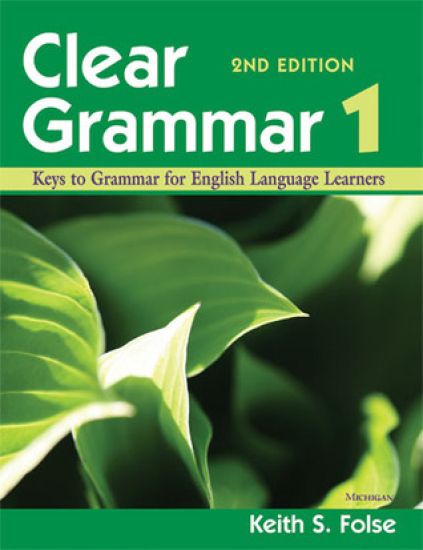
Clear Grammar is a four-level grammar series that features a unique combination of useful grammar information written in clear language with activities that promote more accurate and fluent vocabulary usage, writing, speaking, and reading. Important features of all four new editions of Clear Grammar include:More user-friendly charts to accompany grammar explanations High-frequency, corpus-based vocabulary related to each grammar point Grammar discovery tasks using students’ inductive learning skills A greater variety and increased number of activities, including more practice online Many more activities at the longer discourse level The addition of reading practice at the end of the unit, as well a critical-reading task More writing practice, including one on editing student writing and another for original student writing Two vocabulary practice activities, including a focus on collocations, in each unit, as well as many one-minute mini lessons showing the connection between grammar and vocabulary More speaking practice, with activities that require students to speak and listen to each other while using the target grammar Support for teachers in the form of indicators that reference how to teach the grammar points in the Clear Grammar series from Keys to Teaching Grammar for English Language Learners by Keith S. Folse (978-0-472-03220-4). Clear Grammar 1 offers students and teachers a solid introduction to beginning-level grammar. It also includes an introduction to the present perfect. Clear Grammar 1, 2nd Ed., includes Present tense of be and regular verbs Possessive adjectives and demonstrative words Descriptive adjectives Past tense of be, regular, and irregular verbs Wh- questions Present progressive Count vs. non-count nouns Prepositions Be going to + Verb Review of verb tensesThe book's companion website includes the additional grammar/vocabulary activities indicated in the textbook.
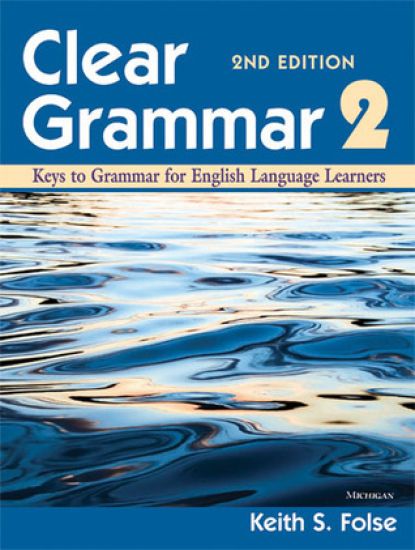
Clear Grammar is a four-level grammar series that features a unique combination of useful grammar information written in clear language with activities that promote more accurate and fluent vocabulary usage, writing, speaking, and reading. Important features of all four new editions of Clear Grammar include:More user-friendly charts to accompany grammar explanations High-frequency, corpus-based vocabulary related to each grammar point Grammar discovery tasks using students’ inductive learning skills A greater variety and increased number of activities, including more practice online Many more activities at the longer discourse level The addition of reading practice at the end of the unit, as well a critical-reading task More writing practice, including one on editing student writing and another for original student writing Two vocabulary practice activities, including a focus on collocations, in each unit, as well as many one-minute mini lessons showing the connection between grammar and vocabulary More speaking practice, with activities that require students to speak and listen to each other while using the target grammar Support for teachers in the form of indicators that reference how to teach the grammar points in the Clear Grammar series from Keys to Teaching Grammar for English Language Learners by Keith S. Folse (978-0-472-03220-4). Clear Grammar 2 offers students and teachers a solid introduction to low-intermediate grammar. Clear Grammar 2, 2nd Ed., includes* Articles* Past tense of irregular verbs * Present perfect tense * Adverbs of frequency * Nouns used as adjectives* Object pronouns* Past progressive tense* One and Other* Possessives *Comparatives and superlatives *ModalsThe book's companion website includes the additional grammar/vocabulary activities that are referenced in the textbook.
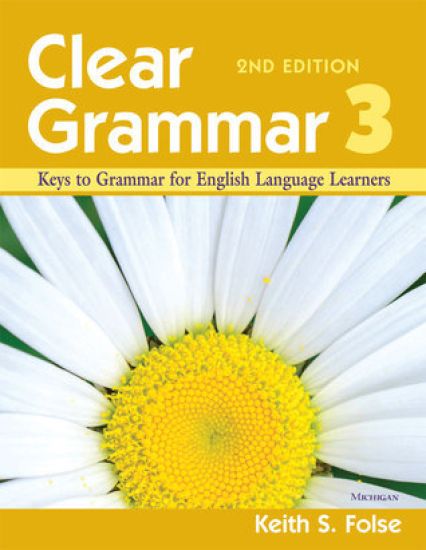
Clear Grammar 3 introduces high-intermediate grammar. Clear Grammar 3, 2nd Ed., includes phrasal verbs infinitives and gerunds participial adjectives: -ing and -ed prepositions after verbs, adjectives, and nouns passive voice adjective clauses adverbs connectors review of verb tenses Clear Grammar 3 concludes with a review of this volume’s contents of high-intermediate grammar points. Clear Grammar is a four-level grammar series that features a unique combination of useful grammar information written in clear language with activities that promote more accurate and fluent writing, speaking, reading, and vocabulary usage. Important features of the new editions of Clear Grammar include:More user-friendly charts to accompany grammar explanations High-frequency, corpus-informed vocabulary related to each grammar point Grammar discovery tasks using students’ inductive learning skills A greater variety and more activities, including practice online (www.press.umich.edu/esl/compsite/cleargrammar/) Many more activities at the longer discourse level The addition of reading practice at the end, plus a critical-reading task More writing practice, including one on editing student writing and another for original student writing Two vocabulary practice activities per unit, with one on collocations; plus many one-minute lessons showing the connection between grammar and vocabulary More speaking practice, with activities that require students to speak and listen to each other while using the target grammar Support for teachers in the form of indicators that reference how to teach the grammar points in the Clear Grammar series from Keys to Teaching Grammar for English Language Learners by Keith S. Folse (978-0-472-03220-4).
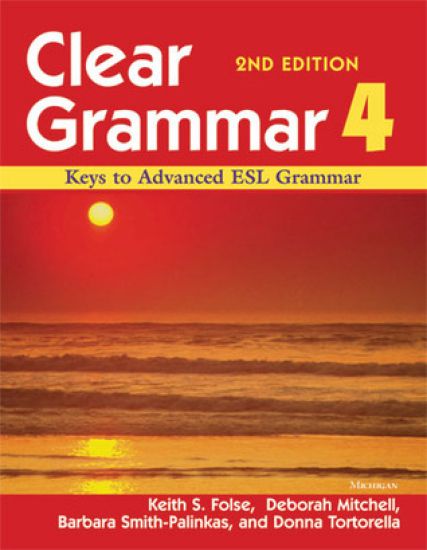
Clear Grammar 4 introduces advanced grammar. Clear Grammar 4, 2nd Ed., includesSubject-verb agreementWord formsPast perfect tenseConditionalsAdverb clausesNoun clausesReduction of adjective and adverb clauses (including appositives)Past modalsReview of verb tensesClear Grammar 4 concludes with a review of this volume’s contents of advanced grammar points. Clear Grammar is a four-level grammar series that features a unique combination of useful grammar information written in clear language with activities that promote more accurate and fluent writing, speaking, reading, and vocabulary usage. Important features of the new editions of Clear Grammar include:More user-friendly charts to accompany grammar explanations High-frequency, corpus-informed vocabulary related to each grammar point Grammar discovery tasks using students’ inductive learning skills A greater variety and more activities, including practice online (www.press.umich.edu/esl/compsite/cleargrammar/) Many more activities at the longer discourse level The addition of reading practice at the end, plus a critical-reading task More writing practice, including one on editing student writing and another for original student writing Two vocabulary practice activities per unit, with one on collocations; plus many one-minute lessons showing the connection between grammar and vocabulary More speaking practice, with activities that require students to speak and listen to each other while using the target grammar Support for teachers in the form of indicators that reference how to teach the grammar points in the Clear Grammar series from Keys to Teaching Grammar for English Language Learners by Keith S. Folse (978-0-472-03220-4).
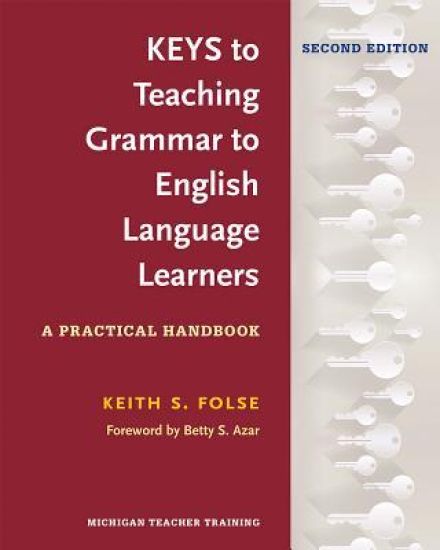
A MICHIGAN TEACHER TRAINING title Keys to Teaching Grammar to English Language Learners: A Practical Handbook is not intended to be an exhaustive reference book about ESL grammar. Written for classroom teachers (K-12, ESL, EFL), this book teaches the most common ESL grammar points in an accessible way through real ESL errors together with suggested teaching techniques. Relevant grammar terminology is explained. The four objectives of this book are to help teachers: (1) identify common ESL grammar points and understand the details associated with each one; (2) improve their ability to answer any grammar question on the spot (when on the “hot seat”); (3) anticipate common ESL errors by grammar point, by first language, and/or by proficiency level; and (4) develop more effective grammar/language learning lessons. These objectives are for all teachers, whether they are teaching grammar directly or indirectly in a variety of classes – including a grammar class, a writing class, a speaking class, an ESP class, or a K-12 class. In the Second Edition, all chapters have been updated and substantively revised. The number of marginal (gray) boxes with tips and extra information has doubled. A 16th Key, on Negating, and three new appendixes have been added. One of the new appendixes provides a sample exercise from an actual ESL textbook plus relevant notes about the designing of grammar activities and suggestions for teaching each grammar point. Also added to each Key is a section on the vocabulary items (e.g., collocations) that are related to the teaching of that particular grammar point. This information is unique to this edition and cannot be found elsewhere on the market. The Workbook for the Second Edition (978-0-472-03679-0), available in 2017, includes numerous activities that practice the essentials of grammar and issues relevant to ESL teachers.