

Kirjahaku
Etsi kirjoja tekijän nimen, kirjan nimen tai ISBN:n perusteella.
1000 tulosta hakusanalla Keith Ward


Divine Action, written by philosopher, theologian, and scholar Keith Ward was briefly available in 1990 before a publishing consolidation took it out of circulation. In this edition, the author has added a new preface reflecting the argument in light of the recent resurgence of naturalism in philosophy. In an intellectual counterpoint to antispirituality arguments, Ward explores what is involved in the idea of creation and particular divine actions in a world of scientific law and intelligibility. He presents his argument for the presence of divine action in the natural world and offers a rationale for divine operation as a continuous spiritual-natural conversation. Dr.Ward defends the Christian doctrine of Incarnation but is also more concerned with discussing the “big questions” in science and religion-those concerning existence, purpose, and inner process. His study embraces an analysis of freedom and necessity, the origins of suffering, constraints of creation, prayer as participation in divine action, miracles as epiphanies of the spirit, divine nature and human nature, and redemption. For scholars in philosophy, theology, and fields that engage in the dialogue of science and religion, this book presents rigorous scientific research and scholarship that significantly contribute to the ongoing debates over the divine operation and divine providence.
Can religious beliefs survive in the scientific age? Are they resoundingly outdated? Or, is there something in them of great importance, even if the way they are expressed will have to change given new scientific context? These questions are among those at the core of the science-religion dialogue. In The Big Questions in Science and Religion, Keith Ward, an Anglican priest who was once an atheist, offers compelling insights into the often contentious relationship between diverse religious views and new scientific knowledge. He identifies ten basic questions about the nature of the universe and human life. Among these are: •Does the universe have a goal or purpose? •Do the laws of nature exclude miracles? •Can science provide a wholly naturalistic explanation for moral and religious beliefs? •Has science made belief in God obsolete? Are there any good science-based arguments for God? With his expertise in the study of world religions, Ward considers concepts from Buddhism, Confucianism, Taoism, Islam, Hinduism, Judaism, and Christianity, while featuring the speculations of cosmologists, physicians, mathematicians, and philosophers. In addition, Ward examines the implications of ancient laws and modern theories and evaluates the role of religious experience as evidence of a nonphysical reality. Writing with enthusiasm, passion, and clarity, Keith Ward conveys the depth, difficulty, intellectual excitement, and importance of the greatest intellectual and existential questions of the modern scientific age.
Language about God is something like the language of poetry--intended not to increase our information about the world--we know facts about the world already--but to evoke in us a certain attitude or way of looking at things or feeling about things. What sort of view of the world, then, is language about God trying to convey? Keith Ward suggests it is that the world is an expression of a reality beyond it. In this book, he unpacks the meaning of the word God and explains why we need to get rid of the crude and unhelpful assumptions that still abound. This is a book for all who are curious about how God, and God's actions, can be understood today.
Is the mind just a by-product of the brain? Or is mind the fundamental reality, which creates matter? This book is a defense of mind as prior to matter. It is a philosophical work, written in an accessible style, which explains idealism as the teaching of most classical philosophers, and as most consistent with modern science.
Keith Ward--philosopher, ethicist, theologian, Anglican priest, cathedral canon, and book-writing addict--has spent his life thinking about "the big questions" (and, what's more, getting paid for it ). This philosophical pilgrimage led him from jobs at Glasgow and St. Andrew's Universities in Scotland, to Cambridge University, then on to King's College, London, followed by Oxford University (by invitation of the Queen ), before moving back to London at Gresham College, Heythrop College, and Roehampton University. Along the way he became a fellow of the British Academy and of a number of academic institutions, gathering up doctorates from various places, and writing more books than your bookshelf can handle. This sounds awfully dull, but according to Keith Ward, it was great fun, and he experienced all these things with a feeling of slight surprise, and with an irrepressible sense of humour. Having retired, exhausted, at eighty-one, Ward could not resist one more book. This is it--a humorous account of his life and thought, especially to show how he developed his own philosophy of personal idealism. It is both a genuinely amusing account of the life of an English academic and a rather profound account of an anti-materialistic and scientifically informed philosophy.
Keith Ward--philosopher, ethicist, theologian, Anglican priest, cathedral canon, and book-writing addict--has spent his life thinking about ""the big questions"" (and, what's more, getting paid for it ). This philosophical pilgrimage led him from jobs at Glasgow and St. Andrew's Universities in Scotland, to Cambridge University, then on to King's College, London, followed by Oxford University (by invitation of the Queen ), before moving back to London at Gresham College, Heythrop College, and Roehampton University. Along the way he became a fellow of the British Academy and of a number of academic institutions, gathering up doctorates from various places, and writing more books than your bookshelf can handle. This sounds awfully dull, but according to Keith Ward, it was great fun, and he experienced all these things with a feeling of slight surprise, and with an irrepressible sense of humour. Having retired, exhausted, at eighty-one, Ward could not resist one more book. This is it--a humorous account of his life and thought, especially to show how he developed his own philosophy of personal idealism. It is both a genuinely amusing account of the life of an English academic and a rather profound account of an anti-materialistic and scientifically informed philosophy.
A defense of the New Testament view that all things are to be united in Christ, which entails that the ultimate destiny of the universe, and of all that is in it, is to be united in God. Keith Ward argues that this conflicts with classical ideas of God as simple, impassible, and changeless--ideas that many modern theologians espouse, and which Ward subjects to careful and critical scrutiny. He defends the claim that the cosmos contributes something substantial to--and in that way changes--the divine nature, and the cosmos is destined to manifest and express the essential creativity and relationality of a God of beatific, agapic, redemptive, and unitive love.
Most people agree that Jesus' parables are about the kingdom of God. But what is that? They seem to have a lot about hell and judgment, but how is that consistent with the Parable of the Prodigal Son and Jesus' search for ""lost sheep""? They speak of the ""Son of Man,"" but who or what is that? Some have thought they predict the end of the world, but could that be a failure to understand biblical language? In a new survey of Jesus' parables, Keith Ward proposes that they imply a theology of the universal and unlimited love of God, a moral demand to care for the well-being of all living things, a compassion for the poor and rejected of the earth, an open door of repentance that even death cannot close, the offer of new life in the Spirit, and an ultimate goal of universal creative sharing in the life of the cosmic Christ.
Most people agree that Jesus' parables are about the kingdom of God. But what is that? They seem to have a lot about hell and judgment, but how is that consistent with the Parable of the Prodigal Son and Jesus' search for ""lost sheep""? They speak of the ""Son of Man,"" but who or what is that? Some have thought they predict the end of the world, but could that be a failure to understand biblical language? In a new survey of Jesus' parables, Keith Ward proposes that they imply a theology of the universal and unlimited love of God, a moral demand to care for the well-being of all living things, a compassion for the poor and rejected of the earth, an open door of repentance that even death cannot close, the offer of new life in the Spirit, and an ultimate goal of universal creative sharing in the life of the cosmic Christ.
From Descartes to Dostoevsky, the debate concerning the relationship between religion and morality has raged for centuries. Can there be a solid foundation for ethics without God? Or would we be consigned to a relativist morality, where “the good” is just a product of societal values or natural selection? In this landmark work, acclaimed philosopher and theologian, Keith Ward, presents a revolutionary new contribution to this discussion. Reflecting on the work of philosophers old and new – including Hume, Mill, Murdoch and Moore – he argues that our conception of morality intrinsically depends on our model of reality. And if we want a meaningful, objective ethics, then only God can provide the solid metaphysical foundations. Carefully structured and written in Ward’s famously clear prose, Morality, Autonomy and God will be an invaluable primer for students of theology or philosophy of religion. But more than that, this strident and controversial book is guaranteed to shape philosophical opinion for years to come.
The author maintains that the denial of the existence of the human soul has devastating effects on our valuation of human beings and human endeavour. He takes current scientific arguments back to their essentials and presents a convincing case countering this denial. 2
Is there a universal concept of God? Do all the great faiths of the world share a vision of the same supreme reality? In an attempt to answer these questions, Keith Ward considers the doctrine of an ultimate reality within five world religions - Hinduism, Buddhism, Islam, Judaism and Christianity. He studies closely the works of definitive, orthodox writers from each tradition - Sankara, Ramanuja, Asvaghosa, Maimonides, Al-Ghazzali and Aquinas - to build up a series of 'images' of God, a common core of belief. Ward discovers that while the great religious traditions of the world retain their differences, there are convergences of thought at the deepest level, with a broad similarity of structure in concepts of God. He concludes that a recognition of these beliefs, as well as encouraging a clearer acceptance of the mystery of the divine, might also lead to an increase in understanding and tolerance of other faiths, to the enrichment of one's own.
The so-called ‘new materialism’ argues that science and religious belief are incompatible. From Cosmology to Biology, its exponents have included such eminent names as Stephen Hawking, Richard Dawkins, Peter Atkins and Michael Ruse. With a carefully argued, point by point refutation of scientific atheism, God, Chance and Necessity shows that modern scientific knowledge does not undermine belief in God, but actually points to the existence of God as the best explanation of the way things are. Thus, it sets out to demolish the claims of books like The Selfish Gene, and to show that the overwhelming appearance of design in nature is not deceptive.
In this text, Keith Ward looks at what might be called a mainstream Christian worldview, and examines how it could reasonably and non-hypocritically be interpreted given a full aceptance of scientific beliefs, for the beginning of a new millennium.
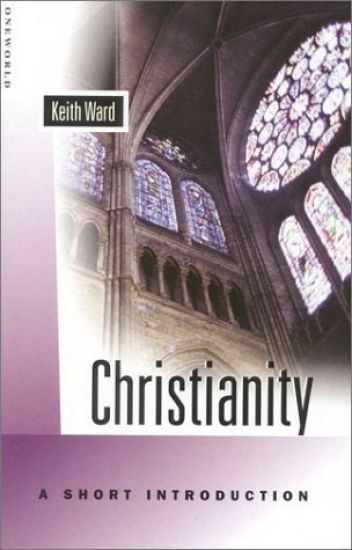
Considering all the major tenets of the faith from three different Christian points of view, this text covers areas such as sin, salvation, death and the virgin birth,