Dr. Johnson moves beyond the existing literature on rural-urban population shifts during the past forty years to examine the effects of those shifts on the business infrastructure that supplies goods and services to rural areas in the United States. First establishing a historical demographic context to serve as a backdrop, he provides a detailed longitudinal treatment on the linkage between population change and the rural commercial infrastructure, as well as timely information on the impact of the recent rural population turnaround on business. Some of his findings, based on the latest data available, refute earlier expectations that a decrease in population necessarily leads to a decline in the local business community.
Environmental professionals are (and will continue to be) under increased pressure to become more knowledgeable of environmental management issues. Basic Concepts in Environmental Management fulfills the long-standing need for fundamental knowledge-especially concerning government regulations on environmental and natural resource protection. As a leading environmental professional and consultant since the 1940s, Kenneth M. Mackenthun offers a unique perspective on the breadth, scope, and ever-constant change in environmental legislation at the federal, state, and local levels... and what those guidelines signify for industry and citizens alike. By maintaining an awareness of existing and forthcoming laws, environmentalists can substantially enhance their career potential-and be in a better position to protect the land, air, and sea. The starting point for that knowledge: Basic Concepts in Environmental Management.
Kenneth M. (Washington Univ. School of Medicine Murphy; Casey (University of Alabama at Birmingham Weaver; Leslie J. (University of Colorado School of Medicine) Berg
This book examines the military collapse of China’s Ming Dynasty to a combination of foreign and domestic foes. The Ming’s defeat was a highly surprising development, not least because as recently as in the 1590s the Ming had managed to defeat a Japanese force considered to be perhaps the most formidable of its day when the latter attempted to subjugate Korea en-route to a planned invasion of China. In contrast to conventional explanations for the Ming’s collapse, which focus upon political and socio-economic factors, this book shows how the military collapse of the Ming state was intimately connected to the deterioration of the personal relationship between the Ming throne and the military establishment that had served as the cornerstone of the Ming military renaissance of the previous decades. Moreover, it examines the broader process of the militarization of late Ming society as a whole to arrive at an understanding of how a state with such tremendous military resources and potential could be defeated by numerically and technologically inferior foes. It concludes with a consideration of the fall of the Ming in light of contemporary conflicts and regime changes around the globe, drawing attention to climatological factors and developments outside state control. Utilizing recently released archival materials, this book adds a much needed piece to the puzzle of the collapse of the Ming Dynasty in China.
This popular text provides a clear, succinct explanation of how reflection is integral to teachers’ understandings of themselves, their practice, and their context, and elaborates how various conceptions of reflective teaching differ from one another. The emphasis on the importance of both self and context is embedded within distinct and varied educational traditions (conservative, progressive, radical, and spiritual). Readers are encouraged to examine their own assumptions and understandings of teaching, learning, and schooling and to reflect on self and context. The major goal of both this book, and of all of the volumes in the "Reflective Teaching and the Social Conditions of Schooling" series, is to help teachers explore and define their own positions with regard to key topics and issues related to the aims of education in a democratic society. Its core message is that such reflection is essential to becoming more skilled, more capable, and in general better teachers.
This popular text provides a clear, succinct explanation of how reflection is integral to teachers’ understandings of themselves, their practice, and their context, and elaborates how various conceptions of reflective teaching differ from one another. The emphasis on the importance of both self and context is embedded within distinct and varied educational traditions (conservative, progressive, radical, and spiritual). Readers are encouraged to examine their own assumptions and understandings of teaching, learning, and schooling and to reflect on self and context. The major goal of both this book, and of all of the volumes in the "Reflective Teaching and the Social Conditions of Schooling" series, is to help teachers explore and define their own positions with regard to key topics and issues related to the aims of education in a democratic society. Its core message is that such reflection is essential to becoming more skilled, more capable, and in general better teachers.
A totally revised new edition of the bestselling guide to business school basics The bestselling book that invented the "MBA in a book" category, The Portable MBA Fifth Edition is a reliable and information-packed guide to the business school curriculum and experience. For years, professionals who need MBA-level information and insight-but don't need the hassle of business school-have turned to the Portable MBA series for the very best, most up-to-date coverage of the business basics. This new revised and expanded edition continues that long tradition with practical, real-world business insight from faculty members from the prestigious Darden School at the University of Virginia. With 50 percent new material, including new chapters on such topics as emerging economies, enterprise risk management, consumer behavior, managing teams, and up-to-date career advice, this is the best Portable MBA ever. Covers all the core topics you'd learn in business school, including finance, accounting, marketing, economics, ethics, operations management, management and leadership, and strategy.Every chapter is totally updated and seven new chapters have been added on vital business topicsIncludes case studies and interactive web-based examples Whether you own your own small business or work in a major corporate office, The Portable MBA gives you the comprehensive information and rich understanding of the business world that you need.
An accessible introduction to the theoretical and computational aspects of linear algebra using MapleTM Many topics in linear algebra can be computationally intensive, and software programs often serve as important tools for understanding challenging concepts and visualizing the geometric aspects of the subject. Principles of Linear Algebra with Maple uniquely addresses the quickly growing intersection between subject theory and numerical computation, providing all of the commands required to solve complex and computationally challenging linear algebra problems using Maple. The authors supply an informal, accessible, and easy-to-follow treatment of key topics often found in a first course in linear algebra. Requiring no prior knowledge of the software, the book begins with an introduction to the commands and programming guidelines for working with Maple. Next, the book explores linear systems of equations and matrices, applications of linear systems and matrices, determinants, inverses, and Cramer's rule. Basic linear algebra topics such as vectors, dot product, cross product, and vector projection are explained, as well as the more advanced topics of rotations in space, rolling a circle along a curve, and the TNB Frame. Subsequent chapters feature coverage of linear transformations from Rn to Rm, the geometry of linear and affine transformations, least squares fits and pseudoinverses, and eigenvalues and eigenvectors. The authors explore several topics that are not often found in introductory linear algebra books, including sensitivity to error and the effects of linear and affine maps on the geometry of objects. The Maple software highlights the topic's visual nature, as the book is complete with numerous graphics in two and three dimensions, animations, symbolic manipulations, numerical computations, and programming. In addition, a related Web site features supplemental material, including Maple code for each chapter's problems, solutions, and color versions of the book's figures. Extensively class-tested to ensure an accessible presentation, Principles of Linear Algebra with Maple is an excellent book for courses on linear algebra at the undergraduate level. It is also an ideal reference for students and professionals who would like to gain a further understanding of the use of Maple to solve linear algebra problems.
A hands-on introduction to the theoretical and computational aspects of linear algebra using Mathematica® Many topics in linear algebra are simple, yet computationally intensive, and computer algebra systems such as Mathematica® are essential not only for learning to apply the concepts to computationally challenging problems, but also for visualizing many of the geometric aspects within this field of study. Principles of Linear Algebra with Mathematica uniquely bridges the gap between beginning linear algebra and computational linear algebra that is often encountered in applied settings, and the commands required to solve complex and computationally challenging problems using Mathematica are provided. The book begins with an introduction to the commands and programming guidelines for working with Mathematica. Next, the authors explore linear systems of equations and matrices, applications of linear systems and matrices, determinants, inverses, and Cramer's rule. Basic linear algebra topics, such as vectors, dot product, cross product, and vector projection are explored, as well as a unique variety of more advanced topics including rotations in space, 'rolling' a circle along a curve, and the TNB Frame. Subsequent chapters feature coverage of linear transformations from Rn to Rm, the geometry of linear and affine transformations, with an exploration of their effect on arclength, area, and volume, least squares fits, and pseudoinverses. Mathematica is used to enhance concepts and is seamlessly integrated throughout the book through symbolic manipulations, numerical computations, graphics in two and three dimensions, animations, and programming. Each section concludes with standard problems in addition to problems that were specifically designed to be solved with Mathematica, allowing readers to test their comprehension of the presented material. All related Mathematica code is available on a corresponding website, along with solutions to problems and additional topical resources. Extensively class-tested to ensure an accessible presentation, Principles of Linear Algebra with Mathematica is an excellent book for courses on linear algebra at the undergraduate level. The book is also an ideal reference for students and professionals who would like to gain a further understanding of the use of Mathematica to solve linear algebra problems.
Darwinian theory, with genes at its center, still frames our discussion of evolution. Yet now the picture within the framea portrait rendered in detail at the cellular and molecular levelcontains the real stuff of todays big questions about living organisms. Genetics and molecular biology have revealed a new realm of complexity in life, with major implications for how we understand evolution. Genetics and the Logic of Evolution provides a much-needed overview and analysis of general principles and patterns of evolution in light of contemporary biology. Taking a functional approach to explain how genes are used across the diverse range of species, the authors consider: *Basic concepts and principles of biological complexity *Alternative and supplemental principles to Darwinian theory *Building blocks of life: how DNA, RNA, and genes work in single-cell and multi-cellular organisms *Communication within an organism *Detection and perception of the environment *Evolutionary order and disorder and the sometimes fluid relationships between phenotypes and genotypes Working outwards from the molecular level, Genetics and the Logic of Evolution moves its discourse towards a broader sense of life and how organisms live it. Written to be both scientifically rigorous and accessible to the layman, this treatment offers students and practitioners a refreshingly grand tour of the most important generalizations to emerge from recent biological research.
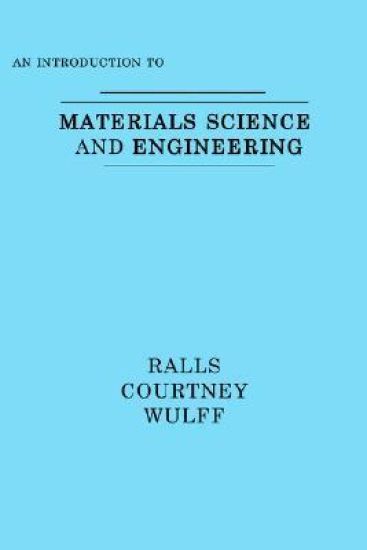
Ralls' Introduction to Materials Science and Engineering is intended for students who want to learn about the nature of solid substances and, especially, for beginning engineering students who are making their first serious contact with the structure and properties of real solids. It represents, clearly and logically, the chemical and physical principles on which the properties of materials depend. The basic relationships introduced in general chemistry and physics courses are reviewed and extended in order to permit the student to relate the properties of ceramic, metallic, and polymeric solids to their internal structure and external environment.
Most have heard of the French Resistance during World War Two. Few are aware of the Belgian Resistance movements during the First World War and the enormous role they played in the defeat of the enemy. This book tells the story of those underground organisations in Belgium during the Great War and in particular the 'Prisoner Help Network'. A very large proportion of the network were women. Other resistance organisations were l'Assistance Discr te (The Discreet Assistance) and La Dame Blanche (The White Lady). The author's in-depth research using as a base, the recollections of New Zealand soldier Bert Hansen in particular and other Allied soldiers, allowed the details to be revealed for the first time. Learn who were those brave resistance people, what they did, how they did it and where they lived. They hid and cared for escaped allied soldiers in the face of a brutal occupation and saw the soldiers across the frontier into Holland to fight again. They were the true Obscure Heroes of Liberty.
Most have heard of the French Resistance during World War Two. Few are aware of the Belgian Resistance movements during the First World War and the enormous role they played in the defeat of the enemy. This book tells the story of those underground organisations in Belgium during the Great War and in particular the 'Prisoner Help Network'. A very large proportion of the network were women. Other resistance organisations were l'Assistance Discr te (The Discreet Assistance) and La Dame Blanche (The White Lady). The author's in-depth research using as a base, the recollections of New Zealand soldier Bert Hansen in particular and other Allied soldiers, allowed the details to be revealed for the first time. Learn who were those brave resistance people, what they did, how they did it and where they lived. They hid and cared for escaped allied soldiers in the face of a brutal occupation and saw the soldiers across the frontier into Holland to fight again. They were the true Obscure Heroes of Liberty.
For historians of early New Zealand and the Hokianga and his family descendants, Joseph Bryers the settler has long been an enigma. This book by Kenneth Baker, his great-great-grandson and based on in-depth research, outlines his birth in Flanders in what is now Belgium and of his family and life before Joseph arrived in New Zealand circa 1835. Joseph's very early life in New Zealand is recounted including the taking of Koho Katerina Whareumu as a wife and the birth and lives of his children.
Recent developments in molecular and computational methods have made it possible to identify the genetic basis of any biological trait, and have led to spectacular advances in the study of human disease. This book provides an overview of the concepts and methods needed to understand the genetic basis of biological traits, including disease, in humans. Using examples of qualitative and quantitative phenotypes, Professor Weiss shows how genetic variation may be quantified, and how relationships between genotype and phenotype may be inferred. This book will appeal to many biologists and biological anthropologists interested in the genetic basis of biological traits, as well as to epidemiologists, biomedical scientists, human geneticists and molecular biologists.
At the beginning of his Metaphysics, Aristotle attributed several strange-sounding theses to Plato. Generations of Plato scholars have assumed that these could not be found in the dialogues. In heated arguments, they have debated the significance of these claims, some arguing that they constituted an 'unwritten teaching' and others maintaining that Aristotle was mistaken in attributing them to Plato. In a prior book-length study on Plato's late ontology, Kenneth M. Sayre demonstrated that, despite differences in terminology, these claims correspond to themes developed by Plato in the Parmenides and the Philebus. In this book, he shows how this correspondence can be extended to key, but previously obscure, passages in the Statesman. He also examines the interpretative consequences for other sections of that dialogue, particularly those concerned with the practice of dialectical inquiry.
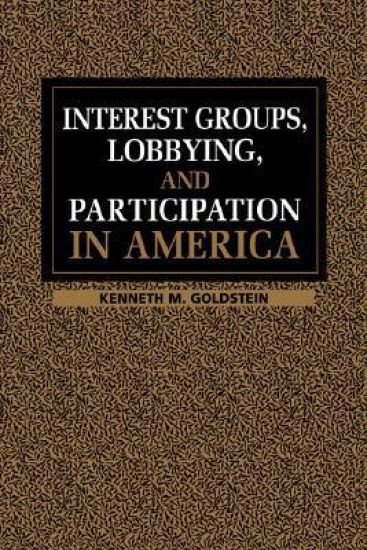
Understanding why individuals participate in politics demands attention to more than just individual attributes and attitudes. Similarly, understanding how interest groups influence policy-making demands attention to more than just the financial donations and direct activities of Washington-based lobbyists. To answer fundamental questions about what determines when and why people participate in politics and how organized interests go about trying to influence legislative decision-making we must understand how and why political leaders recruit which members of the public into the political arena. Looking from the bottom up with survey data and from the top down with data from interest group interviews, Kenneth Goldstein develops and tests a theory of how tactical choices in a grass-roots campaign are made. In doing so, he demonstrates that outside lobbying activities deserve a place in any correctly-specified model of interest group influence, political participation, or legislative decision-making.
This book explores the impact of economic crises and free-market reforms on party systems and political representation in contemporary Latin America. It explains why some patterns of market reform align and stabilize party systems, whereas other patterns of reform leave party systems vulnerable to widespread social protest and electoral instability. In contrast to other works on the topic, this book accounts for both the institutionalization and the breakdown of party systems, and it explains why Latin America turned to the Left politically in the aftermath of the market-reform process. Ultimately, it explains why this 'left turn' was more radical in some countries than others and why it had such varied effects on national party systems.
This book explores the impact of economic crises and free-market reforms on party systems and political representation in contemporary Latin America. It explains why some patterns of market reform align and stabilize party systems, whereas other patterns of reform leave party systems vulnerable to widespread social protest and electoral instability. In contrast to other works on the topic, this book accounts for both the institutionalization and the breakdown of party systems, and it explains why Latin America turned to the Left politically in the aftermath of the market-reform process. Ultimately, it explains why this 'left turn' was more radical in some countries than others and why it had such varied effects on national party systems.