
Kirjahaku
Etsi kirjoja tekijän nimen, kirjan nimen tai ISBN:n perusteella.
1000 tulosta hakusanalla Kim R. Fowler
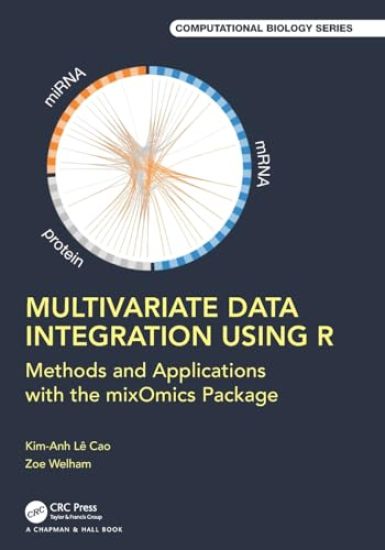
Multivariate Data Integration Using R
Kim-Anh Lê Cao; Zoe Marie Welham
TAYLOR FRANCIS LTD
2024
nidottu
Large biological data, which are often noisy and high-dimensional, have become increasingly prevalent in biology and medicine. There is a real need for good training in statistics, from data exploration through to analysis and interpretation. This book provides an overview of statistical and dimension reduction methods for high-throughput biological data, with a specific focus on data integration. It starts with some biological background, key concepts underlying the multivariate methods, and then covers an array of methods implemented using the mixOmics package in R. Features: Provides a broad and accessible overview of methods for multi-omics data integration Covers a wide range of multivariate methods, each designed to answer specific biological questions Includes comprehensive visualisation techniques to aid in data interpretation Includes many worked examples and case studies using real data Includes reproducible R code for each multivariate method, using the mixOmics package The book is suitable for researchers from a wide range of scientific disciplines wishing to apply these methods to obtain new and deeper insights into biological mechanisms and biomedical problems. The suite of tools introduced in this book will enable students and scientists to work at the interface between, and provide critical collaborative expertise to, biologists, bioinformaticians, statisticians and clinicians.

Sleep training isn’t recommended until your baby is 6 months old, but that doesn’t mean you’re powerless to help them (and you) sleep better now. For the past three decades, Kim West, known around the world as The Sleep Lady®, has personally helped over twenty thousand families gently teach their children how to fall asleep—and fall back asleep—without leaving them to cry it out alone. Now, in The Sleep Lady®’s Gentle Newborn Sleep Guide, she offers gentle, research-backed, easy-to-remember and easy-to-apply ways to help your newborn sleep. In month-by-month chapters that are easily digestible (even in the middle of the night!), West and her Gentle Sleep Team share: The key developmental milestones from birth through 5 months, and how they impact your baby’s sleep F.A.S.T. (Feeding, Attachment and Soothing, Sleep, and Temperament) strategies specific to each age Safer co-sleeping guidelines Stories from real families Ample advice for parents of twins Plus, what you need to know to make sure you’re taking care of you, too! It’s easy to get overwhelmed by conflicting advice on sleep training, nap coaching, sleep schedules, and more. The Sleep Lady®’s Gentle Newborn Sleep Guide provides clear guidance and a safe haven free of judgment, guilt, and criticism for parents seeking options that align with their parenting values and beliefs.

52 Kids who R.O.C.K. Every Day: Inspiring stories from young people who Radiate Outrageous Compassion & Kindness
Kim David
Independently Published
2019
nidottu
Transform your home, school, and community with kids who Radiate Outrageous Compassion & Kindness. This book features the inspiring stories of 52 young people and their acts of kindness. The book also provides tips, supply lists, and steps for kids wanting to organize their own service projects or want to incorporate acts of kindness into their day.

No Peace For Kim: Colonel Day Investigative series ? The Beginning
R. C. McDonald
Createspace Independent Publishing Platform
2016
nidottu
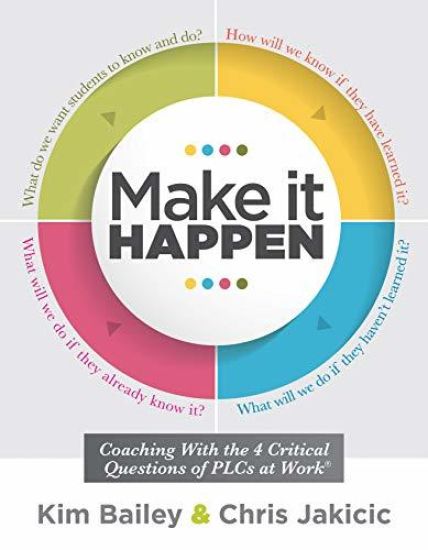
Make It Happen: Coaching with the Four Critical Questions of Plcs at Work(r) (Professional Learning Community Strategies for Instructional Coaches)
Kim Bailey; Chris Jakicic
Solution Tree
2018
nidottu
Ensure every educator is engaged in the right work with a collective focus on improved student learning. Aligned to the Professional Learning Communities (PLC) at Work(R) model, this resource includes instructional coaching tools, processes, protocols, templates, tips, and strategies designed to support the multidimensional work of instructional coaches and PLC training. Each chapter includes action steps and reflective coaching activities, as well as suggestions for navigating some of the most common issues instructional coaches face. Use this book to understand the unique requirements of instructional coaches in building a school that answers the four critical questions of a PLC at Work: Learn how to provide PLC training and professional development for collaborative teacher teams. Study three major variables that will affect instructional coaching (capacity, culture, and context) and four major actions that will act as guiding principles. Explore issues that can arise in PLC schools, as well as teacher coaching strategies to help resolve these issues. Deepen your understanding of instructional coaching in a PLC with helpful online reproducibles and teacher coaching tools. Acquire capacity-building strategies aligned to the four PLC questions. Contents: Introduction Chapter 1: How to Get Started as an Instructional Coach Chapter 2: What Do We Want Students to Know and Be Able to Do? Chapter 3: How Will We Know if They Have Learned It? Chapter 4: How Will We Respond When Some Students Do Not Learn? Chapter 5: How Will We Extend the Learning of Students Who Are Already Proficient? Epilogue: Maintaining the Momentum and Sustaining the Process References and Resources Index

The Basics of Item Response Theory Using R
Frank B. Baker; Seock-Ho Kim
Springer International Publishing AG
2017
sidottu
This graduate-level textbook is a tutorial for item response theory that covers both the basics of item response theory and the use of R for preparing graphical presentation in writings about the theory. Item response theory has become one of the most powerful tools used in test construction, yet one of the barriers to learning and applying it is the considerable amount of sophisticated computational effort required to illustrate even the simplest concepts. This text provides the reader access to the basic concepts of item response theory freed of the tedious underlying calculations. It is intended for those who possess limited knowledge of educational measurement and psychometrics.Rather than presenting the full scope of item response theory, this textbook is concise and practical and presents basic concepts without becoming enmeshed in underlying mathematical and computational complexities. Clearly written text and succinct R code allow anyone familiarwith statistical concepts to explore and apply item response theory in a practical way. In addition to students of educational measurement, this text will be valuable to measurement specialists working in testing programs at any level and who need an understanding of item response theory in order to evaluate its potential in their settings.
The Basics of Item Response Theory Using R
Frank B. Baker; Seock-Ho Kim
Springer International Publishing AG
2018
nidottu
This graduate-level textbook is a tutorial for item response theory that covers both the basics of item response theory and the use of R for preparing graphical presentation in writings about the theory. Item response theory has become one of the most powerful tools used in test construction, yet one of the barriers to learning and applying it is the considerable amount of sophisticated computational effort required to illustrate even the simplest concepts. This text provides the reader access to the basic concepts of item response theory freed of the tedious underlying calculations. It is intended for those who possess limited knowledge of educational measurement and psychometrics.Rather than presenting the full scope of item response theory, this textbook is concise and practical and presents basic concepts without becoming enmeshed in underlying mathematical and computational complexities. Clearly written text and succinct R code allow anyone familiarwith statistical concepts to explore and apply item response theory in a practical way. In addition to students of educational measurement, this text will be valuable to measurement specialists working in testing programs at any level and who need an understanding of item response theory in order to evaluate its potential in their settings.
Nonparametric Statistics with Applications to Science and Engineering with R
Paul Kvam; Brani Vidakovic; Seong-joon Kim
Wiley-Blackwell
2022
sidottu
NONPARAMETRIC STATISTICS WITH APPLICATIONS TO SCIENCE AND ENGINEERING WITH R Introduction to the methods and techniques of traditional and modern nonparametric statistics, incorporating R code Nonparametric Statistics with Applications to Science and Engineering with R presents modern nonparametric statistics from a practical point of view, with the newly revised edition including custom R functions implementing nonparametric methods to explain how to compute them and make them more comprehensible. Relevant built-in functions and packages on CRAN are also provided with a sample code. R codes in the new edition not only enable readers to perform nonparametric analysis easily, but also to visualize and explore data using R’s powerful graphic systems, such as ggplot2 package and R base graphic system. The new edition includes useful tables at the end of each chapter that help the reader find data sets, files, functions, and packages that are used and relevant to the respective chapter. New examples and exercises that enable readers to gain a deeper insight into nonparametric statistics and increase their comprehension are also included. Some of the sample topics discussed in Nonparametric Statistics with Applications to Science and Engineering with R include: Basics of probability, statistics, Bayesian statistics, order statistics, Kolmogorov–Smirnov test statistics, rank tests, and designed experiments Categorical data, estimating distribution functions, density estimation, least squares regression, curve fitting techniques, wavelets, and bootstrap sampling EM algorithms, statistical learning, nonparametric Bayes, WinBUGS, properties of ranks, and Spearman coefficient of rank correlation Chi-square and goodness-of-fit, contingency tables, Fisher exact test, MC Nemar test, Cochran’s test, Mantel–Haenszel test, and Empirical Likelihood Nonparametric Statistics with Applications to Science and Engineering with R is a highly valuable resource for graduate students in engineering and the physical and mathematical sciences, as well as researchers who need a more comprehensive, but succinct understanding of modern nonparametric statistical methods.


This in-depth exploration of culture, media, and protest follows South Korea’s transition from the Korean War to the political struggles and socioeconomic transformations of the Park Chung Hee era. Although the post-Korean War years are commonly remembered as a time of crisis and disarray, Charles Kim contends that they also created a formative and productive juncture in which South Koreans reworked pre-1945 constructions of national identity to meet the political and cultural needs of postcolonial nation-building. He explores how state ideologues and mainstream intellectuals expanded their efforts by elevating the nation’s youth as the core protagonist of a newly independent Korea. By designating students and young men and women as the hope and exemplars of the new nation-state, the discursive stage was set for the remarkableoutburst of the April 19th Revolution in 1960.Kim’s interpretation of this seminal event underscores student participants’ recasting of anticolonial resistancememories into South Korea’s postcolonial politics. This pivotal innovation enabled protestors to circumvent the state’s official anticommunism and, in doing so, brought about the formation of a culture of protest that lay at the heart of the country’s democracy movement from the 1960s to the 1980s. The positioning of women as subordinates in the nation-building enterprise is also shown to be a direct translation of postwar and Cold War exigencies into the sphere of culture; this cultural conservatism went on to shape the terrain of gender relations in subsequent decades.A meticulously researched cultural history, Youth for Nation illuminates the historical significance of the postwar period through a rigorous analysis of magazines, films, textbooks, archival documents, and personal testimonies. In addition to scholars and students of twentieth-century Korea, the book will be welcomed by those interested in ColdWar cultures, social movements, and democratization in East Asia.
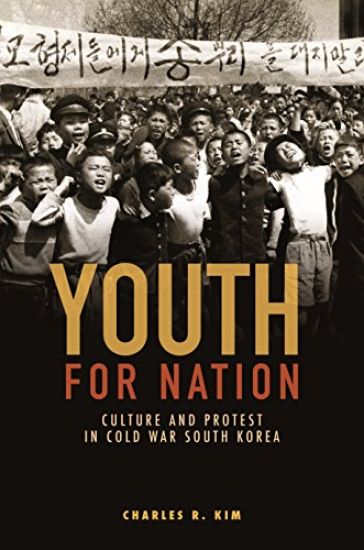
This in-depth exploration of culture, media, and protest follows South Korea's transition from the Korean War to the start of the political struggles and socioeconomic transformations of the Park Chung Hee era. Although the post–Korean War years are commonly remembered as a time of crisis and disarray, Charles Kim contends that they also created a formative and productive juncture in which South Koreans reworked pre-1945 constructions of national identity to meet the political and cultural needs of postcolonial nation-building. He explores how state ideologues and mainstream intellectuals expanded their efforts by elevating the nation's youth as the core protagonist of a newly independent Korea. By designating students and young men and women as the hope and exemplars of the new nation-state, the discursive stage was set for the remarkable outburst of the April Revolution in 1960.Kim's interpretation of this seminal event underscores student participants' recasting of anticolonial resistance memories into South Korea's postcolonial politics. This pivotal innovation enabled protestors to circumvent the state's official anticommunism and, in doing so, brought about the formation of a culture of protest that lay at the heart of the country's democracy movement from the 1960s to the 1980s. The positioning of women as subordinates in the nation-building enterprise is also shown to be a direct translation of postwar and Cold War exigencies into the sphere of culture; this cultural conservatism went on to shape the terrain of gender relations in subsequent decades.A meticulously researched cultural history, Youth for Nation illuminates the historical significance of the postwar period through a rigorous analysis of magazines, films, textbooks, archival documents, and personal testimonies. In addition to scholars and students of twentieth-century Korea, the book will be welcomed by those interested in Cold War cultures, social movements, and democratization in East Asia.
Geometry Examples Positions and Angles
Seong R. Kim
Createspace Independent Publishing Platform
2012
nidottu
This book is for young students Gifted or Advanced in math. Students need the best teacher, so you need examples, because examples are the best teacher. All the examples in this book are fully worked, and help you do math better. And this book is for your skill of geometry, and you will grow the skill through examples. Some examples may look too easy or too hard. It all depends on your skill of algebra. Whatever your skill may be though, you can grow yours if you follow the steps in each example. Each is detailed so that you can learn those tools fast, and increase your caliber quickly as well as properly. And this book covers geometry, and is particularly about angles, so it explains what an angle is about, how it gets made and what we can do with it or how to use it. What then, is it for? An angle is an idea in math, so it's a math idea, and is a tool in math. So it's a math tool. And we use it, solving problems, of course. So students need to get the idea. Thus, this book helps you get the idea of an angle, that is, the concept of a math object called an angle, and you will get to see how to work with it properly, because the book explains how it gets made, and how it works, along with its nature so that you can develop your own idea, to solve problems, of course. And some sample pages are at: http: //www.runmath.com/ExcerptFromPosAngSeongKim.pdf
Algebra Examples Basic Functions 1
Seong R. Kim
Createspace Independent Publishing Platform
2012
nidottu

Algebra Examples Polynomial Factorizations 1
Seong R. Kim
Createspace Independent Publishing Platform
2012
nidottu
Algebra Examples Polynomial Factorizations 2
Seong R. Kim
Createspace Independent Publishing Platform
2012
nidottu
Algebra Examples Basic Functions
Seong R. Kim
Createspace Independent Publishing Platform
2012
nidottu