Kirjojen hintavertailu. Mukana 11 244 527 kirjaa ja 12 kauppaa.

Kirjahaku

Etsi kirjoja tekijän nimen, kirjan nimen tai ISBN:n perusteella.

667 tulosta hakusanalla Lucretius

Lucretius on Death and Anxiety

Lucretius on Death and Anxiety

Charles Segal

Princeton University Press
2016
sidottu
In a fresh interpretation of Lucretius's On the Nature of Things, Charles Segal reveals this great poetical account of Epicurean philosophy as an important and profound document for the history of Western attitudes toward death. He shows that this poem, aimed at promoting spiritual tranquillity, confronts two anxieties about death not addressed in Epicurus's abstract treatment--the fear of the process of dying and the fear of nothingness. Lucretius, Segal argues, deals more specifically with the body in dying because he draws on the Roman concern with corporeality as well as on the rich traditions of epic and tragic poetry on mortality. Segal explains how Lucretius's sensitivity to the vulnerability of the body's boundaries connects the deaths of individuals with the deaths of worlds, thereby placing human death into the poem's larger context of creative and destructive energies in the universe. The controversial ending of the poem, which describes the plague at Athens, is thus the natural culmination of a theme developed over the course of the work. Originally published in 1990. The Princeton Legacy Library uses the latest print-on-demand technology to again make available previously out-of-print books from the distinguished backlist of Princeton University Press. These editions preserve the original texts of these important books while presenting them in durable paperback and hardcover editions. The goal of the Princeton Legacy Library is to vastly increase access to the rich scholarly heritage found in the thousands of books published by Princeton University Press since its founding in 1905.
Lucretius and the Transpadanes

Lucretius and the Transpadanes

Louise Adams Holland

Princeton University Press
2016
sidottu
In the absence of tape recordings from antiquity, we have a limited knowledge of how classical Latin prose or verse sounded as it was rendered orally. Yet we do know that the spoken word varied greatly from place to place, regardless of how much uniformity the written language maintained. Louise Adams Holland considers the geographical basis for these linguistic differences, and advances new arguments for the origin of Lucretius. She shows that he came from the same area of northern Italy--the Transpadane--as Catullus and Virgil, not from Rome, as the majority of his critics have contended. Originally published in 1979. The Princeton Legacy Library uses the latest print-on-demand technology to again make available previously out-of-print books from the distinguished backlist of Princeton University Press. These editions preserve the original texts of these important books while presenting them in durable paperback and hardcover editions. The goal of the Princeton Legacy Library is to vastly increase access to the rich scholarly heritage found in the thousands of books published by Princeton University Press since its founding in 1905.
Lucretius in the Modern World

Lucretius in the Modern World

W.R. Johnson

Bristol Classical Press
2000
pokkari
Lucretius' "On the Nature of Things", one of the glories of Latin literature, provides a vivid poetic exposition of the doctrines of the Greek atomist, Epicurus. The poem played a crucial role in the reinvention of science in the seventeenth century, its influence on the French Enlightenment was powerful and pervasive, and it became a major battlefield in the wars of religion with science in nineteenth-century England. But in the twentieth century, despite its vital contributions to modern thought and civilisation, it has been largely neglected by common readers and scientists alike. This book offers an extensive description of the poem, with special emphasis on its cheerful version of materialism and on its attempt to devise an ethical system that suits such a universe. It surveys major relevant texts form the eighteenth and ninetheenth centuries (Dryden, Diderot, Voltaire, Tennyson, Santayana) and speculates on why Lucretius and the ancient scientific tradition he championed has become marginalised in the twentieth century. It closes with a discussion of what value the poem has for students of science and technology in the new century: what advice it has to offer us about how to go about reinventing our machines and our morality.
Lucretius: De Rerum Natura IV

Lucretius: De Rerum Natura IV

John Godwin

Aris Phillips Ltd
1987
sidottu
Book IV of Lucretius' great philosophical poem deals mainly with the psychology of sensation ad thought. The heart of this book is a new text, incorporating the latest scholarship on the text of Lucretius, with a clear prose facing translation. The commentary concentrates on the thought of the text (relating it to other philosophers beside Epicurus) and the poetry of the Latin, placing the text in relation to Roman literature in general, and attempting to demonstrate the poetic genius of Lucretius. The introduction deals with the didactic tradition in ancient literature and Lucretius' place in it, the structure of De Rerum Natura, the salient features of the philosophy of Epicurus and the transmission of the text.
Lucretius: De Rerum Natura IV

Lucretius: De Rerum Natura IV

John Godwin

Aris Phillips Ltd
1987
nidottu
Book IV of Lucretius' great philosophical poem deals mainly with the psychology of sensation ad thought. The heart of this book is a new text, incorporating the latest scholarship on the text of Lucretius, with a clear prose facing translation. The commentary concentrates on the thought of the text (relating it to other philosophers beside Epicurus) and the poetry of the Latin, placing the text in relation to Roman literature in general, and attempting to demonstrate the poetic genius of Lucretius. The introduction deals with the didactic tradition in ancient literature and Lucretius' place in it, the structure of De Rerum Natura, the salient features of the philosophy of Epicurus and the transmission of the text.
Lucretius: De Rerum Natura VI

Lucretius: De Rerum Natura VI

John Godwin

Aris Phillips Ltd
1991
sidottu
The purpose of this edition is to demonstrate the quality and interest of book VI: the intellectual curiosity of the analyst of earthquakes, volcanoes and marvellous phenomena, the rhetorical and philosophical powers of a thinker who wants to make his interpretation of Epicureanism both cogent and vivid, the deep humane compassion of the chronicler of the Plague at Athens, the sheer brilliance of the poet whose verse inspired all later writers in the tradition. This edition of the book is designed to make the poem accessible to readers who have not picked up Lucretius before and so the background has been treated as fully as possible. Latin text with facing-page translation.
Lucretius: De Rerum Natura VI

Lucretius: De Rerum Natura VI

John Godwin

Aris Phillips Ltd
1991
nidottu
The purpose of this edition is to demonstrate the quality and interest of book VI: the intellectual curiosity of the analyst of earthquakes, volcanoes and marvellous phenomena, the rhetorical and philosophical powers of a thinker who wants to make his interpretation of Epicureanism both cogent and vivid, the deep humane compassion of the chronicler of the Plague at Athens, the sheer brilliance of the poet whose verse inspired all later writers in the tradition. This edition of the book is designed to make the poem accessible to readers who have not picked up Lucretius before and so the background has been treated as fully as possible. Latin text with facing-page translation.
Lucretius: De Rerum Natura III

Lucretius: De Rerum Natura III

P. Michael Brown

Aris Phillips Ltd
1997
nidottu
Lucretius' poem, for which Epicurean philosophy provided the inspiration, attempts to explain the nature of the universe and its processes with the object of freeing mankind from religious fears. The third book not only seeks to demonstrate that, since the soul is mortal, there can be no after-life, but also aims to reconcile the reader to the prospect of the end of his consciousness. This edition incorporates a new text and prose translation and is designed to set the book in the context of the whole poem and of the Epicurean philosophical system, to explain and elucidate its argument, and at the same time to analyse some of the literary and artistic features which contribute to Lucretius' poetic achievement and stature. Latin text with facing page translation.
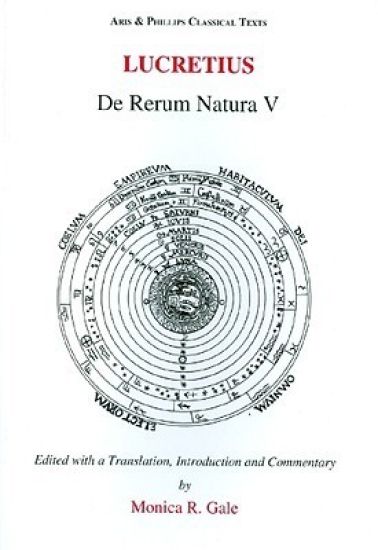
Lucretius: De Rerum Natura V
For a work written more than two thousand years ago, in a society in many ways quite alien to our own, Lucretius' De Rerum Natura contains much of striking, even startling, contemporary relevance. This is true, above all, of the fifth book, which begins by putting a strong case against what it has recently become fashionable to call 'intelligent design', and ends with an account of human evolution and the development of society in which the limitations of technological progress form a strong and occasionally explicit subtext. Along the way, the poet touches on many themes which may strike a chord with the twenty-first century reader: the fragility of our ecosystem, the corruption of political life, the futility of consumerism and the desirability of limiting our acquisitive instincts are all highly topical issues for us, as for the poem's original audience. Book V also offers a fascinating introduction to the world-view of the upper-class Roman of the first century BC. This edition (which complements existing Aris and Phillips commentaries on books 3, 4 and 6) will help to make Lucretius' urgent and impassioned argument, and something of his remarkable poetic style, accessible to a wider audience, including those with little or no knowledge of Latin. Both the translation and commentary aim to explain the scientific argument of the book as clearly as possible; and to convey at least some impression of the poetic texture of Lucretius' Latin.
Lucretius: De Rerum Natura V
For a work written more than two thousand years ago, in a society in many ways quite alien to our own, Lucretius' De Rerum Natura contains much of striking, even startling, contemporary relevance. This is true, above all, of the fifth book, which begins by putting a strong case against what it has recently become fashionable to call 'intelligent design', and ends with an account of human evolution and the development of society in which the limitations of technological progress form a strong and occasionally explicit subtext. Along the way, the poet touches on many themes which may strike a chord with the twenty-first century reader: the fragility of our ecosystem, the corruption of political life, the futility of consumerism and the desirability of limiting our acquisitive instincts are all highly topical issues for us, as for the poem's original audience. Book V also offers a fascinating introduction to the world-view of the upper-class Roman of the first century BC. This edition (which complements existing Aris and Phillips commentaries on books 3, 4 and 6) will help to make Lucretius' urgent and impassioned argument, and something of his remarkable poetic style, accessible to a wider audience, including those with little or no knowledge of Latin. Both the translation and commentary aim to explain the scientific argument of the book as clearly as possible; and to convey at least some impression of the poetic texture of Lucretius' Latin.
Lucretius and the End of Masculinity

Lucretius and the End of Masculinity

Michael Pope

Cambridge University Press
2023
sidottu
From beginning to end, the De rerum natura upsets expectations. This book's premise is that Lucretius intentionally provokes his imagined male audience, playfully and forcefully proving to them that they are not the men they suppose themselves to be. From astral bodies to the magnetic draw of human sexuality to the social bonds linking parents to children, Lucretius shows that everything is compounded material, both a source of atomic issue and receptacle of atomic ingress. The universe, as Lucretius presents it, is a never-ending cycle of material interpenetration, connectivity, and dissolution. Roman men, in the vastness of it all, are only exceptional in their self-defeating fantasies. Close analysis of Lucretius' poetics reveals an unremitting assault upon the fictions that comprise Roman masculinity, from seminal conception in utero to existential decomposition in the grave. Nevertheless, Lucretius offers an Epicurean vision of masculinity that just might save the Republic.
Lucretius and the End of Masculinity

Lucretius and the End of Masculinity

Michael Pope

Cambridge University Press
2025
pokkari
From beginning to end, the De rerum natura upsets expectations. This book's premise is that Lucretius intentionally provokes his imagined male audience, playfully and forcefully proving to them that they are not the men they suppose themselves to be. From astral bodies to the magnetic draw of human sexuality to the social bonds linking parents to children, Lucretius shows that everything is compounded material, both a source of atomic issue and receptacle of atomic ingress. The universe, as Lucretius presents it, is a never-ending cycle of material interpenetration, connectivity, and dissolution. Roman men, in the vastness of it all, are only exceptional in their self-defeating fantasies. Close analysis of Lucretius' poetics reveals an unremitting assault upon the fictions that comprise Roman masculinity, from seminal conception in utero to existential decomposition in the grave. Nevertheless, Lucretius offers an Epicurean vision of masculinity that just might save the Republic.
Lucretius and Scientific Thought

Lucretius and Scientific Thought

Alban Dewes 1899-1973 Winspear

Hassell Street Press
2021
sidottu
This work has been selected by scholars as being culturally important and is part of the knowledge base of civilization as we know it.This work is in the public domain in the United States of America, and possibly other nations. Within the United States, you may freely copy and distribute this work, as no entity (individual or corporate) has a copyright on the body of the work.Scholars believe, and we concur, that this work is important enough to be preserved, reproduced, and made generally available to the public. To ensure a quality reading experience, this work has been proofread and republished using a format that seamlessly blends the original graphical elements with text in an easy-to-read typeface.We appreciate your support of the preservation process, and thank you for being an important part of keeping this knowledge alive and relevant.
Lucretius and His Influence

Lucretius and His Influence

George Depue 1875-1954 Hadzsits

Hassell Street Press
2021
sidottu
This work has been selected by scholars as being culturally important and is part of the knowledge base of civilization as we know it.This work is in the public domain in the United States of America, and possibly other nations. Within the United States, you may freely copy and distribute this work, as no entity (individual or corporate) has a copyright on the body of the work.Scholars believe, and we concur, that this work is important enough to be preserved, reproduced, and made generally available to the public. To ensure a quality reading experience, this work has been proofread and republished using a format that seamlessly blends the original graphical elements with text in an easy-to-read typeface.We appreciate your support of the preservation process, and thank you for being an important part of keeping this knowledge alive and relevant.
Lucretius and Scientific Thought

Lucretius and Scientific Thought

Alban Dewes 1899-1973 Winspear

Hassell Street Press
2021
nidottu
This work has been selected by scholars as being culturally important and is part of the knowledge base of civilization as we know it.This work is in the public domain in the United States of America, and possibly other nations. Within the United States, you may freely copy and distribute this work, as no entity (individual or corporate) has a copyright on the body of the work.Scholars believe, and we concur, that this work is important enough to be preserved, reproduced, and made generally available to the public. To ensure a quality reading experience, this work has been proofread and republished using a format that seamlessly blends the original graphical elements with text in an easy-to-read typeface.We appreciate your support of the preservation process, and thank you for being an important part of keeping this knowledge alive and relevant.
Lucretius and His Influence

Lucretius and His Influence

George Depue 1875-1954 Hadzsits

Hassell Street Press
2021
nidottu
This work has been selected by scholars as being culturally important and is part of the knowledge base of civilization as we know it.This work is in the public domain in the United States of America, and possibly other nations. Within the United States, you may freely copy and distribute this work, as no entity (individual or corporate) has a copyright on the body of the work.Scholars believe, and we concur, that this work is important enough to be preserved, reproduced, and made generally available to the public. To ensure a quality reading experience, this work has been proofread and republished using a format that seamlessly blends the original graphical elements with text in an easy-to-read typeface.We appreciate your support of the preservation process, and thank you for being an important part of keeping this knowledge alive and relevant.
Lucretius as Theorist of Political Life

Lucretius as Theorist of Political Life

J. Colman

Palgrave Macmillan
2012
sidottu
"John Colman has presented us with a profound and scrupulously detailed inquiry into how Lucretius understood the tensions between the philosophic life and the requirements and characteristics of the life of political action—tensions with which Lucretius had to deal in his endeavor to bring philosophy into Rome." – James H. Nichols, Jr., Professor of Government, Claremont McKenna College, USA"Lucretius has been drawing renewed attention for both the depth of his message and the beauty of his poem. Nevertheless, only a few commentators are attentive to the paradox of a philosophic teaching that reduces everything to matter in motion in the form of a beautiful poem. John Colman represents the even more rare case of someone who sees this paradox and explains it intelligently. He is able to show the way Lucretius addresses those interested in beauty and those interested in politics in a work that appears to reject both." – Christopher Kelly, Professorof Political Science, Boston College, USA"A careful study of Lucretius by a notable young scholar showing, not just assuming, that he had a politics. The result is to reveal how his politics compares with that in the Socratic tradition and how he was distorted by his modern students and interpreters." – Harvey C. Mansfield, Professor of Government at Harvard; Senior Fellow at the Hoover Institution, Stanford, USALucretius as Theorist of Political Life is an interpretation of Lucretius' poem On the Nature of Things as a defense of philosophy given the irremediable tension between the competing claims of the philosophic and political life. The central issue is the need for, and attempt by, philosophy to justify and defend its way of life to the political community. This work uncovers how Lucretius' conception of the philosophic life, and the reaction to the human, religious, and political implications of thediscovery of nature, distinguish his intention from the anti-theological animus that drives the politically and scientifically ambitious project of his modern appropriators.