Kirjojen hintavertailu. Mukana 12 361 754 kirjaa ja 12 kauppaa.

Kirjahaku

Etsi kirjoja tekijän nimen, kirjan nimen tai ISBN:n perusteella.

1000 tulosta hakusanalla Mark D Martin

The Invention of Sodomy in Christian Theology

The Invention of Sodomy in Christian Theology

Mark D. Jordan

University of Chicago Press
1998
nidottu
This text explores the invention of sodomy in medieval Christendom, examining its conceptual foundations in theology and gauging its impact on Christian sexual ethics both then and now. It traces the historical genealogy of this enduring cultural construct through many of the idiosyncratic worldviews of the Middle Ages - worldviews at war with themselves in their attitudes toward sex, love and eroticism. Moving from poetic conceit through medieval treatise to confessor's manual and scholastic summa, the text demonstrates that the medieval notion of sodomy was fashioned out of conceptual instabilities and tensions.
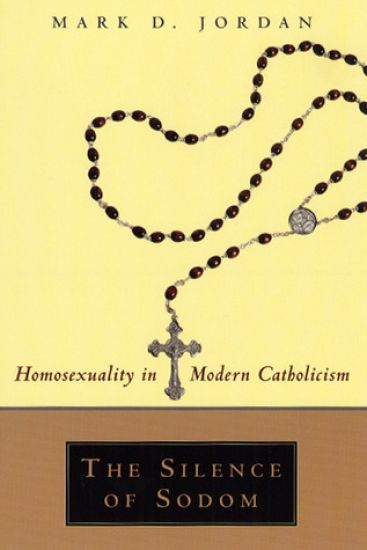
The Silence of Sodom

The Silence of Sodom

Mark D. Jordan

University of Chicago Press
2000
sidottu
Sexual scandals in the Roman Catholic Church have been highly public in recent years, and increasingly shrill directives from the Vatican about homosexuality have become commonplace. The visibility of these issues begs the question of how the Catholic Church can be at once so homophobic and so homoerotic. Mark D. Jordan, the authors of the award-winning "The Invention of Sodomy in Christian Theology", takes up this fundamental question in a deeply learned yet readable study of the relationship between male homosexuality and Catholicism. "The Silence of Sodom" is devoted, first, to teasing out the Church's complex bureaucratic language about sexual morality. Rather than trying to point out that official Catholic documents are simply wrong in their discussions and directives regarding homosexuality, Jordan examines the rhetorical devices used by the Church throughout its history to actively produce silence around the topic of male homosexuality. Arguing that we cannot find the Church's knowledge of homosexuality in its documents, Jordan looks to the unspoken but widely known features of clerical culture to illuminate the striking analogies between clerical institutions and contemporary gay culture, particularly in the mechanisms of discipline, the training of seminarians and the ambiguities of liturgical celebration. The Catholic Church's long experiment with masculine desire cannot be discovered through sensationalist trials of priest-paedophiles or surveys of gay clergy. "The Silence of Sodom" looks deeply into the intertwining, in words and deeds, of Catholicism with homoeroticism; it is a profound reflection on both "being gay" and "being Catholic".
The Silence of Sodom

The Silence of Sodom

Mark D. Jordan

University of Chicago Press
2002
nidottu
Sexual scandals in the Roman Catholic Church have been highly public in recent years, and increasingly shrill directives from the Vatican about homosexuality have become commonplace. The visibility of these issues begs the question of how the Catholic Church can be at once so homophobic and so homoerotic. Mark D. Jordan, the authors of the award-winning "The Invention of Sodomy in Christian Theology", takes up this fundamental question in a deeply learned yet readable study of the relationship between male homosexuality and Catholicism. "The Silence of Sodom" is devoted, first, to teasing out the Church's complex bureaucratic language about sexual morality. Rather than trying to point out that official Catholic documents are simply wrong in their discussions and directives regarding homosexuality, Jordan examines the rhetorical devices used by the Church throughout its history to actively produce silence around the topic of male homosexuality. Arguing that we cannot find the Church's knowledge of homosexuality in its documents, Jordan looks to the unspoken but widely known features of clerical culture to illuminate the striking analogies between clerical institutions and contemporary gay culture, particularly in the mechanisms of discipline, the training of seminarians and the ambiguities of liturgical celebration. The Catholic Church's long experiment with masculine desire cannot be discovered through sensationalist trials of priest-paedophiles or surveys of gay clergy. "The Silence of Sodom" looks deeply into the intertwining, in words and deeds, of Catholicism with homoeroticism; it is a profound reflection on both "being gay" and "being Catholic".
Recruiting Young Love

Recruiting Young Love

Mark D. Jordan

University of Chicago Press
2011
sidottu
In the view of many Christians, the teenage years are simultaneously the most dangerous and the most promising. At the very moment when teens are trying to establish a sense of identity and belonging, they are beset by temptation on all sides - from the pressure of their peers to the nihilism and materialism of popular culture. Add the specter of homosexuality to the mix, and you've got a situation ripe for worry, sermonizing, and exploitation. In "Recruiting Young Love", Mark D. Jordan explores more than a half century of American church debate about homosexuality to show that even as the main lesson - homosexuality is bad, teens are vulnerable - has remained constant, the arguments and assumptions have changed remarkably. At the time of the first Kinsey Report, in 1948, homosexuality was simultaneously condemned and little discussed - a teen struggling with same-sex desire would have found little specific guidance. Sixty years later, church rhetoric has undergone a radical shift, as silence has given way to frequent, public, detailed discussion of homosexuality and its perceived dangers. Along the way, churches have quietly adopted much of the language and ideas of modern sexology, psychiatry, and social reformers-deploying it, for example, to buttress the credentials of anti-gay 'deprogramming' centers and traditional gender roles. Jordan tells this story through a wide variety of sources, including oral histories, interviews, memoirs, and even pulp novels; the result is a fascinating window onto the never-ending battle for the teenage soul.
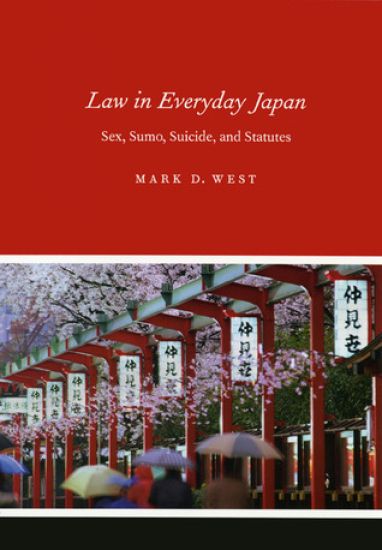
Law in Everyday Japan

Law in Everyday Japan

Mark D. West

University of Chicago Press
2005
sidottu
Lawsuits are rare events in most people's lives. And high-stakes cases are even less commonplace. Why is it, then, that scholarship concerning the Japanese legal system has focused almost exclusively on big topics like corporate law and large-scale social issues? Mark D. West's Law in Everyday Japan fills a void in our understanding of the relationship between law and social life in Japan by shifting the focus to cases most representative of everyday Japanese life. Compiling case studies based on seven fascinating themes - karaoke-based noise complaints, sumo wrestling, love hotels, post-Kobe earthquake condominium reconstruction, lost-and-found outcomes, working hours, and debt-induced suicide - Law in Everyday Japan offers a vibrant portrait of the way law intermingles with social norms, historically ingrained ideas, and cultural mores in Japan. Each example is informed by extensive fieldwork. West interviews the participants - from judges and lawyers to defendants, plaintiffs, and their families - to uncover an everyday Japan where law matters, albeit in very unexpected ways.
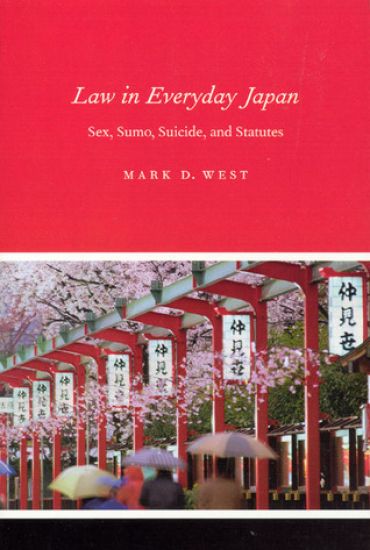
Law in Everyday Japan

Law in Everyday Japan

Mark D. West

University of Chicago Press
2005
nidottu
Lawsuits are rare events in most people's lives. And high-stakes cases are even less commonplace. Why is it, then, that scholarship concerning the Japanese legal system has focused almost exclusively on big topics like corporate law and large-scale social issues? Mark D. West's Law in Everyday Japan fills a void in our understanding of the relationship between law and social life in Japan by shifting the focus to cases most representative of everyday Japanese life. Compiling case studies based on seven fascinating themes - karaoke-based noise complaints, sumo wrestling, love hotels, post-Kobe earthquake condominium reconstruction, lost-and-found outcomes, working hours, and debt-induced suicide - Law in Everyday Japan offers a vibrant portrait of the way law intermingles with social norms, historically ingrained ideas, and cultural mores in Japan. Each example is informed by extensive fieldwork. West interviews the participants - from judges and lawyers to defendants, plaintiffs, and their families - to uncover an everyday Japan where law matters, albeit in very unexpected ways.
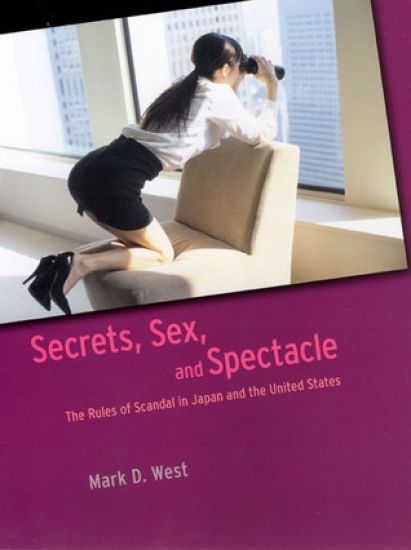
Secrets, Sex, and Spectacle

Secrets, Sex, and Spectacle

Mark D. West

University of Chicago Press
2006
sidottu
A leader of a global superpower is betrayed by his mistress, who makes public the sordid details of their secret affair. His wife stands by as he denies the charges. Debates over definitions of moral leadership ensue. Sound familiar? If you guessed Clinton and Lewinsky, try again. This incident involved former Japanese prime minister Sosuke Uno and a geisha. In Secrets, Sex, and Spectacle, Mark D. West organizes the seemingly random worlds of Japanese and American scandal—from corporate fraud to baseball cheaters, political corruption to celebrity sexcapades—to explore well-ingrained similarities and contrasts in law and society. In Japan and the United States, legal and organizational rules tell us what kind of behavior is considered scandalous. When Japanese and American scandal stories differ, those rules—rules that define what’s public and what’s private, rules that protect injuries to dignity and honor, and rules about sex, to name a few—often help explain the differences. In the cases of Clinton and Uno, the rules help explain why the media didn’t cover Uno’s affair, why Uno’s wife apologized on her husband’s behalf, and why Uno—and not Clinton—resigned. Secrets, Sex, and Spectacle offers a novel approach to viewing the phenomenon of scandal—one that will be applauded by anyone who has obsessed over (or ridiculed) these public episodes.
As it Was in the Beginning

As it Was in the Beginning

Mark D. Owens

James Clarke Co Ltd
2016
nidottu
The meaning of Paul's comments about the new creation in 2 Corinthians 5:17 and Galatians 6:15 has long been obscured. Debate has raged for years, with some arguing that the phrase "new creation" solely refers to the inward transformation believers have experienced through faith in Jesus Christ, and others that this phrase should be understood cosmologically and linked with Isaiah's "new heavens and new earth". Still more advocate an ecclesiological interpretation of this phrase that centres Paul in the new community formed around Jesus Christ. In As It Was in the Beginning, Mark Owens argues that the concept of "new creation" should be understood within the realm of Paul's anthropology, cosmology, and ecclesiology. Paul's understanding of new creation belongs within an Urzeit-Endzeit typological framework, especially within 2 Corinthians 5-6 and Ephesians 1-2. Owens's reading of "new creation" gives due weight to the use of Isaianic traditions in Paul's letters, and to demonstrate that the vision of new creation in 2 Corinthians and Galatians is in striking harmony with that of Ephesians.
Okinawan Karate (Kobudo & Te) Teachers, Styles and Secret Techniques
Time moves on, cultures change with the twists of history and secret arts are lost. To understand the essence of karate, kobudo and te is to read and digest this work. To devour the mysteries of the secret principles it records is to dwell in a former time, only then will the reader know the true meanings of what the masters passed on. This book was a classic of the 20th century and, with the passing of time, is now considered to be an historic record for the modern era; both a time capsule and an integrated tool of knowledge transmission. Also featuring contributions from the latest breed of expert researchers, this Expanded Third Edition keeps the original version alive in its entirety, while bringing the Okinawan karate world up to date, as it expands into an ever-increasing international world. Be warned though, it also answers questions that have not been asked until now and topics that could not have been discussed, while expanding on newly debatable issues. This is what the masters were really saying
Zen Bodywork Dynamics, Enigma Key to Restorative Martial Arts
Zen Bodywork Dynamics is a natural, martial-arts-based, hands-on method of helping to restore health in a holistic way. It corresponds with other martial-arts training, which it is seen as complementing - whatever the style. Thumbs, hands, elbows and feet, etc. are used to apply pressure and relieve pent-up stress in the format of: Relax, Release & Let Go. Many trainees have benefitted from its wisdom, as have thousands of members of the public - the book is highly recommended.
Okinawan Karate: Teachers, Styles & Secret Techniques, Revised & Expanded Second Edition: Master Version
Progression is a positive trait, as long as one keeps in touch with the past and has a staple backdrop to focus or fall back on. Although the Revised Expanded Third Edition contains all the wording and photographs that are reproduced in both the first edition, as well as this Revised and Expanded Second Edition, it comparatively represents a step into what was, for these latter two books, the future. The year 2019, in which I am writing this foreword, represents respectively 30 years and 20 years into the future since the publication of these two books, so I think this faithful reproduction of the Master Version by Q&I Publications is well timed. For some readers it might bring about nostalgia, for others it might be an eye-opener into a world that is not always truthfully represented, due to commercial or other reasons. For the teachers who I interviewed and have been embodied herein, I hope this Master Version will remain a testament into how they wished to be represented for time immemorial.
Okinawan Te, In the Footsteps of The Masters
Known for its knock-out strikes, fluid footwork & bladed weaponry, Okinawan te is a survivor that has endured due to its ability to adapt to social changes. In 1609, in order to suppress Okinawa's developing military might & vast trading links, the Japanese Satsuma clan launched a massive invasion & subjugated the island kingdom. Until then, te had been a bushido battlefield system, with organised castle & naval warfare. However, under Satsuma's rule, the Okinawan bushi, could no longer bear arms in public or have standing armies, so te was transformed into a personal fighting system & recreational activity. Within karate, Okinawan dance & music, the hidden essence of te still provides the framework. It fills Okinawan cultural life & keeps its subtle social machinery revolving. In this detailed work the foundation stones of Okinawan te are laid out through the explanations of historic technical photographs left by the masters for future generations; their forethought has enabled us to walk in their footsteps.
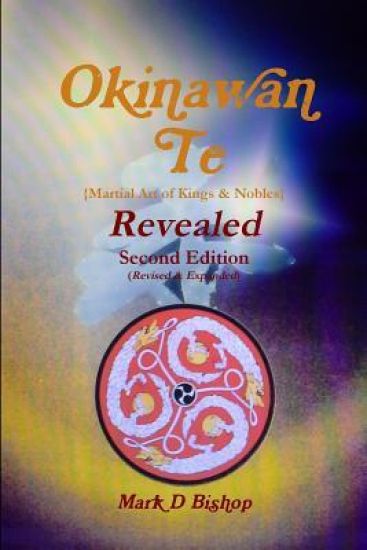
Okinawan Te (Martial Art of Kings & Nobles) Revealed, Second Edition (Revised & Expanded)
Another revealing book by Mark D Bishop. This work expands on the original best-selling version, by including more than 40 extra pages and further explaining the methodology of applications, as well training methods, for proper conditioning. Providing a teaching format for the instructor, it is also an informative workbook for the beginner and a how-to-do manual for those already with experience in the martial arts. In effect, it is the first ever work that deals thoroughly with the training and techniques of Okinawan Te as it developed from 1609, following the Satsuma Invasion of the Ryukyu Islands, until 1879, when the monarchy was dissolved by Japan. Until now, despite demonstrations of its effectiveness, the study of and training in Okinawan Te of this period has been known only to a few adherents. This has led to a mystification and often false representation. However, this can no longer be the case, as all is uncovered in this detailed and brilliantly coordinated work.
Karate Uncovered (Fact & Fiction, Wisdom & Magic)
Explosively direct: Always one to stand his ground for technical reality and historical fact, this work reflects the quality and sheer scale of information in the author's previous works. Poignant questions are asked, debates are raised and down-to-earth, enlightening answers are given. Much of what is considered to be tradition by many a karate-ka is shown to be not necessarily the case. If you think the closed-fist punch is standard fair, read the facts. If you have been taught that karate is an ancient Japanese art founded on violence, reconsider the fiction. If you think karate training is for self-development, absorb the wisdom. If you seek the truth about zen, enjoy the magic. Packed with until now undisclosed information, this book leads the way for the mature karate-ka to discover those hidden treasures that lie beneath the surface. Fifty years of training will give any teacher insights and Mark D Bishop has more than most to offer. Read, absorb, be enriched & uncover your true self, through karate