Kirjojen hintavertailu. Mukana 12 390 323 kirjaa ja 12 kauppaa.

Kirjahaku

Etsi kirjoja tekijän nimen, kirjan nimen tai ISBN:n perusteella.

1000 tulosta hakusanalla Matthew H. Kramer

Polyandry and Wife-Selling in Qing Dynasty China

Polyandry and Wife-Selling in Qing Dynasty China

Matthew H. Sommer

University of California Press
2015
sidottu
This book is a study of polyandry, wife-selling, and a variety of related practices in China during the Qing dynasty (1644-1912). By analyzing over 1200 legal cases from local and central court archives, Matthew Sommer explores the functions played by marriage, sex, and reproduction in the survival strategies of the rural poor under conditions of overpopulation, worsening sex ratios, and shrinking farm sizes. Polyandry and wife-selling represented opposite ends of a spectrum of strategies. At one end, polyandry was a means to keep the family together by expanding it. A woman would bring in a second husband in exchange for his help supporting her family. In contrast, wife sale was a means to survive by breaking up a family: a husband would secure an emergency infusion of cash while his wife would escape poverty and secure a fresh start with another man. Even though Qing law prohibited both practices under the rubric "illicit sexual relations," Sommer shows how magistrates charged with propagating and enforcing a fundamentalist Confucian vision of female chastity tried to cope with their social reality in the face of daunting poverty. This contradiction illuminates both the pragmatism of routine adjudication and the increasingly dysfunctional nature of the dynastic state in the face of mounting social crisis. By casting a spotlight on the rural poor and the experiences of both men and women, Sommer provides an alternative to the standard paradigms of women's history that have long dominated scholarship on gender and sexuality in late imperial China.

Lurid Little Nightmare Makers: Volume Three: The Lancashire Cowboy
The Lancashire Cowboy: A brief biography of Denis McLoughlin by Matthew H. Gore. Annie Oakley - Buffalo Bill Wild West Annual #2 (1950). Art by Denis Mcloughlin. The Great Indian Flood - Buffalo Bill Wild West Annual #3 (1951). Story by Arthur Groom, art by Denis Mcloughlin. Red Men of the West - Buffalo Bill Wild West Annual #2 (1950). Story by Colin McLoughlin, art by Denis Mcloughlin. Bad Men - Buffalo Bill Wild West Annual #2 (1950). Story by Colin McLoughlin, art by Denis Mcloughlin. The Wells Fargo Company - Buffalo Bill Wild West Annual #3 (1951). Story by Arthur Groom, art by Denis Mcloughlin. Gold - Buffalo Bill Wild West Annual #3 (1951). Story by Arthur Groom, art by Denis Mcloughlin.A gallery of Denis McLoughlin's painted Western artwork taken from the 1950 and 1951 Buffalo Bill volumes.
The Language of the Moldovans

The Language of the Moldovans

Matthew H. Ciscel

Lexington Books
2007
sidottu
Who are the Moldovans? The Language of the Moldovans explores this question from the perspective of debates about the languages spoken by the people of this ex-Soviet state. Locating language as a central point of both cohesion and conflict in the region's recent history, the peculiarities of the Moldovans are illustrated by a survey of language attitudes, a series of ethnographic interviews, and extensive observations by the author. The result is an image of an emerging nation that is, at once, similar to the experiences of other ex-Soviet states and uniquely complex. Much of that complexity lies in the population's extensive multilingualism and in uncertainty about the Romanian-ness of the official language. This cross-discipline volume is of great interest to advanced students and researchers of linguistics, political science, and Eastern European studies.
Albert Camus and the Political Philosophy of the Absurd
This book demonstrates that Albert Camus’ concept of absurdity is best understood when decoupled from what might be called its ontological aspirations. Rather than pretend that absurdity usefully describes ‘the human condition,’ ‘the silence of god,’ ‘the deprivation of transcendence,’ or ‘metaphysical revolt,’ I argue that, for absurdity to be a fruitful idea, it must be approached as a psychological disposition and its basic tenets must be translated into phenomenal and psychological language. The book defines the particular psychological disposition of absurdity by analogizing it with the constructs of ambivalence, integration, conscious resistance, and creativity. Its central contention is that absurdity may be interpreted as a kind of ambivalence and, thus, as an aspect of psychological experience that demands a creative and mature response. Absurdists’ cries of spiritual anguish need not persuade us that the conditions of loss, terror, alienation, and deprivation they describe are objectively ‘real’. If, instead, descriptions of absurdity may be understood as psychological accounts of the powerfully ambivalent impulses toward merger and toward separateness, toward group-immersion and toward subjectivity, then absurd revolt involves recognizing, resisting, and integrating such impulses in order to facilitate mature ethical action. It may be possible, I argue, by examining the dynamics of absurdity, ambivalence, resistance, and creativity, to develop a new grounding for an absurd political morality. This book asks what unique properties and advantages this renewed political morality offers and applies this grounding to some of the political and moral crises of Camus’ time and of our own.
Exporting the Bomb

Exporting the Bomb

Matthew H. Kroenig

Cornell University Press
2010
sidottu
In a vitally important book for anyone interested in nuclear proliferation, defense strategy, or international security, Matthew Kroenig points out that nearly every country with a nuclear weapons arsenal received substantial help at some point from a more advanced nuclear state. Why do some countries help others to develop nuclear weapons? Many analysts assume that nuclear transfers are driven by economic considerations. States in dire economic need, they suggest, export sensitive nuclear materials and technology—and ignore the security risk—in a desperate search for hard currency. Kroenig challenges this conventional wisdom. He finds that state decisions to provide sensitive nuclear assistance are the result of a coherent, strategic logic. The spread of nuclear weapons threatens powerful states more than it threatens weak states, and these differential effects of nuclear proliferation encourage countries to provide sensitive nuclear assistance under certain strategic conditions. Countries are more likely to export sensitive nuclear materials and technology when it would have the effect of constraining an enemy and less likely to do so when it would threaten themselves. In Exporting the Bomb, Kroenig examines the most important historical cases, including France's nuclear assistance to Israel in the 1950s and 1960s; the Soviet Union's sensitive transfers to China from 1958 to 1960; China's nuclear aid to Pakistan in the 1980s; and Pakistan's recent technology transfers, with the help of "rogue" scientist A. Q. Khan, from 1987 to 2002. Understanding why states provide sensitive nuclear assistance not only adds to our knowledge of international politics but also aids in international efforts to control the spread of nuclear weapons.
Exporting the Bomb

Exporting the Bomb

Matthew H. Kroenig

Cornell University Press
2010
pokkari
In a vitally important book for anyone interested in nuclear proliferation, defense strategy, or international security, Matthew Kroenig points out that nearly every country with a nuclear weapons arsenal received substantial help at some point from a more advanced nuclear state. Why do some countries help others to develop nuclear weapons? Many analysts assume that nuclear transfers are driven by economic considerations. States in dire economic need, they suggest, export sensitive nuclear materials and technology—and ignore the security risk—in a desperate search for hard currency. Kroenig challenges this conventional wisdom. He finds that state decisions to provide sensitive nuclear assistance are the result of a coherent, strategic logic. The spread of nuclear weapons threatens powerful states more than it threatens weak states, and these differential effects of nuclear proliferation encourage countries to provide sensitive nuclear assistance under certain strategic conditions. Countries are more likely to export sensitive nuclear materials and technology when it would have the effect of constraining an enemy and less likely to do so when it would threaten themselves. In Exporting the Bomb, Kroenig examines the most important historical cases, including France's nuclear assistance to Israel in the 1950s and 1960s; the Soviet Union's sensitive transfers to China from 1958 to 1960; China's nuclear aid to Pakistan in the 1980s; and Pakistan's recent technology transfers, with the help of "rogue" scientist A. Q. Khan, from 1987 to 2002. Understanding why states provide sensitive nuclear assistance not only adds to our knowledge of international politics but also aids in international efforts to control the spread of nuclear weapons.
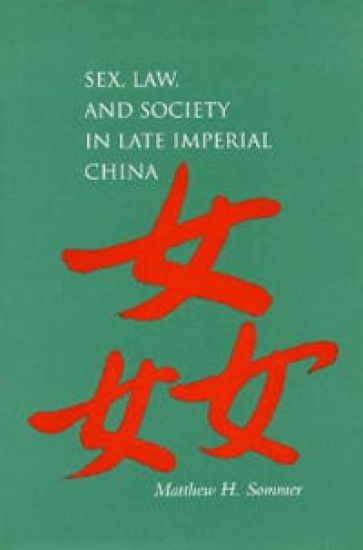
Sex, Law, and Society in Late Imperial China

Sex, Law, and Society in Late Imperial China

Matthew H. Sommer

Stanford University Press
2002
pokkari
This study of the regulation of sexuality in the Qing dynasty explores the social context for sexual behavior criminalized by the state, arguing that the eighteenth century in China was a time of profound change in sexual matters. During this time, the basic organizing principle for state regulation of sexuality shifted away from status, under which members of different groups had long been held to distinct standards of familial and sexual morality. In its place, a new regime of gender mandated a uniform standard of sexual morality and criminal liability across status boundaries—all people were expected to conform to gender roles defined in terms of marriage. This shift in the regulation of sexuality, manifested in official treatment of charges of adultery, rape, sodomy, widow chastity, and prostitution, represented the imperial state's efforts to cope with disturbing social and demographic changes. Anachronistic status categories were discarded to accommodate a more fluid social structure, and the state initiated new efforts to enforce rigid gender roles and thus to shore up the peasant family against a swelling underclass of single, rogue males outside the family system. These men were demonized as sexual predators who threatened the chaste wives and daughters (and the young sons) of respectable households, and a flood of new legislation targeted them for suppression. In addition to presenting official and judicial actions regarding sexuality, the book tells the story of people excluded from accepted patterns of marriage and household who bonded with each other in unorthodox ways (combining sexual union with resource pooling and fictive kinship) to satisfy a range of human needs. This previously invisible dimension of Qing social practice is brought into sharp focus by the testimony, gleaned from local and central court archives, of such marginalized people as peasants, laborers, and beggars.
With Zeal and With Bayonets Only

With Zeal and With Bayonets Only

Matthew H. Spring

University of Oklahoma Press
2010
nidottu
The image is indelible: densely packed lines of slow-moving Redcoats picked off by American sharpshooters. Now Matthew H. Spring reveals how British infantry in the American Revolutionary War really fought.This groundbreaking book offers a new analysis of the British Army during the ""American rebellion"" at both operational and tactical levels. Presenting fresh insights into the speed of British tactical movements, Spring discloses how the system for training the army prior to 1775 was overhauled and adapted to the peculiar conditions confronting it in North America.First scrutinizing such operational problems as logistics, manpower shortages, and poor intelligence, Spring then focuses on battlefield tactics to examine how troops marched to the battlefield, deployed, advanced, and fought. In particular, he documents the use of turning movements, the loosening of formations, and a reliance on bayonet-oriented shock tactics, and he also highlights the army's ability to tailor its tactical methods to local conditions.Written with flair and a wealth of details that will engage scholars and history enthusiasts alike, With Zeal and with Bayonets Only offers a thorough reinterpretation of how the British Army's North American campaign progressed and invites serious reassessment of most of its battles.
An Introduction to Theories of Learning

An Introduction to Theories of Learning

Matthew H. Olson; Julio J. Ramirez

CRC Press Inc
2020
sidottu
Since its first edition, An Introduction to Theories of Learning has provided a uniquely sweeping review of the major learning theories from the 20th century that profoundly influenced the field of psychology. In this tenth edition, the authors present further experimental evidence that tests many of the fundamental ideas presented in these classic theories, as well as explore many of the advances in psychological science and neuroscience that have yielded greater insight into the processes that underlie learning in human beings and animals. The four main goals of this text are to define learning and to show how the learning process is studied (Chapters 1 and 2), to place learning theory in historical perspective (Chapter 3), and to present essential features of the major theories of learning with implications for educational practices (Chapters 4 through 16). The authors retained the best features of earlier editions while making revisions that reflect current research and scholarship, including coverage of active learning and the testing effect, information for problem solving in ravens, data illustrating the neurobiological basis of the cognitive map and spatial learning, new research on brain plasticity and its role in learning as well as the impact of poverty on brain and cognitive development, and new evidence that challenges the notion of learning styles.Complete with chapter summaries, discussion questions, and a glossary, this text is essential reading for theories of learning and applied cognitive psychology courses.See "Support Material" below for new online resources. Instructor resources include PowerPoint slides and a testbank containing over 500 questions (in both Microsoft Word and GIFT file formats). Student resources include chapter summaries, discussion questions, and a glossary of key terms.
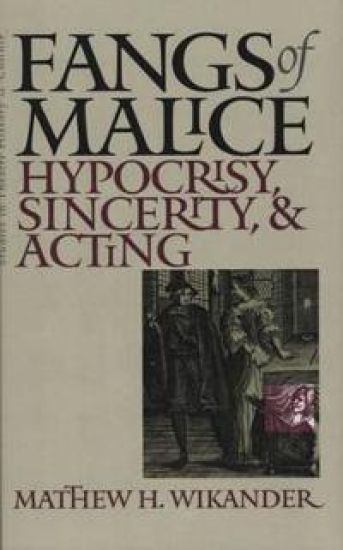
Fangs of Malice

Fangs of Malice

Matthew H. Wikander

University of Iowa Press
2002
sidottu
The idea that actors were hypocrites and fakes and therefore dangerous to society was widespread in the 17th and 18th centuries. This work examines the equation between the vice of hypocrisy and the craft of acting, as it appears in anti-theatrical tracts, in popular and high culture, and especially in plays of the period. Rousseau and others argue that actors pose a threat to society; yet dissembling seems also to be an inevitable consequence of human social intercourse. The ""anti-theatrical prejudice"" offers a perspective on the high value that modern western culture places on sincerity, on being true to one's own self. The book is structured in acts and scenes, each based on a particular slander against actors. A prologue introduces his main issues. Act One deals with the proposition ""They Dress Up"": foppish slavery to fashion, cross-dressing, and dressing as clergy. Act Two treats the proposition ""They Lie"" by focusing on social dissembling and the phenomenon of the self-deceiving hypocrite and on the public, princely hypocrite. Act Three, ""They Drink"", examines a wide range of antisocial behaviour ascribed to actors, such as drinking, gambling, and whoring. An epilogue ties the ancient ideas of possession and the panic that actors inspire to contemporary anxieties about representation not only in theatre but also in visual and literary arts.
Respect Earned

Respect Earned

Matthew H Dick

Matthew H. Dick
2022
pokkari
The San Luis Valley Judo Club in the small town of Alamosa, Colorado, began in the autumn of 1962 and continued through 1977. The driving force behind it was Judge Whitford W. "Whit" Myers, who initiated, handled logistics for, and generally promoted the club. In 1963, he arranged for a black-belt instructor from the Denver School of Judo to move to Alamosa. This person was Edwin Jun "Eddie" Imada, who taught judo to hundreds of kids and young adults in the San Luis Valley across a period of 14 years and inspired them by example. Under his training, SLV Judo reached competitive prominence in the Rocky Mountain Region and beyond, and produced several black belts, two of whom eventually reached ranks of 6th and 7th dan. Eddie's immense dedication and service to the community were ironic, in that he and his family had been forcibly moved to Colorado as internees in the Granada Relocation Center (Camp Amache) during WWII. The publication of this book happens to coincide with the 80th anniversary of the construction of Camp Amache. This story is about judo, Japanese Americans and their history, and life in a small Western town in the 1960s. The author was a founding member of the club and practiced with SLV Judo for six years, attending its first session as well as some in its later years. The book includes 28 illustrations.