Kirjojen hintavertailu. Mukana 11 244 527 kirjaa ja 12 kauppaa.

Kirjahaku

Etsi kirjoja tekijän nimen, kirjan nimen tai ISBN:n perusteella.

1000 tulosta hakusanalla Maynard Savin

Maynard's House

Maynard's House

Herman Raucher

Diversion Books
2015
pokkari
“An unsettling experience. [C]onfounding, touching and well-written.” —THE NEW YORK TIMES BOOK REVIEW Austin Fletcher, a disturbed young Vietnam War vet, is willed a small house deep in the woods of northern Maine. He comes to own it by the generosity of a brother-in-arms—a fellow soldier and confidante, Maynard Whittier, killed in action by a wayward mortar shell. The rugged landscape of Maine is an intoxicating blend of claustrophobic interiors and endless frozen wastelands. Little by little, the mysterious force in the house asserts itself until Austin isn't exactly sure what is in his mind and what is real. And just when our hero's had enough and is ready to quit the place, a blizzard arrives and the real haunting begins.
John Maynard Keynes

John Maynard Keynes

Hyman Minsky

McGraw-Hill Professional
2008
nidottu
“Today, Mr. Minsky's view [of economics] is more relevant than ever.”- The New York Times“Indeed, the Minsky moment has become a fashionable catch phrase on Wall Street.”-The Wall Street JournalJohn Maynard Keynes offers a timely reconsideration of the work of the revered economics icon. Hyman Minsky argues that what most economists consider Keynesian economics is at odds with the major points of Keynes's The General Theory of Employment, Interest, and Money. Keynes and Minsky refuse to ignore pervasive uncertainty. Once uncertainty is given center stage, recurring episodes of financial system crises are all but inescapable. As Robert Barbera notes in a new preface, “Benign economic circumstances…invite increasingly aggressive financial market wagers. Innovation in finance is a signature development in a capitalist economy. Once leveraged wagers are in place, small disappointments can have exaggerated consequences.” Thus for Minsky economic calm on Main Street engenders financial system fragility which, in turn, ensures a perpetuation of boom and bust cycles.Minsky colleagues Dimitri B. Papadimitriou and L. Randall Wray write in a new introduction, “We offer this new edition, in the hope that it will contribute to the reformation of economic theory so that it can address the world in which we actually live-the world that was always the topic of Minsky's analysis.”
John Maynard Keynes

John Maynard Keynes

Skidelsky Robert

Penguin Books Ltd
2013
nidottu
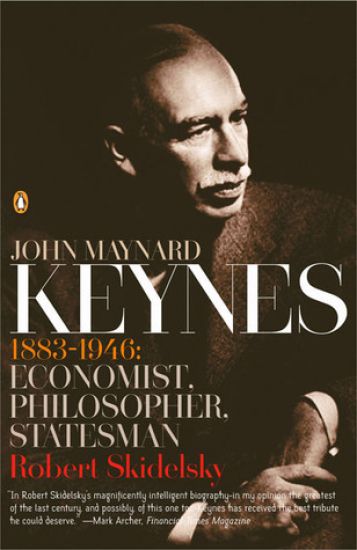
THE DEFINITIVE SINGLE-VOLUME BIOGRAPHYRobert Skidelsky's three-volume biography of John Maynard Keynes has been acclaimed as the authoritative account of the great economist-statesman's life. Here, Skidelsky has revised and abridged his magnum opus into one definitive book, which examines in its entirety the intellectual and ideological journey that led an extraordinarily gifted young man to concern himself with the practical problems of an age overshadowed by war. John Maynard Keynes offers a sympathetic account of the life of a passionate visionary and an invaluable insight into the economic philosophy that still remains at the centre of political and economic thought.ROBERT SKIDELSKY is Emeritus Professor of Political Economy at the University of Warwick. His three volume biography of John Maynard Keynes (1983, 1992, 2000) received numerous prizes, including the Lionel Gelber Prize for International Relations and the Council on Foreign Relations Prize for International Relations. ('This three-volume life of the British economist should be given a Nobel Prize for History if there was such a thing' - Norman Stone.) He was made a life peer in 1991, and a Fellow of the British Academy in 1994.'A masterpiece of biographical and historical analysis' - New York Times
John Maynard Keynes and International Relations

John Maynard Keynes and International Relations

Donald Markwell

Oxford University Press
2006
sidottu
Sixty years after his death, the life and thought of the economist, John Maynard Keynes, continues to be a subject of the greatest interest to scholars. Yet one of the most significant areas of Keynes' thinking has been strangely overlooked - international relations, a subject that was always of central importance to him. The purpose of this book is to explore comprehensively, for the first time, the evolution of Keynes' thinking on international relations , and to show how this is linked to the changing of his opinions on economic matters, in a way which deepens our understanding of both.
John Maynard Keynes

John Maynard Keynes

P. Davidson

Palgrave Macmillan
2007
nidottu
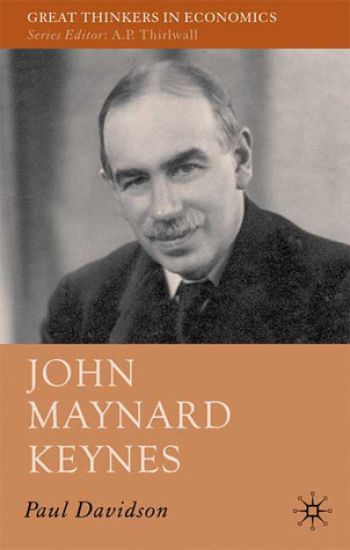
This book looks at the life of Keynes leading up to the writing of his seminal General Theory , examines the General Theory in detail, and explores how it differs from classical theory. The impact of Keynes's work on the economy postwar and up to the present day is also assessed.
John Maynard Keynes

John Maynard Keynes

Blaug Mark

Palgrave Macmillan
1990
nidottu
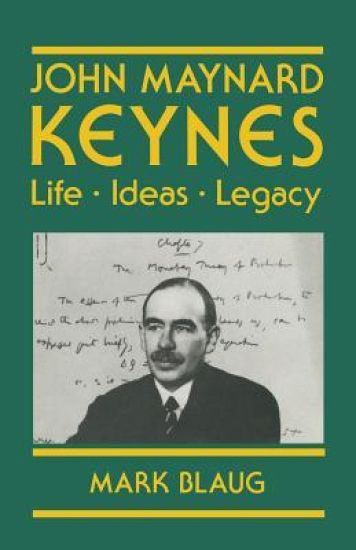
An introduction to Keynesian economics and a study of the influence of Keynes' ideas on economic theory and economic policy through conversations with eight leading economists, including several Nobel prizewinners. It has been fifty years since Keynes published his controversial book, The General Theory of Employment (1936) and yet he remains a controversial figure to this day, attacked and criticised from both left and right, as this book amply demonstrates.
John Maynard Keynes

John Maynard Keynes

P. Mini

Palgrave Macmillan
1994
sidottu
Keynes's personality was fixed by the clash between Moorean values - other-worldliness, idealism, pacifism - and Keynes's own nature which craved and attained worldly success, wealth and social influence and approbation. The result was an 'existential' outlook that caused him to become particularly sensitive to the human condition, to human suffering and to real concern. Accordingly, Keynes came to see the world through human, down-to-earth, social nd psychological categories, which were opposed to the 'devine' Platonism of classical economics. This book is thus opposed to the recent probability-based interpretations of Keynes's mature work.
John Maynard Keynes
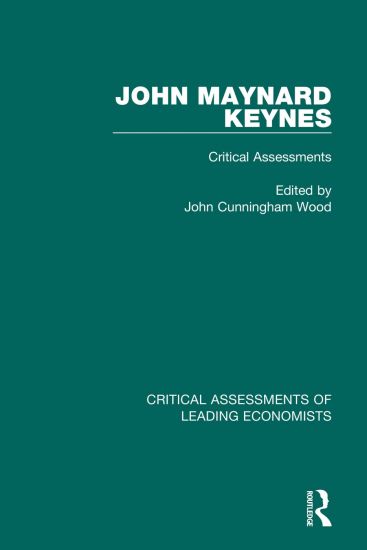
First published in 1982. This collection is part of the Routledge Critical Assessments of Leading Economists series. John Maynard Keynes: Critical Assessments presents a detailed overview of the analytic writings on John Maynard Keynes from contemporary sources through to the present day. All aspects of Keynes’ writings are considered from both their theoretical and practical applications. The volumes are arranged thematically under the following headings: 1. The Life of John Maynard Keynes and Perspectives on his Thought 2. Keynes’ General Theory of Employment, Interest and Money 3. Keynesian Economic Analysis (Volumes III & IV).
John Maynard Keynes
Keynes is universally acknowledged as both the greatest and the most influential economist of the twentieth century. These volumes complement the project of the earlier volumes, making available 150 additional articles
John Maynard Keynes: Critical Responses
John Maynard Keynes, heralded in his own time by the press as "our greatest living economist", is acknowledged as one of the most influential thinkers of the 20th Century. This set presents contemporary responses to Keynes and provides a range of reviews, academic assessments and scholarly essays on Keynes' published works.This important collection draws upon an enormous range of sources, from the popular press to academic journals, and includes responses from Germany, Italy, and France as well as the UK and North America.* Volume One contains reviews of Indian Currency and Finance (1913), The Economic Consequences of Peace (1919), The Revision of the Treaty (1921), A Treatise on Probability (1921), A Tract on Monetary Reform (1923), The End of Laissez-Faire (1926) and Laissez-Faire and Communism (1926)* Volume Two contains reviews of A Treatise on Money (1930), Unemployment as a World Problem (1931), Essays in Persuasion (1931), Essays in Biography (1933) and The Means of Prosperity (1933)* Volume Three contains reviews of The General Theory of Unemployment, Interest and Money (1936) and How to Pay for the War (1940)* Volume Four includes obituaries and final assessments
John Maynard Keynes

John Maynard Keynes

Vincent Barnett

Routledge
2012
sidottu
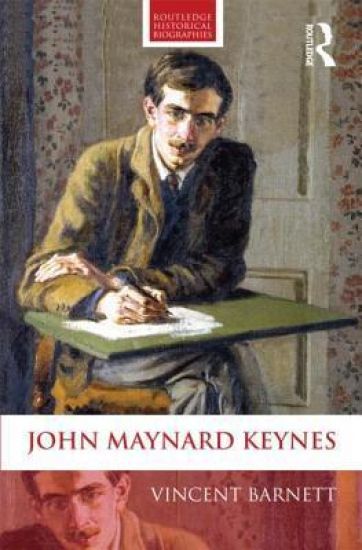
John Maynard Keynes is arguably the most important and influential economist of the twentieth century, and stands alongside Adam Smith and Karl Marx as one of the most famous economic thinkers of all time. Keynes’s radical reassessment of the accepted principles of economics led to new ways of thinking about how to deal with financial crises and economic depressions, and encouraged governments to increase levels of state investment to create economic growth.This historical biography shows how Keynes was more than an academic theorist and how his policy proposals had a significant impact on the economic and financial architecture of many Western countries from the 1920s onward, and on the post-war international financial system. It also tells the story of his colourful private life - Keynes was an active member of the Bloomsbury group of artists and intellectuals, he entertained various ‘secret’ male lovers in his youth, he married a famous Russian ballerina in 1925 and he was also an astute collector of fine art and antiquarian books. Vincent Barnett emphasizes the relationship between the personal and professional by presenting the book chapters in pairs, examining first the central features of Keynes’s life, personal development and policy ideas over the period in question, and then the theoretical content of his major writings from the same period.Barnett argues controversially that allowing psychology a much greater role within economics was a main but often-neglected feature of The General Theory of Employment, Interest and Money, and that Keynes’s policy writings were more concerned with the Britain’s national interest than is sometimes recognised. The result is a concise new biography that is both intellectually rigorous and easily accessible to students and anyone else seeking to understand the life and work of England‘s foremost economist.
John Maynard Keynes

John Maynard Keynes

Vincent Barnett

Routledge
2012
nidottu
John Maynard Keynes is arguably the most important and influential economist of the twentieth century, and stands alongside Adam Smith and Karl Marx as one of the most famous economic thinkers of all time. Keynes’s radical reassessment of the accepted principles of economics led to new ways of thinking about how to deal with financial crises and economic depressions, and encouraged governments to increase levels of state investment to create economic growth.This historical biography shows how Keynes was more than an academic theorist and how his policy proposals had a significant impact on the economic and financial architecture of many Western countries from the 1920s onward, and on the post-war international financial system. It also tells the story of his colourful private life - Keynes was an active member of the Bloomsbury group of artists and intellectuals, he entertained various ‘secret’ male lovers in his youth, he married a famous Russian ballerina in 1925 and he was also an astute collector of fine art and antiquarian books. Vincent Barnett emphasizes the relationship between the personal and professional by presenting the book chapters in pairs, examining first the central features of Keynes’s life, personal development and policy ideas over the period in question, and then the theoretical content of his major writings from the same period.Barnett argues controversially that allowing psychology a much greater role within economics was a main but often-neglected feature of The General Theory of Employment, Interest and Money, and that Keynes’s policy writings were more concerned with the Britain’s national interest than is sometimes recognised. The result is a concise new biography that is both intellectually rigorous and easily accessible to students and anyone else seeking to understand the life and work of England‘s foremost economist.