Kirjojen hintavertailu. Mukana 12 390 323 kirjaa ja 12 kauppaa.

Kirjahaku

Etsi kirjoja tekijän nimen, kirjan nimen tai ISBN:n perusteella.

1000 tulosta hakusanalla Nancy Lang

Documentation and Reimbursement for Speech-Language Pathologists
Although it is the least noticed by patients, effective documentation is one of the most critical skills that speech-language pathologists must learn. With that in mind, Documentation and Reimbursement for Speech-Language Pathologists: Principles and Practiceprovides a comprehensive guide to documentation, coding, and reimbursement across all work settings.The text begins with section 1 covering the importance of documentation and the basic rules, both ethical and legal, followed by an exploration of the various documentation forms and formats. Also included are tips on how to use electronic health records, as well as different coding systems for diagnosis and for procedures, with an emphasis on the link between coding, reimbursement, and the documentation to support reimbursement.Section 2 explains the importance of focusing on function in patient-centered care with the ICF as the conceptual model, then goes on to cover each of the types of services speech-language pathologists provide: evaluation, treatment planning, therapy, and discharge planning. Multiple examples of forms and formats are given for each.In section 3, Nancy Swigert and her expert team of contributors dedicate each chapter to a work setting in which speech-language pathologists might work, whether adult or pediatric, because each setting has its own set of documentation and reimbursement challenges. And since client documentation is not the only kind of writing done by speech-language pathologists, a separate chapter on “other professional writing” includes information on how to write correspondence, avoid common mistakes, and even prepare effective PowerPoint presentations.Each chapter in Documentation and Reimbursement for Speech-Language Pathologists contains activities to apply information learned in that chapter as well as review questions for students to test their knowledge. Customizable samples of many types of forms and reports are also available.Included with the text are online supplemental materials for faculty use in the classroom.Documentation and Reimbursement for Speech-Language Pathologists: Principles and Practice is the perfect text for speech-language pathology students to learn these vital skills, but it will also provide clinical supervisors, new clinicians, and speech-language pathologists starting a private practice or managing a department with essential information about documentation, coding, and reimbursement.

Retailing and the Language of Goods, 1550-1820
In this book the author explores the various meanings assigned to goods sold retail from 1550 to 1820 and how their labels were understood. The first half of the book focuses on these labels and on mercantile language more broadly; how it was used in trade and how lexicographers and others approached what, for them, were new vocabularies. In the second half, the author turns to the goods themselves, and their relationships with terms such as ’luxury’, ’choice’ and ’love’; terms that were used as descriptors in marketing goods. The language of objects is a subject of ongoing interest and the study of consumables opens up new ways of looking at the everyday language of the early modern period as well as the experiences of trade and consumption for both merchant and consumer.
Documentation and Reimbursement for Speech-Language Pathologists
Although it is the least noticed by patients, effective documentation is one of the most critical skills that speech-language pathologists must learn. With that in mind, Documentation and Reimbursement for Speech-Language Pathologists: Principles and Practiceprovides a comprehensive guide to documentation, coding, and reimbursement across all work settings.The text begins with section 1 covering the importance of documentation and the basic rules, both ethical and legal, followed by an exploration of the various documentation forms and formats. Also included are tips on how to use electronic health records, as well as different coding systems for diagnosis and for procedures, with an emphasis on the link between coding, reimbursement, and the documentation to support reimbursement.Section 2 explains the importance of focusing on function in patient-centered care with the ICF as the conceptual model, then goes on to cover each of the types of services speech-language pathologists provide: evaluation, treatment planning, therapy, and discharge planning. Multiple examples of forms and formats are given for each.In section 3, Nancy Swigert and her expert team of contributors dedicate each chapter to a work setting in which speech-language pathologists might work, whether adult or pediatric, because each setting has its own set of documentation and reimbursement challenges. And since client documentation is not the only kind of writing done by speech-language pathologists, a separate chapter on “other professional writing” includes information on how to write correspondence, avoid common mistakes, and even prepare effective PowerPoint presentations.Each chapter in Documentation and Reimbursement for Speech-Language Pathologists contains activities to apply information learned in that chapter as well as review questions for students to test their knowledge. Customizable samples of many types of forms and reports are also available.Included with the text are online supplemental materials for faculty use in the classroom.Documentation and Reimbursement for Speech-Language Pathologists: Principles and Practice is the perfect text for speech-language pathology students to learn these vital skills, but it will also provide clinical supervisors, new clinicians, and speech-language pathologists starting a private practice or managing a department with essential information about documentation, coding, and reimbursement.

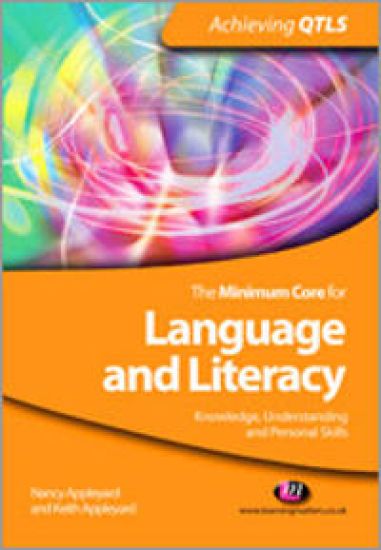
The Minimum Core for Language and Literacy: Knowledge, Understanding and Personal Skills
The teacher training framework, introduced in September 2007, requires all teachers in the post-16 sector to possess knowledge, understanding and personal skills to at least level 2 in the minimum core for language and literacy. Coverage and assessment of the core has to be embedded in all Certificate and Diploma courses leading to QTLS and ATLS status. This book is a practical guide to language and literacy for trainee teachers in the Lifelong Learning sector. It enables trainee teachers to identify and develop their own language and literacy skills and also to support their students' language and literacy.
Informal Assessment and Instruction in Written Language

Informal Assessment and Instruction in Written Language

Nancy Mather; Rhia Roberts

John Wiley Sons Inc
1996
nidottu
The purpose of this book is to help educators increase their proficiency in analyzing and teaching writing to students with learning disabilities. The text is organized into nine chapters. The first is the introductory chapter, the second provides a review of the various components of written language and the types of difficulties that students may have with handwriting, spelling, usage, vocabulary and text structure. The third chapter provides an overview of the writing process approach. The fourth chapter reviews the legal protections and various accommodations to which students are entitled. Chapters five, six and seven contain summaries of instructional strategies that may be used to enhance student performance in the areas of handwriting, basic skills and written expression. The eighth chapter presents analyses of writing samples from students in first-through eighth-grade levels that are reviewed within a diagnostic-prescriptive format. Chapter nine contains writing samples with guided questions that can be used for independent study, as assignments, or for in-class discussions.
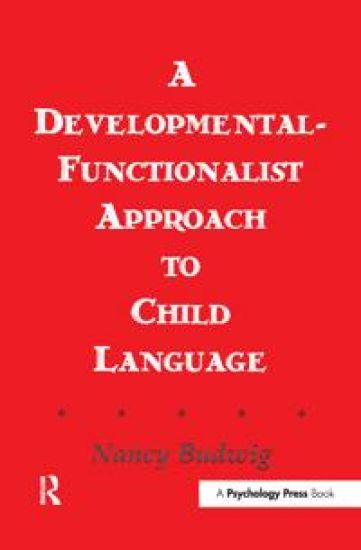
A Developmental-functionalist Approach To Child Language
Although there has been much empirical study within what has been referred to as "functional approaches to child language," there has yet to be a major attempt to compare and contrast such proposals. In addition, much of the work carried out within child language from a functionalist perspective has not been specific with regard to the nature of the approach adopted. In attempting to fill the gap, the author of this book begins with a comparison of various functionalist approaches. By concentrating on one domain -- agentivity and control -- Budwig develops a set of research questions based on an examination of findings stemming from linguistics, psycholinguistics, and developmental psychology, and also provides an in-depth discussion of related methodological issues. In the second part of the book, she traces the development of linguistic means to refer to oneself within a developmental-functionalist perspective. Individual case studies as well as group analyses of six children in the early phases of acquiring English grammar are provided. In the last part, Budwig examines the relationship between forms and functions in development with special attention to potential generalizations about the organization and reorganization of the children's linguistic systems.
The Big Book of Tasks for English Language Development, Grades K-8
Ready-to-go English Language Development tasks that focus on students "doing the doing" of talking, reading, listening, and responding. In recent years, the percentage of English Language Learners (ELLs) has increased in almost every state, so most teachers are faced with the challenge of teaching literacy to students acquiring English alongside English-speaking students. However, in many integrated learning situations, English Language Development (ELD) instruction is strikingly different than the teaching we provide students whose first language is English. The Big Book of Tasks for English Language Development helps teachers meet that challenge head-on! Bestselling author and esteemed education consultant Nancy Akhavan shows that teaching multilingual learners requires changing our instruction to focus on practices that have high impact for students as they acquire language. Yet it’s not about doing more— it’s about doing smarter. It’s about having high expectations for all students and providing scaffolds to support students at all levels of English language proficiency as they learn and grow more confident. All the ready-to-go activities in the book Center on active tasks where students do the thinking, talking, reading, and writing, with appropriate supportActivate the domains of language — listening, speaking, reading, and writing — and recognize that these do not develop at the same rateHonor the continuum of language development and build on what students can doProvide teaching tools such as learning targets, suggestions for when to use a task, basic instructions and "teacher talk" for launching a task, and "Watch Fors and Work-Arounds" Focus on the linguistic assets multilingual learners bring to the classroom and provide opportunities to help them collaborate with peers With Akhavan’s signature straight-forward, teacher-friendly style, this book offers an uplifting reminder that with the right teaching strategies, educators can support multilingual learners to achieve their full potential and thrive in their learning journeys.
A Developmental-functionalist Approach To Child Language
Although there has been much empirical study within what has been referred to as "functional approaches to child language," there has yet to be a major attempt to compare and contrast such proposals. In addition, much of the work carried out within child language from a functionalist perspective has not been specific with regard to the nature of the approach adopted. In attempting to fill the gap, the author of this book begins with a comparison of various functionalist approaches. By concentrating on one domain -- agentivity and control -- Budwig develops a set of research questions based on an examination of findings stemming from linguistics, psycholinguistics, and developmental psychology, and also provides an in-depth discussion of related methodological issues. In the second part of the book, she traces the development of linguistic means to refer to oneself within a developmental-functionalist perspective. Individual case studies as well as group analyses of six children in the early phases of acquiring English grammar are provided. In the last part, Budwig examines the relationship between forms and functions in development with special attention to potential generalizations about the organization and reorganization of the children's linguistic systems.
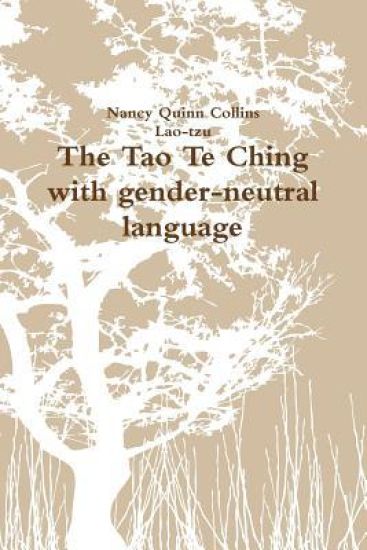
The Tao Te Ching with gender-neutral language
This version of the Tao Te Ching is in gender-neutral language, in English, and with American spelling. It is based on the English translation of the Tao Te Ching done by James Legge as part of volume 39 of The Sacred Books of the East series, issued in 1891 by Oxford University Press (note that this translation is in the public domain). For this book, that translation was then changed into gender-neutral language and American spelling by Nancy Quinn Collins. The gender-neutral language is used in the whole book; for example "Not to value and employ people of superior ability" is used rather than "Not to value and employ men of superior ability"; the only exceptions are that quotes are left as they originally were, and it is written that (as it really was historically) only princes and kings call[ed] themselves 'Orphans, 'Men of small virtue, ' and as 'Carriages without a nave.'
Languages of Dress in the Middle East

Languages of Dress in the Middle East

Bruce Ingham; Nancy Lindisfarne-Tapper

RoutledgeCurzon
1997
sidottu
Considers how the languages of dress in the region connect with other social practices, and with political and religious conformity in particular. Treating cases as diverse as practices of veiling in Oman and dress reform laws in Turkey, these ethnographic studies extend from Malta to the ME and Caucasus.
Languages of Dress in the Middle East

Languages of Dress in the Middle East

Bruce Ingham; Nancy Lindisfarne-Tapper

RoutledgeCurzon
1997
nidottu
Considers how the languages of dress in the region connect with other social practices, and with political and religious conformity in particular. Treating cases as diverse as practices of veiling in Oman and dress reform laws in Turkey, these ethnographic studies extend from Malta to the ME and Caucasus.
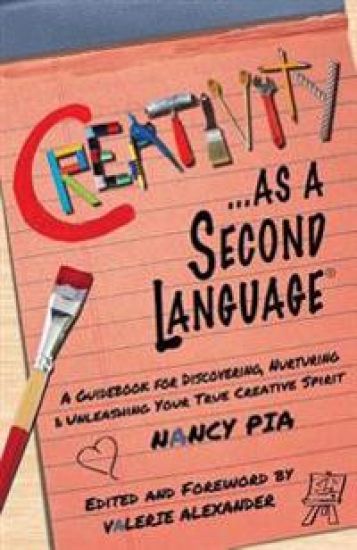
Creativity as a Second Language

Creativity as a Second Language

Valerie Alexander; Nancy Pia

Createspace Independent Publishing Platform
2017
pokkari
The Ultimate Guidebook for Unleashing Your True Creative Self Creativity, unlike any spoken language, is one we are born fluent in. We have the innate ability to create, but as we grow, develop and discover the world, some learn to nourish that spirit while others have their natural creativity suppressed. The language of Creativity is never gone. There's no such thing as a person who is not creative, merely someone who has lost touch with that expressive, artistic, imaginative creator inside. With this book as your guide, you will learn: How to see the objects in your daily life as inspirations for originalityHow to unlock your inner adventurer by investigating the topics that interest youThe "nouns and verbs" that free your mind to create without boundariesWhat courage has to do with eliminating self-doubts and limitationsHow to be flexible, to improvise and to open your mind and heart to what you are naturally able to createThis book is the first step in your journey back to being the creative person you were born to be The work is fun, inspiring, sometimes challenging, and as long as you keep with it, you cannot fail And you will be fluent in Creativity - once again - in no time
Kids Come in All Languages

Kids Come in All Languages

Oscar Corrigan; Nancy Frey; Douglas Fisher; John Hattie

SAGE PUBLICATIONS INC
2023
nidottu
Everything you need to create a high-trust, high-achieving learning environment for multilingual students We have never known more than we do now about teaching multilingual students — nevertheless, we teeter on the edge of retreating to old-think practices. The next generation depends upon our getting this right, and this spare, salient guide helps ensure we do. Kids Come in All Languages provides teachers and leaders with all they need to design high-quality curriculum to support multilingual learners. With this book, learn to: Create a low-anxiety, high-expectation classroom climate that gives multilingual students access to engaging grade-level contentPlan clear, cohesive lessons and tasks that motivate students to produce language, use critical thinking skills, and access complex textsOffer ample time for student-led talk that ramps up knowledge and amps up a sense of belongingUse heterogeneous, flexible grouping so children acquiring English don’t stall out in fixed-mindset, below-grade level groupsAnd much more Teachers act like tributaries, helping learners access a wider stream of knowledge, and catch the swift current of wanting to learn. It’s time to envision this expansiveness for multilingual students. It’s time to design learning experiences with optimism for their futures.
Assessment and Intervention for English Language Learners

Assessment and Intervention for English Language Learners

Susan Unruh; Nancy A. McKellar

Springer International Publishing AG
2017
sidottu
This book presents evidence-based practices for appropriate assessment of and school-based services for young English language learners. It identifies and addresses the challenges of assessing and intervening with these students at the curricular, instructional, environmental, and individual levels, particularly the complexities of determining the presence or absence of learning disabilities. Case studies and comparisons with fluent English speakers illustrate the screening and evaluation process – including multi-tier system of supports (MTSS) and response to intervention (RTI) – and proactive intervention planning in core literacy and math domains. Together, these chapters model effective teaching practice, advocacy, and teamwork with parents and colleagues as well as policy development toward meeting the needs of this diverse student population.This invaluable guide:Examines challenges of data collection when working with English language learners.Traces the development of dual-language fluency and competence.Discusses language-acquisition issues affecting oral language assessment.Reviews commonly used assessment and intervention tools in use with English learners.Features specialized chapters relating to reading, writing, and mathematics competencies.Can be used regardless of first language spoken by students.Assessment and Intervention for English Language Learners is an essential resource for researchers, professionals, and graduate students in diverse fields including school and clinical child psychology; assessment, testing, and evaluation; language education; special education; and educational psychology.
Assessment and Intervention for English Language Learners

Assessment and Intervention for English Language Learners

Susan Unruh; Nancy A. McKellar

Springer International Publishing AG
2018
nidottu
This book presents evidence-based practices for appropriate assessment of and school-based services for young English language learners. It identifies and addresses the challenges of assessing and intervening with these students at the curricular, instructional, environmental, and individual levels, particularly the complexities of determining the presence or absence of learning disabilities. Case studies and comparisons with fluent English speakers illustrate the screening and evaluation process – including multi-tier system of supports (MTSS) and response to intervention (RTI) – and proactive intervention planning in core literacy and math domains. Together, these chapters model effective teaching practice, advocacy, and teamwork with parents and colleagues as well as policy development toward meeting the needs of this diverse student population.This invaluable guide:Examines challenges of data collection when working with English language learners.Traces the development of dual-language fluency and competence.Discusses language-acquisition issues affecting oral language assessment.Reviews commonly used assessment and intervention tools in use with English learners.Features specialized chapters relating to reading, writing, and mathematics competencies.Can be used regardless of first language spoken by students.Assessment and Intervention for English Language Learners is an essential resource for researchers, professionals, and graduate students in diverse fields including school and clinical child psychology; assessment, testing, and evaluation; language education; special education; and educational psychology.
Sociolinguistics and Language Teaching

Sociolinguistics and Language Teaching

Sandra L. McKay; Nancy F. Hornberger

CAMBRIDGE UNIVERSITY PRESS_
1995
sidottu
This text provides an introduction to the field of sociolinguistics for second and foreign language teachers. The hardback edition provides an introduction to the field of sociolinguistics for second and foreign language teachers. Chapters cover the basic areas of sociolinguistics that have a bearing on language teaching, including regional and social variations in dialects, language and gender, World English, and intercultural communication. Each chapter has been specially written for this collection by an individual who has done extensive research on the topic explored. For each topic there is an overview of central terms and issues, and a discussion of implications for the language classroom. This is the first introductory text to address explicitly the pedagogical implications of current theory and research in sociolinguistics. The book will also be of interest to any teachers with students from linguistically diverse backgrounds.