Kirjojen hintavertailu. Mukana 11 627 064 kirjaa ja 12 kauppaa.

Kirjahaku

Etsi kirjoja tekijän nimen, kirjan nimen tai ISBN:n perusteella.

1000 tulosta hakusanalla Neil R. Nicholson

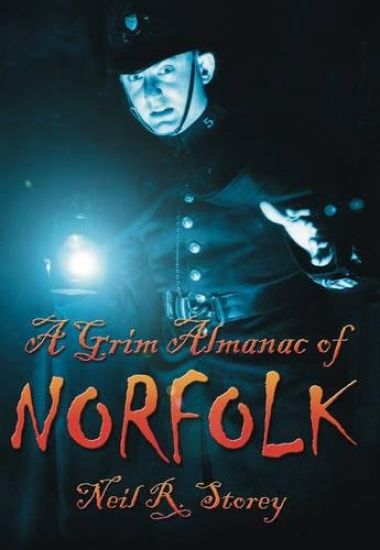
A Grim Almanac of Norfolk

A Grim Almanac of Norfolk

Neil R Storey

The History Press Ltd
2010
nidottu
Did you know... In one of the last executions in Norwich Castle Gaol in 1885 an event so horrible occurred that a shadow was cast on the nation’s Public Executioner for the rest of his career? And Matthew Hopkins, ‘The Witchfinder General’, found witches in King’s Lynn, Norwich and Great Yarmouth in the mid-seventeenth century? Have you ever wondered about the darker history of Norfolk? If you have then enquire within. This almanac explores dreadful deeds, macabre deaths, strange occurrences and grim tales from the shadier side of the county’s past. Jostling for position in this cornucopia of the criminal and curious are diverse tales of highwaymen, smugglers, murderers, bodysnatchers, duellists, footpads, poachers, rioters and rebels. This sordid cast of characters is deservedly accompanied by accounts of lock-ups, prisons, bridewells and punishments, as well as a liberal smattering of bizarre funerals, disasters and peculiar medicine. If it’s horrible, if it’s ghastly, if it’s strange, it’s here — and if you have the stomach for it, then read on...
A Grim Almanac of Lincolnshire

A Grim Almanac of Lincolnshire

Neil R Storey

The History Press Ltd
2011
nidottu
A Grim Almanac of Lincolnshire is a day-by-day catalogue of 365 ghastly tales from around the county dating from the twelfth to the twentieth centuries. Full of dreadful deeds, macabre deaths, strange occurrences and heinous homicides, this almanac explores the darker side of Lincolnshire’s past. This compilation contains such diverse tales of highwaymen, smugglers, giants, hangmen, poachers, witches, rioters and rebels, as well as accounts of old lock-ups, prisons, bridewells and punishments. All these, plus tales of murder, suicide, mysterious deaths, accidents by land, sea and air, and much more, are here. If you have ever wondered about what nasty goings-on occurred in the Lincolnshire of yesteryear, then look no further — it’s all here, and if you have the stomach for it, then read on... if you dare!
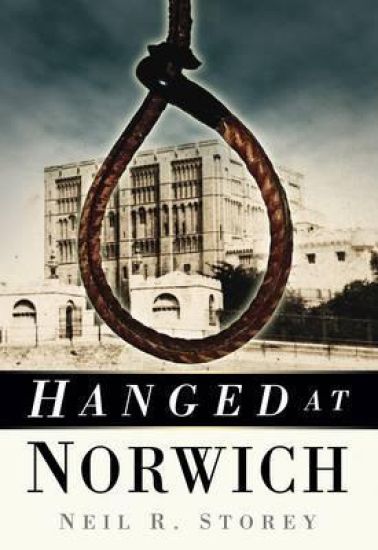
Hanged at Norwich

Hanged at Norwich

Neil R Storey

The History Press Ltd
2011
nidottu
This is the story of those who ended up on the end of the hangman’s rope at Norwich Castle Prison, Norwich City Prison on Earlham Road and the later Victorian Norwich Prison on Knox Road. The executions included in this book range from some of the earliest recorded in the county during the thirteenth century, then down the years including two gallows survivors and the execution of Kett and many of his rebels in 1549, to the last execution conducted in the county in 1951, when two young men went to the gallows for separate incidents but having committed the same crime — they both murdered their pregnant sweethearts. Recorded here are executions for a host of forgotten cases and a cornucopia of crimes as diverse as highway robbery, housebreaking, riot, arson and theft of livestock. Norwich was the location for the hangings of such notorious criminals as Frances Billing and Catherine Frary ‘The Burnham Poisoners’ — the last public double execution and last women to hang in the county; James Blomfield Rush, the Stanfield Hall Murderer; William Sheward, the murderer who confessed almost eighteen years after the murder and dismemberment of his wife; and Herbert Bennett, the Yarmouth Bootlace Murderer who may, or may not, have been guilty of his crime. Norwich Castle Prison was also the scene of one of the most infamous incidents in the history of British hangings and recalled with trepidation by all executioners who came after as ‘The Goodale Mess’.
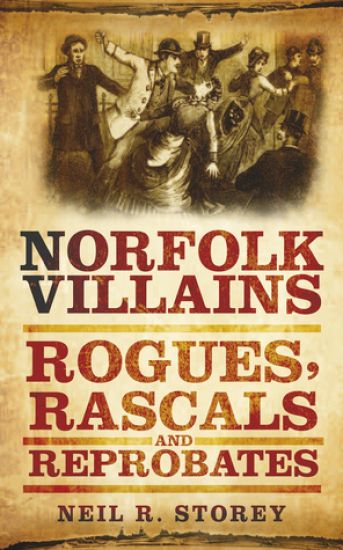
Norfolk Villains

Norfolk Villains

Neil R Storey

The History Press Ltd
2012
nidottu
Discover the darker side of Norfolk with this remarkable collection of true-life crimes from across the county. Featuring tales of some of the most notorious, nefarious and murderous characters from the county’s past, including pirates, smugglers, highwaymen, poachers, thieves, murderers and bodysnatchers, all factions of the criminal underworld are included in this macabre selection of tales. Drawing on a wide variety of historical sources and containing many cases which have never before been published, Norfolk Villains will fascinate everyone interested in true crime and the history of Norfolk.
The Little Book of Norfolk

The Little Book of Norfolk

Neil R Storey

The History Press Ltd
2011
sidottu
The Little Book of Norfolk is a repository of intriguing, fascinating, obscure, strange and entertaining facts and trivia about one of England’s most colourful counties. It is an essential to the born and bred Norfolk folk or anyone who knows and loves the county. Armed with this fascinating tome the reader will have such knowledge of the county, its landscape, people, places, pleasures and pursuits they will be entertained and enthralled and never short of some frivolous fact to enhance conversation or quiz! A reference book and a quirky guide, this can be dipped in to time and time again to reveal something new about the people, the heritage, the secrets and the enduring fascination of the county. A remarkably engaging little book, this is essential reading for visitors and locals alike.
A Grim Almanac of Essex

A Grim Almanac of Essex

Neil R Storey

The History Press Ltd
2011
nidottu
Neil R. Storey’s macabre calendar chronicles the darker side of life in Essex. Murderers and footpads, pimps and prostitutes, riots, rebels, bizarre funerals, disaster and peculiar medicine all feature. The book is illustrated with engravings, newspaper reports, photographs and original documents. It is horrible, if it is ghastly, if it is strange, then it is here! If you have the stomach for it, then read on.
The Little Book of Murder

The Little Book of Murder

Neil R Storey

The History Press Ltd
2013
sidottu
The Little Book of Murder is a chilling compendium of intriguing, obscure and strange facts and trivia about murders and murderers from around the world. From infamous cases and serial killers, to unusual murder weapons and crime scene investigations, this book is sure to make you sit up and say, ‘I never knew that!’ A reference book and a quirky guide, this volume can be dipped in to time and time again to reveal something new about the murderers, the victims, the people who write about crime, and the advances in scientific detection. A remarkably engaging little book, this is essential reading for true crime and crime fiction fans alike.
The Little Book of Great Britain

The Little Book of Great Britain

Neil R Storey

The History Press Ltd
2012
sidottu
This little gem of a book is a repository of intriguing, fascinating, obscure, strange and entertaining facts and trivia about Britain and all the things that have made it great. Within this volume are such themes as myths and legends, traditions and customs, great Britons and great British places, while not forgotten is a celebration of the best of British music, food, entertainment and sport and a host of topics that explore the more eccentric and eclectic people and things that contribute to and define Great Britain. Despite being a relatively small collection of islands, there is always something new, fascinating, frivolous or even bizarre to discover about Great Britain – you will find much of it here.Did You Know?There is no location in Britain which is more than 74½ miles from the sea.The first person in Britain to be convicted of speeding was Walter Arnold of Kent, who in 1896 was fined 1s plus costs for driving at a breakneck 8mph.Britain has some thoroughly unusual pub names, including: The Bucket of Blood in Phillack, Cornwall, The Honest Lawyer in Folkestone and The Old Thirteenth Cheshire Astley Volunteer Rifleman Corps Inn in Stalybridge – which also enjoys the honour of having Britain’s longest pub name.Her Majesty Queen Elizabeth II is a well-known corgi fan. She has owned no fewer than 30 during her reign, the first being Susan, who was given to her in 1944.
The Little Book of Death

The Little Book of Death

Neil R Storey

The History Press Ltd
2013
sidottu
This little book is a repository of intriguing, fascinating, obscure, strange and entertaining facts and trivia about the one certainty in all our lives - death. Within this volume are some horrible, unfortunate and downright ludicrous ends. Find out what body parts of the departed great and famous are still with us (and, in some cases, what they sold for). Learn of odd last requests, burials, epitaphs and death rites from around the world, as well as the strange fates of some cadavers – and a whole host of horrible tales about mummies, vampires, zombies, auto-icons and body-snatchers. Anyone brave enough to read this book will be entertained and enthralled and never short of some frivolous fact to enhance a conversation or quiz! With 50 chilling illustrations, get out of your crypt and buy it whilst you can!
The Dracula Secrets

The Dracula Secrets

Neil R Storey

The History Press Ltd
2012
sidottu
Since the first publication of Dracula in 1897, there have been suggestions that the book’s protagonist is more closely associated with Jack the Ripper than a Transylvanian count. In The Dracula Secrets, historian Neil R. Storey undertakes an in-depth investigation of the sources used by Stoker during the writing of his seminal masterpiece. Painting an evocative portrait of Stoker, his influences, his friends and the London he frequented in the late nineteenth century, Storey explores how Stoker created Dracula out of the climate of fear that was created by the Whitechapel murders in 1888. Indeed he asks, did Stoker know Jack the Ripper personally and hide the clues to this terrible knowledge in his book? Having gained unprecedented access to the unique archive of one of Stoker’s most respected friends and the dedicatee of Dracula, Storey sheds new light on both Stoker and Dracula, and reveals startling new links between Stoker’s creation and the most infamous serial killer of all time.
Popular Music, Gender and Postmodernism

Popular Music, Gender and Postmodernism

Neil R. Nehring

SAGE Publications Inc
1997
sidottu
Popular Music, Gender, and Postmodernism begins by tracing the migration of cynical academic ideas about postmodernism into music journalism. The result has been a widespread fatalism over the presumed ability of the music industry to absorb any expression of defiance in hiphop and rock. Commercial "incorporation" supposedly makes a charade of musical outrage, somehow disconnecting anger in music from any meaning or significance. Author Neil Nehring documents the considerable damage done by the journalistic employment of this tenet of postmodern theory, particularly in the case of the late Kurt Cobain of Nirvana, whose emotional intensity was repeatedly belittled for its purported incoherence. As a rebuttal to academic postmodernism and its exploitation by the mass media, Popular Music, Gender, and Postmodernism emphasizes that emotion and reason are mutually interdependent. Though mistakes can occur in the conscious choice of an object at which to direct oneÆs feelings, the preverbal appraisal of social situations that generates emotions is always perfectly rational. Nehring also surveys work in literary criticism, psychology, and especially feminist philosophy that argues on the basis for the political significance of anger even prior to its full articulation. The emotional performance in popular music, he concludes, cannot be discounted on the grounds, for example, that lyrics such as CobainÆs are difficult to understand. After detailing more and less progressive approaches to emotion in music criticism, Nehring focuses on recent punk rock by women, including the Riot Grrrls.
Popular Music, Gender and Postmodernism

Popular Music, Gender and Postmodernism

Neil R. Nehring

SAGE Publications Inc
1997
nidottu
Popular Music, Gender, and Postmodernism begins by tracing the migration of cynical academic ideas about postmodernism into music journalism. The result has been a widespread fatalism over the presumed ability of the music industry to absorb any expression of defiance in hiphop and rock. Commercial "incorporation" supposedly makes a charade of musical outrage, somehow disconnecting anger in music from any meaning or significance. Author Neil Nehring documents the considerable damage done by the journalistic employment of this tenet of postmodern theory, particularly in the case of the late Kurt Cobain of Nirvana, whose emotional intensity was repeatedly belittled for its purported incoherence. As a rebuttal to academic postmodernism and its exploitation by the mass media, Popular Music, Gender, and Postmodernism emphasizes that emotion and reason are mutually interdependent. Though mistakes can occur in the conscious choice of an object at which to direct oneÆs feelings, the preverbal appraisal of social situations that generates emotions is always perfectly rational. Nehring also surveys work in literary criticism, psychology, and especially feminist philosophy that argues on the basis for the political significance of anger even prior to its full articulation. The emotional performance in popular music, he concludes, cannot be discounted on the grounds, for example, that lyrics such as CobainÆs are difficult to understand. After detailing more and less progressive approaches to emotion in music criticism, Nehring focuses on recent punk rock by women, including the Riot Grrrls.
How We Got the Bible

How We Got the Bible

Neil R. Lightfoot

Baker Books, a division of Baker Publishing Group
2010
nidottu
How We Got the Bible provides factual, accessible answers to questions such asHow and when did the books of the Bible originate? In what sense are these books different from other books? How have these books been preserved and transmitted to us? Why do we have so many different translations of the Bible?A popular guide for Bible students, it has sold more than 1 million copies during its forty years in print. This trade paper edition of the well-loved classic offers readers an even more affordable way to learn about the development of the most important book in history.
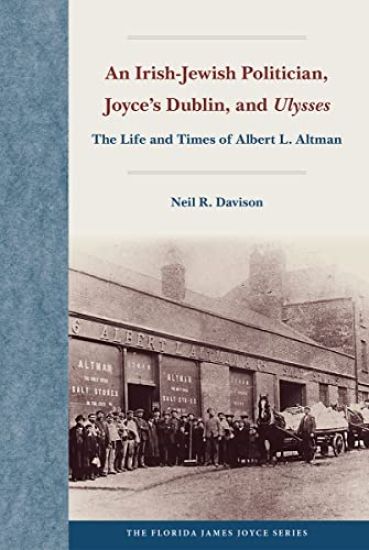
An Irish-Jewish Politician, Joyce's Dublin, and "Ulysses

An Irish-Jewish Politician, Joyce's Dublin, and "Ulysses

Neil R. Davison

University Press of Florida
2022
sidottu
A forgotten historical figure and his influence on the writing of James JoyceIn this book, Neil Davison argues that Albert Altman (1853—1903), Dublin-based businessman and Irish nationalist, influenced James Joyce's creation of the character of Leopold Bloom as well as Ulysses broader themes surrounding race, nationalism, and empire. Using extensive archival research, Davison reveals parallels between the lives of Altman and Bloom, including how the experience of double marginalization which Altman felt as both a Jew in Ireland and an Irishman in the British Empire is a major idea explored in Joyce's work. Altman, successful salt and coal merchant, was involved in municipal politics ove issues of Home Rule and labour, and frequently appeared in the press over the two decades of Joyce's youth. His prominence, Davison shows, made him a familiar name in the Home Rule circles with which Joyce and his father most identified. The book concludes by tracing the influence of Altman's career on the Dubliners story Ivy Day in the Committee Room as well as throughout the whole of Ulysses.Through Altman's biography, Davison recovers a forgotten life story that illuminates Irish and Jewish identity and culture in Joyce's Dublin.A volume in the Florida James Joyce Series, edited by Sebastian D. G. Knowles.
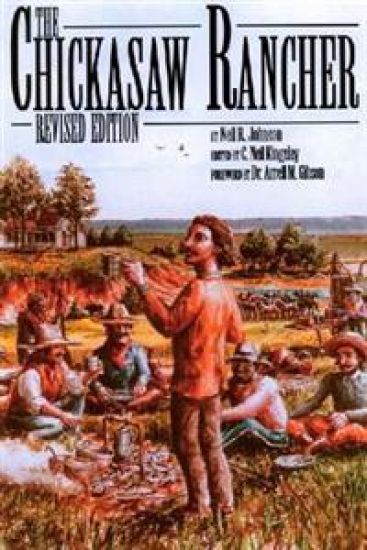
The Chickasaw Rancher

The Chickasaw Rancher

Neil R. Johnson; Arrell M. Gibson

University Press of Colorado
2001
nidottu
First published in 1960, Neil R. Johnson's The Chickasaw Rancher, Revised Edition, tells the story of Montford T. Johnson and the first white settlement of Oklahoma. Abandoned by his father after his mother's death and then left on his own following his grandmother's passing in 1868, Johnson became the owner of a piece of land in the northern part of the Chickasaw Nation in what is now Oklahoma.The Chickasaw Rancher follows Montford T. Johnson's family and friends for the next thirty-two years. Neil R. Johnson describes the work, the ranch parties, cattle rustling, gun fights, tornadoes, the run of 1889, the hard deaths of many along the way, and the rise, fall, and revival of the Chickasaw Nation. This revised edition of The Chickasaw Rancher, edited by C. Neil Kingsley, Neil R. Johnson's grandson, is the perfect addition to any reader's collection of the history of the American West.