Elastomer Technology Handbook is a major new reference on the science and technology of engineered elastomers. This contributed volume features some of the latest work by international experts in polymer science and rubber technology. Topics covered include theoretical and practical information on characterizing rubbers, designing engineering elastomers for consumer and engineering applications, properties testing, chemical and physical property characterization, polymerization chemistry, rubber processing and fabrication methods, and rheological characterization. The book also highlights both conventional and emerging market applications for synthetic rubber products and emphasizes the latest technology advancements. Elastomer Technology Handbook is a "must have" book for polymer researchers and engineers. It will also benefit anyone involved in the handling, manufacturing, processing, and designing of synthetic rubbers.
This pocket handbook is intended as a handy reference guide for engineers, scientists and students on widely used mathematical relationships, statistical formulas and problem-solving methods, including illustrated examples for problem-solving methods.
This book provides direction in constructing regression routines that can be used with worksheet software on personal computers. The book lists useful references for those readers who desire more in-depth understanding of the mathematical bases, and is helpful for science and engineering students.
This text provides approaches and methodologies for implementing pollution prevention (P2) and waste minimization programmes to reduce manufacturing operational costs significantly. It focuses on reducing manufacturing and environmental compliance costs by instituting feedstock substitution, improved operational schemes, recycling and by-product recovery, waste minimization, and energy efficiency policies, and offers project cost accounting tools that assist in evaluating money-saving P2 options.
Offers a guide to current environmental health and safety statutes--providing a working knowledge of the major legislations and regulations and demonstrating the steps necessary for compliance. Illustrates overall health and safety management skills for multimedia facilities.
Subject Matter The original title of this book was Tractatus Classico-Quantummechanicus, but it was pointed out to the author that this was rather grandiloquent. In any case, the book discusses certain topics in the interface between classical and quantum mechanics. Mathematically, one looks for similarities between Poisson algebras and symplectic geometry on the classical side, and operator algebras and Hilbert spaces on the quantum side. Physically, one tries to understand how a given quan tum system is related to its alleged classical counterpart (the classical limit), and vice versa (quantization). This monograph draws on two traditions: The algebraic formulation of quan tum mechanics and quantum field theory, and the geometric theory of classical mechanics. Since the former includes the geometry of state spaces, and even at the operator-algebraic level more and more submerges itself into noncommutative geometry, while the latter is formally part of the theory of Poisson algebras, one should take the words "algebraic" and "geometric" with a grain of salt! There are three central themes. The first is the relation between constructions involving observables on one side, and pure states on the other. Thus the reader will find a unified treatment of certain aspects of the theory of Poisson algebras, oper ator algebras, and their state spaces, which is based on this relationship.
There have been many volumes written that claim to be the most "comprehensive" compendium or handbook on chemical data. These wieldy volumes are often too big and extraneous to be useful to the practicing engineer. This new volume aims to be the most useful "go to" volume for the working engineer, scientist, or chemist who needs quick answers to daily questions about materials or chemicals and doesn't want to go on long searches through voluminous tomes or lengthy internet searches. Covering only the most commonly used chemicals in the most important processes in industry, A Guide to Safe Material and Chemical Handling includes industrial chemicals, such as gases, fuels, and water, which are not incorporated in most "comprehensive" books on materials and chemical properties. Safety plans and procedures that can be implemented by any engineer or plant manager by following the easy, step-by-step instructions in the book are also provided.
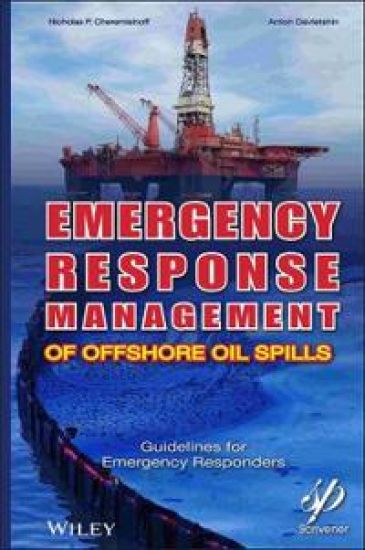
EMERGENCY RESPONSE MANAGEMENT OF OFFSHORE Examines the Deepwater Horizon disaster and offers processes for safety and environmental protection Though renewable energy is a growing piece of the energy “pie,” fossil fuels still dominate our energy supplies and will continue to do so for decades. This makes offshore drilling, especially in places like the Gulf of Mexico and North Sea, extremely important for the future of the world’s energy supply. Unfortunately, the world has been witnessing, over and over again, accidents, deadly explosions, spills, and environmental disasters that could have been avoided with proper safety and environmental processes put in place. The Deepwater Horizon catastrophe is the largest offshore oil spill in U.S. history and an ecological nightmare of epic proportions. Emergency Response Management of Offshore Oil Spills aids in the response of this and future disasters by providing this handy reference volume for engineers, managers, and other emergency responders. This timely publication outlines the toxic nature of crude oil, covering properties of crude oil, chemical composition, toxicity to humans and marine life, and investigates the impact of oil spills from historical case studies. The current arsenals available to address oil spills, such as dispersants, absorbing booms, skimming, and other methods, are also discussed. Technologies that are rapidly being developed to address the Gulf Oil Spill are considered, along with extensive information on chemical protective clothing, air monitoring, respiratory protection, management of waste, and much more. The book concludes with a chapter discussing responsible care and takes a critical look at the reasons why the Deepwater Horizon rig catastrophe happened and examines the follow-up that ensued after the incident. Emergency Response Management of Offshore Oil Spills provides: Examples of 26 major oil spills ranked from largest to smallest, describing each incident and the amount of oil spilledRecommendations and guidance on proper air monitoring methodsSuggestions related to protective garments such as respiratorsComparative product information on chemical dispersants, shoreline bleaching and cleaning chemicalsDetailed toxicity data for humans and marine lifeDiscussions in the areas of deficiencies in responding to spills and why the oil industry needs to be more responsive to developing technologiesHazardous materials protocols, including OSHA- and EPA- recommended safe work practices for dealing with hazardous materials
The Parrot's Secret wings its way across the generations, taking off in the 1870's and landing in the 1960's. A nonstop adventure that grabs the reader from the first page and pinballs them across the world. From the steamy jungles of South America, through the bustling streets of Victorian London and on to the mysteries of Constantinople in the heart of the Middle East. It's here we meet the all-powerful Sultan and his beautiful daughter, Princess Ayla, as they battle against their kingdom's destruction by evil forces.The saga of the Elsworthy Family, with its rags to riches founder, Sir Richard, is inextricably intertwined with the lives of the Sultan and his daughter. Ever present and central to the mystery is the loyal and enigmatic Angelique. Only she can reveal The Parrot's Secret.
This volume provides extensive health (toxicological) and safety handling information and data on over 1,000 chemicals of commercial and industrial importance. This volume will provide extensive health (toxicological) and safe-handling information and data on more than 1000 chemicals of commercial and industrial importance. It provides chemical specific information pertinent to safe handling and transportation of chemicals, worker protection, emergency response information to address spills, explosions on fire situations, and chemical stability/reactivity data. It is designed as a standard reference handbook for chemical engineers, safety engineers, toxicologists, fire safety specialists, chemists, laboratory and plant technicians.
This reference book provides a comprehensive overview of the nature, manufacture, structure, properties, processing, and applications of commercially available polymers. The main feature of the book is the range of topics from both theory and practice, which means that physical properties and applications of the materials concerned are described in terms of the theory, chemistry and manufacturing constraints which apply to them. It will therefore enable scientists to understand the commercial implications of their work as well as providing polymer technologists, engineers and designers with a theoretical background.
The Handbook of Air Pollution Prevention and Control provides a concise overview of the latest technologies for managing industrial air pollution in petrochemical, oil and gas, and allied industries. Detailed material on equipment selection, sizing, and troubleshooting operations is provided along with practical design methodology. Unique to this volume are discussions and information on energy-efficient technologies and approaches to implementing environmental cost accounting measures.Included in the text are sidebar discussions, questions for thinking and discussing, recommended resources for the reader (including Web sites), and a comprehensive glossary.The Handbook of Air Pollution Prevention and Control also includes free access to US EPA's air dispersion model SCREEN3. Detailed examples on the application of this important software to analyzing air dispersion from industrial processes and point sources are provided in the Handbook, along with approaches to applying this important tool in developing approaches to pollution prevention and in selecting control technologies. By applying SCREEN3, along with the examples given in the Handbook, the user can: evaluate the impact of processes and operations to air quality, and apply the model to assess emergency scenarios to help in planning, to develop environmental impact assessments, to select pollution control technologies, and to develop strategies for pollution prevention. Two companion books by Cheremisinoff are available:Handbook of Water and Wastewater Treatment Technologies, and Handbook of Solid Waste Management and Waste Minimization Technologies.
Handbook of Solid Waste Management and Waste Minimization Technologies is an essential tool for plant managers, process engineers, environmental consultants, and site remediation specialists that focuses on practices for handling a broad range of industrial solid waste problems. In addition to equipment and process options, the author presents information on waste minimization practices that can be used in conjunction with or can provide alternatives to equipment and process investments. Environmental cost accounting measures and energy-efficient technologies are provided. Valuable information for those concerned with meeting government regulations and with the economic considerations (such as fines for violations and cost-effective methods) is presented in a practical manner. Included in the text are sidebar discussions, questions for thinking and discussion, recommended resources for the reader (including Web sites), and a comprehensive glossary. Two companion books by Cheremisnoff are available: Handbook of Water and Wastewater Treatment Technologies, and Handbook of Air Pollution Control Technologies.
One of the keys to the enduring popularity of the British singer Morrissey is his carefully crafted enigmatic persona. This critical book examines the role of enigma in the celebrity's public life, exploring how a level of mystery is maintained through television interviews, videos, reviews and concerts, as well as through his music and lyrics. Of particular interest is the way in which enigma stimulates interest and desire in his audience, and how the artist manipulates traditional modes of masculinity and the conventions of pop music to further cultivate enigma.