Kirjojen hintavertailu. Mukana 11 244 527 kirjaa ja 12 kauppaa.

Kirjahaku

Etsi kirjoja tekijän nimen, kirjan nimen tai ISBN:n perusteella.

1000 tulosta hakusanalla Nicholas Royle

The Literary Role of History in the Fiction of J. R. R. Tolkien
This volume analyzes the literary role played by history in the works of J. R. R. Tolkien. It argues that the events of The Lord of the Rings are placed against the background of an already- existing history, both in reality and in the fictional worlds of the books. History is unfolded in various ways, both in explicitly archival annals and in stories told by characters on the road or on the fly, and in which different visions of history emerge. In addition, the history within the work can resemble, or be patterned on, histories in our world. These histories range from the deep past of prehistoric and ancient worlds to the early medieval era of the barbarian invasions and Byzantium, to the modern worlds of urbane civility and a paradoxical longing for nature, and finally to great power rivalries and global prospects. The book argues that Tolkien did not employ these histories indiscriminately or reductively. Rather, he regarded them as aspects of aesthetic and representative figuration that are above all literary. While most criticism has concentrated on Tolkien’s use of historical traditions of Northern Europe, this book argues that Tolkien also valued Southern and Mediterranean pasts and registered the Germanic and the Scandinavian pasts as they related to other histories as much as his vision of them included a primeval mythic aura.

Robles y Valdivia

Robles y Valdivia

Nicholas Gómez

Independently Published
2019
pokkari
Jorge y Marcos son mejores amigos y compa eros de la literatura. Juntos comienzan un movimiento literario que afecta la vida de amigos cercanos e individuos cotidianos. A trav s de sus escritos y los escritos de toda la gente a su alrededor, se observan las ventajas y los obst culos de formar una vida en M xico, y se propone la pregunta: C mo se define la masculinidad?
Has the role of rituals in medieval politics been exaggerated?
Seminar paper from the year 2006 in the subject History Europe - Other Countries - Middle Ages, Early Modern Age, grade: 1,5, University of Wales, Aberystwyth (History Department), course: Politics and Political Culture in Norman and Angevin England, language: English, abstract: The problems arising from both the term "politics" and the term "ritual" is that they are essentially modern concepts, at least in the sense in which we use them today. Consequently, anything said about the involvement and use of ritual in the realm of politics, a word here used in a broad sense of meaning, should be read with extreme caution. Politics, on a provisional definition for the purpose of this essay, is therefore to be understood as the means and mechanism through which decisions concerning the community are taken, exercised, and communicated. A ritual, on the other hand, is harder to define, and all attempts to do so would not pass unchallenged. For the purpose of this essay it will be understood as an often recurring proceeding, with symbolic meaning attached to its outer appearance. Borrowing from linguistics, but without engaging in that discipline's debate between structuralists and followers of Noam Chomsky's generative grammar, the notion of Ferdinand de Saussure's sign theory may help: a ritual itself will in this essay be understood as a sign, the realization of which is a signifier (signifiant), and the meaning of which is the signified (signifi ). In other words, ritual here is understood as following similar patterns as language. Letters are of no use to an illiterate, as the shapes of letters mean nothing to him, nor does a ritual for someone unfamiliar with any given society's customs and values. The meaning (signified) has a dialectic connection with its realized counterpart, the performance of ritual (or, in Saussure's field, speech). The ritual itself is thus an abstract concept standing above both as the sign, which is, in turn, hollow if unperforme
Fooled by Randomness: The Hidden Role of Chance in Life and in the Markets
Fooled by Randomness is a standalone book in Nassim Nicholas Taleb's landmark Incerto series, an investigation of opacity, luck, uncertainty, probability, human error, risk, and decision-making in a world we don't understand. The other books in the series are The Black Swan, Antifragile, Skin in the Game, and The Bed of Procrustes. Now in a striking new hardcover edition, Fooled by Randomness is the word-of-mouth sensation that will change the way you think about business and the world. Nassim Nicholas Taleb-veteran trader, renowned risk expert, polymathic scholar, erudite raconteur, and New York Times bestselling author of The Black Swan-has written a modern classic that turns on its head what we believe about luck and skill. This book is about luck-or more precisely, about how we perceive and deal with luck in life and business. Set against the backdrop of the most conspicuous forum in which luck is mistaken for skill-the world of trading-Fooled by Randomness provides captivating insight into one of the least understood factors in all our lives. Writing in an entertaining narrative style, the author tackles major intellectual issues related to the underestimation of the influence of happenstance on our lives. The book is populated with an array of characters, some of whom have grasped, in their own way, the significance of chance: the baseball legend Yogi Berra; the philosopher of knowledge Karl Popper; the ancient world's wisest man, Solon; the modern financier George Soros; and the Greek voyager Odysseus. We also meet the fictional Nero, who seems to understand the role of randomness in his professional life but falls victim to his own superstitious foolishness. However, the most recognizable character of all remains unnamed-the lucky fool who happens to be in the right place at the right time-he embodies the "survival of the least fit." Such individuals attract devoted followers who believe in their guru's insights and methods. But no one can replicate what is obtained by chance. Are we capable of distinguishing the fortunate charlatan from the genuine visionary? Must we always try to uncover nonexistent messages in random events? It may be impossible to guard ourselves against the vagaries of the goddess Fortuna, but after reading Fooled by Randomness we can be a little better prepared. PRAISE FOR FOOLED BY RANDOMNESS Named by Fortune One of the Smartest Books of All Time A Financial Times Best Business Book of the Year " Fooled by Randomness] is to conventional Wall Street wisdom approximately what Martin Luther's ninety-five theses were to the Catholic Church." -Malcolm Gladwell, author of Blink "The book that rolled down Wall Street like a hand grenade." -Maggie Mahar, author of Bull A History of the Boom, 1982--1999 "Fascinating . . . Taleb will grab you." -Peter L. Bernstein, author of Capital Ideas Evolving "Recalls the best of scientist/essayists like Richard Dawkins . . . and Stephen Jay Gould." -Michael Schrage, author of Serious Play: How the World's Best Companies Simulate to Innovate "We need a book like this. . . . Fun to read, refreshingly independent-minded." -Robert J. Shiller, author of Irrational Exuberance "Powerful . . . loaded with crackling little insights and] extreme brilliance." -National Review
The Role of Green Chemistry in Biomass Processing and Conversion

The Role of Green Chemistry in Biomass Processing and Conversion

Haibo Xie; Nicholas Gathergood

John Wiley Sons Inc
2013
sidottu
Sets the stage for the development of sustainable, environmentally friendly fuels, chemicals, and materials Taking millions of years to form, fossil fuels are nonrenewable resources; it is estimated that they will be depleted by the end of this century. Moreover, the production and use of fossil fuels have resulted in considerable environmental harm. The generation of environmentally friendly energy from renewable sources such as biomass is therefore essential. This book focuses on the integration of green chemistry concepts into biomass processes and conversion in order to take full advantage of the potential of biomass to replace nonsustainable resources and meet global needs for fuel as well as other chemicals and materials. The Role of Green Chemistry in Biomass Processing and Conversion features contributions from leading experts from Asia, Europe, and North America. Focusing on lignocellulosic biomass, the most abundant biomass resource, the book begins with a general introduction to biomass and biorefineries and then provides an update on the latest advances in green chemistry that support biomass processing and conversion. Next, the authors describe current and emerging biomass processing and conversion techniques that use green chemistry technologies, including: Green solvents such as ionic liquids, supercritical CO2, and waterSustainable energy sources such as microwave irradiation and sonificationGreen catalytic technologiesAdvanced membrane separation technologies The last chapter of the book explores the ecotoxicological and environmental effects of converting and using fuels, chemicals, and materials from biomass. Recommended for professionals and students in chemical engineering, green chemistry, and energy and fuels, The Role of Green Chemistry in Biomass Processing and Conversion sets a strong foundation for the development of a competitive and sustainable bioeconomy. This monograph includes a Foreword by James Clark (University of York, UK).
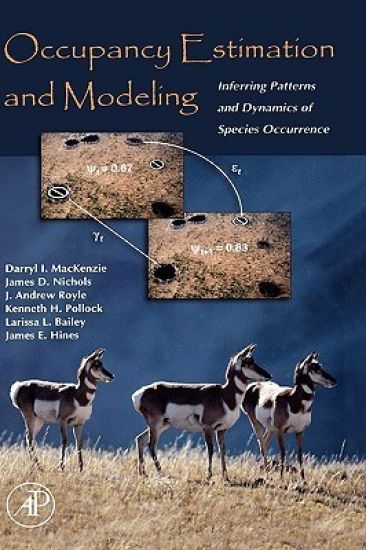
Occupancy Estimation and Modeling

Occupancy Estimation and Modeling

Darryl I. MacKenzie; James D. Nichols; J. Andrew Royle; Kenneth H. Pollock; Larissa Bailey; James E. Hines

Academic Press Inc
2005
sidottu
Occupancy Estimation and Modeling is the first book to examine the latest methods in analyzing presence/absence data surveys. Using four classes of models (single-species, single-season; single-species, multiple season; multiple-species, single-season; and multiple-species, multiple-season), the authors discuss the practical sampling situation, present a likelihood-based model enabling direct estimation of the occupancy-related parameters while allowing for imperfect detectability, and make recommendations for designing studies using these models.
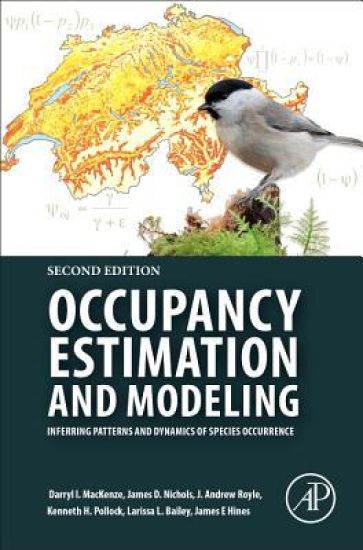
Occupancy Estimation and Modeling

Occupancy Estimation and Modeling

Darryl I. MacKenzie; James D. Nichols; J. Andrew Royle; Kenneth H. Pollock; Larissa Bailey; James E. Hines

Academic Press Inc
2017
nidottu
Occupancy Estimation and Modeling: Inferring Patterns and Dynamics of Species Occurrence, Second Edition, provides a synthesis of model-based approaches for analyzing presence-absence data, allowing for imperfect detection. Beginning from the relatively simple case of estimating the proportion of area or sampling units occupied at the time of surveying, the authors describe a wide variety of extensions that have been developed since the early 2000s. This provides an improved insight about species and community ecology, including, detection heterogeneity; correlated detections; spatial autocorrelation; multiple states or classes of occupancy; changes in occupancy over time; species co-occurrence; community-level modeling, and more. Occupancy Estimation and Modeling: Inferring Patterns and Dynamics of Species Occurrence, Second Edition has been greatly expanded and detail is provided regarding the estimation methods and examples of their application are given. Important study design recommendations are also covered to give a well rounded view of modeling.
The Role of Ideology in the Origins of the Cold War
This book argues that American Exceptionalism and Eurasianism engendered the ideological principles that propelled the geostrategic interests of the United States and the Soviet Union in the post-World War Two period. The correlation between ideology and the pursuit of certain geostrategic aims led to the creation of the interventionist mechanisms that established a sound management of the international order in the post-World War Two era.
Die Rolle der Markenpersönlichkeit für die kommunikative Führung einer Marke
Marken sind kollektive Vorstellungsbilder, die wir mit einem Produkt oder - nem Unternehmen konnotativ und assoziativ verknupfen. Die Marke lebt davon, dass wir auf sie Eigenschaften und Werte projizieren, als ob sie Personen waren, mit denen wir in Interaktion treten. Insofern kennzeichnen Marken Wahrn- mungs- und Projektionsraume, die wir in unsere Lebenswelt integrieren. Je pr- nanter und konsistenter das Wahrnehmungsbild einer Marke ist, desto eindeu- ger konnen wir sie als Identitat wahrnehmen. Identitat reduziert Komplexitat und erzeugt gerade dadurch Vertrauen. Je mehr unsere Wahrnehmungswelt durch die Vielfalt von Informationen und medialen Angeboten herausgefordert wird, desto wichtiger werden Angebote, die uns helfen, dieses Uberangebot an Informat- nen und Signalen zu strukturieren. Insofern sind Marken wichtige Wahrn- mungs- und Deutungsmuster, die Orientierung und Sinn vermitteln. Marken sind aber zugleich auch Trager von Botschaften und Werten. Sie realisieren sich in den sozialen und medial vermittelten Kommunikationen und Interaktionen, in die sie eingebettet sind. Das macht Marken zu hervorgehobenen Wahrnehmungs- und Interpretationsgegenstanden. Wir definieren uns uber M- ken, indem wir uber Marken mit anderen kommunizieren. Diese Einbeziehung von Marken und Markeneigenschaften in unsere alltaglichen Kommunikationen, in die symbolische und thematische Verwendung von Marken, macht sie als Kommunikationsgegenstand erst anschlussfahig. In der Regel geben wir Marken einen Vertrauensvorschuss, aber dieses V- trauen muss sich in der Markenverwendung wie in der Kommunikation mit und uber die Marke bewahren. Insofern ist eine uberzeugende Markenkommunika- on, die sich auf wahrnehmbare Eigenschaften und attraktive Erscheinungsbilder stutzen kann, die grosste Herausforderung an eine Markenfuhrung und Mark- kommunikation."