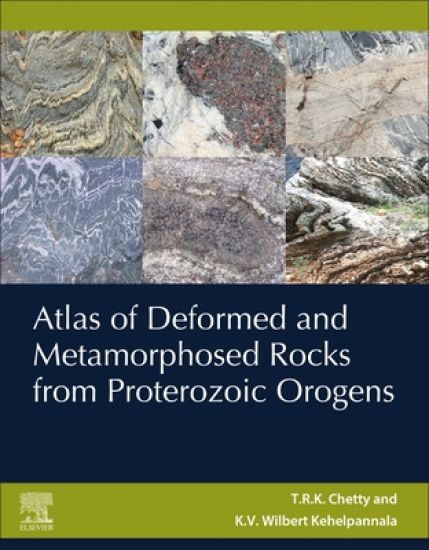
Atlas of Deformed and Metamorphosed Rocks from Proterozoic Orogens is a richly illustrated reference book featuring over 660 full-color field images of a range of lithologies from some Proterozoic terrains that were subjected to multiple events of magmatism, deformation, metamorphism, and metasomatism. The Atlas focuses on amphibolite to granulite facies lithologies and associated ma?c-ultrama?c rocks from Proterozoic orogens of India, Sri Lanka, Botswana, South Africa, East Antarctica, and Western Australia. Each chapter in the book begins with a brief review of geology, including deformation and metamorphic history, along with a regional geological map to help readers to visualize the ?eld observations in the relevant geological context. Each image is accompanied by a concise description providing location, lithology, structural fabric, possible deformational history, metamorphic features, partial melting, metasomatism, and other important crustal processes. This Atlas is an important source of information for a broad range of earth scientists, graduate and undergraduate students, researchers, academicians, and other professionals. This book will form a great treasure to those geoscientists who never had an opportunity to visit any of the Proterozoic orogenic belts.
This book will broaden readers’ understanding of pegmatites in a special geodynamic setting, dealing with the emplacement of the Hagendorf-Pleystein Pegmatite Province (HPPP) in the Central European Variscides. This treatise illustrates the complex processes leading to the formation and partial destruction of the pegmatites, documenting the geochronological, chemical, mineralogical, geological and geomorphological / sedimentological data set. The book starts with a detailed account of the economic geology of the various pegmatites, explaining why these deposits are a major resource of ceramic raw materials. In its concluding section, a model of the pegmatite evolution in an ensialic orogen provides meaningful insights into the genetic aspects of pegmatite generation.The Late Paleozoic rare-element pegmatites of the HPPP, Oberpfalz-SE, Germany, rank among the largest concentrations in Europe. The biggest pegmatite of this mining district totals 4.4 million tons of ore (Hagendorf-South). The mining history of the HPPP is restricted to the 20th century, when local entrepreneurs started mining operations in search of ceramic raw materials, feldspar and quartz. Today the “Silbergrube Aplite” is still worked for feldspar. The traditional mining of pegmatitic and aplitic rocks in Central Europe, such as the Bohemian Massif, which is shared by Germany, the Czech Republic, Poland and Austria, has been focused on these industrial minerals. In addition to these major commodities, lithium was mined for a period of time. But even today many of these pegmatites of calc-alkaline affiliation have not lost their appeal to mineralogists and mineral enthusiasts for their wealth of minerals that contain P, Nb, Ta, Li, Be, B, U, Th, Sc, Ti and Sn. The most favorable crustal section to bring about pegmatitic rocks of this type, encompassing pegmatoids, metapegmatites, reactivated pseudopegmatites and pegmatites sensu stricto is the ensialic orogen,exemplified by the Variscan (Hercynian) Orogen, which geodynamically connects the Paleozoic pegmatite provinces in North America and Europe. The geological history of the HPPP, however, goes much further than the Carboniferous-Permian magmatic activity, when the last structural disturbances of the Variscan orogeny affected the NE-Bavarian Basement between 450 and 330 Ma. During this time mafic magmatic rocks together with calcareous and arenaceous sediments were converted into paragneisses, calcsilicate rocks, and amphibolites. It is the period of time when tectonic shortening led to over thrusting and when the emplacement of nappes and the architectural elements of the ensialic orogen began taking shape. During the Late Permian, the Mesozoic and the Cenozoic, the HPPP did not lie idle in geological terms; hypogene and supergene alteration continued and found its most recent expression in alluvial-fluvial “nigrine” placer deposits, which resulted from the unroofing of the pegmatites and aplites in the HPPP and can be used even outside HPPP as an ore guide to pegmatites.
This book will broaden readers’ understanding of pegmatites in a special geodynamic setting, dealing with the emplacement of the Hagendorf-Pleystein Pegmatite Province (HPPP) in the Central European Variscides. This treatise illustrates the complex processes leading to the formation and partial destruction of the pegmatites, documenting the geochronological, chemical, mineralogical, geological and geomorphological / sedimentological data set. The book starts with a detailed account of the economic geology of the various pegmatites, explaining why these deposits are a major resource of ceramic raw materials. In its concluding section, a model of the pegmatite evolution in an ensialic orogen provides meaningful insights into the genetic aspects of pegmatite generation.The Late Paleozoic rare-element pegmatites of the HPPP, Oberpfalz-SE, Germany, rank among the largest concentrations in Europe. The biggest pegmatite of this mining district totals 4.4 million tons of ore (Hagendorf-South). The mining history of the HPPP is restricted to the 20th century, when local entrepreneurs started mining operations in search of ceramic raw materials, feldspar and quartz. Today the “Silbergrube Aplite” is still worked for feldspar. The traditional mining of pegmatitic and aplitic rocks in Central Europe, such as the Bohemian Massif, which is shared by Germany, the Czech Republic, Poland and Austria, has been focused on these industrial minerals. In addition to these major commodities, lithium was mined for a period of time. But even today many of these pegmatites of calc-alkaline affiliation have not lost their appeal to mineralogists and mineral enthusiasts for their wealth of minerals that contain P, Nb, Ta, Li, Be, B, U, Th, Sc, Ti and Sn. The most favorable crustal section to bring about pegmatitic rocks of this type, encompassing pegmatoids, metapegmatites, reactivated pseudopegmatites and pegmatites sensu stricto is the ensialic orogen,exemplified by the Variscan (Hercynian) Orogen, which geodynamically connects the Paleozoic pegmatite provinces in North America and Europe. The geological history of the HPPP, however, goes much further than the Carboniferous-Permian magmatic activity, when the last structural disturbances of the Variscan orogeny affected the NE-Bavarian Basement between 450 and 330 Ma. During this time mafic magmatic rocks together with calcareous and arenaceous sediments were converted into paragneisses, calcsilicate rocks, and amphibolites. It is the period of time when tectonic shortening led to over thrusting and when the emplacement of nappes and the architectural elements of the ensialic orogen began taking shape. During the Late Permian, the Mesozoic and the Cenozoic, the HPPP did not lie idle in geological terms; hypogene and supergene alteration continued and found its most recent expression in alluvial-fluvial “nigrine” placer deposits, which resulted from the unroofing of the pegmatites and aplites in the HPPP and can be used even outside HPPP as an ore guide to pegmatites.
I Dina ögon handlar om hur Thomas tidigt anar något annorlunda hos sin dotter. Han söker hjälp i jakten på en lösning hos myndigheter men får istället i flera år kämpa mot det han behöver minst - skuld. Den oförstående omgivningen och bristen på stöd blir till slut övermäktig och det för hans dotter ifrån honom. Trots dotterns frånvarao finns känslorna ständigt närvarande; sorg, ilska och frustration men även stolthet, glädje och hopp. Thomas Nybom är pappa till fyra barn varav Shara är den näst äldsta. Han bor utanför Norrköping och har arbetat med personer med neuropsykiatriska diagnoser i tjugo år och handleder även inom ämnet NP. År 2009 startade han lokalföreningen NP Vision, som är en anhörigförening för personer med neuropsykiatriska diagnoser.
The classical Appalachian, Caledonian, Hercynian, and Mauritanide orogens are now only segments of a once-continuous Paleozoic mountain belt which has been fragmented during Mesozoic-Cenozoic formation of the North Atlantic Ocean. These segments are major parts of the countries surrounding the North Atlantic - most of which are members of NATO. The aim of this NATO conference was to evaluate these fragments in terms of their pre-Mesozoic positions, and to attempt a synthesis of their geologic evolution on an international and orogen-wide scale. Geologists who have studied these scattered remnants have been separated by both geography and discipline. Orogen-wide syntheses have beeen attempted in the past by individuals who are specialists not only in discipline but also in geography; therefore, these attempts have not been satisfactory to everyone. This conference brought together the foremost specialists in different disciplines from each country. They attempted to teach other specialists, not only in their own fields, but in other disciplines, about regional variations and particular problems. The resulting international cross-fertilization, both within and between speciaLties, enriched individual workers and helped to provide a multi-disciplinary overview of the orogen.
This book is the first systematic treatise of available data and view-points obtained from geological and geochemical studies of the Mo deposits in Qinling Orogen, China. Qinling Orogen has a minimum reserve of 8.7 Mt Mo, ranking the largest molybdenum province both in China and the world. Incorporating all known Mo deposit types in the world, it presents extensive studies of Mo deposits of world-class and unusual types within tectonic settings. The Qinling Orogen was finally formed during continental collision between Yangtze and North China cratons, following the Triassic closure of the northernmost paleo-Tethys. It hosts 49 Mo deposits formed in seven mineralization events since 1850 Ma, with all the world-class deposits being formed during 160-105 Ma, coeval with collisional orogeny. These deposits are assigned to magmatic and metamorphic hydrothermal classes. The magmatic hydrothermal class includes porphyries, skarns, and intrusion-related veins (carbonatite, fluorite and quartz). The porphyry Mo systems in Qinling Orogen are predominated by Dabie-type formed in continental collision setting, followed by Endako- and Climax-types formed in continental arcs and rifts, respectively. The metamorphic hydrothermal Mo deposits are only reported in Qinling Orogen, and thus a new crustal continuum model for the orogenic class mineral systems is proposed. A scientific linkage between ore geology and fluid inclusions is introduced and verified both by theory and case studies. This is the first research book comprehensively displaying continental collision metallogeny. This literature will benefit both Western and Chinese mineral explorers and miners, as well as research scientists and students.
This open access book presents a new structural model of “multi-arc-basin-terrane system” based on the in-depth research of the Nujiang-Lancangjiang-Jinshajiang region, especially several Paleo-Tethys ophiolitic mélange belts and sets of arc-basin systems, and a new orogenic model of “The Hengduan shan Mountains” based on penetrated research on spatial-temporal framework and orogenic models of different orogenic belts under large-scale strike-slip-shear-nappe structures evolution. The authors paid special attention on the coupling relation between orogeny and metallogenesis. The metallogenesis and dynamic process are probed under the crust–mantle interaction and material-energy exchange-transmission background and the tectonic units evolution. The ore genesis and distribution of deposits have been thoroughly analyzed, and the metallogenic theories of "multi-arc-basin-terrane" and "intracontinental tectonic transformation" in the Nujiang-Lancangjiang-Jinshajiang region have been carriedout. This book also illustrates how to explore metallic deposits in the Nujiang-Lancangjiang-Jinshajiang region by using the metallogenic regulations. Meanwhile, this book has high reference value for researchers working in the fields of basic geology, environmental geology, and energy geology.
This open access book presents a new structural model of “multi-arc-basin-terrane system” based on the in-depth research of the Nujiang-Lancangjiang-Jinshajiang region, especially several Paleo-Tethys ophiolitic mélange belts and sets of arc-basin systems, and a new orogenic model of “The Hengduan shan Mountains” based on penetrated research on spatial-temporal framework and orogenic models of different orogenic belts under large-scale strike-slip-shear-nappe structures evolution. The authors paid special attention on the coupling relation between orogeny and metallogenesis. The metallogenesis and dynamic process are probed under the crust–mantle interaction and material-energy exchange-transmission background and the tectonic units evolution. The ore genesis and distribution of deposits have been thoroughly analyzed, and the metallogenic theories of "multi-arc-basin-terrane" and "intracontinental tectonic transformation" in the Nujiang-Lancangjiang-Jinshajiang region have been carriedout. This book also illustrates how to explore metallic deposits in the Nujiang-Lancangjiang-Jinshajiang region by using the metallogenic regulations. Meanwhile, this book has high reference value for researchers working in the fields of basic geology, environmental geology, and energy geology.
This book studies the Fuegian Andes in Argentina, showing both simple and complex aspects. The first ones refer to the general stratigraphy of the area and the latter result from their tectonic characteristics. Concerning the stratigraphy, an appraisal of the denomination and valorization of formations of Jurassic and early Cretaceous age is performed here to reach the simple scheme of the Fuegian-Patagonian continuity under the name of “Fuegian Andes Deformed Complex”. As an essay the formational nomenclature is simplified and the local concept of basement is evaluated. In relation to their structural aspects it is assumed that the formation of the orogenic Fuegian arc and the folding of the Mesozoic and early Tertiary layers are connected phenomena. Tectonic forces from the West, the Northeast and the South have had participation in the formation of the tectonic arc. The lithostatic column pressure was added once the layers were folded and thrusted upwards during the birth of the Fuegian Andes. Even the speculation of a great main fold overturned to North, as an abstraction, is considered. Instead, the Magallanes-Fagnano fault is appreciated only as a product of the transcurrent Quaternary movements, lacking associated eruptive processes that contribute to define plate borders.
2 Ingenieurgeologie, der Werkstoffwissenschaften, der Messtechnik u. a. , um Berichte aus der vielschichtigen und komplexen Welt der Gesteine zu horen und zu diskutieren. Die Salzburger Kolloquien sind aus dem wissenschaftlichen Kongress- leben nicht mehr fortzudenken; dies belegt schon die von 14 auf 800 an- gestiegene Zahl ihrer Besucher. Wie bekannt, ist aus diesem Kreis die "Internationale Gesellschaft fur Felsmechanik" hervorgegangen, nachdem Felsbaukatastrophen die ursprung- lich an diesem Thema wenig interessierte internationale Fachwelt von der Notwendigkeit der Etablierung einer Geomechanik im Kreis der Wissen- schaften uberzeugt haben. Seit 1964 haben die meisten Lander eine wach- sende Zahl von Instituten und Lehrstuhlen eingerichtet, in welchen diese junge, der friedlichen Nutzung der Naturwissenschaften dienende Disziplin gepflegt und weiterentwickelt wird. F. Pacher Rock Mechanics, Suppl. 6, 3-15 (1978) Rock Mechanics Felsmechanik Mecanique des Roches (c) by Springer-Verlag 1978 Entwicklungstendenzen in der Geomechanik Ein Geomechanik-Konzept im Sinne von Hans Cloos Von Leopold Muller-Salzburg Mit 3 Abbildungen Zusammenfassung - Summary - Resurne Entwicklungstendenzen in der Geomechanik. Die auf die Aufgaben der Bau- technik angewendete Felsmechanik, also die Felsbaumechanik, hat einen Entwick- lungsstand erreicht, auf welchem die mechanischen Ansatze und deren rechnerische Verarbeitung eigentlich keine grundsatzlichen Probleme aufwerfen, um so mehr aber die Bereitstellung der Eingangswerte, mitunter auch die Aufstellung naturentspre- chender Gedankenmodelle Schwierigkeiten bereiten. Die mechanische Interpretation 1" 4 L.
This volume is aimed at providing a comprehensive overview of the state of art of research related to geo-related hazards in the Caucasus and other orogenic regions; it is also devoted to shedding light on a broad array of geological phenomena as well as discussing innovative tools and strategies for geohazard assessment. Additional emphasis is placed on preventive and mitigation measures, which might be helpful in tackling seismic, volcanic and landslide risks affecting major lifelines and infrastructures. The innovative, multidisciplinary methodologies illustrated in this volume may be successfully applied to other orogenic regions across the globe. The book features major scientific contributions from experts working on different Earth Science topics, such as seismology, structural geology, applied geology and volcanology. Its chapters describe a wide gamut of cutting-edge research methodologies and are thus intended to be read and shared by the worldwide Earth Science community.In particular, the readers will have a chance to gain a thorough knowledge of a number of key geological features that can be observed across both the Greater and Lesser Caucasus. Moreover, the volume provides a thorough description of the techniques employed to assess seismic hazard in major cities - such as microzonation - and an overview of the efforts taken to monitor and prevent seismic and landslide hazard posed to vital energy infrastructures in the Caucasus region.
This volume is aimed at providing a comprehensive overview of the state of art of research related to geo-related hazards in the Caucasus and other orogenic regions; it is also devoted to shedding light on a broad array of geological phenomena as well as discussing innovative tools and strategies for geohazard assessment. Additional emphasis is placed on preventive and mitigation measures, which might be helpful in tackling seismic, volcanic and landslide risks affecting major lifelines and infrastructures. The innovative, multidisciplinary methodologies illustrated in this volume may be successfully applied to other orogenic regions across the globe. The book features major scientific contributions from experts working on different Earth Science topics, such as seismology, structural geology, applied geology and volcanology. Its chapters describe a wide gamut of cutting-edge research methodologies and are thus intended to be read and shared by the worldwide Earth Science community.In particular, the readers will have a chance to gain a thorough knowledge of a number of key geological features that can be observed across both the Greater and Lesser Caucasus. Moreover, the volume provides a thorough description of the techniques employed to assess seismic hazard in major cities - such as microzonation - and an overview of the efforts taken to monitor and prevent seismic and landslide hazard posed to vital energy infrastructures in the Caucasus region.
Orogen Sevier z okresu kredy do paleogenu w zachodniej części Ameryki P lnocnej jest uważany za starożytny plaskowyż o wysokim wzniesieniu, zasadniczo analogiczny do wsp lczesnego Altiplano w Andach. Orogen Sevier ulegl od tego czasu rozszerzeniu i zapadnięciu się topografii, a obecnie zajmuje go prowincja Basin and Range, region wąskich pasm g rskich oddzielonych szerokimi dolinami ograniczonymi uskokami. Dominujące modele geologiczne sugerują, że w okresie p źnej kredy i paleogenu obszar Sevier byl plaskim, spokojnym tektonicznie plaskowyżem. Nowe mapy geologiczne przekroju typu formacji Sheep Pass w Nevadzie wskazują, że osadzanie się mialo miejsce w odpowiedzi na ruchy uskok w normalnych, a osadzanie się podstawowej formacji Sheep Pass mialo miejsce najp źniej w okresie kredy, zgodnie z nowymi danymi dotyczącymi wieku bezwzględnego. Dane te sugerują, że dziesiątki milion w lat przed powstaniem wsp lczesnego basenu i pasma g rskiego, częśc zaplecza Sevier zajmowal pradawny basen i pasmo g rskie. Badanie to wzmacnia zatem por wnania zaplecza Sevier do And w-Altiplano, ponieważ podobne procesy normalnych uskok w na szczycie plaskowyżu zostaly udokumentowane we wsp lczesnych Andach.
L'orogenesi Sevier del Cretaceo-Paleogene dell'America settentrionale occidentale considerata un antico altopiano, in gran parte analogo all'odierno Altiplano andino. Da allora l'orogenesi Sevier ha subito un'estensione e un collasso topografico e oggi occupata dalla provincia Basin and Range, una regione caratterizzata da strette catene montuose separate da ampie valli delimitate da faglie. I modelli geologici prevalenti suggeriscono che l'entroterra di Sevier fosse un altopiano a basso rilievo e tettonicamente quiescente durante il tardo Cretaceo e il Paleogene. La nuova mappatura geologica della sezione tipo della formazione Sheep Pass del Nevada indica che la deposizione avvenuta in risposta al movimento normale della faglia, con la deposizione della formazione basale Sheep Pass racchiusa nel tardo Cretaceo sulla base di nuovi dati di controllo dell'et assoluta. Questi dati suggeriscono che un antico Basin and Range occupasse porzioni dell'entroterra di Sevier decine di milioni di anni prima dell'inizio del moderno Basin and Range. Questo studio rafforza quindi i confronti tra l'entroterra di Sevier e l'Altiplano andino, poich processi simili di faglie normali sulla cima dell'altopiano sono stati documentati nelle Ande moderne.