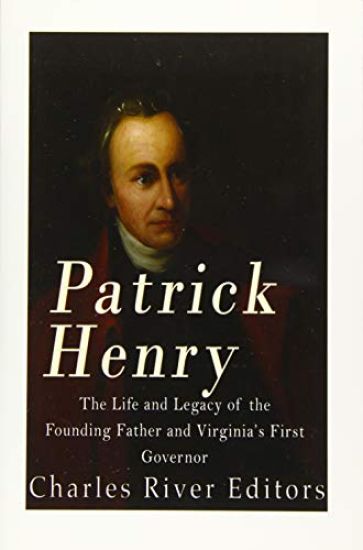
*Includes pictures *Includes Henry's quotes about his life and career *Includes a bibliography for further reading "If this is treason, make the most of it." - Patrick Henry The American Revolution is replete with seminal moments that every American learns in school, from the "shot heard 'round the world" to the Declaration of Independence, but the events that led up to the fighting at Lexington & Concord were borne out of 10 years of division between the British and their American colonies over everything from colonial representation in governments to taxation, the nature of searches, and the quartering of British regulars in private houses. From 1764-1775, a chain of events that included lightning rods like the Townshend Acts led to bloodshed in the form of the Boston Massacre, while the Boston Tea Party became a symbol of nonviolent protest. Of course, the Revolutionary era also produced some of the most famous Americans in history, and Patrick Henry has the ironic distinction of frequently being overlooked in comparison to his contemporaries while also being remembered for speaking one of the most famous lines in American history despite the fact he may never have actually said it. When Henry famously cried out, "Give me liberty or give me death," he knew a surprising amount about both. He had known the liberty of running across open fields on warm Virginia mornings and of riding at breakneck speed across fields he owned. He had fought for, and won, the liberty of numerous clients he defended in Virginia's colonial courts. He had also taken the liberty of others, though for different reasons. He owned slaves and saw what it cost them to serve him each day, and he had even kept his own young wife in chains to prevent her from harming herself or one of their children. In the midst of the Revolutionary War, he was spared the horror of ordering men to their deaths by instead serving in an executive role during the war. He buried one wife and married another, and he lived to see 17 children born to the freedom he so cherished. Over time, he also helped shape this hard won freedom, speaking out against a strong federal government that he felt might take away the new nation's liberty. At the same time, he also lived to see the effects of unbridled liberty in France, and he was shaped by what he learned, to the extent that he spoke toward the end of his life for a more centralized government. Henry played crucial roles both during the Revolution and before it, locally and nationally. He was Virginia's first governor, and he was instrumental in convincing Virginian politicians to go to war. And yet, his life and career have mostly been reduced to the famous phrase "Give me liberty, or give me death," even though it's actually unclear whether those most famous of words were actually in the speech. This is because the first transcript of the speech came over a generation after Henry delivered it, in a biography of Henry written by William Wirt. Thus, ironically, historians are divided over whether the phrase Henry's best known for was actually his words or those of his biographer. Moreover, similar variations of that phrase already existed, and it's possible Henry was familiar with them, much the same way Franklin Roosevelt's line about fear had predecessors as far back as Duke Wellington over a century earlier. Either way, the words and the debate over it have overshadowed what was a monumental career in service of his new country, and the fact that Henry was at the forefront of the battles that ultimately shaped its direction. Patrick Henry: The Life and Legacy of the Founding Father and Virginia's First Governor looks at one of colonial Virginia's most important political leaders. Along with pictures of important people, places, and events, you will learn about Patrick Henry like never before.
Chronicles the life of the colonial American practical joker, passionate Virginia lawyer-politician, and patriotic orator whose words and principles helped fire the American Revolution
Myths and Men: Patrick Henry, George Washington, and Thomas Jefferson is a book by Bernard Mayo that explores the lives and legacies of three of America's founding fathers. The book examines the myths that have been created around these figures and the reality of their lives and actions. Mayo delves into the political and personal lives of Patrick Henry, George Washington, and Thomas Jefferson, examining their roles in the American Revolution and the formation of the United States. He explores how their actions and beliefs have been mythologized over time, and how these myths have shaped the way we think about these historical figures today. The book also looks at the flaws and contradictions of these men, including their attitudes towards slavery and their personal lives. Mayo provides a nuanced and complex portrait of these three important figures, challenging readers to reconsider their preconceptions and understand the complexities of history. Overall, Myths and Men: Patrick Henry, George Washington, and Thomas Jefferson is a thought-provoking and insightful exploration of three of America's most important founding fathers. It offers a fresh perspective on their lives and legacies, and encourages readers to think critically about the myths and legends that have grown up around them.This scarce antiquarian book is a facsimile reprint of the old original and may contain some imperfections such as library marks and notations. Because we believe this work is culturally important, we have made it available as part of our commitment for protecting, preserving, and promoting the world's literature in affordable, high quality, modern editions, that are true to their original work.
""Washington Under The Sway Of Romanism: Patrick Henry O'Brien Said So "" is a book written by Angelo Di Domenica. The book discusses the influence of Roman Catholicism in the United States government, particularly in Washington D.C. The author cites the writings of Patrick Henry O'Brien, a former Catholic priest who converted to Protestantism, as evidence of the alleged sway that Roman Catholicism holds over the political landscape of the United States. The book delves into the history of Roman Catholicism in the United States, including its role in immigration and the establishment of Catholic schools and churches. The author argues that the influence of Roman Catholicism in Washington D.C. has led to policies and decisions that are not in the best interest of the American people. The book is controversial and has been criticized for promoting anti-Catholic sentiment.Which Our Old Glory Or The Pope's Crown.This scarce antiquarian book is a facsimile reprint of the old original and may contain some imperfections such as library marks and notations. Because we believe this work is culturally important, we have made it available as part of our commitment for protecting, preserving, and promoting the world's literature in affordable, high quality, modern editions, that are true to their original work.