Kirjojen hintavertailu. Mukana 11 699 587 kirjaa ja 12 kauppaa.

Kirjahaku

Etsi kirjoja tekijän nimen, kirjan nimen tai ISBN:n perusteella.

1000 tulosta hakusanalla Pedro M. García

Analysis and Algebra on Differentiable Manifolds

Analysis and Algebra on Differentiable Manifolds

Pedro M. Gadea; Jaime Muñoz Masqué; Ihor V. Mykytyuk

Springer
2015
nidottu
This is the second edition of this best selling problem book for students, now containing over 400 completely solved exercises on differentiable manifolds, Lie theory, fibre bundles and Riemannian manifolds.The exercises go from elementary computations to rather sophisticated tools. Many of the definitions and theorems used throughout are explained in the first section of each chapter where they appear.A 56-page collection of formulae is included which can be useful as an aide-mémoire, even for teachers and researchers on those topics.In this 2nd edition:• 76 new problems • a section devoted to a generalization of Gauss’ Lemma• a short novel section dealing with some properties of the energy of Hopf vector fields• an expanded collection of formulae and tables• an extended bibliographyAudienceThis book will be useful to advanced undergraduate and graduate students of mathematics, theoretical physics and some branches of engineering with a rudimentary knowledge of linear and multilinear algebra.

Characterization of Partially Polarized Light Fields

Characterization of Partially Polarized Light Fields

Rosario Martínez-Herrero; Pedro M. Mejías; Gemma Piquero

Springer-Verlag Berlin and Heidelberg GmbH Co. K
2009
sidottu
Polarization involves the vectorial nature of light fields. In current applications of optical science, the electromagnetic description of light with its vector features has been shown to be essential: In practice, optical radiation also exhibits randomness and spatial non-uniformity of the polarization state. Moreover, propagation through photonic devices can alter the correlation properties of the light field, resulting in changes in polarization. All these vectorial properties have been gaining importance in recent years, and they are attracting increasing attention in the literature. This is the framework and the scope of the present book, which includes the authors’ own contributions to these issues.
Characterization of Partially Polarized Light Fields

Characterization of Partially Polarized Light Fields

Rosario Martínez-Herrero; Pedro M. Mejías; Gemma Piquero

Springer-Verlag Berlin and Heidelberg GmbH Co. K
2012
nidottu
Polarization involves the vectorial nature of light fields. In current applications of optical science, the electromagnetic description of light with its vector features has been shown to be essential: In practice, optical radiation also exhibits randomness and spatial non-uniformity of the polarization state. Moreover, propagation through photonic devices can alter the correlation properties of the light field, resulting in changes in polarization. All these vectorial properties have been gaining importance in recent years, and they are attracting increasing attention in the literature. This is the framework and the scope of the present book, which includes the authors’ own contributions to these issues.
Biofortificação agronômica da soja com selênio

Biofortificação agronômica da soja com selênio

Roberto Antonio Savelli Martinez; Pedro M de Resende

Novas Edicoes Academicas
2019
pokkari
A essencialidade do elemento sel nio para os seres humanos um tema muito discutido na atualidade. Diversas pesquisas na rea de nutri o determinam essa essencialidade. O sel nio possui propriedades antioxidantes, anticancer genas e metab licas, o que o faz um candidato perfeito para ser inclu do na dieta regular das pessoas. Mais de 3 bilh es de pessoas no planeta sofrem de subnutri o ou mal nutri o e a biofortifica o atrav s do enriquecimento de partes consum veis de plantas de forma gen tica e agron mica vem amenizar os efeitos dessas car ncias. Quando se fala na biofortifica o agron mica com sel nio de diversas culturas, s o levadas em considera o as duas principais fontes desse elemento como s o o selenato e o selenito de s dio. Essas fontes possuem propriedades diferenciadas nos processos de biofortifica o da cultura da soja e aqui neste livro essas propriedades ser o discutidas atrav s de tr s experimentos. A biofortifica o agron mica da soja poder auxiliar na melhora da qualidade nutricional dessa cultura melhorando a qualidade da dieta tanto de seres humanos quanto de animais.
Visual Statistics

Visual Statistics

Forrest W. Young; Pedro M. Valero-Mora; Michael Friendly

John Wiley Sons Inc
2006
sidottu
A visually intuitive approach to statistical data analysis Visual Statistics brings the most complex and advanced statistical methods within reach of those with little statistical training by using animated graphics of the data. Using ViSta: The Visual Statistics System-developed by Forrest Young and Pedro Valero-Mora and available free of charge on the Internet-students can easily create fully interactive visualizations from relevant mathematical statistics, promoting perceptual and cognitive understanding of the data's story. An emphasis is placed on a paradigm for understanding data that is visual, intuitive, geometric, and active, rather than one that relies on convoluted logic, heavy mathematics, systems of algebraic equations, or passive acceptance of results. A companion Web site complements the book by further demonstrating the concept of creating interactive and dynamic graphics. The book provides users with the opportunity to view the graphics in a dynamic way by illustrating how to analyze statistical data and explore the concepts of visual statistics. Visual Statistics addresses and features the following topics: * Why use dynamic graphics? * A history of statistical graphics * Visual statistics and the graphical user interface * Visual statistics and the scientific method * Character-based statistical interface objects * Graphics-based statistical interfaces * Visualization for exploring univariate data This is an excellent textbook for undergraduate courses in data analysis and regression, for students majoring or minoring in statistics, mathematics, science, engineering, and computer science, as well as for graduate-level courses in mathematics. The book is also ideal as a reference/self-study guide for engineers, scientists, and mathematicians. With contributions by highly regarded professionals in the field, Visual Statistics not only improves a student's understanding of statistics, but also builds confidence to overcome problems that may have previously been intimidating.
Topology Control in Wireless Sensor Networks

Topology Control in Wireless Sensor Networks

Miguel A. Labrador; Pedro M. Wightman

Springer-Verlag New York Inc.
2009
sidottu
The eld of wireless sensor networks continues to evolve and grow in both practical and research domains. More and more wireless sensor networks are being used to gather information in real life applications. It is common to see how this technology is being applied in irrigation systems, intelligent buildings, bridges, security mec- nisms,militaryoperations,transportation-relatedapplications,etc.Atthesametime, new developments in hardware, software, and communication technologies are - panding these possibilities. As in any other technology, research brings new dev- opments and re nements and continuous improvements of current approaches that push the technology even further. Looking toward the future, the technology seems even more promising in two directions. First, a few years from now more powerful wireless sensor devices will be available, and wireless sensor networks will have applicability in an endless number of scenarios, as they will be able to handle traf c loads not possible today, make more computations, store more data, and live longer because of better energy sources. Second,a few years from now, the opposite scenario might also be possible. The availability of very constrained, nanotechnology-made wireless sensor devices will bring a whole new world of applications, as they will be able to operate in - vironments and places unimaginable today. These two scenarios, at the same time, will both bring new research challenges that are always welcome to researchers.
Topology Control in Wireless Sensor Networks

Topology Control in Wireless Sensor Networks

Miguel A. Labrador; Pedro M. Wightman

Springer
2010
nidottu
The eld of wireless sensor networks continues to evolve and grow in both practical and research domains. More and more wireless sensor networks are being used to gather information in real life applications. It is common to see how this technology is being applied in irrigation systems, intelligent buildings, bridges, security mec- nisms,militaryoperations,transportation-relatedapplications,etc.Atthesametime, new developments in hardware, software, and communication technologies are - panding these possibilities. As in any other technology, research brings new dev- opments and re nements and continuous improvements of current approaches that push the technology even further. Looking toward the future, the technology seems even more promising in two directions. First, a few years from now more powerful wireless sensor devices will be available, and wireless sensor networks will have applicability in an endless number of scenarios, as they will be able to handle traf c loads not possible today, make more computations, store more data, and live longer because of better energy sources. Second,a few years from now, the opposite scenario might also be possible. The availability of very constrained, nanotechnology-made wireless sensor devices will bring a whole new world of applications, as they will be able to operate in - vironments and places unimaginable today. These two scenarios, at the same time, will both bring new research challenges that are always welcome to researchers.
Location-Based Information Systems

Location-Based Information Systems

Miguel A. Labrador; Alfredo J. Pérez; Pedro M. Wightman

CRC Press
2019
nidottu
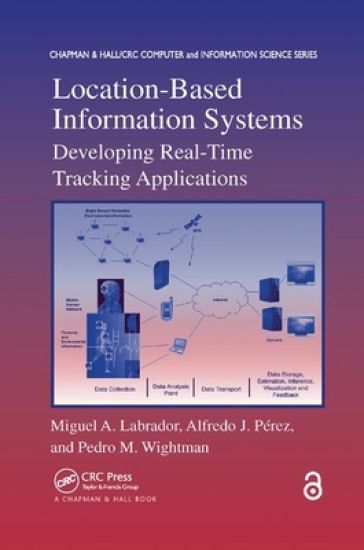
Drawing on the authors’ more than six years of R&D in location-based information systems (LBIS) as well as their participation in defining the Java ME Location API 2.0, Location-Based Information Systems: Developing Real-Time Tracking Applications provides information and examples for creating real-time LBIS based on GPS-enabled cellular phones. Each chapter presents a general real-time tracking system example that can be easily adapted to target any application domain and that can incorporate other sensor data to make the system "participatory sensing" or "human-centric sensing."The book covers all of the components needed to develop an LBIS. It discusses cellular phone programming using the Java ME platform, positioning technologies, databases and spatial databases, communications, client- and server-side data processing, and real-time data visualization via Google Maps and Google Earth. Using freely available software, the authors include many code examples and detailed instructions for building your own system and setting up your entire development environment. Web ResourceA companion website at www.csee.usf.edu/~labrador/LBIS provides additional information and supporting material. It contains all of the software packages and applications used in the text as well as PowerPoint slides and laboratory examples.Although LBIS applications are still in the beginning stages, they have the potential to transform our daily lives, from warning us about possible health problems to monitoring pollution levels around us. Exploring this novel technology, Location-Based Information Systems describes the technical components needed to create location-based services with an emphasis on nonproprietary, freely available solutions that work across different technologies and platforms.
Location-Based Information Systems

Location-Based Information Systems

Miguel A. Labrador; Alfredo J. Perez; Pedro M. Wightman

Taylor Francis Inc
2010
sidottu
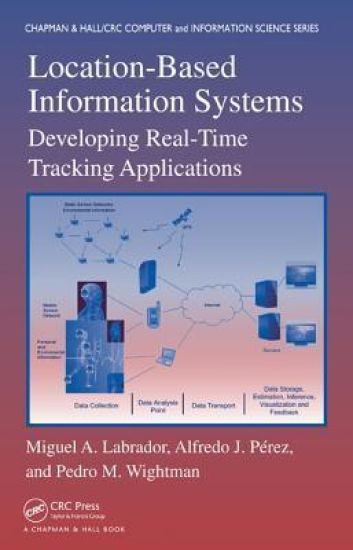
Drawing on the authors’ more than six years of R&D in location-based information systems (LBIS) as well as their participation in defining the Java ME Location API 2.0, Location-Based Information Systems: Developing Real-Time Tracking Applications provides information and examples for creating real-time LBIS based on GPS-enabled cellular phones. Each chapter presents a general real-time tracking system example that can be easily adapted to target any application domain and that can incorporate other sensor data to make the system "participatory sensing" or "human-centric sensing."The book covers all of the components needed to develop an LBIS. It discusses cellular phone programming using the Java ME platform, positioning technologies, databases and spatial databases, communications, client- and server-side data processing, and real-time data visualization via Google Maps and Google Earth. Using freely available software, the authors include many code examples and detailed instructions for building your own system and setting up your entire development environment. Web ResourceA companion website at www.csee.usf.edu/~labrador/LBIS provides additional information and supporting material. It contains all of the software packages and applications used in the text as well as PowerPoint slides and laboratory examples.Although LBIS applications are still in the beginning stages, they have the potential to transform our daily lives, from warning us about possible health problems to monitoring pollution levels around us. Exploring this novel technology, Location-Based Information Systems describes the technical components needed to create location-based services with an emphasis on nonproprietary, freely available solutions that work across different technologies and platforms.
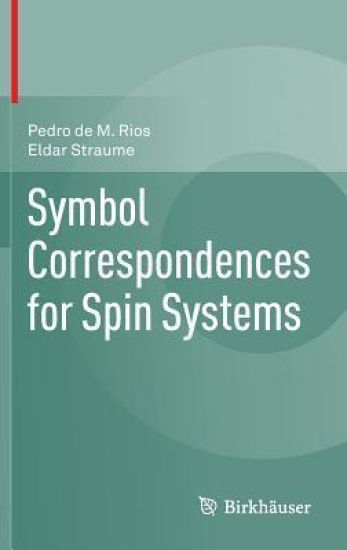
Symbol Correspondences for Spin Systems

Symbol Correspondences for Spin Systems

Pedro de M. Rios

Birkhauser Verlag AG
2014
sidottu
In mathematical physics, the correspondence between quantum and classical mechanics is a central topic, which this book explores in more detail in the particular context of spin systems, that is, SU(2)-symmetric mechanical systems. A detailed presentation of quantum spin-j systems, with emphasis on the SO(3)-invariant decomposition of their operator algebras, is first followed by an introduction to the Poisson algebra of the classical spin system and then by a similarly detailed examination of its SO(3)-invariant decomposition. The book next proceeds with a detailed and systematic study of general quantum-classical symbol correspondences for spin-j systems and their induced twisted products of functions on the 2-sphere. This original systematic presentation culminates with the study of twisted products in the asymptotic limit of high spin numbers. In the context of spin systems it shows how classical mechanics may or may not emerge as an asymptotic limit of quantum mechanics. The book will be a valuable guide for researchers in this field and its self-contained approach also makes it a helpful resource for graduate students in mathematics and physics.
Symbol Correspondences for Spin Systems

Symbol Correspondences for Spin Systems

Rios Pedro de M.; Straume Eldar

Birkhauser Verlag AG
2016
nidottu
In mathematical physics, the correspondence between quantum and classical mechanics is a central topic, which this book explores in more detail in the particular context of spin systems, that is, SU(2)-symmetric mechanical systems. A detailed presentation of quantum spin-j systems, with emphasis on the SO(3)-invariant decomposition of their operator algebras, is first followed by an introduction to the Poisson algebra of the classical spin system and then by a similarly detailed examination of its SO(3)-invariant decomposition. The book next proceeds with a detailed and systematic study of general quantum-classical symbol correspondences for spin-j systems and their induced twisted products of functions on the 2-sphere. This original systematic presentation culminates with the study of twisted products in the asymptotic limit of high spin numbers. In the context of spin systems it shows how classical mechanics may or may not emerge as an asymptotic limit of quantum mechanics. The book will be a valuable guide for researchers in this field and its self-contained approach also makes it a helpful resource for graduate students in mathematics and physics.
Iron Horse

Iron Horse

M San Pedro

St. Vitus Dance
2021
sidottu
A small investment, a large return. Iron Horse is a book for anyone in pain, confused, lacking direction and regretting mistakes they've made in life. This book is meant to serve you in your time of need: when your mind is getting the best of you, when you are on a roller coaster of emotions, or in those days when adversity rallies against you. It is is meant to condition your mind and strengthen your spirit. It is designed to give you the mental endurance of a thoroughbred, so you can go the distance against all of life's harsh realities. Iron Horse is also a journal. The bottom portion of each page is for you to reflect on what you have read. One page per day. Meditating on these short, pithy maxims and how they align with your situation.