Kirjojen hintavertailu. Mukana 11 627 488 kirjaa ja 12 kauppaa.

Kirjahaku

Etsi kirjoja tekijän nimen, kirjan nimen tai ISBN:n perusteella.

1000 tulosta hakusanalla Philippe Sabourdy

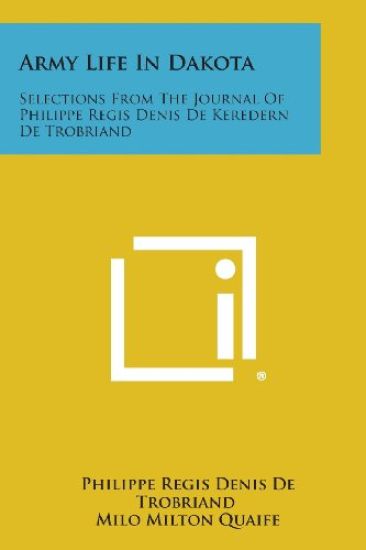
Army Life in Dakota: Selections from the Journal of Philippe Regis Denis de Keredern de Trobriand
Army Life in Dakota is a book that features selections from the journal of Philippe Regis Denis De Keredern De Trobriand. The book offers a unique perspective on life in the US Army during the late 19th century, specifically in the Dakota Territory. De Trobriand was a French-born officer who served in the Union Army during the Civil War and later in the frontier West. His journal entries provide a vivid account of his experiences as an officer in the US Army, including his interactions with Native American tribes, the challenges of frontier life, and the daily routines of military service. The book also includes historical context and commentary from the editor, providing readers with a deeper understanding of the time period and the events that shaped it. Overall, Army Life in Dakota is a fascinating glimpse into the life of a soldier on the American frontier.This is a new release of the original 1941 edition.This scarce antiquarian book is a facsimile reprint of the old original and may contain some imperfections such as library marks and notations. Because we believe this work is culturally important, we have made it available as part of our commitment for protecting, preserving, and promoting the world's literature in affordable, high quality, modern editions, that are true to their original work.
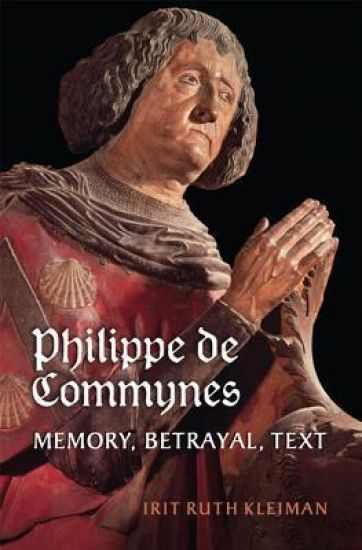
Philippe De Commynes

Philippe De Commynes

Irit Ruth Kleiman

University of Toronto Press
2013
sidottu
Philippe de Commynes, a diplomat who specialized in clandestine operations, served King Louis XI during his campaign to undermine aristocratic resistance and consolidate the sovereignty of the French throne. He is credited with inventing the political memoir, but his reminiscence has also been described as ‘the confessions of a traitor’: Commynes had abandoned Louis’ rival, the Burgundian duke Charles the Bold, before joining forces with the king. This study provides a literary re-evaluation of Commynes’ text – a perennial subject of scandal and fascination – while questioning what the terms ‘traitor’ or ‘betrayed’ meant in the context of fifteenth-century France. Drawing on diplomatic letters and court transcripts, Irit Kleiman examines the mutual connections between writing and betrayal in Commynes’ representation of Louis’ reign, the relationship between the author and the king, and the emergence of the memoir as an autobiographical genre. This study significantly deepens our understanding of how historical narrative and diplomatic activities are intertwined in the work of this iconic, iconoclastic figure.
Philippe Aries and the Politics of French Cultural History

Philippe Aries and the Politics of French Cultural History

Patrick H. Hutton

University of Massachusetts Press
2004
nidottu
A revealing study of one of the twentieth century's most original and influential historians; The author of Centuries of Childhood and other landmark historical works, Philippe Aries (1914-1984) was a singular figure in French intellectual life. He was both a political reactionary and a path-breaking scholar, a sectarian royalist who supported the Vichy regime and a founder of the new cultural history - popularly known as l'histoire des mentalites - that developed in the decades following World War II. In this book, Patrick H. Hutton explores the relationship between Aries's life and thought and evaluates his contribution to modern historiography, in France and abroad. According to Hutton, the originality of Aries's work and the power of his appeal derived from the way he drew together the two strands of his own intellectual life: his enduring ties to the old cultural order valued by the right-wing Action Francaise, and a newfound appreciation for the methodology of the leftist Annales school of historians. A demographer by training, he pioneered a new route into the history of private life that eventually won him a wide readership and in late life an appointment to the faculty of the prestigious Ecole des Hautes Etudes en Sciences Sociales. At the same time, he fashioned himself as a man of letters in the intellectual tradition of the Action francaise and became a perspicacious journalist as well as a stimulating writer of autobiographical memoirs. In Hutton's view, this helps explain why, more than any other historian, Philippe Aries left his personal signature on his scholarship.
Philippe Grandrieux

Philippe Grandrieux

Greg Hainge

Bloomsbury Academic USA
2017
nidottu
Philippe Grandrieux is one of cinema’s only living true radicals and feted as one of the most innovative and important film makers of his generation. His consistently controversial work remains, however, relatively unknown outside of the international art film festival circuit. In this volume, the first book-length study of the work of Grandrieux in any language, Greg Hainge provides an overview and critical analysis of Grandrieux’s entire career during which he has produced works for television, video installations, photography, performance pieces, documentary films, short films and prize-winning feature films. As well as providing an overview, the book argues that a critical appraisal of his work necessarily leads us to problematize many of the critical orthodoxies that have been formed in recent times, to reject the concept of a haptic cinema and to supplant this instead with the idea of a sonic cinema.
Philippe Grandrieux

Philippe Grandrieux

Greg Hainge

Bloomsbury Academic USA
2017
sidottu
Philippe Grandrieux is one of cinema’s only living true radicals and feted as one of the most innovative and important film makers of his generation. His consistently controversial work remains, however, relatively unknown outside of the international art film festival circuit. In this volume, the first book-length study of the work of Grandrieux in any language, Greg Hainge provides an overview and critical analysis of Grandrieux’s entire career during which he has produced works for television, video installations, photography, performance pieces, documentary films, short films and prize-winning feature films. As well as providing an overview, the book argues that a critical appraisal of his work necessarily leads us to problematize many of the critical orthodoxies that have been formed in recent times, to reject the concept of a haptic cinema and to supplant this instead with the idea of a sonic cinema.