Pieper collects his contributions to radio programs and to a number of journals and periodicals. The book also includes a selection of notes and comments. The contributions fall into two main groups: the period which encompasses the immediate pre-war period as well as the war period itself, and the post-war period up to 1953.The reader becomes witness, first, to Pieper’s problems with the National Socialist regime and, second, to his problems with the ensuing challenges to religious life as it is exposed to increasing secularization.As with his later works, Pieper draws on traditional wisdom which, for him, dates back to Plato and Aristotle, and in these contributions we also see his early preoccupation with the wisdom of St. Thomas Aquinas. The normal boundaries between philosophy and theology are here not clearly drawn. Pieper is preoccupied with the mystery of our world and its importance as a source of symbols signifying deeper levels of reality. He sees the sacraments as achieving their fundamental effect from divine intervention, but he also highlights the need for careful observance of the rituals, so that their meaning is not obscured. Proper execution of the sacrament should enable the faithful to enjoy the existential fruits of their participation in the ritual. This work manifests the organic cohesion of Pieper’s thinking, and it reflects his profound awareness of the role to be played not so much by the professional (academic) philosopher as by the existential Philosophizer.
Pieper collects his contributions to radio programs and to a number of journals and periodicals. The book also includes a selection of notes and comments. The contributions fall into two main groups: the period which encompasses the immediate pre-war period as well as the war period itself, and the post-war period up to 1953.The reader becomes witness, first, to Pieper’s problems with the National Socialist regime and, second, to his problems with the ensuing challenges to religious life as it is exposed to increasing secularization.As with his later works, Pieper draws on traditional wisdom which, for him, dates back to Plato and Aristotle, and in these contributions we also see his early preoccupation with the wisdom of St. Thomas Aquinas. The normal boundaries between philosophy and theology are here not clearly drawn. Pieper is preoccupied with the mystery of our world and its importance as a source of symbols signifying deeper levels of reality. He sees the sacraments as achieving their fundamental effect from divine intervention, but he also highlights the need for careful observance of the rituals, so that their meaning is not obscured. Proper execution of the sacrament should enable the faithful to enjoy the existential fruits of their participation in the ritual. This work manifests the organic cohesion of Pieper’s thinking, and it reflects his profound awareness of the role to be played not so much by the professional (academic) philosopher as by the existential Philosophizer.
The authors give, in brief and simple form, a summary of the fundamental teachings of the Catholic Church, and of the fruits of the faith contained in the teachings. The first part, The Faith of the Christian, outlines the basic teachings as embodied in the Apostles Creed, followed by chapters on the Seven Sacraments and the Liturgical Year. The second part, entitled The Life of the Christian, is concerned with the fruits of faith, treats Christian virtues. No similar book covers so much ground, in such simple terms, in one brief work. What Catholics Believe was written before the liturgical changes implemented by the Second Vatican Council, but its theology and anthropology remain as relevant today as they did a half-century ago, and its impact is all the more startling for the clear, direct, orthodox approach it takes. This edition adds explanatory notes that cross-reference the text with contemporary rubrics for the benefit of modern readers.
Josef Pieper has attached no commentary to the texts brought together in this breviary of the philosophy of St. Thomas, preferring that the reader should encounter them, "on his own". His work has been one of selection, in which he has sought to assemble such passages as will provide an introduction to the form and design of the whole Thomistic system. Yet he has so ordered his texts as to impress upon the reader a special feature of St. Thomas's thought, what he calls its double aspect: St. Thomas sees the whole scheme of reality ordered and penetrable by reason; yet the mystery of Being itself remains: "The effort of human thought has not been able to track down the essence of a single gnat." Author Josef Pieper himself was one of the most highly regarded Thomistic philosophers of the twentieth century.
In ordinary conversation, including among the 'educated,' the word 'sin' rarely gets mentioned except when one is trying to be coy or facetious. As Thomas Mann once said, 'sin' is nowadays 'an amusing word used only when one is trying to get a laugh.' But this small work will interpret sin in its true - that is, serious - meaning. What will emerge from its analysis is the discovery that the concept of sin can still serve to unlock the mystery of existence, at least for a thinking that wants to press down to the very foundations. In this work Pieper brings Plato, Augustine, and Thomas Aquinas into a living dialogue with T. S. Eliot, Andre Gide, even with Jean-Paul Sartre. As he shows in this powerful work, none of these writers leaves any doubt that the fact of sin is central: It is the willful denial of one's own life-ground, a denial that alone rightly bears the name 'sin.' Paradoxically, this reality is both willed and yet also pre-given, that is, both adventitious and yet somehow innate to our existence - a paradox which, next to the mystey of existence itself, is the most impenetrable mystery of all.
In ordinary conversation, including among the 'educated,' the word 'sin' rarely gets mentioned except when one is trying to be coy or facetious. As Thomas Mann once said, 'sin' is nowadays 'an amusing word used only when one is trying to get a laugh.' But this small work will interpret sin in its true - that is, serious - meaning. What will emerge from its analysis is the discovery that the concept of sin can still serve to unlock the mystery of existence, at least for a thinking that wants to press down to the very foundations. In this work Pieper brings Plato, Augustine, and Thomas Aquinas into a living dialogue with T. S. Eliot, Andre Gide, even with Jean-Paul Sartre. As he shows in this powerful work, none of these writers leaves any doubt that the fact of sin is central: It is the willful denial of one's own life-ground, a denial that alone rightly bears the name 'sin.' Paradoxically, this reality is both willed and yet also pre-given, that is, both adventitious and yet somehow innate to our existence - a paradox which, next to the mystey of existence itself, is the most impenetrable mystery of all.
Brings the actual situation in the dialogue - Athens and its intellectuals engaged in spirited debate - alive. Equally alive is the discussions of ideas, which are brought to bear on contemporary experience and made to prove the perennial validity of Socratic wisdom, and its power to excite the mind. The main thesis - that in poetry and in love man is "beside himself," that is, divinely inspired - is discussed with reference to modern poets, novelists, and modern psychology.
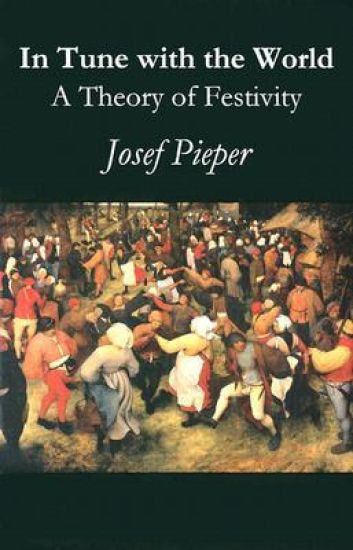
In this stimulating and still-timely study, Josef Pieper takes up a theme of paramount importance to his thinking – that festivals belong by rights among the great topics of philosophical discussion. As he develops his theory of festivity, the modern age comes under close and painful scrutiny. It is obvious that we no longer know what festivity is, namely, the celebration of existence under various symbolsPieper exposes the pseudo-festivals, in their harmless and their sinister forms: traditional feasts contaminated by commercialism; artificial holidays created in the interest of merchandisers; holidays by coercion, decreed by dictators the world over; festivals as military demonstrations; holidays empty of significance. And lastly we are given the apocalyptic vision of a nihilistic world which would seek its release not in festivities but in destruction.Formulated with Pieper's customary clarity and elegance, enhanced by brilliantly chosen quotations, this is an illuminating contribution to the understanding of traditional and contemporary experience.
A single theme runs through the three essays on St. Thomas gather in this book. It is the theme of mystery or, more exactly, the response of the searching human intellect to the fact of mystery. Both the fact and the response are suggested in a short biography of St. Thomas that forms the first essay and are then sketched out in detail by a presentation of the “negative element” in his philosophy. The third essay shows that contemporary Existentialism is in basic agreement with the philosophia perennis on this fundamental element of philosophical thinking.