Kirjojen hintavertailu. Mukana 11 244 527 kirjaa ja 12 kauppaa.

Kirjahaku

Etsi kirjoja tekijän nimen, kirjan nimen tai ISBN:n perusteella.

1000 tulosta hakusanalla Rainer Schulz

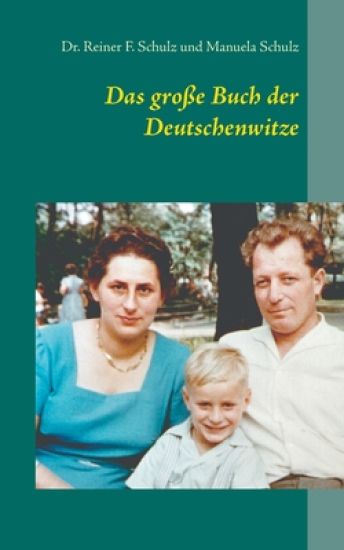
Das große Buch der Deutschenwitze

Das große Buch der Deutschenwitze

Reiner F Schulz; Manuela Schulz

Books on Demand
2020
pokkari
Dieses Werk stellt die erste bedeutende Sammlung von Deutschenwitzen dar. Es wird sich sehr schnell als das Standardwerk zum Deutschenwitz etablieren. Die Autoren verstehen es, sich dem ernsten Thema Humor in analytisch-spielerischer Weise zu n hern. Dabei finden nur klassische, reine Deutschenwitze Aufnahme in diese Anthologie. Leider kursieren in den sogenannten sozialen Medien viele Pseudo-Deutschenwitze, die einen billigen Rassismus transportieren. Dies steht in krassem Gegensatz zur Grundidee des wahren Deutschenwitzes. Durch die Lekt re dieses kleinen Buches erschlie t sich der Leser den feinen Witz dieser weltweit so untersch tzten teutonischen Literaturkleinodien. Das Genre Deutschenwitz wird hier erstmals als solches klar defninert und wird seinen verdienten Platz in der Literaturgeschichte finden.
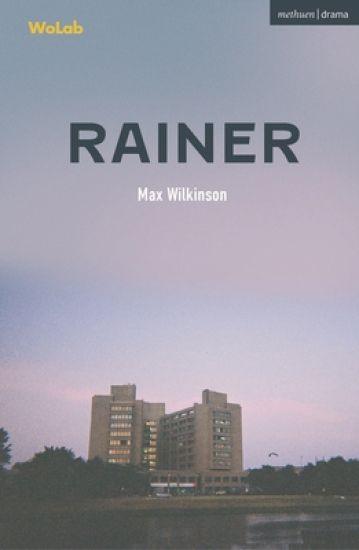
Rainer

Rainer

Max Wilkinson

BLOOMSBURY PUBLISHING PLC
2022
nidottu
Some guys listen to music, some guys like to sing. I like to work people out.Rainer is a solitary delivery rider, moving across London, delivering food to whoever will summon her. From luxury flats to leafy suburbs, she loves to create stories in her head, re-imagining London as one of her favourite sci-fi films or Scorsese’s Taxi Driver. She loves her life. Until reality starts to slip and she begins forgetting stuff – even the city she knows so well. And when her one-time lover Jack disappears, when her mum keeps on calling, she has to ask herself: is everything really okay?A one-woman show partly inspired by Dylan Thomas’s Under Milkwood, Rainer is a celebration of a city and the people within it, seen and unseen. It was a finalist for Samuel French’s Off-Broadway Award, longlisted for Theatre Uncut’s Political Playwriting Award and winner of the Prix Royal competition in Paris. This edition was published to coincide with the production at the Arcola Theatre, London, in June 2022.
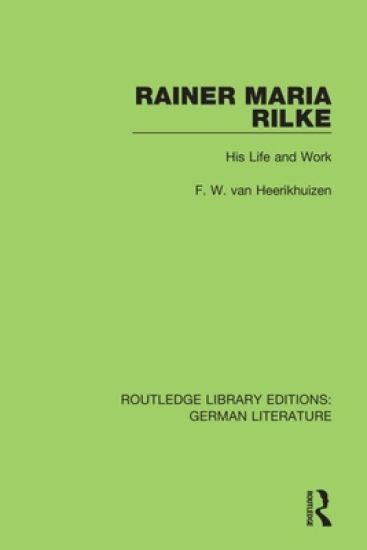
Rainer Maria Rilke

Rainer Maria Rilke

F. W. van Heerikhuizen

Routledge
2020
sidottu
Originally published in English in 1951, this biography of one of Germany’s foremost mystical poets dis-proves many of the myths surrounding Rainer Maria Rilke and examines his life and work from social, historical and psychological perspectives, while all the time referencing Rilke’s works to his complex personality. The legacy of his work on younger generations is also examined. All German prose quotations have been translated into English for this edition, existing translations used for the German poetry.
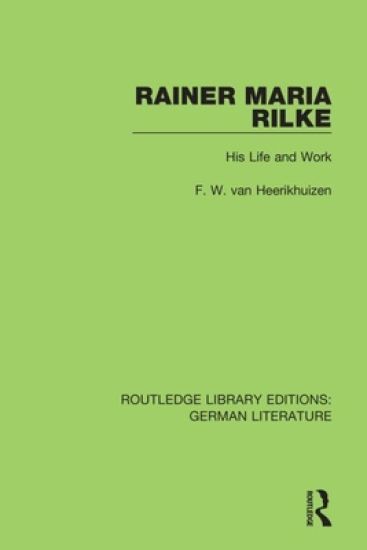
Rainer Maria Rilke

Rainer Maria Rilke

F. W. van Heerikhuizen

TAYLOR FRANCIS LTD
2021
nidottu
Originally published in English in 1951, this biography of one of Germany’s foremost mystical poets dis-proves many of the myths surrounding Rainer Maria Rilke and examines his life and work from social, historical and psychological perspectives, while all the time referencing Rilke’s works to his complex personality. The legacy of his work on younger generations is also examined. All German prose quotations have been translated into English for this edition, existing translations used for the German poetry.
Wartime Letters of Rainer Maria Rilke

Wartime Letters of Rainer Maria Rilke

Rainer Maria Rilke

W. W. Norton Company
1964
pokkari
These letters give the account of Rilke's own state of mind and of his final approach to the threshold of his great works. They show the rapid change he underwent after his reaction to the first excitement of the war; how his dismay at the cruelty and confusion of war helped to render the poet in him speechless for many years; how he nevertheless characteristically held to his own fundamental views throughout war and revolution and in spite of everything retained his belief in the capacity of humanity to create for itself a better future.
Letters of Rainer Maria Rilke, 1892-1910

Letters of Rainer Maria Rilke, 1892-1910

Rainer Maria Rilke

W. W. Norton Company
1969
nidottu
The period here covered reflects all the great experiences of Rilke's early adult life: his difficult beginnings, his relationships with Lou Andreas-Salome and with his wife Clara, his two journeys to Russia, his contact with the Worpswede artists, the influence of Paris, the revelation of Cezanne. Many of the letters are psychologically revealing; many touch upon characteristic themes, or freshly transcribe experience that sooner or later passes into the poetry.
Letters of Rainer Maria Rilke, 1910-1926

Letters of Rainer Maria Rilke, 1910-1926

Rainer Maria Rilke

W. W. Norton Company
1948
nidottu
There are important letters here to Muzot, Lou Andreas-Salome, to Princess Marie of Thurn and Taxis Hohenlohe, and many others. The most significant of the Wartime Letters: 1914-1921 are also included. An Introduction briefly traces the development of Rilke's work during these years; the Notes provide the necessary framework of biographical details and point up significant references to the poetry.
Rainer Werner Fassbinder and the German Theatre

Rainer Werner Fassbinder and the German Theatre

David Barnett

Cambridge University Press
2009
pokkari
Using extensive and untapped archival material as well as a series of in-depth interviews with Fassbinder's main theatre associates, this book offers commentary on and insights into Fassbinder's plays, his dramaturgies and staging practice. David Barnett helps to unlock the much discussed theatricality of Fassbinder's films by showing its many concrete sources. The first study of Fassbinder's work in the theatre, as a playwright and director, this book gives a full contextualisation of his work within the upheavals of its times. Readers are introduced to the cultural history of the West German theatre in the late 1960s and early 1970s. Radicalism in society meets experiment on stage as Fassbinder emerges from the cellar theatre scene of Munich, co-founds the antiteater and is then integrated into the most subsidised theatre in Europe, before being offered his own theatre to run for one fateful season.
Rainer Maria Rilke's 'Gedichte An Die Nacht'

Rainer Maria Rilke's 'Gedichte An Die Nacht'

Anthony Stephens

Cambridge University Press
2010
pokkari
The Gedichte an die Nacht is a collection of 22 poems composed between January 1913 and February 1914, which Rilke copied into a manuscript book for his friend Rudolf Kassner in about 1916. The importance of the poems as a collection lies in the fact that they were written during the period of composition of Rilke's most outstanding work, the Duinese Elegien, and they show the poet at work on ideas and motifs which are central to the elegies. The first part of the book analyses the poems thematically, whilst the second part gives the results of this analysis wider application. During the period Rilke was writing Gedichte an die Nacht, the meaning of 'night' in the Elegies often approaches that of 'angel', whilst at other times it is quite different. Dr Stephens traces the genesis of this ambivalence in other poems, revealing the incomplete and sometimes contradictory nature of his poetic thought.
Rainer Werner Fassbinder and the German Theatre

Rainer Werner Fassbinder and the German Theatre

David Barnett

Cambridge University Press
2005
sidottu
Using extensive and untapped archival material as well as a series of in-depth interviews with Fassbinder's main theatre associates, this book offers commentary on and insights into Fassbinder's plays, his dramaturgies and staging practice. David Barnett helps to unlock the much discussed theatricality of Fassbinder's films by showing its many concrete sources. The first study of Fassbinder's work in the theatre, as a playwright and director, this book gives a full contextualisation of his work within the upheavals of its times. Readers are introduced to the cultural history of the West German theatre in the late 1960s and early 1970s. Radicalism in society meets experiment on stage as Fassbinder emerges from the cellar theatre scene of Munich, co-founds the antiteater and is then integrated into the most subsidised theatre in Europe, before being offered his own theatre to run for one fateful season.