
Kirjahaku
Etsi kirjoja tekijän nimen, kirjan nimen tai ISBN:n perusteella.
1000 tulosta hakusanalla Rice Daniel F.
Among the staple foods most welcomed on southern tables-and on tables around the world-rice is without question the most versatile. As Michael Twitty observes, depending on regional tastes, rice may be enjoyed at breakfast, lunch, and dinner; as main dish, side dish, and snack; in dishes savory and sweet. Filling and delicious, rice comes in numerous botanical varieties and offers a vast range of scents, tastes, and textures depending on how it is cooked. In some dishes, it is crunchingly crispy; in others, soothingly smooth; in still others, somewhere right in between. Commingled or paired with other foods, rice is indispensable to the foodways of the South. As Twitty's fifty-one recipes deliciously demonstrate, rice stars in Creole, Acadian, soul food, Low Country, and Gulf Coast kitchens, as well as in the kitchens of cooks from around the world who are now at home in the South. Exploring rice's culinary history and African diasporic identity, Twitty shows how to make the southern classics as well as international dishes-everything from Savannah Rice Waffles to Ghananian Crab Stew. As Twitty gratefully sums up, "Rice connects me to every other person, southern and global, who is nourished by rice's traditions and customs.
Among the staple foods most welcomed on southern tables—and on tables around the world—rice is without question the most versatile. As Michael W. Twitty observes, depending on regional tastes, rice may be enjoyed at breakfast, lunch, and dinner; as main dish, side dish, and snack; in dishes savory and sweet. Filling and delicious, rice comes in numerous botanical varieties and offers a vast range of scents, tastes, and textures depending on how it is cooked. In some dishes, it is crunchingly crispy; in others, soothingly smooth; in still others, somewhere right in between. Commingled or paired with other foods, rice is indispensable to the foodways of the South. As Twitty's fifty-one recipes deliciously demonstrate, rice stars in Creole, Acadian, soul food, Low Country, and Gulf Coast kitchens, as well as in the kitchens of cooks from around the world who are now at home in the South. Exploring rice's culinary history and African diasporic identity, Twitty shows how to make the southern classics as well as international dishes—everything from Savannah Rice Waffles to Ghanaian Crab Stew. As Twitty gratefully sums up, "Rice connects me to every other person, southern and global, who is nourished by rice's traditions and customs.

Rice is one of the principal cereals used by the world's inhabitants. The hope for improved nourishment of the world's population depends on the development of better rice varieties and improved methods for rice production and utilization. During the past four decades, interest in rice research and production has increased in many countries. The development of new and better varieties by the International Rice Research Institute in the Philippines and other rice research institutes has stimulated numerous research stations to test the performance of these varieties in many countries under different climates, soil properties, cultural practices, and environmental conditions. The methods of harvesting, handling, drying, and milling rough rice have improved as a result of research efforts by the engineers and the rice milling industries. The first edition of Rice: Production and Utilization was published in 1980. This second edition presents the recent developments and progress made by the researchers, the industries, and various experiment stations. Because of the large amounts of literature available in recent years on rice production and utilization, this edition is divided into two volumes, Volume 1: Production and Volume II: Utilization. It is hoped that the books will be useful to rice researchers, processors, and people interested in rice production and utilization. Those studying v vi PREFACE the agronomy of rice plants, especially the genetics, breeding, cultivation, diseases, and insects that attack both the rice plant and the stored grain, will find this edition helpful in their search for new knowledge.
Rice
Science Publishers,U.S.
2010
sidottu
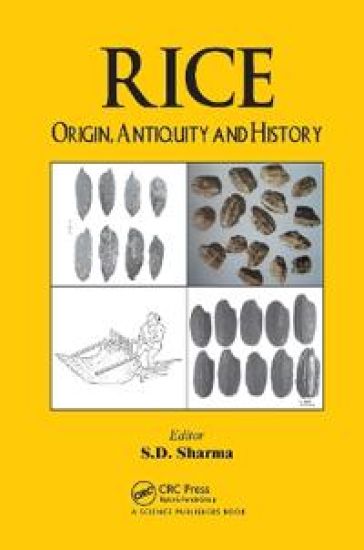
During the last nine millennia or so, man has improved the rice plant, increased its productivity and has found various uses of its parts. The story of rice differs from region to region and has been different in different periods of time. There was a time when tax was collected in the form of rice in Japan, the Southeast Asian kingdoms created hydraulic feats for its cultivation and Ottoman armies advanced with rice as their ration. In recent years, there have been riots due to scarcity of rice and also international efforts to produce enough rice to avoid hunger. The book provides an interesting reading of all such events in the course of its 9000 years long history.
Rice
Nova Science Publishers Inc
2012
sidottu

Rice
Delve Publishing
2016
sidottu
Rice is a cereal grain and represents the most consumed staple food for the major part of the human population, especially in Asia. Rice production has been improved, especially through genetic studies. In this book, the latest papers about rice germplasm, genetic and improvement are presented. The state-of-the-art of genomic studies on rice cultivars is also reported.
Rice
MURDOCH BOOKS
2026
sidottu

From sushi to risotto and from rice pudding to pilau, few foods are as ubiquitous as rice. A dietary staple and indispensable agricultural product from Asia to the Americas, rice can be found in Michelin-starred restaurants and family kitchens alike. Rice has played a significant role in society and the food economy as it journeyed from Asia and West Africa to global prominence.Trade in rice was powered both by profits from high-status export rice and by the use of lower-quality rice in feeding countless labourers. It came to be used in kitchens around the world because the culinary traditions of slaves and indentured labourers were taken up by the cuisines of their host countries. The rise of rice continues today as newer immigrant communities arrive. The pressures of urbanization, and increases in marketing and advertising, have also contributed to the rise of a processed rice industry that is continuing to expand. The result is that the kind of rice one eats is a clue to the cultural and ethnic groups one belongs to, and rice in its many forms has been celebrated in cultural rituals, literature, music, painting and poetry. Chock full of delicious recipes from across the globe, Rice is a fascinating look at how this culinary staple has defined us.Renee Marton interviewed by Leonard Lopate on WNYC Radio.
The present research book "Rice: yield and its components role in high yielding variety development" based on research finding for rice yield, yield components, quality traits, existence of genetic divergence, association among different characters, combining ability variance and their effects, gene action involved in the inheritance of characters, heritability and genetic advance and estimate heterosis over better-parent and standard variety. Rice, one of the important cereal crops of India, is cultivated as pure culture mainly in Kharif. The crop is cultivated in large area but is characterized by very low productivity due to lack of high yielding varieties adapted to different seasons and agronomic conditions at different parts of country. Yield is a complex end product of a number of components most of which are under polygenic control. All changes in yield must be accompanied by changes in one or more of the components. The ultimate goal of any plant breeding programme is to develop improved genotypes better than the existing ones. This requires genetic amelioration through maximum utilization of allelic resources to develop ideal genotype.

Rice: - Its cultivation, production, and distribution in the United States and foreign countries - Vol. 6 is an unchanged, high-quality reprint of the original edition of 1893. Hansebooks is editor of the literature on different topic areas such as research and science, travel and expeditions, cooking and nutrition, medicine, and other genres. As a publisher we focus on the preservation of historical literature. Many works of historical writers and scientists are available today as antiques only. Hansebooks newly publishes these books and contributes to the preservation of literature which has become rare and historical knowledge for the future.
Rice is the most important cereal crop which feeds more than half the population of the world. It is being grown in more than 144. 641 million ha with a production of over 468. 275 million tons (in 1988). Rice is attacked by a large number of pests and diseases which cause an enormous loss in its yield. Therefore, the major objectives in rice breeding are the development of disease resistance, tolerance to insects, adverse soil water, and drought; and improvement of quality including increased protein content. Tremendous efforts being made at the International Rice Research Institute have resulted in the release of improved varieties. It is estimated that the world's annual rice production must increase from 460 million tons (in 1987) to 560 million tons by the year 2000, and to 760 million tons by 2020 (a 65% increase) in order to keep up with the population growth (IRRI Rice Facts 1988). To achieve this gigantic goal, new strategies have to be evolved. Since the success of any crop improvement program de pends on the extent of genetic variability in the base population, new techniques need to be developed not only to generate the much needed variability but also for its conservation. In this regard the progress made in the biotechnology of rice during the last 5 years has amply demonstrated the immense value of innovative approaches for further improvement of this crop.


Rice
In Tech
2014
sidottu
Rice is a staple food for half of the worlds population mostly in Asia. Productivity of rice has largely been improved since the Green Revolution in 1960s. Further improvement of rice yield is necessary to keep pace with population growth, which is a challenging task for breeders. This book, Rice - Germplasm, Genetics and Improvement, as its name implies, comprehensively reviews current knowledge in germplasm exploration, genetic basis of complex traits, and molecular breeding strategies in rice. In the germplasm part, we highlight the application of wild rice in rice breeding. In the genetics part, most of the complex traits related with yield, disease, quality have been covered. In the improvement part, Chinese experiences in hybrid rice breeding have been summarized together with many molecular breeding practices scattering in different chapters.
Rice
IntechOpen
2017
sidottu
Rice is life, for most people living in Asia. Rice has shaped the cultures, diets, and economies of thousands of millions of people. Growing, selling, and eating rice are integral to the culture of many countries. Products of the rice plant are used for a number of different purposes, such as fuel, thatching, industrial starch, and artwork. Rice is the staple food of more than half of the world's population - more than 3.5 billion people depend on rice for more than 20% of their daily calories. Asia accounts for 90% of global rice consumption, exceeding 100 kg per capita annually in many countries. Keeping in view the importance of rice, the United Nations declared 2004 as the International Year of Rice. Food security, which is the condition of having enough food to provide adequate nutrition for a healthy life, is a critical issue. Sustainable rice production is important for food self-sufficiency and food security in changing climates. Sustainable rice production practices are those which (1) increase rice productivity and its quality, (2) improve soil fertility and health, (3) increase water use efficiency and conservation, and (4) increase diversification of rice fields, growers' income, and climate resilience.

William Seltzer Rice (1873-1963) found endless inspiration in nature, creating a vast number of watercolours, drawings, photographs, etchings, and block prints. He arrived in Northern California in 1900, the early days of the region`s Arts and Crafts movement. Rice taught in several schools, including the California College of Arts and Crafts in Oakland, a center for the movement. As a medium, block printing suited the Arts and Crafts ethos of making artwork available to a wide audience at modest cost. Being a skilled craftsman as well as an artist, Rice designed, carved, and printed the blocks all himself. Today his masterful artwork can be found in public and private collections worldwide.

Have you ever eaten rice? Do you eat it every day? Do you know where it comes from? What we eat are grains of rice, called "Gu" in China. The husks of the grains are polished off, and the polished grains are called "Mi." Once those grains are cooked, they're called "Fan." A farmer has to raise all of the rice that we eat. Readers visit a farm and learn more about a hard-working rice farmer's life.