

Kirjahaku
Etsi kirjoja tekijän nimen, kirjan nimen tai ISBN:n perusteella.
1000 tulosta hakusanalla Richard V. Simpson

Whenever a volcano threatens to erupt, scientists and adventurers from around the world flock to the site in response to the irresistible allure of one of nature's most dangerous and unpredictable phenomena. In a unique book probing the science and mystery of these fiery features, the authors chronicle not only their geologic behavior but also their profound effect on human life. From Mount Vesuvius to Mount St. Helens, the book covers the surprisingly large variety of volcanoes, the subtle to conspicuous signs preceding their eruptions, and their far-reaching atmospheric consequences. Here scientific facts take on a very human dimension, as the authors draw upon actual encounters with volcanoes, often through firsthand accounts of those who have witnessed eruptions and miraculously survived the aftermath. The book begins with a description of the lethal May 1980 eruption of Mount St. Helens--complete with an explanation of how safety officials and scientists tried to predict events, and how unsuspecting campers and loggers miles away struggled against terrifying blasts of ash, stone, and heat. The story moves quickly to the ways volcanoes have enhanced our lives, creating mineral-rich land, clean thermal energy, and haunting landscapes that in turn benefit agriculture, recreation, mining, and commerce. Religion and psychology embroider the account, as the authors explore the impact of volcanoes on the human psyche through tales of the capricious volcano gods and attempts to appease them, ranging from simple homage to horrific ritual sacrifice. Volcanoes concludes by assisting readers in experiencing these geological phenomena for themselves. An unprecedented "tourist guide to volcanoes" outlines over forty sites throughout the world. Not only will travelers find information on where to go and how to get there, they will also learn what precautions to take at each volcano. Tourists, amateur naturalists, and armchair travelers alike will find their scientific curiosity whetted by this informative and entertaining book.

Volcanologists venture to treacherous volcanoes the world over in the pursuit of their science. They work around craters of boiling magma and amidst smoke, flames, scorched rocks, and clouds of noxious gases--balancing personal risk against advancing knowledge about one of nature's most dangerous and unpredictable forces. Richard Fisher, a world-renowned volcanologist, has had more than forty years of experience in the field. In this book, he blends autobiography with clear, accessible science to introduce readers to the basics of volcanology and to the wonders of volcanoes that he has studied and learned to both fear and admire. In the course of the book, we follow Fisher as he descends into the steaming crater of the Soufri re Volcano on the island of St. Vincent, as he conducts research on lava flows on the desolate south shore of the Island of Hawaii, and as he struggles to understand the explosion at Mount St. Helens. We learn about his pioneering work on pyroclastic flows and surges--the hurricanes of gases, molten lava, and volcanic debris that cause most of the death and destruction when volcanoes explode. He tells of solving a historic scientific problem at Mount Pelee, Martinique, where 29,000 people were killed in a pyroclastic flow in 1902. Fisher also offers a volcanologist's view of the explosion of Mount Vesuvius that devastated Pompeii and Herculaneum. He writes about the cultural rewards and challenges of conducting research in isolated areas of such countries as Argentina, Mexico, and China. And he discusses the early influences that steered him toward volcanology--including his army experiences as a witness to two atom-bomb explosions at Bikini atoll. Out of the Crater is written in an inviting, nontechnical style. With its deft combination of personal stories and scientific information, it is an inspiring account of a remarkable life and a compelling examination of some of the most spectacular forces shaping the face of the Earth.

Most books on the War of 1812 focus on the burning of Washington, DC, the Battles of Baltimore and New Orleans, and the war in the Old Northwest. Scant attention, however, has been paid to the Niagara Campaign of 1814 - the American army's ambitious but failed attempt to wrest Canada from British control. While a few writers have dealt with individual aspects of this effort, this study offers a comprehensive analysis of the entire campaign. Barbuto covers many aspects of a campaign that saw the American army come of age, even as its military leaders blundered away potential victory and the acquisition of a coveted expanse of North American territory. Vividly recreating the major battles on the Niagara peninsula - at Chippawa, Lundy's Lane, Fort Erie and Cook's Mill - Barbuto also clarifies the role of these engagements within the overall framework of American strategy. Despite early success at Chippawa, four long months of fighting finally ended in something like a draw, with the British still in control of Canada. Barbuto argues that the American government was never really able to harness, co-ordinate and focus its tremendous resources in ways that would have allowed the campaign to succeed. Much of the blame, he shows, can be attributed to the poor leadership and confused strategic thinking of President James Madison and his secretary of war, John Armstrong. The American effort was further undermined by manpower shortages, a few ineffective field commanders, and the American army and navy's inability to co-ordinate their objectives and operations. Even so, the author contends that the American soldier, led by the likes of Jacob Brown and the legendary Winfield Scott, performed surprisingly well against one of the great armies of the 19th century. Barbuto's analysis, unmarred by national bias, presents a balanced picture of these events from the perspective of ""all"" participants - American, British, Canadian and Native American. He also fills an important gap by providing capsule histories of all regimental-sized units involved in the campaign. Breathing new life into these events, his far-ranging study should be a useful source of information on this long-neglected campaign.

Crime in an Insecure World investigates the alarming trend across Western societies of treating every imaginable source of harm as a crime. It locates this trend in the 21st century obsession with insecurity fostered by neo-liberal governments. It explains why selected issues of national security (threats of terrorism), social security (benefit system integrity), corporate security (liabilities for harm) and domestic security (anti-social behaviour) are at the top of the political agenda. It documents how this politics of insecurity leads to enormous expenditures on risk assessment and management that ironically reveal the limits of risk-based reasoning and intensify uncertainty. Catastrophic imaginations are fuelled, precautionary logics become pervasive, and extreme security measures are institutionalized. The security measures include the invention of disturbing new forms of ‘counter law’ or ‘law against law’. Counter law criminalizes not only those who actually cause harm, but also those merely suspected of being harmful, as well as authorities who are deemed responsible for security failures. Traditional principles, standards and procedures of criminal law are eroded or eliminated altogether, and civil and administrative law become more salient in processes of criminalization. Counter law also involves the innovative expansion of surveillance technologies and networks. CCTV, smart cards, data matching, data mining, and private policing all facilitate criminalization of the merely suspicious and security failures. Security trumps justice, and uncertainty proves itself. This book is grounded in leading-edge theory and research across academic disciplines. It contributes to the most critical and contested debates in 21st century politics. It is of great interest not only to students of politics, sociology, law, criminology, risk management and public policy, but also to the general reader.

Crime in an Insecure World investigates the alarming trend across Western societies of treating every imaginable source of harm as a crime. It locates this trend in the 21st century obsession with insecurity fostered by neo-liberal governments. It explains why selected issues of national security (threats of terrorism), social security (benefit system integrity), corporate security (liabilities for harm) and domestic security (anti-social behaviour) are at the top of the political agenda. It documents how this politics of insecurity leads to enormous expenditures on risk assessment and management that ironically reveal the limits of risk-based reasoning and intensify uncertainty. Catastrophic imaginations are fuelled, precautionary logics become pervasive, and extreme security measures are institutionalized. The security measures include the invention of disturbing new forms of ‘counter law’ or ‘law against law’. Counter law criminalizes not only those who actually cause harm, but also those merely suspected of being harmful, as well as authorities who are deemed responsible for security failures. Traditional principles, standards and procedures of criminal law are eroded or eliminated altogether, and civil and administrative law become more salient in processes of criminalization. Counter law also involves the innovative expansion of surveillance technologies and networks. CCTV, smart cards, data matching, data mining, and private policing all facilitate criminalization of the merely suspicious and security failures. Security trumps justice, and uncertainty proves itself. This book is grounded in leading-edge theory and research across academic disciplines. It contributes to the most critical and contested debates in 21st century politics. It is of great interest not only to students of politics, sociology, law, criminology, risk management and public policy, but also to the general reader.


Inspire boys to be confident and caring through the biographies of 50 fascinating men, past and present, representing the under-represented fields of health, education, the arts, and literacy (HEAL).Inspired by his own experiences as a father and policy expert, Richard Reeves’s groundbreaking book Of Boys and Men uncovered some of the ways and extents to which boys and men have been falling behind and imagined initiatives like “He Can H.E.A.L.” to inspire boys to pursue paths that they might otherwise feel are inaccessible or inappropriate for them. He says:“Gender equality is not a zero sum game. We can do more for boys and men without doing less for women and girls. We can be passionate about women’s rights, and compassionate towards the struggles of boys and men.”Working with national elementary art educator of the year Jonathan Juravich, Richard puts “He Can H.E.A.L.” into action with Yes, Boys Can!, a book for boys ages 8 to 12 that tells the stories of men who have followed their dreams, cared for others, and changed the world, conveyed through biography, illustration, and simple suggested activities.Here are just a few of the many compassionate and enterprising men introduced:Booker T. Washington – educator and authorLuther Christman – the first man inducted into the American Nursing Association’s Hall of Fame in 2004LeVar Burton – actor and literacy advocateTom Daley – Olympian and knitter While not all the names might be familiar, each of these life stories will inspire boys to fearlessly imagine what kind of man they could be and how they could change the world for good.Because representation matters, and if you don't see it, you can't be it.

Thrust into the position of captain by the necessity of war, Richard Bovbjerg, a young biologist, chronicles a fascinating look at the lives of men aboard a minesweeper, the YMS 353. Bovbjerg guides his crew from Miami, Florida through the South Pacific to the Philippines in the closing year of World War II. From their small wooden hulled boat, Bovbjerg and his crew experience the boredom of endless days at sea punctuated by kamikaze attacks, meetings with a Stone Age tribe in the South Pacific, shore leaves in pre-revolutionary Cuba, the creativity necessary to survive Navy bureaucracy, the terror of tropical typhoons among uncharted reefs, the endless terror of mines, and finally, miraculously, their survival without casualty. An intimate, gritty testimony to be shared by the captains and sailors of the Pacific minesweepers with their children and with all those interested in the daily realities of war, Steaming as Before provides a compelling account of war from life at the base in Miami to the liberation of Palau.

Detailing the histories of 35 vessels, the first volume of The Boats of Summer spotlights the New York Harbor and Hudson River summertime excursion steamboats of the nineteenth century. During the golden age of steamboating, summer life in New York City meant climbing aboard a grand steamer for a daytime excursion. Drawing on a lifetime of investigation by author Richard V. Elliott with assistance from other prominent maritime historians, this meticulously researched maritime history features • steamboat profiles that include physical descriptions, a rundown of routes and destinations, and tales of mishaps; • histories of well-known vessels, including the beloved Mary Powell and the doomed General Slocum; • spotlights on many lesser-known excursion steamboats that are described in detail here for the first time; • rare historical images and paintings by noted maritime artist William G. Muller; • explorations of Coney Island, Playland, and the beach resorts, picnic groves, and other recreation destinations where the vessels delivered millions of passengers; and • a look at the vessels' key role in water parades and other major celebrations in New York Harbor. Embark on a nostalgic journey into New York's maritime past with this look at the excursion steamboats that captured the hearts of generations of New Yorkers and visitors. Full steam ahead!
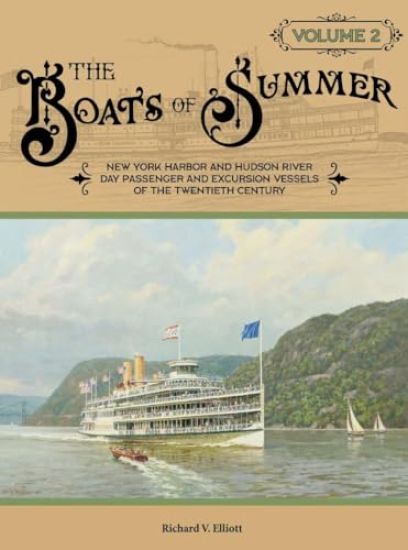
Detailing the histories of 28 vessels, the second volume of The Boats of Summer spotlights the New York Harbor and Hudson River summertime excursion steamboats of the twentieth century. During the golden age of steamboating, summer life in New York City meant climbing aboard a grand steamer for a daytime excursion. Drawing on a lifetime of investigation by author Richard V. Elliott with assistance from other prominent maritime historians, this meticulously researched maritime history features • steamboat profiles that include physical descriptions, a rundown of routes and destinations, and tales of mishaps; • histories of passenger steamers spanning from 1901's Thomas Patten through the region's last paddlewheeler, the Alexander Hamilton, as well as a few diesel-powered vessels that closed out the excursion era in the late 1980s; • spotlights on well-known vessels as well as many lesser-known excursion steamboats that are described in detail here for the first time; • rare historical images and paintings by noted maritime artist William G. Muller; • explorations of Coney Island, Playland, and the beach resorts, picnic groves, and other recreation destinations where the vessels delivered millions of passengers; and • a look at the vessels' key role in water parades and other major celebrations in New York Harbor. Embark on a nostalgic journey into New York's maritime past with this look at the excursion steamboats that captured the hearts of generations of New Yorkers and visitors. Full steam ahead!

Almost every week reports of violence erupting in the workplace make headlines. Contrary to popular opinion, such incidents are not random and senseless but, according to Richard V. Denenberg and Mark Braverman, typically result from conflict that has been allowed to fester. Combining the insights of both crisis management and dispute resolution, their book presents a comprehensive look at the problem of violence on the job, including ways of preventing it. Rather than focusing on the supposedly "lethal" or dysfunctional employee as the source of danger, Denenberg and Braverman point to the dysfunctional workplace as the problem. They describe underlying factors in the workplace which can foster extreme behavior and prevent an effective response. Calling for early intervention in situations that could result in violence, the authors suggest specific techniques for reducing the risk that an office, plant, or school will suffer crises arising from threats or a climate of hostility. At the heart of the book are fourteen vivid examples of real-life incidents involving violence, a threat of violence, or a perception that such a threat was made. They include instances in which domestic violence spilled over into the workplace, difficulties caused by racial and ethnic tension, and explosive behavior in response to common workplace occurrences such as downsizing or a change in corporate culture. Each example is followed by an analysis of the response to the actual or potential danger, indicating where mistakes were made because of poor information, bad judgment, absence of a clear policy, lack of consensus, or even irrational fear. An extensive appendix provides government guidelines and sample policies intended to serve as templates for violence-prevention plans. Both the examples and sample policies allow organizations to benefit from the experience of others and avoid common mistakes.

Professor Ericson and his colleagues followed the work of patrol officers in a large Canadian regional police force. From their direct observations comes a wealth of information, quantitatively assembled and qualitatively discussed, with insights into the nature of policing. This book reveals that the police are not mere 'referees' of our legal lives, blowing the whistle on our infractions. They are censors of certain types of possibly wrong actions. They are selective in their invocation of criminal law and use the law artfully to restore settings to orderliness. Ericson emphasizes the routine manner in which the patrol officer intervenes and gains compliance fron the citizenry. He demonstrates that when the criminal process is invoked, the police maintain fundamental control over the court outcome. Using these findings, he addresses basic questions about the role of police in relation to crime and how it is produced, literally, by the patrol officer. Crime is also seen as the primary basis of police legitimacy, which in turn enables the police to engage in broad surveillance and information-gathering. The author's conclusions about the nature of policing and his discussion of the implications of proposals for reform of police, will generate better-informed deliberation in political and public decision-making and in the general study of sociological theory.

Popular memory of the War of 1812 caroms from the beleaguered Fort McHenry to the burning White House to an embattled New Orleans. But the critical action was elsewhere, as Richard V. Barbuto tells us in this clarifying work that puts the state of New York squarely at the center of America's first foreign war. British demands to move the northern border as far south as the Ohio River put New York on the first line of defense. But it was the leadership of Governor Daniel D. Tompkins that distinguished the state's contribution to the war effort, effectively mobilizing the considerable human and material resources that proved crucial to maintaining the nation's sovereignty. New York's War of 1812 shows how, despite a widespread antiwar movement and fierce partisan politics, Tompkins managed to corral and maintain support - until 1814, when Britain agreed to peace. Retrieving New York's War of 1812 from the fog of military history, Barbuto describes the disproportionate cost paid by the state in loss of life and livelihood. The author draws on in-depth research of the state's legislative, financial, and militia records, as well as on the governor's extensive correspondence, to plot the conduct of the war regionally and chronologically and to tell the stories of numerous raids, skirmishes, and battles that touched civilians in their homes and communities. Whether offering a clearer picture of the performance of the state militia, providing a more accurate account of the conflict's impact on the state's diverse population, or newly detailing New York's decisive contribution, this deeply researched, closely observed work revises our view of the nation's perhaps least understood war.

Popular memory of the War of 1812 caroms from the beleaguered Fort McHenry to the burning White House to an embattled New Orleans. But the critical action was elsewhere, as Richard V. Barbuto tells us in this clarifying work that puts the state of New York squarely at the center of America’s first foreign war. British demands to move the northern border as far south as the Ohio River put New York on the first line of defense. But it was the leadership of Governor Daniel D. Tompkins that distinguished the state’s contribution to the war effort, effectively mobilizing the considerable human and material resources that proved crucial to maintaining the nation’s sovereignty. New York’s War of 1812 shows how, despite a widespread antiwar movement and fierce partisan politics, Tompkins managed to corral and maintain support—until 1814, when Britain agreed to peace. Retrieving New York’s War of 1812 from the fog of military history, Barbuto describes the disproportionate cost paid by the state in loss of life and livelihood. The author draws on in-depth research of the state’s legislative, financial, and militia records, as well as on the governor’s extensive correspondence, to plot the conduct of the war regionally and chronologically and to tell the stories of numerous raids, skirmishes, and battles that touched civilians in their homes and communities. Whether offering a clearer picture of the performance of the state militia, providing a more accurate account of the conflict’s impact on the state’s diverse population, or newly detailing New York’s decisive contribution, this deeply researched, closely observed work revises our view of the nation’s perhaps least understood war.

America is becoming a class-based society.It's now conventional wisdom to focus on the excesses of the top 1% - especially the top 0.01% - and how the ultra-rich are hoarding income and wealth while incomes for most other Americans are stagnant. But the more important, and widening, gap in American society is between the upper middle class and everyone else.Reeves defines the upper middle class as those whose incomes are in the top 20 percent of American society. Income isn't the only way to measure a society, but in a market economy it is crucial because access to money generally determines who gets the best quality education, housing, health care, and other necessary goods and services.As Reeves shows, the growing separation between the upper middle class and everyone else can be seen in family structure, neighborhoods, attitudes, and lifestyle. Those at the top of the income ladder are becoming more effective at passing on their status to their children, reducing overall social mobility. The result is a fracturing of American society along class lines, not just an economic divide. Upper-middle-class children become upper-middle-class adults.These trends matter because the separation and perpetuation of the upper middle class corrode prospects for more progressive approaches to policy. Various forms of ""opportunity hoarding"" among the upper middle class make it harder for others to rise up to the top rung. Examples include zoning laws and schooling, occupational licensing, college application procedures, and the allocation of internships. Upper middle class opportunity hoarding, Reeves argues, results in a less competitive economy as well as a less open society.Inequality is inevitable and can even be good, within limits. But Reeves argues that society can take effective action to reduce opportunity hoarding and thus promote broader opportunity. This fascinating book shows how American society has become the very class-defined society that earlier Americans rebelled against - and what can be done to restore a more equitable society.


Fundamentals of the Theory of Operator Algebras
Richard V. Kadison; John R. Ringrose
Amer Mathematical Society
1997
sidottu
This work and "Fundamentals of the Theory of Operator Algebras Volume II, Advanced Theory" present an introduction to functional analysis and the initial fundamentals of $C^*$- and von Neumann algebra theory in a form suitable for both intermediate graduate courses and self-study. The authors provide a clear account of the introductory portions of this important and technically difficult subject. Major concepts are sometimes presented from several points of view; the account is leisurely when brevity would compromise clarity. An unusual feature in a text at this level is the extent to which it is self-contained; for example, it introduces all the elementary functional analysis needed. The emphasis is on teaching. Well supplied with exercises, the text assumes only basic measure theory and topology.The book presents the possibility for the design of numerous courses aimed at different audiences. '...these two volumes represent a magnificent achievement. They will be an essential item on every operator algebraist's bookshelves and will surely become the primary source of instruction for research students in von Neumann algebra theory' - "Bulletin of the London Mathematical Society".'Volumes I and II were published in 1982 and 1983. Since then they have quickly established themselves as The Textbooks in operator algebra theory'- "Bulletin of the American Mathematical Society". 'One of the splendid features of the original two volumes is their large supply of exercises...which illustrate the results of the text and expand its scope' - "L'Enseignement Mathematique".

Fundamentals of the Theory of Operator Algebras
Richard V. Kadison; John R. Ringrose
Amer Mathematical Society
1997
sidottu
This work and "Fundamentals of the Theory of Operator Algebras, Volume I, Elementary Theory" present an introduction to functional analysis and the initial fundamentals of $C^*$- and von Neumann algebra theory in a form suitable for both intermediate graduate courses and self-study. The authors provide a clear account of the introductory portions of this important and technically difficult subject. Major concepts are sometimes presented from several points of view; the account is leisurely when brevity would compromise clarity. An unusual feature in a text at this level is the extent to which it is self-contained; for example, it introduces all the elementary functional analysis needed. The emphasis is on teaching. Well supplied with exercises, the text assumes only basic measure theory and topology.The book presents the possibility for the design of numerous courses aimed at different audiences. '...these two volumes represent a magnificent achievement.They will be an essential item on every operator algebraist's bookshelves and will surely become the primary source of instruction for research students in von Neumann algebra theory' - "Bulletin of the London Mathematical Society". 'Volumes I and II were published in 1982 and 1983. Since then they have quickly established themselves as The Textbooks in operator algebra theory' - "Bulletin of the American Mathematical Society". 'One of the splendid features of the original two volumes is their large supply of exercises...which illustrate the results of the text and expand its scope' - "L'Enseignement Mathematique".

Fundamentals of the Theory of Operator Algebras, Volume IV
Richard V. Kadison; John R. Ringrose
AMERICAN MATHEMATICAL SOCIETY
2013
pokkari
The goal of this text is to teach the subject and lead readers to where the vast literature - in the subject specifically and in its many applications - becomes accessible. The choice of material was made from among the fundamentals of what may be called the "classical'' theory of operator algebras.