Kirjojen hintavertailu. Mukana 11 627 483 kirjaa ja 12 kauppaa.

Kirjahaku

Etsi kirjoja tekijän nimen, kirjan nimen tai ISBN:n perusteella.

1000 tulosta hakusanalla Robert F. Carter

Robert F. Young Super Pack

Robert F. Young Super Pack

Robert F Young

Positronic Publishing
2020
pokkari
Here is the Robert F. Young collection you've been waiting for; over 200,000 words and more than 600 pages long making it the largest collection of Young's work ever released. Robert F. Young was a Hugo nominated author known for his lyrical and sentimental prose. His work appeared in Amazing Stories, Fantastic Stories, Startling Stories, Playboy, The Saturday Evening Post, Collier's, Galaxy Magazine, and Analog Science Fact & Fiction. Included in this collection are: Audience Reaction To See Ourselves The Grown-Up People's Feet Collector's Item Pilgrims' Project The Courts of Jamishyd Structural Defect The Leaf Operation Peanut Butter The Magic Window Acre in the Sky Mr. and Mrs. Saturday Night Passage to Gomorrah Star Mother The Last Hero The Wistful Witch The Stars Are Calling, Mr. Keats 40-26-38 Doll-Friend Robot Son Bruggil's Bride Impressionist The Forest of Unreason The Girls From Fieu Dayol Deluge II The Star Fisherman A Drink of Darkness The Blonde from Barsoom Boy Meets Dyevitza The Servant Problem Neither Stairs Nor Door Jupiter Found The Girl in His Mind The Deep Space Scrolls A Knyght Ther Was Redemption Boarding Party The House That Time Forgot Let there be Night Sweet Tooth
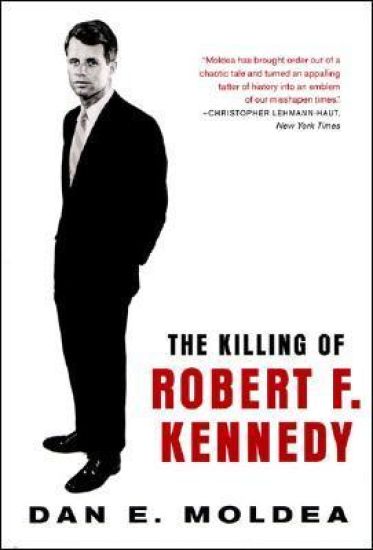
The Killing of Robert F. Kennedy

The Killing of Robert F. Kennedy

Dan E. Moldea

WW Norton Co
1997
nidottu
On June 5, 1968, Robert F. Kennedy was shot in the pantry of the Ambassador Hotel in Los Angeles; his death the following day stunned a nation still recovering from John F. Kennedys assassination five years earlier. Officials insisted, however, that this was not "another Dallas": this was an open-and-shut case--Sirhan Sirhan acted alone. Yet behind the official version of the RFK assassination lies a story of shadows, controversies, conflicting testimony, and missing evidence. Investigative journalist Dan E. Moldea set out to discover the truth; what he found suggested a botched investigation, and perhaps something worse. Was there strong evidence, as certain police officers and the FBI alleged, that too many bullets were fired to have come from Sirhans gun? Could the LAPD have suppressed vital evidence in their rush to judgment? Could Sirhan have had an accomplice? In a fascinating book full of plot twists and intrigue, Moldea turns the case inside out, tracking down witnesses and police officers (many of whom had never before been interviewed), scrutinizing testimony and official files, questioning Sirhan in jail, and polygraphing security guard Thane Eugene Cesar, accused by many of being the real gunman. New evidence mounts and theories fly until Moldea reveals what he believes happened that fateful night. Exhaustively researched, brilliantly analyzed, this book definitively slams the door shut on the mystery of the Robert Kennedy assassination.
Bobby: A Story of Robert F. Kennedy

Bobby: A Story of Robert F. Kennedy

Deborah Wiles

Scholastic Press
2022
sidottu
From two-time National Book Award finalist Deborah Wiles comes a compelling biography of Robert Kennedy.Americans claimed Robert Kennedy as one of their own. They called him Bobby.Lyrical and evocative text by Deborah Wiles (Countdown, Revolution, Anthem, and Kent State) brings the story of Robert F. Kennedy to life, with breathtaking illustrations by Tatyana Fazlalizadeh.Bobby is set in 1968, with a grandfather telling his grandchild about Kennedy's life. Bobby was the younger brother of President John F. Kennedy. He became an accomplished public servant and activist in his own right. Though his run for presidency was tragically cut short on June 5, 1968, Bobby proved the value of empathy and grit. The story concludes as his funeral train makes its solemn journey from New York to Washington, DC.Kennedy was perceived by many to be a rare unifying force in American politics. He was beloved by Americans of all races for his integrity and devotion to the civil rights cause. His life continues to inspire efforts for social change.Deborah Wiles's Bobby will illuminate the importance of Robert Kennedy's life for children, parents, teachers, and librarians. Informative back matter is included.
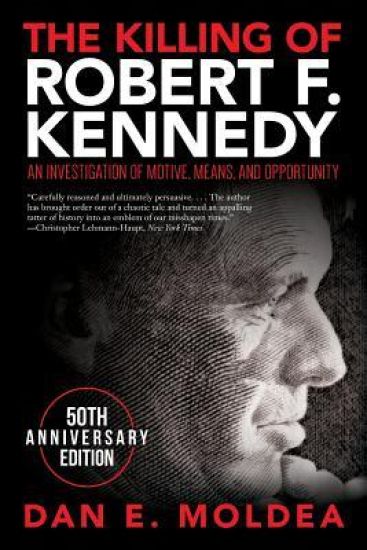
The Killing of Robert F. Kennedy: An Investigation of Motive, Means, and Opportunity
THE UPDATED 50th ANNIVERSARY EDITIONOn June 5, 1968, Senator Robert F. Kennedy, a former U.S. Attorney General, was shot in a kitchen pantry at the Ambassador Hotel in Los Angeles during an election night victory party. His death the following day stunned a nation still recovering from the murder of his brother, President John F. Kennedy, five years earlier in Dallas, which many believed was still an unsolved case.However, law-enforcement officials insisted that the murder of Senator Kennedy was not "another Dallas." This was an open-and-shut case. Senator Kennedy's assassin, Sirhan Sirhan, who was apprehended and arrested at the scene, had acted alone. Yet behind the official version of the RFK killing lies a story of shadows, controversies, conflicting testimonies, and missing evidence. Investigative journalist Dan E. Moldea set out to discover the truth. What he found suggested at the very least a botched investigation. In this compelling and exciting book, filled with plot twists and intrigue, Moldea turns the case inside out, tracking down witnesses and police officers (most of whom had never been interviewed), scrutinizing sworn statements and official files, polygraphing a security guard whom many suspected was the real gunman, and interviewing Sirhan three times in jail. From the welter of evidence and theories, Moldea reveals what he believes happened that fateful night. Exhaustively researched, brilliantly analyzed, and wonderfully written, The Killing of Robert F. Kennedy definitely closes the door on the mystery of the murder of Robert Kennedy. (W.W. Norton)
The Assassination of Robert F. Kennedy

The Assassination of Robert F. Kennedy

William W. Turner; Jonn G. Christian

Carroll Graf Publishers Inc
2006
pokkari
Around midnight shortly after claiming victory in the California presidential primary on June 5, 1968, Senator Robert Kennedy walked into a deadly spray of gunfire. Immediately the Los Angeles Police Department concluded that the assassin, Sirhan Sirhan, had acted alone. The FBI conducted a parallel inquiry and concurred. And the vast majority of the American people accepted their opinion. In this compelling book--mysteriously suppressed on its initial publication--former FBI agent William Turner and investigative reporter Jonn Christian expose convincing evidence that Sirhan did not act alone. Based on more than ten years of intensive research, Turner and Christian raise serious questions about RFK's murder: -What was the virtually apolitical Sirhan's motive?-Why, if Sirhan was standing in front of his victim, were the fatal wounds in the back of Kennedy's head?-Why were there too many spent bullets (some the wrong size) for Sirhan's gun?-Did the LAPD discredit witnesses, try to make them alter their stories, and destroy key records?-Was Sirhan, in fact, a "Manchurian Candidate," programmed through hypnosis either to kill Kennedy or divert attention while others did the job?"The Assassination of Robert F. Kennedy" makes the case that the murder of RFK, and the subsequent police and government investigations, bear all the hallmarks of the conspiracy surrounding the assassination of John F. Kennedy and the resulting Warren Commission. It is a fascinating and chilling reexamination of the tragic events that undoubtedly changed the course of American history.
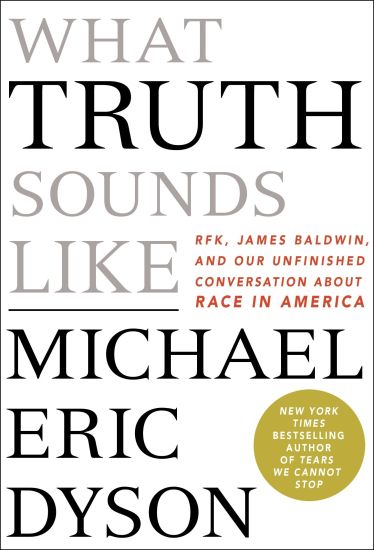
What Truth Sounds Like: Robert F. Kennedy, James Baldwin, and Our Unfinished Conversation about Race in America
Named a 2018 Notable Work of Nonfiction by The Washington Post NOW A NEW YORK TIMES BESTSELLER - Winner, The 2018 Southern Book PrizeNAMED A BEST/MOST ANTICIPATED BOOK OF 2018 BY: Chicago Tribune - Time - Publisher's Weekly A stunning follow up to New York Times bestseller Tears We Cannot Stop The Washington Post: "Passionately written."Chris Matthews, MSNBC: "A beautifully written book."Shaun King: "I kid you not-I think it's the most important book I've read all year..." Harry Belafonte: "Dyson has finally written the book I always wanted to read...a tour de force." Joy-Ann Reid: A work of searing prose and seminal brilliance... Dyson takes that once in a lifetime conversation between black excellence and pain and the white heroic narrative, and drives it right into the heart of our current politics and culture, leaving the reader reeling and reckoning." Robin D. G. Kelley: "Dyson masterfully refracts our present racial conflagration... he reminds us that Black artists and intellectuals bear an awesome responsibility to speak truth to power." President Barack Obama: "Everybody who speaks after Michael Eric Dyson pales in comparison." In 2015 BLM activist Julius Jones confronted Presidential candidate Hillary Clinton with an urgent query: "What in your heart has changed that's going to change the direction of this country?" "I don't believe you just change hearts," she protested. "I believe you change laws." The fraught conflict between conscience and politics - between morality and power - in addressing race hardly began with Clinton. An electrifying and traumatic encounter in the sixties crystallized these furious disputes. In 1963 Attorney General Robert Kennedy sought out James Baldwin to explain the rage that threatened to engulf black America. Baldwin brought along some friends, including playwright Lorraine Hansberry, psychologist Kenneth Clark, and a valiant activist, Jerome Smith. It was Smith's relentless, unfiltered fury that set Kennedy on his heels, reducing him to sullen silence. Kennedy walked away from the nearly three-hour meeting angry - that the black folk assembled didn't understand politics, and that they weren't as easy to talk to as Martin Luther King. But especially that they were more interested in witness than policy. But Kennedy's anger quickly gave way to empathy, especially for Smith. "I guess if I were in his shoes...I might feel differently about this country." Kennedy set about changing policy - the meeting having transformed his thinking in fundamental ways. There was more: every big argument about race that persists to this day got a hearing in that room. Smith declaring that he'd never fight for his country given its racist tendencies, and Kennedy being appalled at such lack of patriotism, tracks the disdain for black dissent in our own time. His belief that black folk were ungrateful for the Kennedys' efforts to make things better shows up in our day as the charge that black folk wallow in the politics of ingratitude and victimhood. The contributions of black queer folk to racial progress still cause a stir. BLM has been accused of harboring a covert queer agenda. The immigrant experience, like that of Kennedy - versus the racial experience of Baldwin - is a cudgel to excoriate black folk for lacking hustle and ingenuity. The questioning of whether folk who are interracially partnered can authentically communicate black interests persists. And we grapple still with the responsibility of black intellectuals and artists to bring about social change. What Truth Sounds Like exists at the tense intersection of the conflict between politics and prophecy - of whether we embrace political resolution or moral redemption to fix our fractured racial landscape. The future of race and democracy hang in the balance.
Nominations of Robert F. Rider, S. David Fineman, and G. Edward DeSeve
This work has been selected by scholars as being culturally important, and is part of the knowledge base of civilization as we know it. This work was reproduced from the original artifact, and remains as true to the original work as possible. Therefore, you will see the original copyright references, library stamps (as most of these works have been housed in our most important libraries around the world), and other notations in the work.This work is in the public domain in the United States of America, and possibly other nations. Within the United States, you may freely copy and distribute this work, as no entity (individual or corporate) has a copyright on the body of the work.As a reproduction of a historical artifact, this work may contain missing or blurred pages, poor pictures, errant marks, etc. Scholars believe, and we concur, that this work is important enough to be preserved, reproduced, and made generally available to the public. We appreciate your support of the preservation process, and thank you for being an important part of keeping this knowledge alive and relevant.